Report Published September 2, 2020 · 14 minute read
Toppling Testing? COVID-19, Test-Optional College Admissions, and Implications for Equity


The Upshot
In making admissions decisions, selective colleges typically consider an applicant’s high school grades and coursework alongside standardized test scores and, to a lesser extent, their extracurricular involvement and information drawn from essays, recommendations, and interviews. Yet in recent decades, a growing number of colleges have enacted test-optional policies, allowing applicants to choose whether to submit SAT or ACT scores (or, in the case of “test-flexible” policies that often fall under the same umbrella, to submit alternate assessments like SAT subject tests instead). The test-optional movement began with private liberal arts colleges, but within the last five to ten years it has expanded to larger research and public universities, and now includes some of the nation’s most selective institutions. A concurrent movement exists in graduate education to make the GRE optional.
In going test-optional, colleges frequently note that standardized test scores, which have shown a positive correlation to being white and higher-income, may unfairly disadvantage racially diverse and low-income students. They also point to research that indicates test scores do little to predict college success once high school grades and student background characteristics are considered.
This spring, the COVID-19 pandemic disrupted the infrastructure of testing—and accelerated the test-optional movement exponentially. With physical test-taking rendered an impossibility and significant hurdles to administering at-home tests, hundreds of four-year colleges, including the University of California and other large state systems, have announced either temporary or permanent shifts to test-optional admissions. As growing numbers of selective colleges move toward test-optional admissions, a critical question remains: do these policies actually expand access for students from racially and economically marginalized backgrounds? While evidence exists that the SAT and ACT may disadvantage students of color and low-income students, it is less clear that test-optional admissions as a single policy can substantially alter inequitable enrollment patterns. Rather, a more comprehensive approach to recruiting, admissions, financial aid, and other services is necessary to center equity in institutional processes.
Narrative
Standardized Testing and Selective College Admissions
Standardized test scores are typically one factor among many that selective colleges (those that receive more applications than seats available) consider when making admissions decisions. In 2016, nearly half of the nation’s most selective public and private colleges reported test scores as “very important” in the admissions process. However, when it comes to academic factors, other components like grades and rigor—meaning the courses a student takes in high school, often considered in the context of the courses available to them at their high school, like Advanced Placement courses—are the two most important factors colleges consider. Ninety percent of the most selective colleges reported academic rigor as “very important” and eighty percent reported grades as “very important.”1
Selective colleges often practice “holistic admissions,” a comprehensive review of applications in which admissions officers evaluate traditional academic factors alongside nonacademic factors such as leadership, talent, character, and personal experiences (often gleaned from an applicant’s extracurricular involvement, essays, interviews, and recommendation letters). In doing so, colleges seek to place applicants’ achievements in the context of their home and school environments.2 For instance, colleges may examine extracurricular involvement in the context of opportunities available in a student’s high school and family obligations a student might have. Or, in the case of test scores, a college might consider a student’s score alongside the distribution of scores at their high school to identify students who have excelled in their environment.3 Regardless of the extent to which colleges contextualize test scores, they remain an important—though not the only or most important—consideration at most selective colleges.4
But critics of standardized tests and their use in the admissions process point to evidence of racial and economic disparities in SAT and ACT scores.5 White and Asian students and students from higher-income families are more likely to take (and re-take) standardized tests, which contributes to college enrollment disparities.6 Some research also indicates that test scores do little to predict college success once high school grades and school characteristics are considered.7 One study, for example, showed that high school grades and student background characteristics explained just over 20% of the variation in college GPAs; the addition of standardized test scores increased that explained variation by just six percentage points.8 The growing number of colleges that have enacted test-optional policies frequently cite these concerns, as well as efforts to emphasize a more “holistic” review of applicants that additionally incorporates non-academic factors, as motivating factors for this shift.
The Rise of Test-Optional Admissions
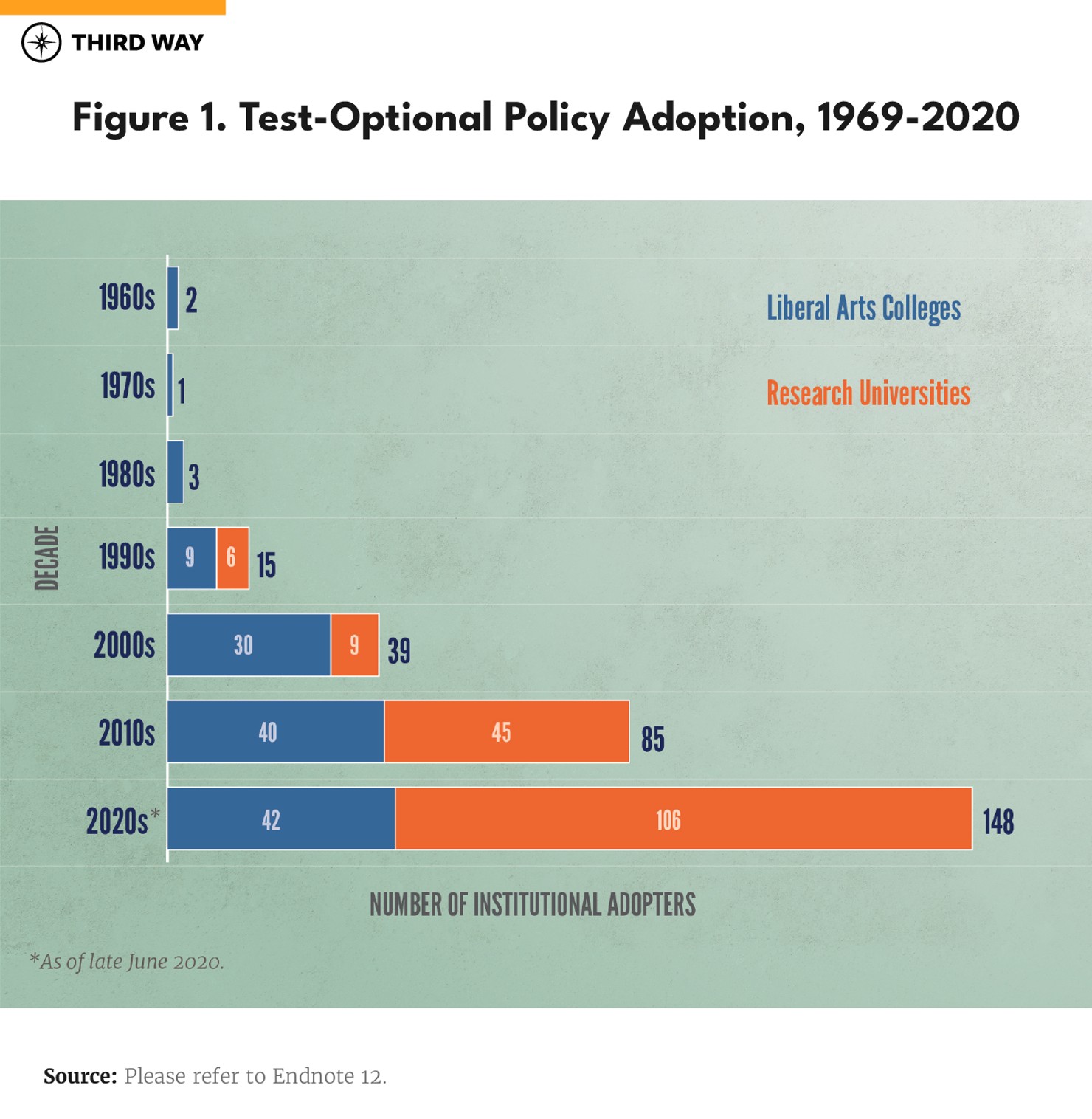
Bowdoin College, a private liberal arts college in Maine, was among the first to enact a test-optional policy in 1969.9 Bates College, also in Maine, followed suit in 1984.10 Following these early adoptions, the movement to make test scores optional became prominent among liberal arts colleges in the late 1990s and 2000s, and around 2010, the test-optional movement expanded to include a wider range of institution types. Highly selective, nationally-ranked institutions like George Washington University and the University of Chicago and large public universities like Temple University have since announced test-optional policies, and every spring, dozens of institutions join the test-optional ranks. To date, more than 1,200 schools are test-optional, including more than 300 colleges that appear on U.S. News & World Report’s national rankings.11
The figure below shows the number of nationally-ranked colleges enacting test-optional policies each year.12
How COVID-19 Accelerated the Test-Optional Movement
The COVID-19 pandemic disrupted the spring 2020 standardized testing cycle and will likely continue to disrupt testing throughout the coming year. In response, hundreds of colleges have announced that they will temporarily (and sometimes permanently) make test scores optional for applicants. The National Center for Fair and Open Testing (FairTest), which has annually documented the test-optional movement in higher education, indicates that half of the four-year colleges in the US will be test-optional for the upcoming admissions cycle.13 Among the nationally-ranked colleges in Figure 1, around half implemented test-optional admissions for the current admissions cycle.
At present, all Ivy League institutions have announced test-optional policies for the 2020-2021 application cycle.14 Many state systems, some of which were already considering discontinuing the use of test scores in admissions, have similarly announced test-optional policies. Notably, the University of California (UC) system’s Board of Regents voted unanimously for its ten campuses to be test-optional this coming year, with plans to implement a new test or move away from tests altogether over the next five years.15 The UC system is joined by the California State University system, the State University of New York system, the University of Wisconsin system (with the exception of the flagship Madison campus), and all public universities in Oregon, among others.16 If these systems and individual institutions extend test-optional policies permanently, this year may mark an inflection point for test-optional admissions, opening the door for a much larger-scale movement away from college entrance exams like the SAT and ACT. While it is too early to know whether the dramatic shift toward test-optional admissions will be sustained (around three-quarters of 2020 adopters have indicated their move is temporary), the present moment represents a clear path toward sweeping changes in the admissions landscape.
A similar movement (colloquially termed “GRExit”) is underway in graduate education as programs move away from considering the GRE or make score submission optional for applicants.17 Dozens of law schools have also begun to accept the GRE in place of the LSAT, reflecting a more flexible approach to testing.18
Yet as more colleges move toward test-optional admissions, a critical question remains: how effective are these policies in expanding college access among students from racially and economically marginalized backgrounds?
Evidence of the Equity Impact of Test-Optional Admissions
A relatively small body of peer-reviewed empirical research examines the effects of test-optional policies. A 2015 study examined enrollment among Black, Latinx, and Native American students and Pell Grant recipients at selective liberal arts colleges from 1990 to 2010.19 The study examined enrollment before and after test-optional admissions were implemented at liberal arts colleges that adopted these policies, relative to enrollment at liberal arts colleges that did not adopt them. The study found that test-optional policies did not result in changes in the enrollment share of racially or economically marginalized students. The study also found that, rather than expanding access for students, test-optional policies may benefit colleges more so by boosting the number of applications they receive and the SAT scores of enrolled students that colleges later report to rankings agencies. After enacting test-optional policies, these colleges received around 200 more applications and their reported test scores rose around 25 points on average.
A 2019 study used a similar approach to examine a larger group of more recent adopters and similarly concluded that test-optional admissions did not lead to changes in racial or economic diversity.20 While applications increased after the test-optional admissions policy was instituted, that increase was not sustained, and yield rate (the percent of admitted students who ultimately enroll, which is another measure of institutional selectivity) actually decreased after test-optional adoption. These findings demonstrate that while test-optional policies may not benefit colleges like the earlier study found, they also do not expand access.
Another 2019 study examined the impact of test-flexible admissions at George Mason University, a public institution in Virginia that in 2007 began allowing applicants above a specified GPA threshold to choose whether to submit test scores. The study similarly did not find evidence of changes in economic and racial diversity after the policy’s implementation.21
Together, these studies highlight potential limits to test-optional admissions as a strategy to promote more equitable enrollment outcomes—and indicate that further federal and institutional action will be necessary to advance equity goals in higher education.
The Limits of Test-Optional Admissions as a Standalone Policy
The test-optional landscape has changed dramatically in recent years. The current year in particular has seen vast numbers of institutions making test scores optional during a global pandemic. Prior studies have largely focused on liberal arts colleges and/or earlier adopters, or only tracked outcomes for a couple of years after the change. But it may take several years to truly see changes in enrollment as a result of test-optional admissions. For instance, it may take students, parents, and high school counselors time to learn about these policies, or they may become more aware as test-optional becomes more prevalent. It is also possible that the most recent adopters—a very different group of institutions than the private, selective liberal arts colleges where the movement began—experience different enrollment effects. And variation in how test-optional policies are designed and implemented can shape outcomes. Some colleges allow all (or nearly all) applicants to decide whether to submit test scores, while others are test-optional only for students above a specified academic threshold, and still others require alternate assessments in place of the SAT or ACT. Each of these institutional policy choices can have an impact on student application and enrollment decisions.
Second, altering one factor in the admissions process may not be enough to fully overcome more systemic biases that exist in selective college admissions. When colleges go test-optional, they may place more weight on grades, academic rigor, extracurricular activities, essays, interviews, and recommendations. Many of these factors may similarly reflect economic and racial privilege. For instance, economically and racially marginalized students are less likely to have access to advanced coursework in high school and are more likely to attend high schools where college counselors have higher caseloads.22 Systemically disadvantaged students may have additional family obligations that more advantaged students may not have, limiting their ability to participate in extracurricular activities. More advantaged students may also have greater access to college consultants to help them craft admissions essays and prepare college application materials.23 If colleges become more reliant on these factors, especially in the wake of a pandemic that is disproportionately affecting communities of color, the same inequitable enrollment patterns may persist.24
Finally, there are other significant barriers to enrollment beyond admissions considerations. Many high-achieving, low-income students never apply to a selective college to begin with.25 College recruiting practices, which research indicates frequently favor white and upper-income schools, may fail to reach potentially qualified students from marginalized backgrounds.26 Real and perceived financial barriers may similarly impose other systemic disadvantages. Listed tuition prices, which are relatively high at many selective colleges, may deter students from applying. Even with the generous financial aid awards many selective colleges offer, students typically do not learn how much financial aid they will receive until after they are admitted. As a result, low-income students may perceive that a college is unaffordable and decide not to apply at all. And even once they receive a financial aid award, the information can be confusing, making it hard to interpret costs, distinguish between grants and loans, and compare offers across colleges.27 These barriers—beyond the admissions process itself—may deter students from entering college or enrolling in an institution that is best suited to help them attain their goals and achieve social mobility.
Policy Recommendations
Research indicates that selective colleges play an important role in upward mobility, particularly for low-income students and students of color.28 Yet higher education remains highly stratified, with economically and racially marginalized students underrepresented at selective colleges.29 As four-year colleges nationwide move to make standardized test scores optional for applicants, often in an effort to expand access and increase diversity, federal and institutional policymakers should be cognizant that:
While college admissions tests present serious equity concerns, going test-optional is not sufficient alone to promote equitable enrollment outcomes. Racial and economic disparities in standardized test scores and differences in test preparation and re-taking patterns, which contribute to these disparities, raise questions about whether test scores can be used equitably in the admissions process.
Yet prior research on test-optional admissions indicates that as a single policy, it has not been effective at expanding enrollment among low income students and students of color. Moreover, other academic and nonacademic factors that admissions offices consider—for example, rigor, extracurricular involvement, essays, interviews, and recommendations—may similarly favor students from privileged groups.
Rather, a full commitment to equity is needed in recruiting, admissions, financial aid, and other services to support students. Given the potential limitations of test-optional admissions in producing equitable enrollment outcomes, a comprehensive approach that considers a broader range of barriers students face to college access and success is needed. Some specific recommendations to reduce barriers include:
- Establishing more equitable recruiting practices. Institutions should reevaluate their recruiting policies and priorities and the effect they have on equity in college access. They should visit high schools with large populations of low-income students and students of color and offer college and financial aid application workshops in these high schools. Colleges should also offer financial support for low-income students and students of color to visit campus (or, while the pandemic continues, offer interactive virtual visits with a targeted focus on students who have been historically marginalized in higher education.).
- Collecting and analyzing data on recruitment and enrollment. Colleges should track application and enrollment numbers (as many currently do), disaggregate that data by economic and racial backgrounds, and rigorously evaluate how admissions practices impact enrollment among low-income students and students of color.
- Streamlining and simplifying the federal financial aid process. The federal government should ensure that potentially eligible high schoolers are notified about the federal Pell grant and how to apply earlier in their high school careers to allow for longer-term college planning. Congress should also streamline the FAFSA form itself to increase the rate of participation and pass legislation to simplify financial aid award letters to ensure that they clearly describe net cost to the student, including the total cost of attendance and the grants, loans, and other aid amounts offered. States and colleges should similarly focus on simplifying the process of applying for financial aid (which in some cases differs from the federal student aid process) and create more transparency around aid eligibility.
