Memo Published May 8, 2020 · 24 minute read
Building Back Better: Investing in Clean Infrastructure to Drive Economic Recovery
Alexander Laska, Andres Prieto, Jackie Toth, & Matt Bright
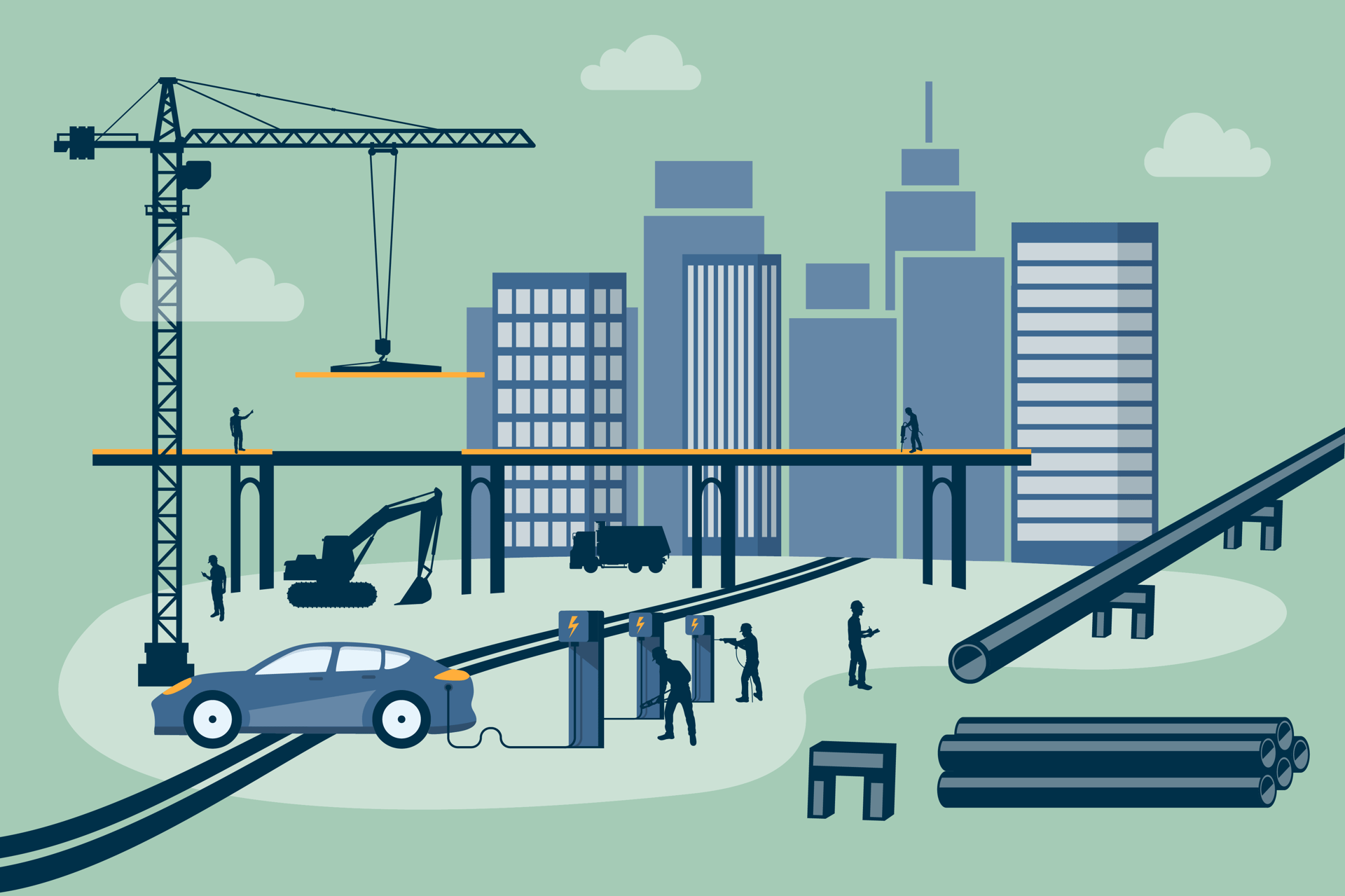
Infrastructure investments are an effective way to help jumpstart an economic recovery. These projects can put a lot of people to work relatively quickly, generate massive amounts of activity across multiple economic sectors, and there’s never a shortage of things that need building or repairing. If done strategically, major infrastructure initiatives also allow a country to prepare for the future by making transportation of goods and services more efficient, expanding access to critical resources, and protecting itself against challenges like extreme heat, flooding, or storms made worse by climate change.
As the world continues to move toward a future with lower carbon emissions, the U.S. must seize investment opportunities that put workers back on the job and get the economy humming in a much cleaner way. This memo recommends dozens of policies to promote worthy infrastructure projects that deliver on all fronts.
Making Sure America Gets Its Money's Worth
The amount of infrastructure spending being discussed for economic stimulus is mind-boggling. Though it’s easy to lose context once we get into the hundreds of billions, no one should be thinking of this as “play money.” Congress has an obligation to invest these funds in a way that maximizes economic recovery, and misses no opportunity to help the U.S. achieve vital national goals. The following principles for infrastructure investments can ensure the country gets its money’s worth:
Buy American
If Americans are the ones making investments in infrastructure, they should be the ones reaping the benefits. The U.S. already has a “Buy American” policy on the books, requiring federally-funded infrastructure to use American-made materials. The American Recovery and Reinvestment Act strengthened these requirements for the purchase of iron, steel, and manufactured goods used in stimulus-funded construction and maintenance projects. These same Buy American provisions should be applied to future stimulus projects to ensure our investments are jumpstarting the U.S. economy.1
Buy Clean
“Buy Clean” policies reduce the climate impact of infrastructure projects by giving preference to less carbon-intensive cement, steel, and other construction materials.2 They also help level the playing field for manufacturers that have invested in making their processes and supply chains cleaner. Congress should adopt a national Buy Clean policy that promotes clean domestic manufacturing and cuts emissions from federally-funded infrastructure projects.
Buy Fair
Federal infrastructure spending should prioritize contracts that will provide the most economic opportunities for workers. This “Buy Fair” approach gives an advantage to companies that agree to use project labor agreements (PLAs), hire local and disadvantaged workers, or use materials manufactured in unionized facilities.3 Federal funding should also come with Davis-Bacon prevailing wage standards to ensure the workers rebuilding our economy will be paid a fair wage.
Highways and Bridges
Prioritize maintenance of existing highway assets over new construction. This will create more jobs while making our transportation network safer and avoiding the buildout of unnecessary lane-miles, which leads to more vehicle-miles traveled and more emissions.4
Adopt a “Fix it First” policy requiring states to tackle a significant portion of their road and bridge maintenance backlog before they can construct new roads. This would apply to the Surface Transportation Block Grant Program and the National Highway Performance Program, while discretionary programs like BUILD and other formula programs like the Highway Safety Improvement Program would maintain their current requirements.5 Road and bridge repair projects create jobs and get money into the economy more quickly than new construction projects and create 16% more jobs per dollar.6
*The House Majority’s “Moving Forward Framework” includes a Fix it First policy prioritizing asset maintenance.7
Fully fund surface transportation maintenance needed to clear backlog. The percentage of roads in poor condition has grown from 14% to 20% over the past decade, and there are currently 47,000 structurally deficient bridges in the U.S. The road and bridge maintenance backlog is estimated to be nearly $591 billion, including $420 billion for roads and highways.8 Fully funding the maintenance backlog will make our network safer and create as many as 6 million jobs.9 This funding should have a 100% federal cost-share to alleviate the financial burden on cities and states that are struggling with reduced income and sales tax revenues.
Require states that want to build new lane-miles to demonstrate that they can afford to maintain the new infrastructure. This will prevent states from wasting stimulus dollars building something we don’t need that will fall into disrepair.10
Ensure state DOTs are equipped to spend the money quickly. Congress should provide direct grants to state DOTs facing capacity issues. This will ensure states can obligate infrastructure funding quickly to help the economy recover faster.
Transit
Increase funding for transit and allow agencies to use federal funds for operating costs. Increasing funding for transit vis-a-vis highway construction will create more jobs while reducing highway congestion and emissions. Expanding transit networks will also help connect low-income and minority communities to economic opportunities—people of color rely more on transit than white Americans do.11 We’ll also likely need to provide transit agencies with additional federal funding to help cover operating costs to ensure transit systems can continue running during and following the COVID-19 outbreak, enabling hospital workers and other essential employees to get to work.
Fully fund our transit maintenance backlog. USDOT estimates the transit maintenance backlog is $99 billion.12 Fully funding the backlog would create nearly 5 million jobs and generate tens of billions of dollars in economic returns over the next decade.13
Provide additional funding for new transit construction. Congress has only authorized $2.6 billion per year for the Capital Investment Grant (CIG) Program, the primary source of federal funding for transit expansion projects, but there are far more projects going through the approval process than that amount could fund.14 Congress should provide $7.5 billion15 for the CIG program so that the projects that have already been approved or are likely to be approved within the next few years can move forward, creating construction jobs quickly. Additional oversight will be needed from Congress to ensure the Federal Transit Administration (FTA) improves its review process to rapidly get projects underway and workers on site.16
*The House Majority’s “Moving Forward Framework.” calls for increased funding for transit and reforms to the CIG program.17
Raise the federal cost-share for FTA grants. Just as it did in the Recovery Act, stimulus funding should have a 100% federal cost-share to alleviate the financial burden on cities and states that are struggling with reduced income and sales tax revenues. Going forward after stimulus funding, raising the federal share on transit projects to match the higher federal share for highway projects will help reorient federal spending towards mass transit while ensuring those projects can get funded more quickly.18
Provide hard-hit transit agencies with additional funds to defray the cost of operations. Stimulus 3 included $25 billion in assistance to keep transit agencies operating, but they will continue feeling budgetary pressure for the foreseeable future due to the drastic reduction in ridership.19 Congress should be prepared to provide additional operating assistance for transit agencies in future stimulus packages.
Help transit agencies procure zero-emission buses and charging infrastructure. Plussing-up the Low- and No-Emission Bus program will help more transit agencies procure electric and other zero-emission busses, in addition to the infrastructure necessary to keep them running. Adding $520 million to this program would be enough to double the number of electric buses on the road along with accompanying charging infrastructure.20
Freight and Passenger Rail
Modernize and Expand the Rail Network: Intercity passenger rail is far less carbon-intensive than driving or air travel, but U.S. investment in rail has lagged far behind other countries. While freight rail infrastructure is largely funded through private investment, targeted investments in freight rail and intermodal infrastructure will enable us to move more cargo by rail, which is far more fuel efficient than trucking. Rail projects also help create construction jobs in the near-term in addition to ongoing O&M jobs later.
Increase funding for federal programs that invest in rail capital projects, like the CRISI grant program and the freight-specific INFRA grant program.
- CRISI should be improved to allow railroads to apply for and receive multi-year funding, enabling larger, longer-term capital investments.21
- FRA should continue to make CRISI and other funding opportunities available for positive train control (PTC) implementation, making it easier particularly for smaller railroads to implement their systems and become interoperable with other railroads.
- Congress should remove the INFRA program’s cap on non-highway projects. This limit has already been reached, so freight rail and intermodal projects can no longer receive funding.22
Provide funding for intermodal infrastructure. Either through a set-aside in the INFRA program or a new funding stream. This infrastructure catalyzes more freight movement by rail, thereby reducing truck traffic particularly around ports.
Permanently extend the 45G Short Line Tax Credit. This tax credit helps short line railroads privately invest in their infrastructure. While recently extended to 2022, permanent extension would provide the certainty needed by short line railroads to invest in costly, multi-year projects.23
Expand access to tax-exempt Private Activity Bonds (PABs) for higher-speed rail. Currently, intercity passenger rail projects must hit a maximum speed of 150mph in order to be eligible for these bonds; lowering the max speed to 125mph or even 100mph would make it easier for states to access this financing mechanism and construct “higher-speed” intercity rail. More broadly, Congress should consider raising the cap on PABs and expanding eligibility to allow for investment in a wider variety of clean infrastructure projects.24
Promote regional collaboration to support intercity passenger rail service. The federal government should incentivize the creation of interstate passenger rail compacts by providing operating funds to the established entity, as long as the states provide matching funds and demonstrate that they can maintain the rail service.25
Require Amtrak to maintain the existing system. Any stimulus funding for Amtrak should come with a stipulation that Amtrak cannot replace any part of its long-distance routes with bus service.26 Congress should also require Amtrak to develop a strategy for sustaining and growing the National Network.27
Resilient Transportation Infrastructure
Rebuild our transportation infrastructure to be more resilient to climate change, severe weather events, and other kinds of disasters. Severe weather events are increasing in frequency. The U.S. has failed to integrate resiliency into infrastructure planning, chronically underinvesting in projects that would help the system recover after a shock.
Establish a new funding stream to support projects that improve resiliency. Congress should establish a multi-billion dollar program to help fund projects that make our existing infrastructure more resilient to extreme weather. It should be a competitive grant program so applicants must demonstrate how they will spend the funding to improve resiliency.
*Included in the Senate’s America’s Transportation Infrastructure Act.28
Direct USDOT to develop resiliency criteria and factor it into funding decisions. This will ensure a more responsible use of taxpayer dollars by requiring projects that receive federal funding to include appropriate resiliency measures.
*Included in the House Majority’s “Moving Forward Framework”.29
Require lifecycle cost analysis for projects over $30 million. LCCA ensures agencies are taking the entire lifecycle of a facility into account when determining the most cost effective way to build a project, including what materials to use. This requirement would help ensure we’re rebuilding our infrastructure to last and save millions of dollars on repair and reconstruction costs.30
Reestablish federal flood protection standards and apply it to all infrastructure spending. This will allow us to fully account for the future impacts of climate change and severe weather while directing funding away from locations that are most vulnerable, like floodplains.31
Fund a comprehensive effort to assess the condition of our infrastructure from a resiliency standpoint. Beyond the immediate needs of the economic recovery, Congress should make funding available to help states get a holistic picture of their infrastructure resiliency needs. This will help determine which resiliency projects are most critical, how much funding is needed, and how to prioritize federal spending.
Alternative Vehicle Fueling
Build out the Refueling Infrastructure of Tomorrow. To enable our transition to ZEVs, we need to build out our electric vehicle charging infrastructure and other alternative refueling infrastructure. Some estimates project we will need roughly 350,000 public chargers by 202532 and 600,000 by 2030.33 On top of that, we will need millions of chargers installed at people’s homes and workplaces.
Issue funding to state and local governments to buildout alternative refueling infrastructure. Ensuring we have enough public EV chargers available to accommodate the rise of EVs will require an additional $2.3 billion through 2025,34 and roughly $5 billion through 2030. Congress should establish a new funding stream for state and local governments to deploy public alternative refueling infrastructure on highway corridors and within communities,35 or increase funding for an existing program such as the Congestion Mitigation and Air Quality (CMAQ) Program specifically for EV infrastructure deployment.36
*The Senate’s America’s Transportation Infrastructure Act includes a new funding stream.37
Provide a refundable tax credit for businesses and homeowners to deploy charging infrastructure. The vast majority of EV chargers will be located at people’s homes or workplaces.38 Congress recently extended the alternative fuel refueling property credit (30C) through 2020; making the credit permanent would provide businesses and homeowners with certainty that they’ll be able to claim the credit when they install chargers in the future. Congress should also make the credit refundable for at least two years in order to better incentivize charger installation during the economic downturn and should change the credit cap to a per-charger basis, not per-charging station.39
Increase funding for the Alternative Fuels Corridors program. Boosting funding for this program will help more states develop their EV infrastructure deployment plans and address barriers to deployment, such as right-of-way acquisition, so they can move more quickly into construction.
Ports and Waterways
Unlock funding for port and waterway infrastructure. Sea port infrastructure projects create more jobs than almost any other kind of infrastructure project. Investments in our ports and waterways will create jobs and encourage mode shift away from fossil fuel-intensive trucking by making it faster and easier to ship products by barge. Additionally, investments in flood control infrastructure will help make communities more resilient to climate change and extreme weather.
Increase funding for the Army Corps of Engineers Civil Works program. Limited funding for Civil Works has led to a $98 billion backlog in Corps projects, from lock and dam modernization to flood control. Congress should increase funding for the Corps across the board but particularly prioritize the Construction account, so more projects that have gone through Investigation can begin construction in short order.
Increase the cost-share for inland waterway projects.Raising the federal cost share for inland waterways projects to 75% - the same as deep sea port projects - will help get these projects into construction faster, creating jobs and improving barge transportation for our nation’s freight.40
Allow the Army Corps of Engineers to spend down the Harbor Maintenance Trust Fund (HMTF). The Trust Fund has built up a $10 billion surplus due to low Congressional authorizations. While Stimulus 3 will allow the Corps to spend as much as the HMTF took in the previous year, it doesn’t address the $10 billion balance. Unlocking the HMTF will make more funding available for harbor dredging and other port projects.41
Broadband
Increase access to broadband in underserved and rural communities. At a time when more and more Americans rely on an Internet connection for telehealth and virtual learning, too many communities are getting left behind. A lack of connectivity is disproportionately affecting rural African American and Native American communities.42 Building out our broadband infrastructure will help get more Americans online and plugged into the modern economy, while creating construction jobs.43
Establish a national “quick build” promise that uses time-limited “shot clocks” to tear down barriers to construction that currently exist at all levels of government, such as lengthy approval processes and utility pole access issues.44 Federal agencies should be required to publish fees on their websites with explanations for how those fees were calculated—and those fees should be used to hire the staff needed to cut down on application review times.45 The federal government should also encourage states and local governments to do the same.
Make $45 billion in federal funding available through a reverse auction to support broadband projects in hard-to-serve areas.46 The auction can be run through the Federal Communications Commission’s established process and should not discriminate between different providers or technologies—everyone and everything that could potentially serve communities lacking broadband should be able to participate. And to get the most out of these federal dollars, they should be awarded to broadband providers that will connect the most unserved homes for the lowest subsidy.47
Ensure broadband affordability by enabling automatic enrollment for low-income households eligible for the FCC’s Lifeline program.48 Changing the system so that these households receive an automatic notification on their eligibility would help ensure newly-connected communities can afford the Internet services made available to them. All low-income households eligible for Lifeline should also receive a voucher for a low-cost computer to finally end the digital divide.
Implement a “Dig Once” policy to increase access to broadband while reducing costs. Broadband conduit should be included during the construction or reconstruction of any road receiving federal funding if it isn’t already available. This will help reduce overall costs by limiting the number of times a road has to be dug up while making it easier for communities to access broadband.49 State and local transportation agencies should be encouraged to collaborate with the Internet Service Providers in their communities to minimize redundant digs.
Clean Water Infrastructure
Ensure every American has access to clean water and that our water systems operate as efficiently as possible. The public health crisis and need for frequent hand-washing has illuminated disparities in access to clean water, and this disproportionately affects minority and low-income communities.50 Our water delivery systems are aging, and the crumbling infrastructure is allowing pollutants to seep into local water supplies. We need to super-charge our investment in clean water systems to ensure everyone has access.
Boost federal assistance for states and communities to address their infrastructure and water quality challenges. EPA estimates that $271 billion will be needed for wastewater infrastructure over the next 25 years.51 Congress should provide $40 billion over the next five years to capitalize Clean Water State Revolving Funds (SRFs) to help state and local governments make critical infrastructure repairs and ensure everyone has access to clean water.
*Included in House Democrats’ Moving Forward Framework52
Improve our systems’ energy- and water-efficiency. Congress should require utilities to implement, where feasible, water- and energy-efficiency technologies to reduce waste. This should include projects that recapture and reuse energy produced from wastewater treatment such as methane recapture.
*Included in House Democrats’ Moving Forward Framework53
Set aside funding for green infrastructure. The Recovery Act required states’ Clean Water SRFs to use a portion of their federal funding for green infrastructure and environmentally innovative projects. Future stimulus packages should require states to utilize at least 15 percent of their SRF grants on water- or energy-efficiency projects or nature-based approaches to addressing water quality challenges.
*Included in House Democrats’ Moving Forward Framework54
Electrical Grid
Modernize our electrical system through robust transmission planning and competitive grants for enhancing transmission capacity, reliability, flexibility and climate resiliency of the grid. In order to address the challenges of climate change we need a 21st century grid that can rely solely on clean energy. This means making ambitious and consistent investments towards having a larger, smarter grid, and one that can withstand adverse impacts from climate change.
Provide up to $5 billion in annual grants over 10 years to state, local, and tribal governments for investing in high voltage transmission lines. High voltage transmission lines allow renewable energy to move across long distances, which will substantially cut carbon emissions while also saving consumers money. Federal policy should also facilitate interregional transmission through comprehensive transmission planning and appropriate use of federal authority (with the aim of eventually consolidating a national grid).
*The House’s CLEAN Future Act includes a smaller program.55
Establish a national policy for a robust national transmission grid. The Federal Energy Regulatory Commission, in partnership with DOE and national labs and in consultation with appropriate private sector stakeholders, should develop a reliable, efficient, and resilient transmission infrastructure plan. FERC should also be directed to improve inter-regional planning such that the benefits between multiple regions can be assessed and realized; and planning processes between regions that neighbor one another are synchronized.
*The House’s CLEAN Future Act includes a similar provision.56
Provide at least an additional $500 million annually in grants managed by the DOE’s Grid Modernization Initiative for utilities, national labs, and other stakeholders with projects that showcase the economic benefits of grid modernization.57 These include storage, microgrids (including inter-municipal infrastructure microgrids), advanced metering infrastructure, energy data centers, and distribution-level investments like electric vehicle chargers. These technologies increase the flexibility of our grid and make it easier to integrate and ensure return on investments in clean technology.
For every $5 spent on grid expansion, allocate $1 in spending to a grid resiliency program with an advisory body to allocate resources to grid infrastructure most at risk from extreme weather events, as well as other potential risks like cyber-attacks.58 The advisory body should also attempt to target investments in underserved and marginalized communities. Studies show that every dollar spent ahead of time on measures to reduce risk to our grid and other at-risk infrastructure can save six dollars in future disaster costs.59
Efficient Buildings
Expand energy efficiency programs and increase funding for weatherization and retrofit incentives for buildings. Buildings currently account for 39 percent of US GHG emissions; reducing energy demand is low hanging fruit both for climate and energy consumers.
Provide $5 billion to the Department of Energy Weatherization Assistance Program. Low income households carry a larger burden for energy costs, typically spending 16% of their total income as compared to 3.5% for other households. Weatherization supports job creation and reduces energy bills for the most vulnerable populations.
*This is an expansion of provisions in the House’s CLEAN Future Act.60
Improve the Statutory Authority of WAP to Promote Flexibility, including increasing the average cost per unit, increasing allowable administrative costs, changing the date to begin reviewing previously weatherized lists, and doubling the cost cap for solar to incentivize solar training and building organization capacity for future solar installs while production is shut down.
*Included in the House’s CLEAN Future Act.61
Expand use of Energy Saving Performance Contracts (ESPC) by the federal government and by state and local municipalities. ESPC programs are an effective way to reduce energy use in federal buildings while improving efficiency and resiliency with energy savings leveraged to pay for the cost of the retrofit.62
Provide $500 million in grants to contractor businesses to help companies pay their contractors to undertake online training. “Home On-line Performance-based Energy-efficiency” (HOPE) provides stipend for contractors who complete the HOPE training to advance their careers and help homeowners save energy through home retrofits once contractors are allowed back in homes and buildings.
Provide $6 billion for incentives to retrofit residential buildings. Incentives for homeowners to invest in energy efficiency improvements through a multi-part rebate program to support states with a diversity of building stock, energy efficiency program expertise, and contractor workforce skills and help these states to advance the efficiency, health and safety of their homes.63
Pipelines
Address methane leakages through targeted monitoring and infrastructure investments. Several government agencies and NGOs have identified significant methane leakages in distribution pipelines. Leaks are most likely to occur in old pipelines made of cast iron and unprotected steel. In some cases methane leakages may be so drastic that they may negate the emissions gains of replacing coal power plants with natural gas power plants.64
Evaluate and promote new methane leakage technologies. Several new technologies that can accurately and efficiently detect methane leakages across natural gas supply chains are nearly ready for implementation. DOE should evaluate top innovators in the field and support pilot programs for improved methane leakage monitoring technology, including partnerships with industry, labs, and incubators.65
Increase the required frequency of leakage and repair inspections for company owned oil and gas facilities. Increasing the frequency to a quarterly rather than bi-annual basis would align federal scrutiny of methane leakages with states like California, Colorado and Wyoming, which already implement quarterly inspections for some oil and gas operations and have lower leakage rates than other oil & gas producing states, like Texas.66
Create a pipeline replacement program. The federal government could provide capital to start a revolving loan program that enables owners of natural gas distribution infrastructure to repair methane leaks.67 In addition to financing, grants could be provided to particularly vulnerable and under-resourced communities, as well as to incentivize installation of pipelines that can accommodate higher blends of hydrogen, which can help reduce the carbon footprint of the fuel system.68 According to a study by Stanford University, cities with successful pipeline replacement programs have 90% fewer leaks per mile than cities without such programs.69
Jumpstart the construction of a CO2 transport superhighway. In order to achieve 2050 climate goals, billions of tons of CO2 will need to be captured and permanently sequestered underground.70 With the right infrastructure investments, the U.S. can lower the cost of transport and storage, spur private investment, and develop lucrative new industries around carbon.71
- Provide $500 million in low- and zero-interest loans to build large-volume, long-distance interstate CO2 trunk pipelines.72 As the federal highway system did for state and local roads, this “superhighway” would encourage construction of shorter, cheaper pipelines to move CO2 from multiple industrial facilities and power plants to geologic storage sites. The companies building the pipelines would repay their loans by charging fees for every ton of CO2 Federal support should be offered in regions of the country where this infrastructure does not exist.73
- Designate CO2 pipelines as pollution control devices. This federal designation would exempt pipelines from ad valorem and property taxes in certain states, further incentivizing private investment.
- Unlock natural infrastructure for CO2 storage sites. The U.S. has enormous permanent underground CO2 storage capacity in different regions of the country. The DOE’s CarbonSAFE Program is currently investigating storage in 13 states.74 Congress should appropriate $540 million to prepare multiple CarbonSAFE projects for commercial use. In addition, $50 million should be allocated to ensure that the EPA has the staff capabilities to expedite underground carbon storage permitting.
Manufacturing
Invest in domestic clean energy manufacturing. Every direct job in manufacturing creates more than four additional jobs,75 and every dollar spent in the sector adds another $2.74 to the economy.76 Grants, credits, and procurement requirements benefiting US manufacturers will speed the development of clean energy technologies and materials, save energy, and support innovative businesses at home.
Renew tax incentives for investments in clean energy manufacturing facilities. Restoring the 48C investment tax credit would incentivize businesses to create or expand manufacturing facilities developing a range of clean energy technologies.77 The $2.3 billion offered for this competitive credit under the 2009 stimulus was oversubscribed by more than 3 to 1 and was projected to generate almost 60,000 jobs.78 These credits incentivize manufacturing that supports a wide variety of clean energy technologies, from wind and solar to nuclear and electric vehicles. At least $3 billion should be offered in new 48C credits in each of the next 5 tax years.79 Given the challenges expected in tax equity markets during economic recovery, credits allotted in the first two years should be refundable.
Develop a revolving loan fund to support manufacturers. The federal government should provide industrial loans for manufacturers to encourage the production of clean energy technologies or innovations that reduce emissions. The loans would be targeted to applicants who demonstrate that their projects will result in good-paying, domestic jobs.80
Reinstate matched funds for industrial efficiency projects. The Energy Department, through what is now the Advanced Manufacturing Office,81 has supported energy efficiency improvements for manufacturers through matched grants. For example, the ArcelorMittal Indiana Harbor complex, North America’s largest steelmaking plant, received a $31.6 million matching grant under the 2009 stimulus to develop a 38-megawatt combined heat and power system to turn wasted gas into electricity.82
Provide federal contracts to the best actors in manufacturing. Recovery-targeted federal infrastructure procurements should follow “Buy Clean, Buy America” principles,83 prioritizing purchases from domestic manufacturers with strong labor standards and smaller carbon footprints.84