Memo Published March 19, 2026 · 8 minute read
2026 Update to the Global Nuclear Market Map: From Blueprint to Buildout
Josh Freed, Hamna Tariq, Matthew Parker, Alan Ahn, & Todd Moss
Takeaways
- Third Way and Energy for Growth Hub's latest update to the global nuclear market map shows an increasing number of countries are preparing for new nuclear deployments. More than ever have achieved “ready” or “potentially ready” by 2030 status in our metrics.
- Most new electricity demand will be in countries that will likely be ready to add new nuclear capacity over the next decade. With progress on numerous commercial projects, large-scale new nuclear deployments are a near-term reality.
- The US must do everything it can to capture the enormous potential of the global nuclear market. In the near term, it can unleash allied partnerships and resources, strengthen financing authorities for export credit agencies, create a dedicated interagency coordinator for nuclear exports, and establish Energy Security Compacts with strategic priority countries.
Third Way and Energy for Growth Hub are excited to share the 2026 update to the Global Nuclear Markets Map, a collaboration that began with the original map in 2020 and updates in 2021, 2022, and 2024.
The global nuclear market has grown substantially in the last two years. Multi-unit commercial deals are picking up steam, including Meta’s new multigigawatt deal with Oklo and Terrapower and the advancement of AP1000 projects in Poland and Bulgaria.
These deals highlight a simple fact: new nuclear deployments are accelerating with billions of dollars at stake.
The progress in the nuclear sector presents the US with enormous economic and geopolitical opportunities. Eastern European allies like Poland, Bulgaria, and Romania are actively pursuing projects with US technology, with more regional partners also exploring deployments with US tech. Southeast Asia has become a hotbed of new nuclear with countries like the Philippines and Thailand advancing regulatory and policy actions that support nuclear energy deployment.
However, despite rapidly increasing planned deployments of US reactor technologies, China and Russia still lead in critical readiness metrics for supply chain and financing. China also dominates both the US and Russia in new large reactor construction. Without decisive action, Russian and Chinese leadership will continue in one of the most geopolitically important energy sectors.
US policy decisions made today will have ripple effects for years to come, and it's crucial the US does everything it can to be the leader in nuclear and capture the benefits of global leadership.
Topline Takeaways and 2026 Update
1. The global market for nuclear power is a $380 billion opportunity by 2050 as electricity demand grows rapidly in emerging markets.
- Total global electricity consumption in 2050 is projected to exceed 54,000 TWh annually.
- Additional electricity demand in 2050 is projected to be 25,500 TWh – or the equivalent of adding more than six United States’ worth of power consumption by 2050.
- More than 70% of new demand will be outside of High Income Countries.
- Under our baseline assumptions1, the market value of new nuclear generation is ~$380 billion annually given an average tariff of $90/MWh.
- We estimate that around 16% of all new electricity demand could be served by nuclear power by 2050, translating to roughly 4,200 TWh annually.
2. Electricity demand and nuclear readiness go hand-in-hand.
- More than 85% of all new electricity demand will occur in countries we rate as “ready by 2030” (Green) or “potentially ready by 2030” (Light Green).
- Up to 99 countries, excluding those designated as conflict zones or internationally sanctioned, could be ready for nuclear power by 2050.
- 27 countries currently have commercial nuclear power. An additional 12 countries do not, but are viable markets today.
- Another 10 countries are potential markets for nuclear by 2030. As many as 50 countries will be ready by 2050.
3. Coal replacement, electric vehicles, and other sources of demand could increase the potential nuclear market by another $200-400 billion.
- If 20% of coal generation2 in “ready” or "potentially ready by 2030” countries were replaced with nuclear, this would add another 2,248 TWh, or roughly $202 billion annually.
- Among the largest opportunities are in Vietnam, India, and South Africa.
- Over 95% of coal replacement needs are in “ready by 2030” or “potentially ready by 2030” countries.
- If 50% of new electricity demand3 from electric vehicles is served by nuclear in 2050, this would add approximately 2,600 TWh or $235 billion annually.
Winning the Race for Nth-of-a-Kind
US nuclear technology can play a massive role in the fastest-growing emerging markets. But deployment at scale requires tackling urgent obstacles in fuel supply, financing, and workforce development. China and Russia both operate state-owned enterprises (SOEs) that act as “one-stop-shops” and address all of those challenges. The US has failed to offer attractive alternatives, ceding a geopolitically crucial industry to our strongest adversaries.
To address some of these gaps, the US can:
1. Unleash allied resources and partnerships
Nations like the United Kingdom, France, South Korea, and Japan are close allies and can play important roles in nuclear energy development, offering expertise and investments for US technology both at home and abroad. Stronger and more substantive collaboration between like-minded nations (potentially modeled after AUKUS) can work to address the challenges of new nuclear deployments, expanding opportunities for US and allied industries and addressing the critical deployment advantage currently held by Russia and China.
2. Strengthen the Export-Import Bank (EXIM)
EXIM is the United States’ official export credit agency (ECA). It offers financing support for projects involving US businesses abroad, shouldering risk and crowding in private capital that is critical for exporting expensive infrastructure like nuclear reactors. EXIM’s upcoming reauthorization presents an opportunity to strengthen its authorities through commonsense reforms. These could include:
- Addressing the default rate cap. EXIM’s current 2% default rate cap is restrictive compared to other ECAs. Raising the default rate cap, exempting specified transactions, significantly mitigating the consequences of exceeding this threshold, and/or providing flexibilities for EXIM’s board of directors to bypass this constraint under specific circumstances are all potential solutions to this critical challenge.
- Expanding the China Transformational Exports Program (CTEP). CTEP enables EXIM to offer preferential terms and more flexible financing options for projects competing with Chinese enterprises or working in a designated Transformational Export Areas sector. Broadening the range of eligible sectors to qualify nuclear energy for CTEP will be crucial to US competitiveness in the rapidly growing global market for nuclear energy.
3. Create a dedicated interagency coordinator
Nuclear exports involve many different agencies, including EXIM, the State Department, Department of Energy, and Department of Commerce. Potential US nuclear exports cannot rely on interagency cooperation without a deliberate mechanism to facilitate coordination between agencies and companies. The International Nuclear Energy Act (INEA) recently established a Nuclear Exports Working Group that is a potential medium to strengthen interagency coordination. The working group can bring together nuclear staff from across the government to help streamline their work. However, a dedicated interagency coordinator could be a stronger vehicle for organizing US nuclear exports. A role like the now defunct Director of Nuclear Energy Policy within the National Security Council is an excellent example.
4. Establish Energy Security Compacts
Nuclear exports could be accelerated further via Energy Security Compacts, a proposed new way of providing bilateral investment packages with strategic priority countries. These Compacts create a shared blueprint between the US and partner governments, enabling public and private investment in critical energy infrastructure for both economic and national security objectives. Energy Security Compacts, codified in the recently-introduced DOMINANCE Act, could support nuclear exports via regulatory and policy support, skills and technology transfer, and expanded financing.
How To Use This Map
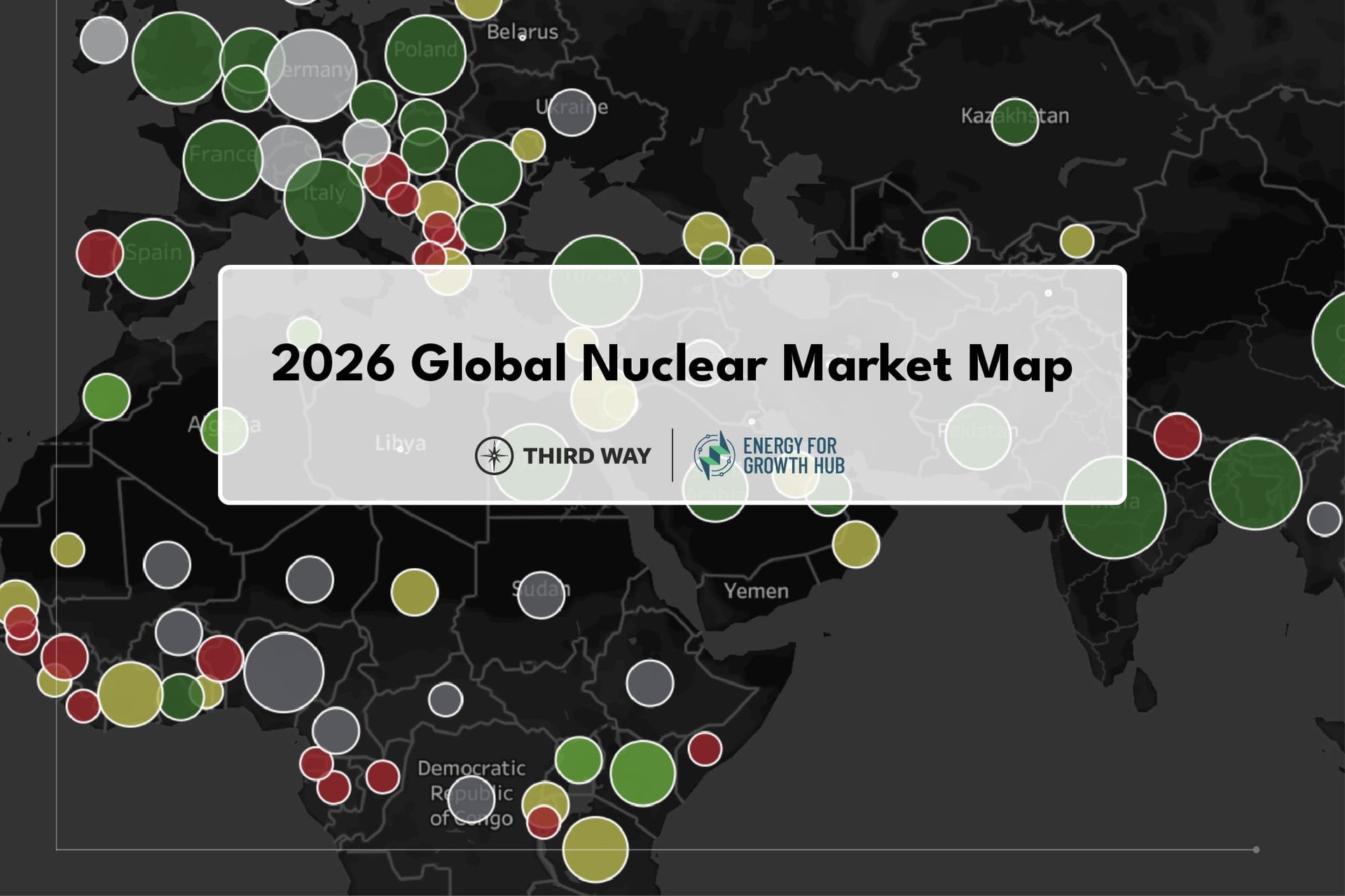
Our map includes several features that will make it easy for policymakers and advocates to find useful information on potential nuclear markets around the world. On the map, every country included in our analysis is marked with a circle. The size of each circle represents the magnitude of the projected increase in energy demand for the corresponding country. The color of each circle illustrates a country’s ranking on our 6-stage scale that assesses relative preparedness for the development of nuclear power. You can find the complete dataset for our analysis here. The map contains seven filters that show:
- A 6-stage color scale describing each country’s relative preparedness for the development of nuclear power.
- Projected percentage growth in national electricity demand from 2023-2050.
- Projected additional electricity demand in TWh for each country in 2050.
- Projected demand from additional demand drivers that are currently nascent markets, or would not be included in the baseline model, including Coal Replacement, Desalination, EV Transition, and electrification of Industry.
- The World Bank’s four Income Groupings: low, lower-middle, upper-middle, and high.
- The NTI Nuclear Security Index ratings that assess actions related to supporting global nuclear security efforts.
- The NTI Nuclear Security Index rankings of 47 countries with nuclear facilities to assess actions to protect those facilities against sabotage.
In order to understand the potential global market for nuclear technologies, we set out to determine two things: Where is the opportunity (using new energy demand), and where can nuclear power contribute in a meaningful way (using our “readiness” score)?
We define a country as “ready” for nuclear if it could be a customer for a nuclear supplier and credibly negotiate a purchase agreement with an international supplier country over the timeframe given. We determine this by using a 10-point checklist covering internal institutions and controls such as policy and regulatory agencies, as well as external signals of interest such as engagement with supplier countries and international institutions like the International Atomic Energy Agency. More information on the scoring methodology can be found here.
To estimate future electricity consumption, we use historical data to establish a trend based on income correlations. We then extrapolate this relationship to 2030 and 2050 for each country, using data and forecasts from the United Nations, International Energy Agency, International Monetary Fund, and the World Bank. More information on the electricity projection methodology is available here.
Some notable new findings and specific updates and changes since the 2024 map can be found here.