Blog Published January 22, 2026 · 6 minute read
What’s Driving High Electricity Prices in Maine?
Francesca Hsie, Maya Gibbs, Dr. Florian A. Schneider, & Carson Ohlen

Household utility bills have boomed this year, and Mainers have been hit harder than others. There’s been considerable attention given to the cost pressures Maine families face, but little detailed data analysis to look under the hood and see what’s really going on. In the absence of robust analysis, some have blamed Maine’s clean energy deployment targets for high electricity costs. And in Washington, D.C., President Trump and others in his administration continue to suggest that renewable deployment is to blame for rising energy bills across the country. Below, we’ll walk through the reality of price hikes, outline the cause of high costs, and examine how clean energy makes Maine’s electricity more affordable, not less.
Price Snapshot: How Much Have Electricity Prices Increased in Maine?
Average residential electricity prices in Maine increased 14% between October 2024 and October 2025–growing faster than all but two other states. Compared to 2015, prices have increased by 78%, more than double the nationwide rate of increase. And income isn’t keeping up: the latest data show median household income has grown by just 48% since 2015.
Central Maine Power and Versant Power MPD/BHD provide power for 96% of Mainers, and prices have risen painfully for these utility customers over the last few years.
To put this in perspective, let’s do the math for the typical household.
The average Maine household uses about 550 kWh of electricity per month and will have a monthly bill of more than $160 starting January 2026. That means monthly bills will be $29-35 more than they were a year ago, in January 2025.
In the abstract, these figures can seem small. But this increase comes on top of years of rising power bills, and many residents of the state were already being pushed to the brink.
2024 census data shows about a quarter of Mainers weren’t able to pay at least one utility bill that year, and more than a third of households reported cutting back on other necessities, like food and medicine, to afford their energy costs.
More than 200,000 Maine households faced unaffordable home energy burdens; for low-income Mainers, home energy costs accounted for 14% of monthly costs, about 50% higher than considered affordable by the state and its partners. Since then, costs have only grown more burdensome. Decoding why prices are so high–and figuring out how to lower them–requires some context.



Where Does Maine Get Its Power?
Like many states, Maine participates in a regional grid and competitive wholesale power market managed by the Independent System Operator for New England (ISO-New England). That system allows communities to share power resources and reduce the overall cost of new infrastructure. As a result, energy policies and investments across ISO-New England set the electricity mix and contribute to the wholesale cost of power in Maine, which in turn shapes the retail rate consumers pay. Decisions made in Augusta certainly shape Maine’s future, but the state’s energy sector is closely tied to its New England neighbors.
Power Sources: What Technologies Keep the Lights on in the Pine Tree State?
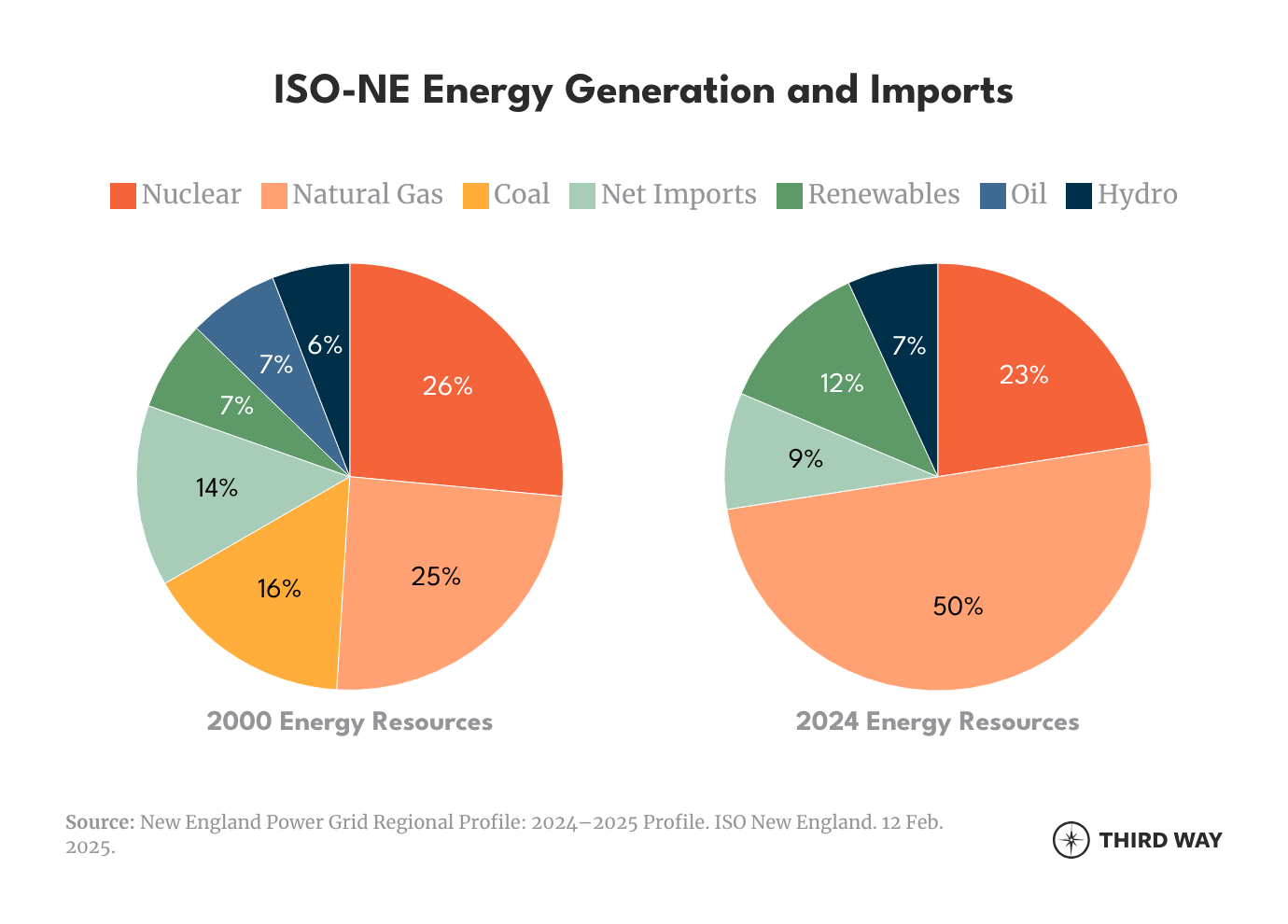
Maine may have set a goal of 100% clean energy by 2040, but the state still relies on a steady stream of natural gas to power homes and businesses. Natural gas’s share of generation in ISO-New England doubled between 2000 and 2024 to half of the regional energy mix, largely displacing higher-cost, aging coal and oil power plants. Non-hydro renewables, like solar and wind, have had a moderate increase from a combined total of 7% in 2000, growing to 12% of the regional energy mix in 2024, while the share of nuclear energy, long one of the most reliable sources of clean power, has actually decreased by 4 percentage points, thanks to plant closures.
In short, Maine’s energy policy isn’t set in a vacuum. Mainers’ electricity costs are shaped by decisions made up and down the eastern seaboard and by a variety of different generation and transmission resources.
Why Are Prices Rising?
The Rising Cost of Natural Gas - Because gas accounts for such a significant share of power generation in ISO-New England, it has an outsized influence on the region's wholesale power market prices. As a result, when natural gas prices rise–whether because of supply constraints, weather events, or other supply chain challenges–wholesale electricity prices can increase significantly, with consequences for retail customers. Between 2015 and 2024, Versant BHD and Central Maine Power saw about a 60% increase in their supply rates, driven primarily by the destabilization of the global gas market following Russia’s invasion of Ukraine. Global events have consequences at home–including for Mainers.
Aging Electricity Grid – Maine’s electricity grid is aging and needs repair and modernization. That decay increases the cost of delivering electricity: Central Maine Power customers have seen a 145% increase in distribution rates, and households in Versant MDP territories faced a 212% rise in transmission costs between 2015 and 2024. Grid upkeep and improvement is essential–and expensive. But the longer utilities defer improvements, the more expensive repairs become, placing an even greater burden on working families.
Can Clean Energy Help Reduce Costs?
Maine and New England’s heavy reliance on natural gas, especially during cold winters, exposes customers to sharp price spikes and higher supply rates. Clean energy sources like solar and wind, along with battery storage, do the opposite. They provide stable, fuel-free power that lowers wholesale electricity prices and insulates households from fossil fuel volatility.
Far from being the cause of rising utility bills, investing in clean energy has been quietly protecting Mainers from even bigger price increases.
Looking ahead, expanding resources like offshore wind will only grow those savings. A regional study by RENEW Northeast found that offshore wind could have cut New England electricity prices by 11% and delivered $400 million in wholesale savings in just three winter months, showing what’s possible during the most expensive periods where Maine relies most heavily on natural gas.
Mainers cannot reap the full benefits of clean energy buildout without significant grid improvements and, crucially, investments from neighboring states in ISO-NE. But the state’s clean energy targets are an important piece of the puzzle for reducing families’ electricity costs and actually providing some price stability for Mainers.
Some, notably members of the Trump Administration, have claimed that renewables are the cause of rising prices. Those claims don’t hold water. Instead, anti-clean energy policies have done far more damage to Mainers’ monthly bills. The “One Big Beautiful Bill Act actively undercut the very clean energy investments that have been keeping prices down, forcing Maine to rely even more on expensive, volatile natural gas. Analysis from Energy Innovation shows that the legislation will raise wholesale electricity prices and cost Maine households up to $80 more per year by 2035. Layer on previously proposed energy tariffs on Canadian energy exports that could have added $419 to $1,000 per year to household energy costs, and it becomes clear which policy levers are actively working towards affordability. Investing in clean energy is a smart way to cut electricity costs in New England. Failing to do so will only worsen the state’s expanding affordability crisis.