Blog Published February 26, 2026 · 8 minute read
Why Does Massachusetts Have Some of the Highest Electricity Prices in the Country?
Francesca Hsie, Maya Gibbs, Dr. Florian A. Schneider, & Carson Ohlen

Massachusetts ranks among the states with the highest residential electricity prices in the nation. It’s easy to assume that’s a recent development, given headlines about rising prices. But today’s bills are actually the culmination of a decade-long climb and deep-rooted structural challenges, including the state’s overreliance on natural gas. And price increases are hitting utilities serving Massachusetts’s biggest cities especially hard.
Eversource, the primary utility for Boston, Holyoke, and Springfield, and National Grid, whose service area includes Worcester and North Adams, have both seen tremendous volatility in the price of power, with repercussions for families across the state.
If we do a direct comparison between what Massachusetts households are paying and the median rate for the US writ large, single-family home owners in Massachusetts are spending more than 2x as much on their monthly electric bills.
There’s no one-and-done fix to lift the burden on working families, but there are changes that could support grid reliability and stabilize prices, chiefly by deploying a lot more clean energy ASAP. Below, we’ll walk through the reality of price hikes, outline the cause of high costs, and examine how clean energy can make Massachusetts's electricity more affordable, not less.
Price Snapshot: How Much Do Massachusetts Residents Pay for Electricity?
Massachusetts has the third-highest electricity rates in the country, almost double the national average. Price growth has been fast: Massachusetts residents’ electricity rates were 70% higher in November 2025 than in November 2015. Nationally, prices were only 40% higher during the same period.
If we take it down to the consumer level, we see major discrepancies between what folks in Massachusetts pay and what the median American pays.
The average Massachusetts household uses about 570 kWh of electricity per month. In 2024, their monthly bill was about $167 per month. Since then, average use stayed the same, but rates have only gone up, and typical bills hover around $180 per month, excluding the state’s temporary reduction in electric bills. Bills in Boston for Eversource customers are a bit below that average, closer to $150 on average, but approaching $200 in the summer.
National Grid customers, however, pay more on average, putting monthly bills around $200/month for apartments and small homes, and closer to $300/month for single-family homes.
By comparison, the average monthly bill was around $151 in New York, $149 in Ohio, and $156 in Indiana, as of November 2025, meaning monthly bills in Massachusetts are as much as 50% higher than elsewhere in the country.
That bill includes both the cost of power supply and the cost of delivering electricity, both of which are sky-high.
To cope with high prices, Massachusetts households reported making difficult choices about other essentials.
- Roughly 1.3 million residential ratepayers have reported needing to choose between paying their energy bills and paying for food or healthcare.
- More than 900,000 households missed at least one energy payment.
Bottom line, Massachusetts is paying far more than other states for electricity, and bills are especially high for single-family homes. Decoding why prices are so high – and figuring out how to lower them – requires some context.
Where Does Massachusetts Get Its Power?
Like many states, Massachusetts participates in a regional grid and competitive wholesale power market managed by the Independent System Operator for New England (ISO-NE). As a result, policy decisions made in one part of New England, including investments and new regulations, impact the entire region. Massachusetts’ energy mix isn’t simply the product of state-wide policymaking. Instead, it’s the result of investments across all six ISO-NE states. That system allows communities to share power resources and reduce the overall cost of new infrastructure – but it also means that every state needs to make a concerted effort to bring down costs across the region for prices to go down in Massachusetts.
Power Sources: What Technologies Keep the Lights On in Massachusetts?
Massachusetts has set ambitious targets for clean energy. But because of its participation in ISO-NE, the state still relies on a steady stream of natural gas to power homes and businesses.
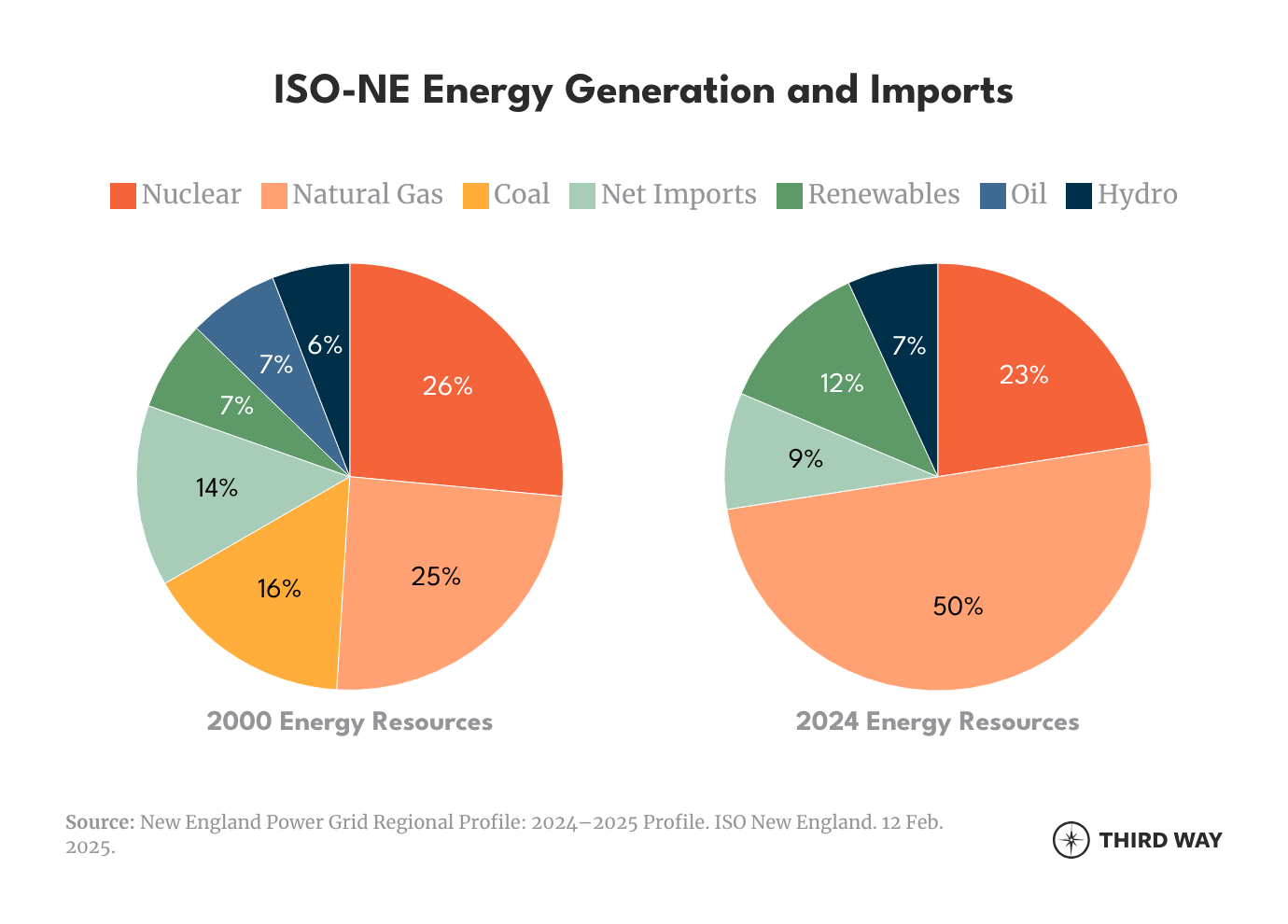
Previously, the region relied on coal and oil power plants to provide reliable power throughout the region. These plants are old, expensive, and dirty – and they’ve largely been supplanted by natural gas. Between 2000 and 2024, natural gas grew to comprise half of the regional energy mix. That shift has helped reduce greenhouse gas emissions, local pollution, and operating costs. But New Englanders’ reliance on natural gas means electricity bills are closely tied to the fluctuating cost of gas and are highly volatile (more on this below).
Non-hydro renewables, like solar and wind, have also grown, but nowhere near as quickly as natural gas. Renewables made up 7% of ISO-NE’s energy mix in 2000; they grew to12% of the regional energy mix in 2024. Renewables can be a cost-effective energy source in and around Massachusetts. To speed up the sluggish pace of wind and solar growth, Massachusetts needs a more modern approach to grid management, faster permitting, and a strategy to combat NIMBY-ism.
While gas and clean generation have grown, the region’s share of nuclear energy, long one of the most reliable sources of clean power, has actually decreased by 4 percentage points between 2000 and 2024. Opposition from anti-nuclear environmental groups and high operating costs led to the closure of multiple nuclear plants, including Vermont Yankee and Pilgrim Nuclear, in the 2010s, significantly reducing the region’s access to clean, firm power. Massachusetts and its New England neighbors are, as a result, highly reliant on natural gas.
Why Are Prices Rising?
Heavy Dependence on Volatile Natural Gas: Because gas accounts for such a significant share of power generation in ISO-NE, it has an outsized influence on the region's wholesale power market prices. When natural gas prices rise–whether because of extreme weather events or global supply shocks–wholesale electricity prices can increase significantly, with consequences for retail customers.
Massachusetts households served by National Grid (a utility that serves about a third of Mass residential customers) experienced a 300% increase in their supply charges, which reflect the cost of generating or purchasing power, from mid-2022 to the winter of 2022/2023. Eversource (serving another third of Mass residents) increased supply rates by 170% from 2022 to 2023. These spikes were temporary and driven primarily by the destabilization of the global gas market following Russia’s invasion of Ukraine, as Europe pivoted away from Russian exports. Demand for oil and gas produced outside of Russia, including in the US, surged, leading to higher prices here at home, especially in gas-dependent places like New England. Those spikes may not have lasted, but overreliance on natural gas makes runaway prices more likely down the line.
Aging Electricity Grid: Massachusetts utilities must maintain and modernize an aging grid, harden infrastructure against severe weather, and upgrade systems to add new energy resources to replace aging power plants and keep up with demand. These costs are reflected in delivery charges on customer bills, which have also grown over time. For example, National Grid household customers have seen the delivery portion of their bill double between 2015 and 2025. Grid upkeep and improvement is essential – and expensive. But the longer utilities defer improvements, the more expensive repairs become, placing an even greater burden on working families.
Can Clean Energy Help Reduce Costs?
Massachusetts and New England’s heavy reliance on natural gas, especially during cold winters, exposes customers to sharp price spikes and higher supply rates. Adding clean energy resources – solar, offshore wind, batteries, and nuclear energy – does the opposite by providing a diversified mix of stable power that ultimately lowers wholesale electricity prices and insulates Massachusetts’ households and businesses from fuel cost volatility.
Increasing the rate of cheaper, clean energy deployment in Massachusetts and across the region will add much-needed supply to the grid, reducing the need to rely on more expensive forms of energy when peak demand is highest.
This is particularly true in years when the temperatures are much colder than average. The winter of 2025 saw consistent sub-freezing temperatures for much of the first few months of the year, straining thermostats and wallets across Massachusetts. A report from Daymark Energy Advisors estimates that had the nearly 3500 MW of planned offshore wind generation been operational between December 2024 and February 2025, Massachusetts residents would have seen savings of $105 to $212 million. To put a finer point on it: slow clean energy deployment is actually costing Massachusetts families money.
The ability of offshore wind farms to offset peak winter natural gas charges will be essential in insulating households and businesses from these spikes moving forward. But projects need to stay on track. They can’t get bogged down in bureaucracy or political disputes. Protecting offshore wind farms and other clean energy is critical to manage energy costs in Massachusetts.
Electric grid enhancements and upgrades will be necessary regardless of what type of electrons keep our lights on. Building clean energy projects in parallel with upgrading our aging transmission and distribution network will reduce the cost of needed improvements for ratepayers and, ultimately, increase price stability throughout the state.
Anti-clean-energy policies like the “One Big Beautiful Bill Act” (OBBBA) are actively undermining the very clean energy investments needed to keep prices down. Analysis from Energy Innovation shows that OBBBA could raise wholesale electricity prices by 38% and cost Massachusetts households an additional $120 per year by 2035. State and local leaders in Massachusetts recognize that investing in clean energy is a smart way to cut electricity costs. Failing to do so will only exacerbate runaway prices.