Blog Published January 22, 2026 · 6 minute read
What's Causing New Jersey's Electricity Price Spike?
Francesca Hsie, Maya Gibbs, Dr. Florian A. Schneider, & Carson Ohlen

New Jersey’s high electricity prices dominated the news cycle during the state’s recent gubernatorial race, and addressing high rates is Priority Number 1 for incoming Governor Mikie Sherrill. President Trump has blamed price spikes on wind turbines, but the reality is more complicated. Let’s look at the data.
Price Snapshot: How much have electricity prices increased in New Jersey?
Average residential electricity prices in New Jersey increased 15% between October 2024 and October 2025–growing faster than prices in all but one other state. In October of last year, New Jersey residents were paying 22.55 cents/kilowatt-hour (kWh) for electricity, 25% higher than the national average, and costs show no immediate sign of going down.
Higher electricity rates mean the average New Jersey household pays $150/month for electricity, one of the highest monthly bills in the country.
High utility bills would be bad enough – but that’s on top of New Jersey’s comparatively high cost of living: the state has the country’s third-highest regional price parity rating, which measures the differences in price levels across states.
On the 2024 census, 28% of New Jerseyans said they’d been unable to pay at least one energy bill in full in the prior year, compared with 23% nationwide.
Across the Garden State, families are struggling to manage rising electricity costs and are badly in need of relief. Public opinion research shows little consensus on who to blame, what to do, or when to expect relief. To identify solutions that could make power more affordable, it’s important to understand how New Jersey keeps the lights on.
Power Sources: What Technologies Keep the Lights on in New Jersey?
New Jersey, like many states, participates in a regional grid and competitive wholesale power market managed by the PJM Interconnection (PJM). That system allows communities to share power resources and reduce the overall cost of new infrastructure. But being part of a competitive wholesale market means New Jersey’s power prices are affected by decisions made not just in New Jersey but also in Maryland, Pennsylvania, Virginia, and 10 other Mid-Atlantic states. Policies and investments across PJM set the electricity mix New Jersey has access to, and, by extension, contribute to the wholesale cost of power, which shapes the retail rate consumers pay.
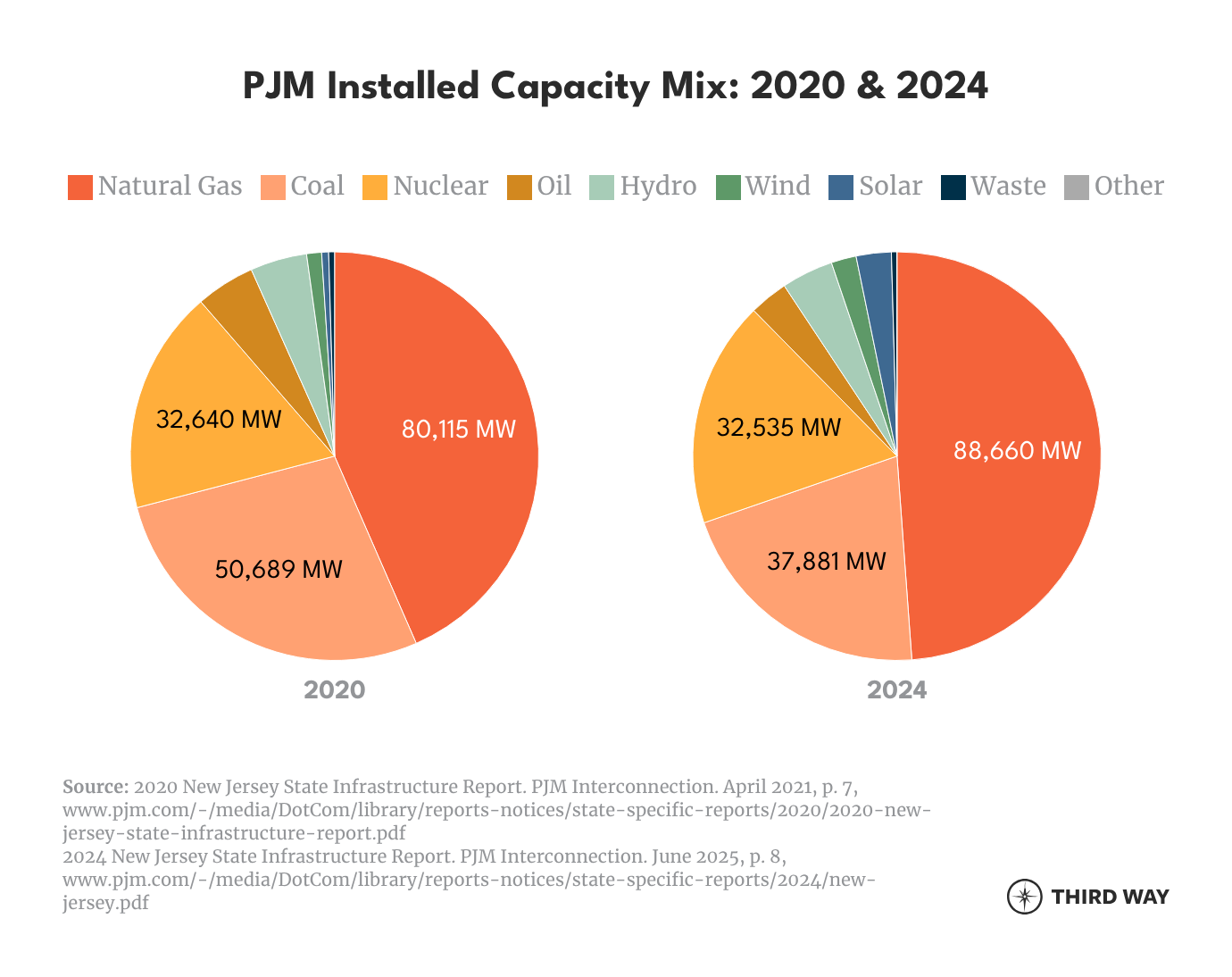
Natural gas accounts for the majority of electricity production in the region, and its share has increased substantially in recent years. Gas now accounts for roughly half of all electricity generation, with coal and nuclear power supplying the next-largest shares, respectively. Solar and wind have increased steadily, but still make up less than 5% of the electricity mix.
Why Are Prices Rising?
PJM Capacity Market: PJM runs a forward capacity market to ensure sufficient future supply to meet peak demand, essentially paying power plants to commit to being available in the future. Because of growth in data centers, manufacturing, and electrification, electricity demand has surged, but PJM hasn't built enough generation to keep pace. Recent capacity auctions have cleared at historically high prices as the market attempts to attract more generators. These higher costs are passed to customers through state-approved retail rates.
Slow Interconnection Process: PJM's inability to meet rising demand stems from its slow, cumbersome interconnection process, which has experienced significant delays, resulting in a large backlog of projects awaiting grid connection. These delays limit the entry of new resources that could help reduce prices and have contributed to tighter capacity conditions. It’s not that developers don’t want to build – PJM has over 200,ooo MW of new generation in queue, about the same as their total installed capacity – it’s that projects cannot connect to the grid and, by extension, consumers cannot get access to new power sources.
Natural Gas Demand: Natural gas generation has an outsized influence on wholesale power prices in New Jersey because it accounts for a significant share of PJM generation. As a result, when natural gas prices rise–whether because of supply constraints, pipeline and storage infrastructure capacity limitations, cold weather-related demand for heating, or global market conditions–wholesale electricity prices increase significantly. These prices are then passed on to retail customers.
Can Clean Energy Help Reduce Costs?
Despite high-profile attacks on renewables, clean energy buildout is actually central to future energy affordability in New Jersey. Expanding in-state renewable generation adds new capacity to the state’s grid without the fuel price volatility associated with natural gas.
By increasing the share of clean energy on the grid, New Jersey can ultimately reduce the dominant influence of natural gas on wholesale electricity prices and ensure greater price stability moving forward.
Accelerating clean energy deployment and interconnection can also ease pressure in PJM’s capacity market by increasing future supply, helping to lower the high capacity auction prices currently being passed on to ratepayers.
When paired with grid modernization and battery storage, clean energy can also help New Jersey flexibly manage real-time growing demand from large data centers more affordably. Energy efficiency, demand response, and distributed clean resources reduce peak demand – the times during the day when electricity use is at its highest. Because we need the lights to stay on at all times of the day, these short peak periods become a key driver of capacity costs. Clean energy solutions can lower or shift demand during these peaks, avoiding costly new infrastructure and keeping electricity bills lower for families and businesses in the state.
The cost benefits could be significant: a 2025 Synapse Energy Economics study found that faster clean energy deployment and grid improvements could save New Jersey households around $467 a year on electricity bills and, when combined with commercial customer savings, total $14.3 billion statewide.
At the federal level, the Trump administration has slowed or reversed investments in low-cost clean energy and related infrastructure, both in New Jersey and nationwide. The administration has taken direct actions to delay or undermine clean energy projects currently under construction, including issuing a stop-work order for the Empire Wind offshore wind project and withdrawing a $716 million federal loan guarantee for transmission upgrades needed to support new generation in the state.
Analysis from Energy Innovation shows that President Trump's "One Big Beautiful Bill Act" would significantly increase the state's reliance on natural gas, driving wholesale electricity prices in New Jersey up by 35 percent by 2035 and increasing annual household energy bills by $220. At the same time, these decisions constrain new clean energy supply, worsen capacity shortages, and push the state deeper into volatile fossil fuel markets, all of which make electricity more expensive for New Jersey families and businesses.