Q&A on Corporate Tax Reform
David Brown, Gabe Horwitz, Jessica Perez
America’s corporate tax system badly needs reform. Though the United States faces stiff international competition, our outdated tax code was designed for a lone economic superpower. High rates, complexity, uncertainty, and steep compliance costs are weighing down American businesses at a time when we desperately need expansion and hiring. As Congress prepares to address the fiscal and economic challenges that will come to a head in the upcoming lame duck session, tax reform will no doubt play a role in any compromise. This is a primer on corporate tax reform issues: what they mean and why they are important.
How does America’s corporate tax rate measure up?
At 35%, America’s corporate tax rate is the highest among industrialized countries. While our rate has not changed for almost 20 years,1 foreign corporate tax rates declined an average of 1% per year from 1995 to 2005 and have continued to drop.2 The United Kingdom recently decreased its rate from 30% to 24%, Germany’s dropped from 25% to 15%, and Canada’s fell from 27% to 15%.3
Corporate Tax Rates, 2000-20124

Of course, the federal tax rate does not reflect the entire tax burden that corporations face. In most European countries, corporations are subject to a value-added tax, whereas in the United States, corporations must pay a number of state and local taxes. Furthermore, the average effective tax rates that specific industries face vary across countries. Nonetheless, the corporate tax rate is an important benchmark for the competitiveness of a nation’s tax system. As our peers have adjusted to the realities of a global economy, the U.S. tax system has become less and less attractive to businesses.
What this means:
If Kia builds a car in South Korea for $15,000 and sells it in Singapore—a country without any import tariffs—for $20,000, the company makes a profit of $5,000. After paying the Korean corporate tax rate of 22%, the after-tax profit is $3,900. But if Ford sells an American-built car in Singapore, it faces the American tax rate of 35%, so Ford must charge $21,000 to take home an equivalent amount after taxes. This phenomenon causes U.S. firms to lose price advantages to international competitors—and this translates to less business for American companies.
Do all companies pay the 35% rate?
Far from it. International tax rules and industry-specific tax preferences cause effective corporate rates to vary widely among and within industries. Companies that earn a large share of their income from foreign sources or from intellectual property most often enjoy lower rates, while those reliant on physical production in the United States tend to pay more.5
What this means:
The precious metals industry, for example, faces an average federal tax rate of less than 10%, while automotive retailers pay about 33%.6 This is because the precious metals industry derives a large portion of income from foreign sources, while car dealerships do not have a comparable way of reducing their tax burden. Other industries like manufacturing, which enjoys widespread support in Congress, are able to pay lower rates due to preferences like the section 199 deduction, for U.S.-based production. In addition, state and local taxes affect industries differently.
What are some examples of expenditures in the corporate code?
The U.S. corporate tax code is rife with credits and deductions. Some address legitimate market failures, while others interfere with efficient allocation of capital. And they vary vastly in both cost and popularity.
What this means:
There are a variety of ways to define a tax expenditure, but the following table lists the top tax expenditures in 2012, according to the Joint Committee on Taxation (JCT).

Source: United States, Congress, Joint Committee on Taxation, “Estimates of Federal Tax Expenditures for Fiscal Years 2011-2015,” Report, January 17, 2012. Accessed September 5, 2012. Available at: https://www.jct.gov/publications.html?func=startdown&id=4386.
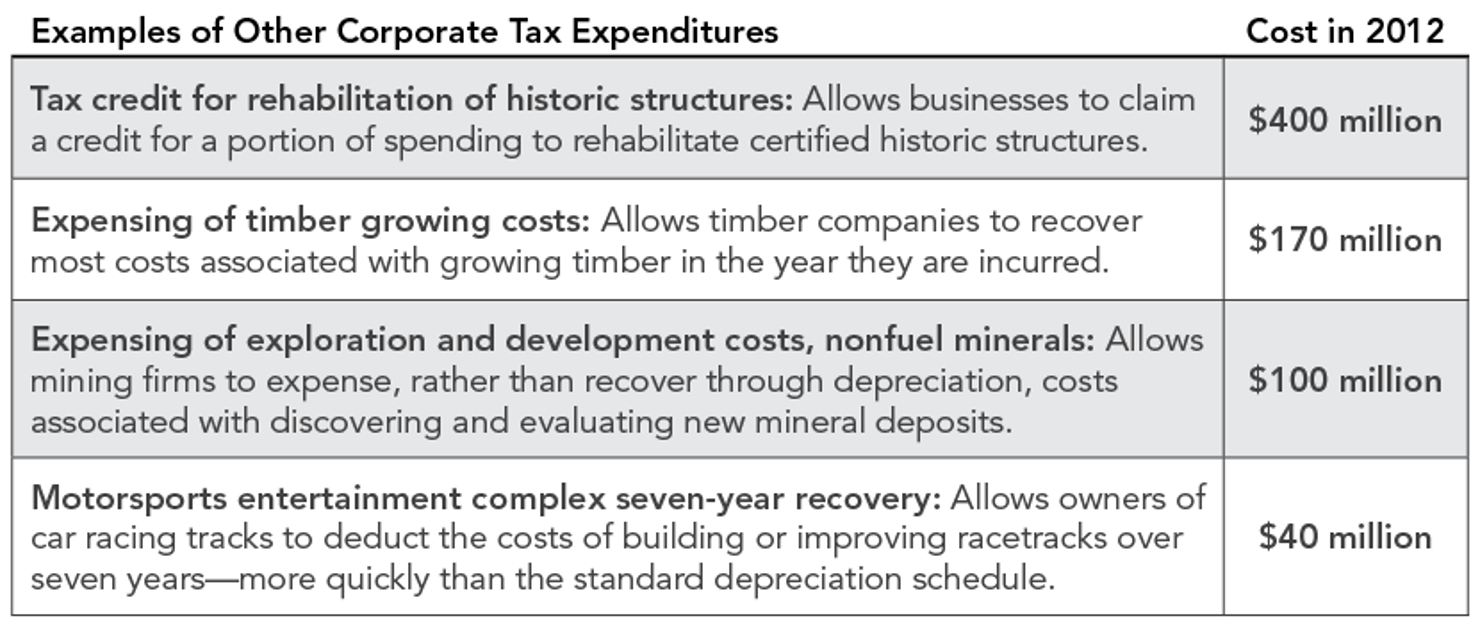
Other well-known corporate tax expenditures include a credit for increasing research activities and the last in, first out (LIFO) accounting method.* Yet, not all expenditures are as large or as broadly applicable. Below are examples of corporate tax expenditures from JCT’s list:
LIFO is an accounting method that assumes that assets produced or acquired last are the ones used or sold first. According to the JCT, LIFO is the seventh largest corporate tax expenditure, costing the government $4 billion in 2012.
For the JCT’s full list of current tax expenditures, visit the JCT Website. Note: The JCT does not classify the deductibility of interest payments as a tax expenditure.
How much are corporate tax expenditures worth?
About $151 billion for 2012. This pales in comparison to the $942 billion spent on individual expenditures, but the corporate tax code comprises a smaller portion of our overall revenue picture.7
What this means:
Corporate tax reform proposals by both Democrats and Republicans aim to lower the rate by reducing and eliminating expenditures. President Obama has proposed a rate of 28%, while Republican presidential nominee Mitt Romney and many House Republicans call for a 25% rate.
But corporate tax reform will require tough choices. For example, The Hamilton Project calculates that if Congress were to eliminate nearly every tax expenditure*—including industry favorites like accelerated depreciation and the domestic manufacturing deduction—the revenue gain would provide for a rate reduction of only 5.6 percentage points, to 29.4%.8 So while there is widespread agreement on the need to lower the rate and broaden the base, policymakers face significant decisions on exactly how to get there.
This does not include elimination of deferral.
How much revenue does the corporate tax raise?
Relatively speaking, not as much as it used to. Corporate tax revenue, as a percentage of total revenue and of the overall economy, has been declining for 60 years. At its peak in 1952, the corporate tax code generated 32% of federal revenue. Last year, it made up only 8.9%.9
What this means:
Corporate tax revenue has declined for several reasons, among them a general decline in taxable corporate profits, as well as a drop in the statutory rate, from a high of 50% in the mid-20th Century to 35% today. Additionally, the share of businesses organized as C-corporations has decreased over time, from 17% of businesses in 1980 to 6% in 2007.10
In recent years, there has been a rise in the number of businesses organizing as S-Corporations. These businesses pass profits directly to the owners, who are taxed at their individual rate, thus bypassing corporate taxes. This shift was caused in part by the 1986 tax reform, which set the top individual tax rate lower than the top corporate rate, making the partnership structure even more attractive. Finally, the many corporate tax expenditures created by Congress have also reduced revenue.
Does this mean that businesses don’t pay much in taxes?
Not necessarily. First, businesses of all kinds face taxes at the state and local level, including state corporate tax, sales tax, and property tax. Second, while some businesses pay less because of tax preferences, many simply pay under the individual code. As pass-through entities have become more prevalent, their taxes have contributed a larger share of revenue. In 1987, the year after tax reform, pass-throughs earned 29% of business income. By 2004, their share had increased to 52%.11 These businesses are still paying taxes, but they are not counted as corporate tax revenue.
What this means:
More than half of business income in the United States bypasses the corporate tax code. The growth of business income that is taxed under only the individual code has contributed significantly to the decline in corporate tax revenue, but this doesn’t necessarily mean that companies are paying less. It’s also important to note that, because many S-Corporation pass-throughs benefit from tax expenditures, reform that eliminates both individual and corporate tax expenditures while lowering the corporate (but not individual) rate would result in a higher effective rate for these businesses.
Just how bad are compliance costs?
Pretty bad. In fact, the United States ranks 69th in the world in ease of paying taxes, just behind Mongolia and Samoa.12 Because of the hundreds of special tax preferences and reporting requirements, American companies spend billions per year complying with tax laws and attempting to reduce their payments. Recently, that amount has exceeded $40 billion per year—more than 12% of corporate revenue.13 These costs divert money from economically beneficial purposes such as hiring, equipment purchases, and R&D. Furthermore, the temporary nature of many tax provisions adds to the difficulty of compliance. Dozens of temporary “tax extenders,” including the research and experimentation credit, are typically renewed by Congress for only one year at a time.
What this means:
United Technologies Corporation, for example, has reported that on any given workday there are ten or more IRS agents present at its headquarters auditing its tax department. Its federal return alone exceeds 19,000 pages. The immense resources devoted to this compliance operation could be better used for the benefit of the company and the overall economy. The compliance costs of some corporate deductions are so large that many U.S. companies, particularly small and medium-sized ones, don’t pursue them. As a result, businesses claim as little as 5% of tax preferences they are entitled to claim.14
What’s the difference between a worldwide and territorial system?
The United States operates under a primarily worldwide system, which taxes domestic and overseas profits of U.S.-based companies. Most of our economic competitors have a territorial system, which taxes only domestic profits. Some countries switched from a worldwide to territorial system recently, including Japan and the United Kingdom in 2009. The list below classifies the tax systems of some of our economic competitors as primarily worldwide or territorial.15
| Primarily Territorial* | Primarily Worldwide |
| Belgium | Brazil |
| Canada | China |
| France | India |
| Germany | United States |
| Japan | |
| United Kingdom |
Countries are classified as having a primarily territorial system if they exempt from tax 95% or more of dividends from foreign affiliates.
So while most foreign-owned companies pay tax only to the country where profits are earned, U.S.-based companies must also pay U.S. taxes. The Foreign Tax Credit does, however, prevent double taxation by allowing a credit for taxes paid to foreign governments. Therefore, companies only pay U.S. taxes on the profits of their foreign subsidiaries to the extent that U.S. tax obligations exceed foreign tax obligations.*16
The foreign tax credit offsets most, but not all, of the taxes U.S. companies pay to foreign governments. In 1990, for example, $25 billion of the $27.4 billion U.S. corporations paid in foreign taxes was creditable against their U.S. tax liability.
U.S. companies also have the advantage of deferral, which allows them to delay taxation on much of their profits from foreign subsidiaries until that money is repatriated to the parent company inside the United States.* According to a study by J.P. Morgan, U.S. multinationals are holding at least 60% of their cash overseas, and some companies have almost all of their cash balances in foreign accounts.17
Deferral only applies to active income, whereas passive income—on royalties, interest, and dividends—is generally subject to immediate taxation.
What this means:
If Ford and Toyota sell cars in Germany, both must pay the 15% German corporate tax. Because Japan operates under a primarily territorial system, Toyota is, for the most part, not required to pay taxes to Japan on those profits. If Ford elects to return profits to the United States, it must pay an additional 20% in U.S. taxes—the U.S. 35% rate minus a Foreign Tax Credit for the 15% paid to Germany. This is one reason Ford may elect to reinvest those profits overseas rather than pay the tax associated with repatriation.
Does our tax code encourage companies to create American jobs?
In every presidential election, it seems, candidates condemn a corporate tax loophole that rewards corporations for “shipping jobs overseas.” What they’re often talking about is the deductibility of moving expenses. The issue is that companies can deduct costs for moving operations not just within the United States, but also overseas.18 Politicians are right to identify this deduction as a concern, but this misses bigger issues. Our high rate, worldwide system, and deferral are major policies that significantly affect companies’ international investment decisions. On the worldwide system and deferral, experts disagree over the extent of any foreign investment incentives.
On one hand, the interaction of worldwide taxation and deferral can incentivize overseas investment. By taxing worldwide profits but allowing certain companies to defer that taxation, the code both provides foreign profits with preferential tax treatment and discourages repatriation. This may encourage companies to make and keep money overseas rather than a) deriving profits from U.S. operations, or b) returning foreign profits to the United States. In extreme cases, companies may decide to relocate their headquarters overseas to avoid U.S. taxes altogether.
On the other hand, alternatives to the current system could have different effects. Switching to a territorial system, for example, could make operating overseas even cheaper for U.S.-based corporations.19 A benefit would be that U.S. companies could repatriate profits without facing additional taxes. But critics say a territorial system could encourage companies to move as much income as possible out of countries with normal tax rates to those infamously known as tax havens.
What this means:
If American company ACME makes money from domestic operations, it must pay a 35% statutory rate—one of the highest in the world. If ACME makes money from its foreign subsidiaries, it most often pays only a lower foreign tax rate, unless it decides to return those profits to the United States. Thus, ACME pays a higher rate on profits either made inside the United States, or brought to the United States. This structure creates incentives for ACME to make and keep money in foreign countries.
Conclusion
As American companies face more and more international competition, our corporate code isn’t cutting it. Our rate is too high, the playing field is too lopsided, too many temporary provisions create uncertainty, and compliance is needlessly burdensome. So rather than encouraging competition and growth, our code encourages businesses to keep money overseas and spend billions to hunt for deductions and alternative business structures.
Corporate tax reform must be part of a growth agenda. By lowering rates and broadening the tax base, Congress can help American businesses compete and thrive on the global stage. The upcoming lame duck session provides a unique opportunity to put corporate tax reform on the agenda in 2013.
Endnotes
United States, Internal Revenue Service, Jack Taylor, “Corporation Income Tax Brackets and Rates, 1999-2002,” Accessed July 19, 2012. Available at: http://www.irs.gov/uac/SOI-Tax-Stats---SOI-Bulletin:-Fall-2003.
United States, Congress, House Committee on Ways and Means, Testimony of Martin Sullivan before the Hearing on “The Current Federal Income Tax and the Need for Reform,” January 20, 2011. Accessed July 19, 2012. Available at: http://waysandmeans.house.gov/calendar/eventsingle.aspx?EventID=219701.
RATE Coalition, Video, March 26, 2012. Accessed July 19, 2012. Available at: http://www.ratecoalition.com/index.php/media-center/videos/227-rate-coalition-releases-video-one-week-before-us-has-highest-corporate-tax-rate-globally.
“Basic (non-targeted) Corporate Income Tax Rates,” Tax Database.Organization for Economic Cooperation and Development. Accessed July 20, 2012. Available at: http://www.oecd.org/document/60/0,3746,en_2649_34533_1942460_1_1_1_1,00.html#C_CorporateCaptial.
United States, Congress, House Committee on Ways and Means, Testimony of Martin Sullivan before the Hearing on “The Current Federal Income Tax and the Need for Reform,” January 20, 2011. Accessed July 19, 2012. Available at: http://waysandmeans.house.gov/calendar/eventsingle.aspx?EventID=219701.
Aswath Damodaran, “dbtfund09.xls,” Dataset, New York University. Accessed July 19, 2012. Available at: http://people.stern.nyu.edu/adamodar/pc/archives/.
Donald B. Marron, “How Large are Tax Expenditures? A 2012 Update,” Tax Policy Center, April 9, 2012. Accessed July 27, 2012. Available at: http://taxpolicycenter.org/publications/url.cfm?ID=1001602.
Michael Greenstone, Dmitri Koustas, Karen Li, Adam Looney, and Leslie B. Samuels, “A Dozen Economic Facts About Tax Reform,” Policy Memo, The Hamilton Project, May 2012. Accessed July 27, 2012. Available at: http://www.hamiltonproject.org/papers/a_dozen_ economic_facts_about_tax_reform/.
Mark P. Keightley, “Reasons for the Decline in Corporate Tax Revenues,” Report, Congressional Research Service, December 8, 2011. Accessed July 17, 2011. Print.
Mark P. Keightley, “Reasons for the Decline in Corporate Tax Revenues,” Report, Congressional Research Service, December 8, 2011. Accessed July 17, 2011. Print.
Peter R. Merrill, “The Corporate Tax Conundrum,” TaxAnalysts.com, 2007. Accessed July 27, 2012. Available at: http://www.taxanalysts.com/www/features.nsf/Articles/FE9DCA58402875D7852573680064DA50?OpenDocument.
“Paying Taxes Survey Rankings,” Table, PwC. Accessed July 19, 2012. Available at: http://www.pwc.com/gx/en/paying-taxes/data-tables.jhtml.
United States, Executive Office of the President, The President’s Economic Recovery Advisory Board, “The Report on Tax Reform Options: Simplification, Compliance, and Corporate Taxation,” August 2010, p. 8. Accessed December 5, 2011. Available at: http://www.whitehouse.gov/sites/default/files/microsites/PERAB_Tax_Reform_Report.pdf.
John D. McKinnon, “Firms Pass Up Tax Breaks, Citing Hassles, Complexity,” The Wall Street Journal, July 23, 2012. Accessed August 2, 2012. Available at: http://online.wsj.com/article/SB10000872396390444025204577543060812237798.html?mod=ITP_pageone_0.
“A Comparison of Key Aspects of the International Tax Systems of Major OECD and Developing Countries,” PriceWaterhouseCoopers for Business Roundtable, May 10, 2010. Accessed July 26, 2012. Available at: http://businessroundtable.org/studies-and-reports/key-comparisons-of-international-tax-systems-of-major-oecd-and-develop/.
Donald J. Rousslang, “Foreign Tax Credit,” Tax Topics, Tax Policy Center. Accessed July 19, 2012. Available at: http://www.taxpolicycenter.org/taxtopics/encyclopedia/Foreign-Tax-Credit.cfm.
Emily Chasan, “At Big U.S. Companies, 60% of Cash Sits Offshore: J.P. Morgan,” The Wall Street Journal, May 17, 2012. Accessed Aug. 7, 2012. Available at: http://blogs.wsj.com/cfo/2012/05/17/at-big-u-s-companies-60-of-cash-sits-offshore-j-p-morgan/.
Josh Dzieza, “8 Ridiculous Tax Loopholes: How Companies Are Avoiding the Tax Man,” The Daily Beast, February 25, 2012. Accessed August 7, 2012. Available at: http://www.thedailybeast.com/articles/2012/02/25/8-ridiculous-tax-loopholes-how-companies-are-avoiding-the-tax-man.html.
Clyde Prestowitz, “Beware territorial tax proposals,” Foreign Policy Magazine, July 23, 2012. Accessed Aug. 7, 2012. Available at: http://prestowitz.foreignpolicy.com/posts/2012/07/23/beware_territorial_tax_proposals.


More in Economy
View all Economy
The Case for Corporate Tax Reform