The Tax Code at 25: Time for Tune Up
Last fall, the modern federal tax code turned 25.* It was last overhauled in 1986, when the Chevy Celebrity was America’s bestselling car.1 Since then, America’s population has grown by about 70 million people,2 The Simpsons has broadcast almost 500 episodes, and the Celebrity has ceased production. In the time that has lapsed since Congress last gave the code a thorough inspection, Michelangelo could have painted the Sistine Chapel six times3 and Kim Kardashian could have gone through 127 marriages.4 Suffice it to say, comprehensive tax reform took place a long time ago, and the road traveled since has been long and unkind.
Unless specifically noted otherwise, information in this paper refers to the entire tax code, consisting of both individual and corporate provisions.
Although today’s tax code retains the name Internal Revenue Code of 1986, much Chevrolet’s sedans, today’s version looks very different. The Tax Reform Act of 1986 (TRA 86), though imperfect, accomplished the same goal that many of today’s reformers envision—broadening the tax base and lowering marginal rates. While the elimination of tax expenditures in many ways made the code simpler and compliance easier, the past quarter century has witnessed a proliferation of aftermarket add-ons—preferences and practices that have once again rendered the code a nearly impenetrable maze of seemingly irrational rules and regulations. This memo summarizes the scope of these changes and provides a few reasons why our tax code is once again ripe for reform.
The code’s suspension is shot.
The tax code has never been a particularly light and nimble vehicle, but 25 years after some considerable trimming its shocks are straining under the weight of thousands of new provisions. Today, it would take nearly 2.5 trees to print one copy of the U.S. tax code.5 That, ironically enough, includes the paper you would use to print the section that provides special timber-industry tax preferences for tree planting.6
This is partly the result of the more than 15,000 changes that have been passed since the 1986 reform.7 These changes have occurred at a dizzying pace and have shaped the code into the behemoth that it is today. Consider the following:
- The 1997 Budget Act alone added 285 sections to the code.8
- Over the last ten years, changes to the code have averaged more than one per day, with 579 in 2010 alone.9
- In 2001 the tax code contained about 1.4 million words. Today, its length has more than doubled to exceed 3.8 million words10 and 20,000 pages.11
- Not only has the code itself expanded, but tax regulations have ballooned as well. In1986, the tax code and related regulations added up to about 5.7 million words. By 2005, they had stretched to more than 9 million words, with significant additions since.12
The sheer size of the code is certainly daunting, but even more alarming is its rapid rate of growth. It is the additions, made year by year and special tax break by special tax break, that have turned the current code into an inscrutable collection of narrowly written and complicated provisions. If the code were merely inconvenient, reform might be seen as a luxury. However, the complexity of the existing code creates serious social and economic costs that must be addressed.
The code isn’t getting great mileage anymore.
One of the virtues of TRA 86 was that it increased efficiency by drastically reducing spending programs administered through the tax code—otherwise known as tax expenditures. By broadening the tax base and decreasing marginal rates, reform both eliminated specific tax expenditures and reduced the value of those that remained. Shortly before passage of TRA 86, spending through the tax code equaled almost 9% of GDP.13 By 1988, annual tax code spending had been reduced by $190 billion,14 and fell to 6% of GDP.15 Examples of tax expenditures eliminated or limited in TRA 1986 include:16 17 18 19 20 21 22
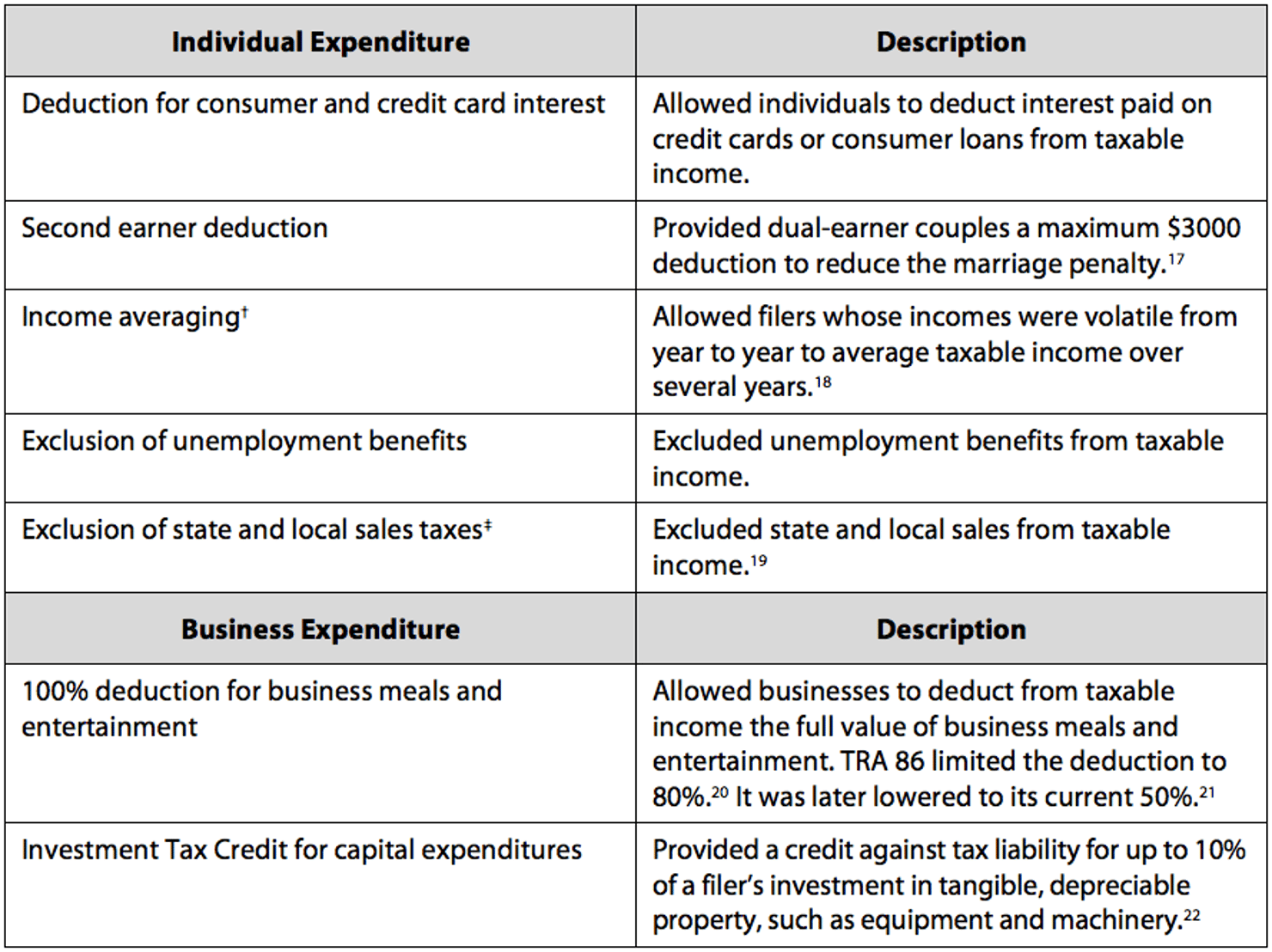
† Income averaging has since been reinstated for farmers and fishermen.
‡ The American Jobs Creation Act of 2004 partially reinstated this measure by giving filers the option to deduct state and local sales tax in lieu of income tax.
Since 1986, however, the tax code has taken on almost chameleonic properties, changing to reflect the political and industrial preferences of each passing Congress. Lawmakers have added expenditures to the code and increased their values by raising marginal rates. Since the 1986 reform, 159 new tax expenditures have been signed into law,23 bringing the total number on the books to more than 250.24 By 2003, the value of expenditures had crept back up to nearly 8% of GDP,25 and in 2010, tax expenditures made up almost a quarter of all federal expenditures.26 The value of these expenditures was multiplied by the rate increases passed under Presidents George H.W. Bush and Clinton, and the current cost is about $1 trillion per year.27
As a share of GDP, and in part because of changes in tax structure, corporate tax expenditures have actually continued to drop—from 1.8% in 1985 to 1% in 1988 to 0.8% in 2010.28 Individual expenditures, however, have reverted to almost pre-1986 levels, dropping from 6.9% in 1985 to 5% in 1988, but then rising to 6.7% by 2010.29 Examples of tax expenditures added since the 1986 reform include:30 31 32 33 34 35 36 37 38

Value of Tax Expenditures in the Code39

The proliferation of post-TRA 86 tax expenditures has created several problems, most notably the growth in backdoor spending and complexity. However, there are more subtle, pernicious impacts as well. In the corporate section of the code, tax subsidies that benefit favored industries distort economic choices.
To make matters worse, many of these provisions actually create tax instability. As Congress has made many of these provisions temporary to hide their true costs, it has created a growing cohort of expiring provisions that demand frequent reconsideration. The number of these expiring, short-term expenditures has increased dramatically from 25 in 1985 to over 141 in 2010.40 In 2012, both individuals and businesses will face uncertainty as Congress confronts expiring marginal income and capital gains rates. As a result, businesses are constantly subjected to needlessly manufactured suspense as to if and when Congress will reauthorize these incentives, creating economic uncertainty.
The code doesn’t handle like it used to.
In the years since TRA 86 rolled off the lot, Americans have found it increasingly difficult to steer their way through the code. During that time, there has been a vast increase in the resources that businesses and individuals devote to filing their taxes. Over the past ten years, the tax compliance burden has grown by about 20%.41
Today, American businesses and individuals spend a collective 6.1 billion hours per year—the equivalent annual workload of 3 million full-time employees—on tax compliance. If compliance were an industry in itself, it would rank just below our country’s agriculture industry in terms of employment.42 In fact, more man-hours are spent on tax preparation than are required for the entire federal civilian workforce to run the government.43
Individual Compliance
As the code has become more complex, the number of filers seeking outside help with their taxes has also dramatically increased. In 2011, approximately 90% of taxpayers used some form of tax preparation assistance,44 compared with 61% in 2005 and 46% in 1986.45 Much of this increase is associated with advances in tax preparation software, but even with these gains, the time required to complete the Form 1040 increased by 4 hours, to 13 hours, between 1990 and 2005.46 The compliance burden can also be measured in dollars. Between 2000 and 2007, the cost for the median individual taxpayer rose by 17%, from $200 to $258.47
It’s not surprising that the tax preparation industry has grown in concert with the increasing complexity of the tax code. USA Today has noted that a 1986 investment of $5,000 in H&R Block stock would have multiplied to more than $170,000 in less than ten years.48
Business Compliance
Corporations have faced some of the most drastic increases in compliance costs. In the ten years following tax reform, corporations saw their compliance costs rise by a staggering 77%.49 One 2002 survey found that firms with over $1 billion in assets were paying more than $1.3 million annually for tax compliance.50 Today, overall corporate compliance costs exceed $40 billion per year—more than 12% of revenues.51
Today, the United States ranks 69th in the world—between Samoa and Dominica—in terms of how easy it is for companies to pay business taxes.52 One survey of chief financial officers found that 71% would be willing to forfeit all tax credits and exemptions in return for a lower corporate rate, even if it did not result in a reduction in taxes.53 At a recent Ways & Means hearing, Gregory Hayes, CEO of United Technologies Corporation, recounted his own company’s compliance challenges: “Because of its size, UTC is under continuous IRS audit. At any given time there are ten to twelve IRS agents on site at our headquarters, full time, year round. Our federal tax return is almost 19,000 pages. And that’s just federal income taxes.”54
All told, the Taxpayer Advocate Service estimates that the overall cost of complying with the individual and corporate code in 2008 was $163 billion, equal to 11% of actual aggregate tax receipts55 and slightly larger than the economy of Romania.56 These excess billions of dollars dedicated to tax preparation don’t just represent a loss for filers, they are a diversion from consumer spending, family savings, and business investments—all of which we need to generate economic growth.
Conclusion
After 25 years of lapsed maintenance, our tax code is ready for a tune-up. Almost immediately after passage, the base-broadening accomplished in TRA 1986 began to give ground to the impulse to create special preferences here or tinker there. The result is a code that is now rife with complexity and inefficiency. Comprehensive tax reform today has the potential to reduce complexity, increase economic efficiency, and put a code in place that will allow us to drive on the road to growth and prosperity.
Endnotes
Matthew Hart, “The Worst Car that your Favorite Brand Has Made,” Motor Trend, August 15, 2008. Accessed February 15, 2012. Available at: http://wot.motortrend.com/thread-of-the-day-the-worst-car-that-your-favorite-brand-has-made-1968.html.
United States, Census Bureau, “State & County QuickFacts,” Accessed December 15, 2011. Available at: http://quickfacts.census.gov/qfd/states/00000.html.
Shelly Esaak, “Michelangelo - The Sistine Chapel Ceiling,” About.com. Accessed December 15, 2011. Available at: http://arthistory.about.com/od/famous_paintings/a/sischap_ceiling.htm.
Third Way calculation based on: “Kim Kardashian and Kris Humphries' marriage labelled a hoax as TV channel hold emergency meetings after divorce announcement,” The Daily Mail, November 1, 2011. Accessed December 15, 2011. Available at: http://www.dailymail.co.uk/tvshowbiz/article-2056105/Kim-Kardashian-divorce-Kris-Humphries-marriage-labelled-hoax.html.
Third Way calculation based on: “Trees into Paper,” Conservatree. Accessed December 15, 2011. Available at: http://www.conservatree.org/learn/EnviroIssues/TreeStats.shtml; See also United States Congress, House of Representatives, “Title 26,” Downloadable U.S. Code. Accessed January 4, 2011. Available at: http://uscode.house.gov/download/title_26.shtml.
Senator Tom Coburn, “Back in Black: A Deficit Reduction Plan,” Report, July 2011, p. 587. Accessed December 29, 2011. Available at: http://www.coburn.senate.gov/public/index.cfm/legislationissues?p=deficit-reduction.
United States, Department of the Treasury, Internal Revenue Service, “Prepared Remarks of IRS Commissioner Douglas H. Shulman before Harvard Kennedy School, Cambridge, Massachusetts,” November 14, 2011. Accessed December 2, 2011. Available at: http://www.irs.gov/newsroom/article/0,,id=249735,00.html.
Daniel Mitchell, “737,734,941,858 Reasons...And Still Counting: Why A Flat Tax Is Needed to Reform the IRS,” Report, The Heritage Foundation, April 15, 1998. Accessed December 1, 2011. Available at: http://www.heritage.org/research/reports/1998/04/bg1170es-why-a-flat-tax-is-needed-to-reform-the-irs.
United States, Department of the Treasury, Internal Revenue Service, U.S. Taxpayer Advocate, 2011 Annual Report to Congress. Accessed February 7, 2012. Available at: http://www.taxpayeradvocate.irs.gov/Media-Resources/FY-2011-Annual-Report-To-Congress-Full-Report.
David Kocieniewski, “I.R.S. Watchdog Calls for Tax Code Overhaul,” The New York Times, January 5, 2011. Accessed January 4, 2012. Available at: http://www.nytimes.com/2011/01/06/business/economy/06tax.html.
United States Congress, House of Representatives, “Title 26,” Downloadable U.S. Code. Accessed January 4, 2011. Available at: http://uscode.house.gov/download/title_26.shtml.
William O’Keefe, “Job One: Tax Code Rewrite,” Investors Business Daily, October 24, 2011. Accessed January 4, 2012. Available at: http://news.investors.com/Article/589117/201110241813/Job-One-Tax-Code-Rewrite.htm.
Allison Rogers and Eric Toder, “Trends in Tax Expenditures, 1985-2016,” Tax Policy Center, September 15, 2011, p. 3. Accessed February 17, 2012. Available at: http://www.urban.org/uploadedpdf/412404-Tax-Expenditure-Trends.pdf.
Unites States, Department of Treasury, Thomas S. Neubig and David Joulfaiain, “Tax Expenditure Budget Before and After the The Tax Reform Act of 1986,” OTA Paper 60, 1988. Accessed December 1, 2011. Available at: http://www.treasury.gov/resource-center/tax-policy/tax-analysis/Documents/ota60.pdf.
Allison Rogers and Eric Toder, “Trends in Tax Expenditures, 1985-2016,” Tax Policy Center, September 15, 2011, p. 3. Accessed February 17, 2012. Available at: http://www.urban.org/uploadedpdf/412404-Tax-Expenditure-Trends.pdf.
“Major Enacted Tax Legislation, 1980-1989,” Tax Policy Center. Accessed December 6, 2011. Available at: http://www.taxpolicycenter.org/legislation/1980.cfm#TRA1986.
Unites States, Congressional Budget Office, “Reducing Marriage Penalties,” For Better or For Worse: Marriage and the Federal Income Tax, June 1997. Accessed February 9, 2012. Available at: http://www.cbo.gov/doc.cfm?index=7&type=0&sequence=6.
Tom Herman, “The Tax Rules for Income Averaging,” The Wall Street Journal, July 3, 2011. Accessed January 4, 2012. Available at: http://online.wsj.com/article/SB10001424052702304490004576422490764070086.html.
United States, Department of the Treasury, Internal Revenue Service, “Topic 503 – Deductible Taxes.” Accessed February 9, 2012. Available at: http://www.irs.gov/taxtopics/tc503.html.
Nancy Ryan, “Losses on Menu with Business-lunch Deduction Diet,” Chicago Tribune, August 6, 1993. Accessed February 9, 2012. Available at: http://articles.chicagotribune.com/1993-08-06/business/9308060166_1_national-restaurant-association-deductibility-of-business-meals-proposal.
United States, Department of the Treasury, Internal Revenue Service, “Other Expenses.” Accessed January 4, 2012. Available at: http://www.irs.gov/publications/p535/ch11.html#en_US_2010_publink1000209148/.
United States, Congress, Joint Committee on Taxation, “Present Law and Historical Overview of the Federal Tax System,” January 18, 2011, p. 22. Accessed February 9, 2012. Available at: http://www.jct.gov/publications.html?func=startdown&id=3719.
United States, Congress, Joint Committee on Taxation, “Background Information on Tax Expenditure Analysis and Historical Survey of Tax Expenditure Estimates,” March 9, 2011. Accessed December 6, 2011. Available at: http://www.jct.gov/publications.html?func=startdown&id=3740.
United States, Department of the Treasury, Internal Revenue Service, “Prepared Remarks of IRS Commissioner Douglas H. Shulman before Harvard Kennedy School, Cambridge, Massachusetts,” November 14, 2011. Accessed December 2, 2011. Available at: http://www.irs.gov/newsroom/article/0,,id=249735,00.html.
Bruce Bartlett, “The Biggest Challenge for Today’s Tax Reformers,” The New York Times Economix Blog, September 20, 2011. Accessed December 6, 2011. Available at: http://economix.blogs.nytimes.com/2011/09/20/the-biggest-challenge-for-todays-tax-reformers/.
Thomas L. Hungerford, “Tax Expenditures and the Federal Budget,” Report, Congressional Research Service, June 1, 2011, re-published by the Federation of American Scientists, p. 13. Accessed Februrary 14, 2012. Available at: http://www.fas.org/sgp/crs/misc/RL34622.pdf.
Thomas L. Hungerford, “Tax Expenditures and the Federal Budget,” Report, Congressional Research Service, June 1, 2011, re-published by the Federation of American Scientists, p. 13. Accessed Februrary 14, 2012. Available at: http://www.fas.org/sgp/crs/misc/RL34622.pdf.
Allison Rogers and Eric Toder, “Trends in Tax Expenditures, 1985-2016,” Tax Policy Center, September 15, 2011, p. 3. Accessed February 17, 2012. Available at: http://www.urban.org/uploadedpdf/412404-Tax-Expenditure-Trends.pdf.
Allison Rogers and Eric Toder, “Trends in Tax Expenditures, 1985-2016,” Tax Policy Center, September 15, 2011, p. 3. Accessed February 17, 2012. Available at: http://www.urban.org/uploadedpdf/412404-Tax-Expenditure-Trends.pdf.
United States, Congress, Joint Committee on Taxation, “Background Information on Tax Expenditure Analysis and Historical Survey of Tax Expenditure Estimates,” March 9, 2011. Accessed December 6, 2011. Available at: http://www.jct.gov/publications.html?func=startdown&id=3740.
Federal Deposit Insurance Corporation (FDIC), “Trust Examination Manual, Appendix G – Collective Investment Fund Law,” Accessed February 9, 2012. Available at: http://www.fdic.gov/regulations/examinations/trustmanual/appendix_g/appendix_g.html.
United States, Department of the Treasury, Internal Revenue Service, “2012 Instructions for form 1040-DIV.” Accessed February 9, 2012. Available at: http://www.irs.gov/pub/irs-pdf/i1099div.pdf.
United States, Department of the Treasury, Internal Revenue Service, “T.D. 9514, Time and Manner for Electing Capital Asset Treatment for Certain Self-Created Musical Works,” Accessed February 9, 2012. Available at: http://www.irs.gov/irb/2011-09_IRB/ar08.html.
United States, Department of the Treasury, “Health Savings Accounts (HSAs),” Accessed January 4, 2012. Available at: http://www.treasury.gov/resource-center/faqs/Taxes/Pages/Health-Savings-Accounts.aspx.
“Tax Credit for Certain Expenditures for Maintaining Tracks,” Subsidy Scope. Accessed January 4, 2012. Available at: http://subsidyscope.org/transportation/tax-expenditures/track-maintenance/.
United States, Department of the Tresuary, Internal Revenue Service, “Internal Revenue Bulletin 2011-47: Deduction for Qualified Film and Television Production Costs,” November 21, 2011. Accessed January 4, 2012. Available at: http://www.irs.gov/irb/2011-47_IRB/ar08.html.
“Credit for the cost of carrying tax-paid distilled spirits in wholesale inventories,” SubsidyScope, Accessed February 9, 2012. Available at: http://subsidyscope.org/tax_expenditures/db/group/89/?estimate=3&year=2009.
U.S. Code Title 26, Subtitle A, Chapter 1, Subchapter A, Part IV, Subpart D, Section 450. Accessed February 9, 2012. Available at: http://www.law.cornell.edu/uscode/usc_sec_26_00000045---O000-.html.
Bruce Bartlett, “The Biggest Challenge for Today’s Tax Reformers,” The New York Times Economix Blog, September 20, 2011. Accessed December 6, 2011. Available at: http://economix.blogs.nytimes.com/2011/09/20/the-biggest-challenge-for-todays-tax-reformers/.
Fichtner and Feldman.
United States, Department of the Treasury, Internal Revenue Service, “Prepared Remarks of IRS Commissioner Douglas H. Shulman before Harvard Kennedy School, Cambridge, Massachusetts,” November 14, 2011. Accessed December 2, 2011. Available at: http://www.irs.gov/newsroom/article/0,,id=249735,00.html.
United States, Department of the Treasury, Internal Revenue Service, U.S. Taxpayer Advocate, 2010 Annual Report to Congress, Executive Summary, December 31, 2010. Accessed February, 14, 2012. Available at: http://www.taxpayeradvocate.irs.gov/files/ExecSummary_2010ARC.pdf.
David Kocieniewski, “I.R.S. Watchdog Calls for Tax Code Overhaul,” January 5, 2011. Accessed January 4, 2012. Available at: http://www.nytimes.com/2011/01/06/business/economy/06tax.html.
United States, Department of the Treasury, Internal Revenue Service, “Prepared Remarks of IRS Commissioner Douglas H. Shulman before Harvard Kennedy School, Cambridge, Massachusetts,” November 14, 2011. Accessed December 2, 2011. Available at: http://www.irs.gov/newsroom/article/0,,id=249735,00.html.
“On April 15, headaches and unpleasant surprises,” USA Today, April 15, 2005. Accessed December 6, 2011. Available at: http://www.usatoday.com/news/opinion/2005-04-14-taxing-thoughts_x.htm.
“On April 15, headaches and unpleasant surprises,” USA Today, April 15, 2005. Accessed December 6, 2011. Available at: http://www.usatoday.com/news/opinion/2005-04-14-taxing-thoughts_x.htm.
United States, Department of the Treasury, Internal Revenue Service, U.S. Taxpayer Advocate, 2010 Annual Report to Congress.
“On April 15, headaches and unpleasant surprises,” USA Today, April 15, 2005. Accessed December 6, 2011. Available at: http://www.usatoday.com/news/opinion/2005-04-14-taxing-thoughts_x.htm.
Lillian F. Mills, “Corporate Tax Compliance and Financial Reporting,” National Tax Journal, September 1, 1996. Print.
Joel Slemrod and Varsha Venkatesh, “The Income Tax Compliance of Large and Mid-size Businesses,” Office of Tax Policy Research, University of Michigan Business School, September 5, 2002, p.15. Accessed December 15, 2011. Available at: http://www.bus.umich.edu/otpr/WP2004-4.pdf.
United States, Executive Office of the President, The President’s Economic Recovery Advisory Board, “The Report on Tax Reform Options: Simplification, Compliance, and Corporate Taxation,” August 2010, p. 8. Accessed December 5, 2011. Available at: http://www.whitehouse.gov/sites/default/files/microsites/PERAB_Tax_Reform_Report.pdf.
“Paying Taxes 2012,” Survey Rankings, PWC. Accessed February 3, 2012. Available at: http://www.pwc.com/gx/en/paying-taxes/data-tables.jhtml.
Kate O’Sullivan, “CFOs Prefer a Simpler Tax Code, Even If They Don't Save,” CFO Magazine, October 1, 2011. Accessed February 3, 2012. Available at: http://www.cfo.com/article.cfm/14599917/?f=rsspage.
United States, Congress, House of Representatives, Committee on Ways and Means, “Testimony of Mr. Gregory J. Hayes, Senior Vice-President and Chief Financial Officer, United Technologies Corporation,” May 12, 2011. Accessed February 3, 2012. Available at: http://waysandmeans.house.gov/UploadedFiles/Hayes.pdf.
United States, Department of the Treasury, Internal Revenue Service, U.S. Taxpayer Advocate, “Most Serious Problems” 2010 Annual Report to Congress, p. 4. Accessed February 9, 2012. Available at: http://www.taxpayeradvocate.irs.gov/files/MSP1_Tax%20Reform.pdf.
“Indicators: GDP,” The World Bank. Accessed February 16, 2012. Available at: http://data.worldbank.org/indicator/NY.GDP.MKTP.CD?order=wbapi_data_value_2010 wbapi_data_value wbapi_data_value-last&sort=asc.

More in Economy
View all Economy
The Case for Corporate Tax Reform
Why All-or-Nothing Approaches Won't Fix the Budget