On the Grid: BAAJA or Bust

More from this series On the Grid
Hi Friend!
Welcome back to On the Grid, Third Way’s bi-weekly newsletter, where we’ll recap how we’re working to deploy every clean energy technology as quickly and affordably as possible.
We’re excited to have you join us!
The Bipartisan American Affordability and Jobs Act (BAAJA) is a critical tool for politicians to answer the public’s demand that the government deliver for the American people. This means more affordable energy, infrastructure that gets built in a reasonable time and works, and that big companies pay for the resources they use.
After weeks of intense negotiations, the Senate approved BAAJA last night, and it is now headed to the House. Any bipartisan deal this consequential requires difficult compromises, and BAAJA is no exception. Senators Martin Heinrich and Sheldon Whitehouse deserve enormous credit for their leadership in navigating those tradeoffs in a way that accelerates the deployment of clean energy, reduces costs, and holds data centers accountable for the energy they consume. Their efforts have brought Congress closer to delivering the kind of permitting reform we’ve long championed. Now is the time to finish the job.
What’s at Stake: Today, permitting delays and a lack of transmission capacity prevent affordable energy from reaching the communities that need it most, driving up costs at a time when demand for cheap, reliable power is soaring. Our new state-by-state analysis, based on Rhodium Group modeling, finds that by facilitating transmission expansion and facilitating clean energy buildout through permitting reform, this bill could save households $36–$56 billion in electricity costs through 2035, lowering electricity prices and bills in 46 of the lower 48 states.
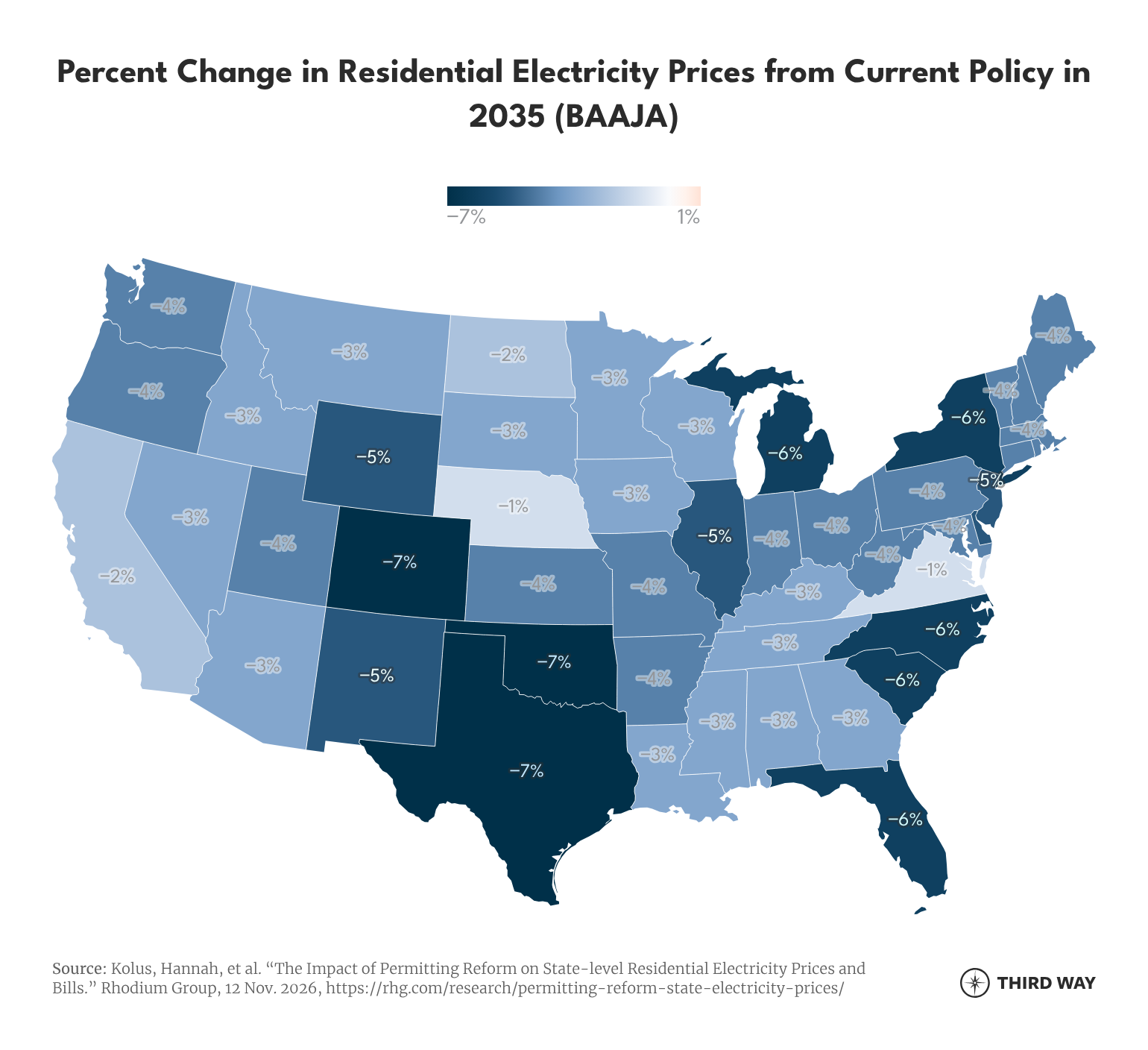
Those savings depend on more than just building new power lines. Transmission reforms alone would deliver only a fraction of the benefits. Pairing them with broader permitting reforms and provisions to ensure that data centers pay their fair share of grid costs could roughly double the consumer benefits.
Americans are on board with these policies. Our recent polling finds that even after hearing arguments from both sides, including concerns about environmental protections, the majority of Americans support the bill. The strongest arguments on BAAJA focused on lower bills, good-paying jobs, critical infrastructure, and making data centers pay their fair share. That support reflects a broader frustration with an energy system that’s struggling to keep up with the country’s energy needs.
And as Josh Freed, Senior Vice President for Climate and Energy at Third Way, said, “ That’s what Americans voted for on November 3: ending the status quo. In this case, that is an aging grid, sluggish project approvals, growing electricity demand, and skyrocketing prices.”
What We’re Doing: We are making the case across Congress that enacting BAAJA helps deliver the energy cost relief, data center accountability, and government reform Americans are demanding. While there are legitimate concerns about parts of the deal, walking away from a bipartisan agreement would be much worse. Passing permitting reform would be a down payment toward lowering energy costs, strengthening the grid, and finally making it easier to build in America, a path the 120th Congress could build on. Doing nothing now would only reinforce Americans' hard-earned anger about what’s broken in Washington.
Data centers were on the ballot in communities across the country this cycle, and they lost almost everywhere. Voters weighed in on roughly 40 local ballot measures restricting data center development, with nearly all passing. Much of the backlash came from small towns and rural communities, where residents are increasingly concerned about the impacts of new facilities on electricity bills, water supplies, and local infrastructure. In Ohio alone, voters considered 21 measures across 18 communities, overwhelmingly siding with restrictions on new development.
Why This Matters: The message from voters is becoming harder for the tech industry to ignore: communities are tired of being asked to shoulder the costs of the AI boom. Some data center developers have attempted to lessen their impact on the grid and circumvent permitting delays by building their own off-grid gas installations; that approach doesn't necessarily protect consumers and can make things worse. By competing with utilities for already scarce equipment, labor, and natural gas, these projects can drive up costs for everyone else while introducing new concerns about pollution and water use.
What We're Doing: Our new blog calls on the data center industry to rethink how it meets its growing energy needs and take greater responsibility for its impacts on the broader electricity system. We also lay out a path forward, calling on developers to pay their fair share of costs, invest in new grid infrastructure and a more diverse mix of energy resources, and be more transparent with communities about their energy needs.
Policymakers have an important role to play in making it easier to build new energy infrastructure and in protecting consumers from rising costs, but the industry also needs to step up to ensure that its growing demand for power strengthens the electricity system rather than putting additional strain on it. With the debate over data center development only set to intensify, we’ll keep making the case that meeting America’s growing energy needs and protecting the communities hosting these facilities must go hand in hand.

Simmone Shah, in TIME, lays out how BAAJA has split clean energy advocates between those who see the legislation as a fast track for renewables and those who fear the bill will boost fossil fuels while gutting environmental safeguards.
The International Energy Agency, in its flagship World Energy Outlook, examines global energy demand, supply, and climate trajectories, as well as the Iran War’s far-reaching effects on the global energy system.
Jason Bordoff, on Columbia’s Energy Exchange podcast, talks with Ethan Zindler and Lily Bermel about how surging electricity demand is driving both clean energy growth and gas expansion—and whether easing permitting, grid, and supply-chain bottlenecks can help emerging clean technologies scale.

Downloads
Also in this Series
- Next: Newsletter On the Grid: (D.R.E.A.M.) Dems Rule Everything Around Me
Latest Publications
A Message to Data Centers Going Off-Grid: Do Better
Winter Forecast: New Analysis Shows New York Should Expect Extreme Price Spikes, Over $1,000 In Electricity Costs
Winter Forecast: New Analysis Shows Maine Should Expect Extreme Price Spikes, Nearly $1,000 In Electricity Costs
Winter Forecast: New Analysis Shows Ohioans Should Expect Extreme Price Spikes, Nearly $1,000 In Electricity Costs
Never Miss an Update
Sign up for updates on the pragmatic, center-left ideas shaping the future of American policy.