On the Grid: (D.R.E.A.M.) Dems Rule Everything Around Me
Hi Friend!
Welcome back to On the Grid, Third Way’s bi-weekly newsletter, where we’ll recap how we’re working to deploy every clean energy technology as quickly and affordably as possible.
We’re excited to have you join us!
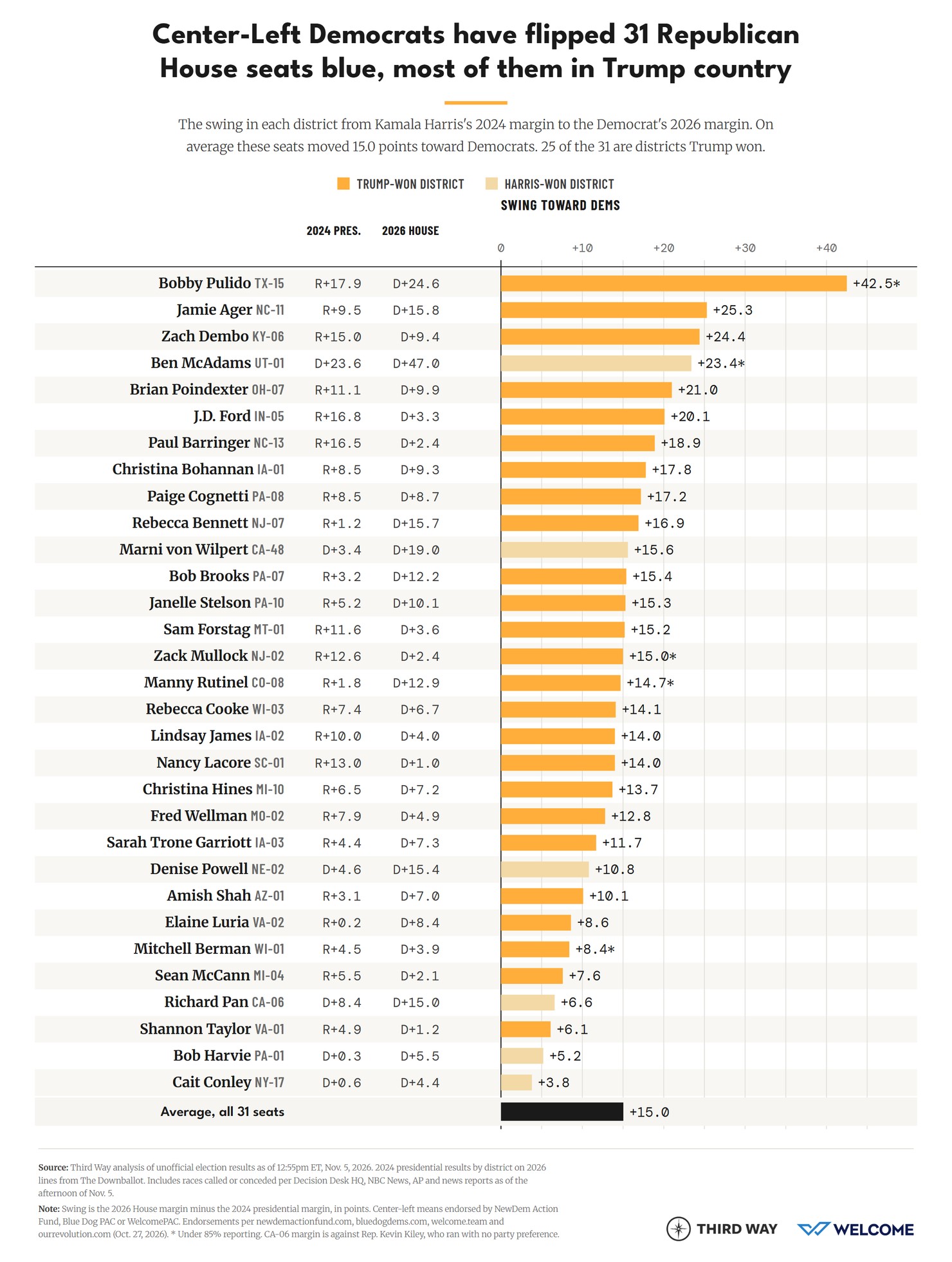
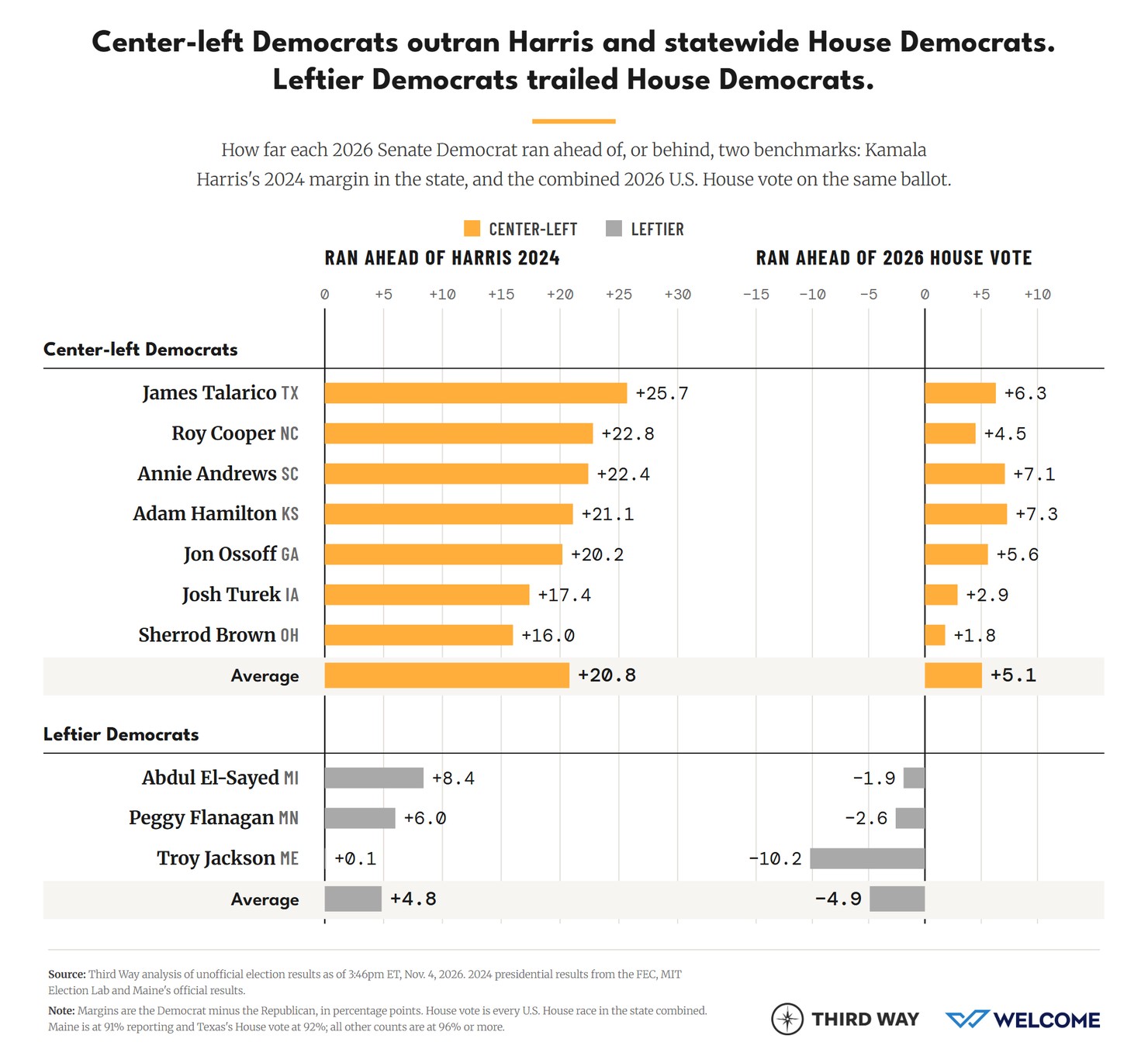
The American political map looks dramatically different today than it did last Tuesday morning. Democrats delivered a sweeping victory across the country, with Democrat candidates flipping at least seven Senate seats. Democrats have also won five new governorships, and are on track to secure at least 255 House victories, with more races still to be called. The breadth of those gains is extraordinary. Moderate Democrats have flipped (so far) 29 House districts that Donald Trump won, some that he carried by double digits in 2024. They also made major inroads in Republican Senate strongholds from Texas and Kansas to South Carolina, as well as in districts targeted by Republicans for favorable redistricting. With more races still outstanding, Democrats are on track for one of the most expansive electoral victories in fifty years.
The progressive left may have dominated the headlines this cycle, but as our Politics team explains, mainstream and moderate Democrats were the ones who built the new Democratic majority and expanded the electoral map in a historic fashion. Center-left candidates flipped 35 Republican-held House seats and outperformed 2024 presidential margins by 15 points. Meanwhile, leftier Our Revolution candidate Matt Dunlap (ME-02) has lost the only Democratic-held district untouched by redistricting, bucking the nationwide blue wave trend.
For a deeper look at the forces behind Tuesday’s results, check out our analysis with Welcome. But for those of us paying attention to energy, it’s clear that some of the most consequential victories came from pragmatic Democrats running in competitive, working-class, and energy-producing states.
Where Did Energy Fit In? Most Democratic candidates put energy affordability front and center. As Mississippi Senate candidate Scott Colom said, “I start where Mississippians start, which is the power bill.” Across the country, in competitive districts and states Democrats embraced an all-of-the-above approach that paired support for domestic energy production, particularly clean energy, with pragmatic reforms to build more projects, expand transmission, and meet growing electricity demand.
In energy-producing states, Democrats embraced an all-of-the-above approach that included oil and gas. Alaska Senate candidate Mary Peltola called for more in-state refining and the Alaska LNG pipeline, alongside restoring renewable energy tax credits. In Texas, James Talarico defended oil and gas jobs as part of an all-of-the-above strategy that also invests in wind and solar. Hamilton pledged to restore energy production tax credits and back all-of-the-above energy production, saying Kansans “should decide what happens on their land”.
Nuclear power also became a mainstream answer to rising demand. In the Northeast, New York Governor Kathy Hochul ordered the state’s first new nuclear plant in decades, and Massachusetts Governor Maura Healey pushed to lift the state's moratorium on new reactors. In the South, Andrews called for an all-of-the-above approach “including nuclear energy,” and Colom backed natural gas, the Grand Gulf nuclear plant, and more solar.
And as electricity demand from data centers continues to grow, candidates made it clear that families shouldn’t get stuck footing the bill. In Ohio, gubernatorial candidate Amy Acton backed a conditional moratorium on new data centers unless they cover their own electricity costs. In Iowa, Rob Sand argued that data centers should pay “full freight” and should stop getting tax breaks. In Kansas, Senate candidate Adam Hamilton called for binding rules requiring data centers to pay their fair share, rather than relying on voluntary pledges. He also pushed for competitive bidding on transmission projects after a $493 million line was awarded to Evergy without a bidding process. South Carolina Senate candidate Annie Andrews called for standing up to data center companies to protect rural ratepayers from rising bills. And in Mississippi, Scott Colom argued that whoever creates new demand should pay for the new generation.
Wins in Unexpected Places: Some of Tuesday’s most consequential energy results came further down the ballot, in races that don’t make national headlines but will have real implications for energy policy. In Texas, state Representative Jon Rosenthal, a former oil field engineer, defeated Republican Bo French to become Texas’s next railroad commissioner – the first time a Democrat has been elected to the commission since 1990. Despite its name, the commission oversees Texas’s oil and gas industry. In Georgia, Democrats Peter Hubbard and Sheila Edwards both defeated Republican challengers for seats on the state Public Service Commission, securing a Democratic majority for the first time in 30 years. The new majority will have major implications for how Georgia meets surging electricity demand from data centers, who pays for new infrastructure, and what Georgians will see on their electricity bills for years to come.
Why This Matters: The significance of these victories goes well beyond how Democrats talked about energy on the campaign trail. A Democratic coalition representing more energy-producing states and communities brings a wider range of priorities to the table, from oil and gas production to nuclear power, clean energy, and the infrastructure we need to meet growing demand. As Josh Freed, Senior Vice President for Climate and Energy at Third Way, told the Financial Times, “The Democratic Party has a more diverse set of views and represents a broader geography . . . and that is particularly important in energy.” At a moment when America urgently needs more power, that diversity could have real consequences for policymaking, creating more room for an all-of-the-above agenda that makes it easier to build, brings down electricity costs, and accelerates the deployment of clean technologies. But as Democrats look toward 2027, the lesson of this election shouldn’t get lost: addressing the economic pressures facing everyday Americans must remain at the center of that energy agenda. More energy, more jobs, and lower electricity bills should be the measures of success.
What We’re Watching: In 2027, a broader Democratic coalition could open new avenues for advancing an all-of-the-above energy, from expanding domestic energy production and modernizing the grid to accelerating clean energy deployment. We’ll be watching how these priorities translate into policy. But with a few weeks still left in this Congress, we’re still keeping our eye on an opportunity to get bipartisan permitting reform across the finish line. The Senate is set to hold a procedural vote on Monday, and the case for action is strong. In our latest poll, the majority of voters support the Bipartisan American Affordability and Jobs Act, even after hearing arguments against it. The question now is whether Congress can deliver before the year is out.

- Emily Pontecorvo and Jael Holzman, in Heatmap, unpack what Democrats’ midterm swipe means for bipartisan permitting reform.
- Michael Sonnenfeldt, in the New York Times, argues that falling clean-energy costs will outweigh Trump’s hostility to renewables, while faster permitting and foreign policy-driven fuel price increases will boost their appeal.
- Sarah McCammon, on the Unmoderated podcast, sits down with Third Way Senior Fellow, Yemisi Egbewole, and Third Way’s Senior Vice President for Social Policy, Education, and Politics, Lanae Erickson, to discuss Democrats’ midterm wins and what the party should focus on next.

Downloads
Latest Publications
Polling: Americans Want Permitting Reform
BAAJA Sets a New Standard for Data Center Accountability
The Energy Midterms and the All-Of-The-Above Democrats
On the Grid: The Price is Not Right
Never Miss an Update
Sign up for updates on the pragmatic, center-left ideas shaping the future of American policy.