POLL: Dem Primary Voters Want a Health Care Revolution. Just Not the One You Think.

Only in America can you pay thousands of dollars for insurance and still end up buried in medical debt. Or walk into a hospital without knowing whether the bill will be $500 or $5,000. Or spend countless hours fighting to get the care your insurance should have paid for. Democratic voters are fed up with a system that costs too much and delivers too little. They want sweeping changes that guarantee universal coverage, make care affordable and easy to use, and put patients ahead of corporate profits. But they don’t necessarily want to tear down the entire system to get there.
To better understand what voters want, Third Way partnered with Impact Research to survey 1,000 likely 2028 Democratic primary voters nationwide from October 12-18, 2026. We tested a bold new approach called a Health Care Bill of Rights. It would guarantee coverage for every American, put limits on what patients pay, and protect people from corporate abuses—all without requiring them to give up the coverage they already have.
The results were striking. Voters overwhelmingly supported a Health Care Bill of Rights, including those who initially preferred Medicare for All. Both approaches share the same fundamental goals, but voters expressed serious concerns about the costs, disruption, and government control that could accompany a transition to single payer. The political implications are clear: even among Democratic primary voters, there is enormous appeal for a bold approach that doesn’t require replacing the entire system.
Voters Want Big Changes That Fix Their Problems
Democrats want sweeping change, not a new system. Three-quarters say the system needs major improvements or a complete overhaul. But within that group, 46% favor major improvements without a complete overhaul, compared with 29% who want to scrap and rebuild it. At the same time, 83% of insured respondents are satisfied with their current coverage. The message is clear: voters want fundamental change, but they don’t want to lose what they already value. (Q14, Q16)
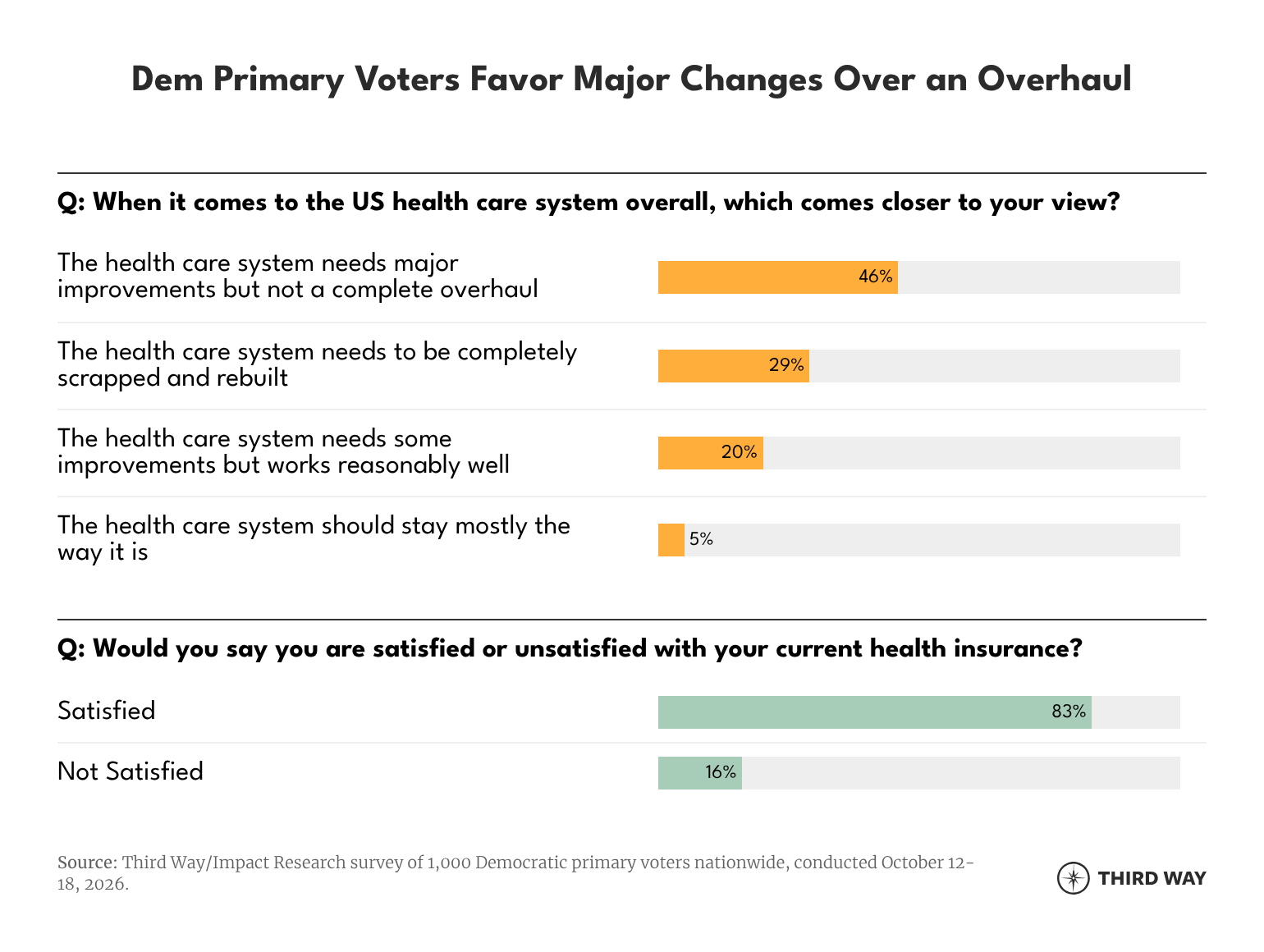
The health care crisis is about costs and insurance company abuses. Nearly two-thirds (65%) identify high health care costs as a top concern, followed by insurance companies denying or delaying care (44%). Those concerns hit close to home: 43% say health care expenses put a major or moderate strain on their finances. For these voters, the frustration isn’t just what they pay for health care, but what they get in return. (Q15, Q17)
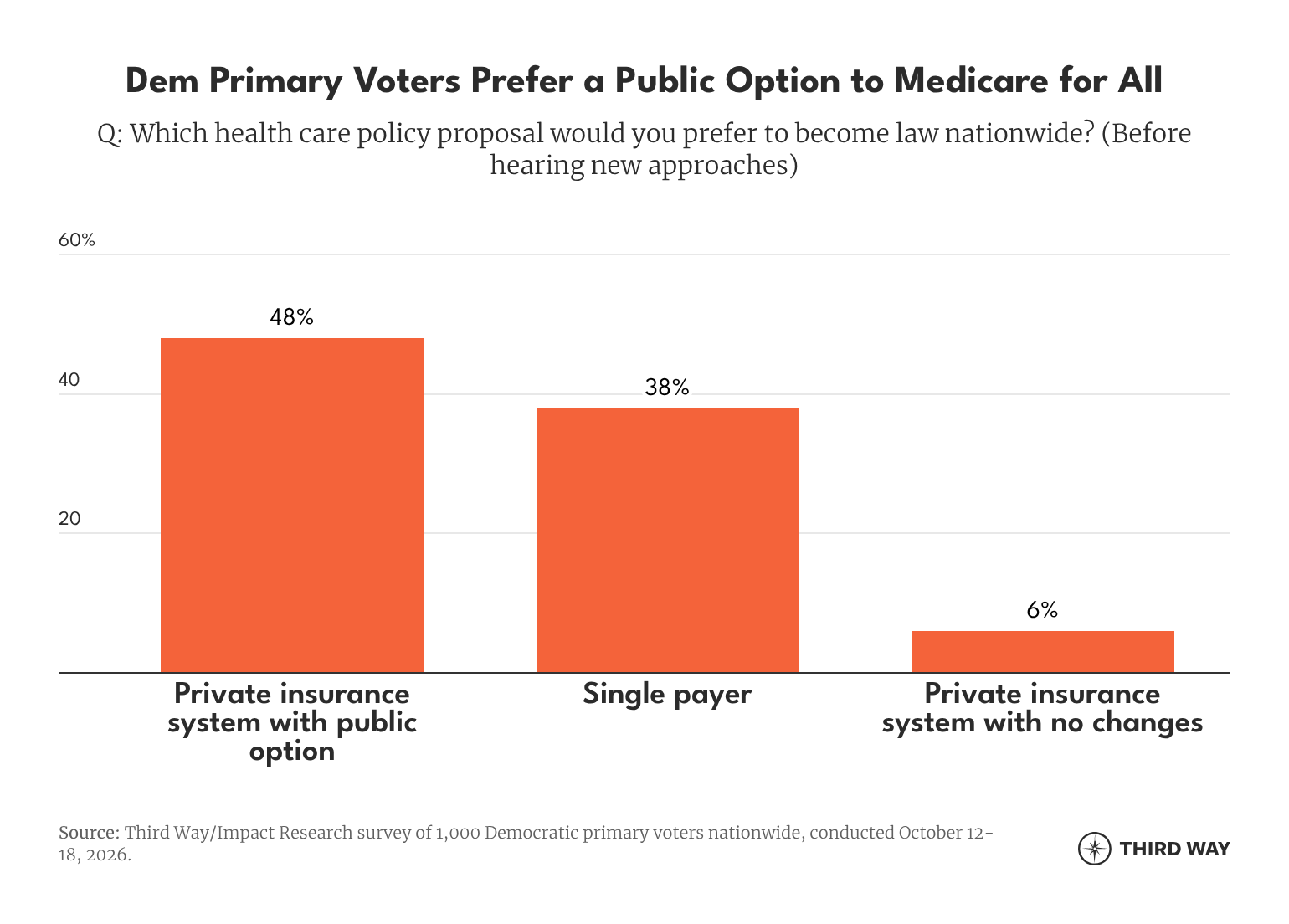
Even Democratic primary voters prefer choice over single payer. Early in the poll, before voters heard about new approaches to reform, we asked them to choose among three familiar options: Medicare for All, a public option, and maintaining the status quo. Notably, more Democratic primary voters preferred keeping private insurance while adding a public option than replacing private insurance with a single government plan (48% to 38%). Just 6% wanted to keep the existing system without changes. The finding underscores an important distinction: Democratic primary voters share the goal of universal coverage, but many prefer to build on the existing system rather than replace it. (Q19)
Voters Overwhelmingly Support a Health Care Bill of Rights
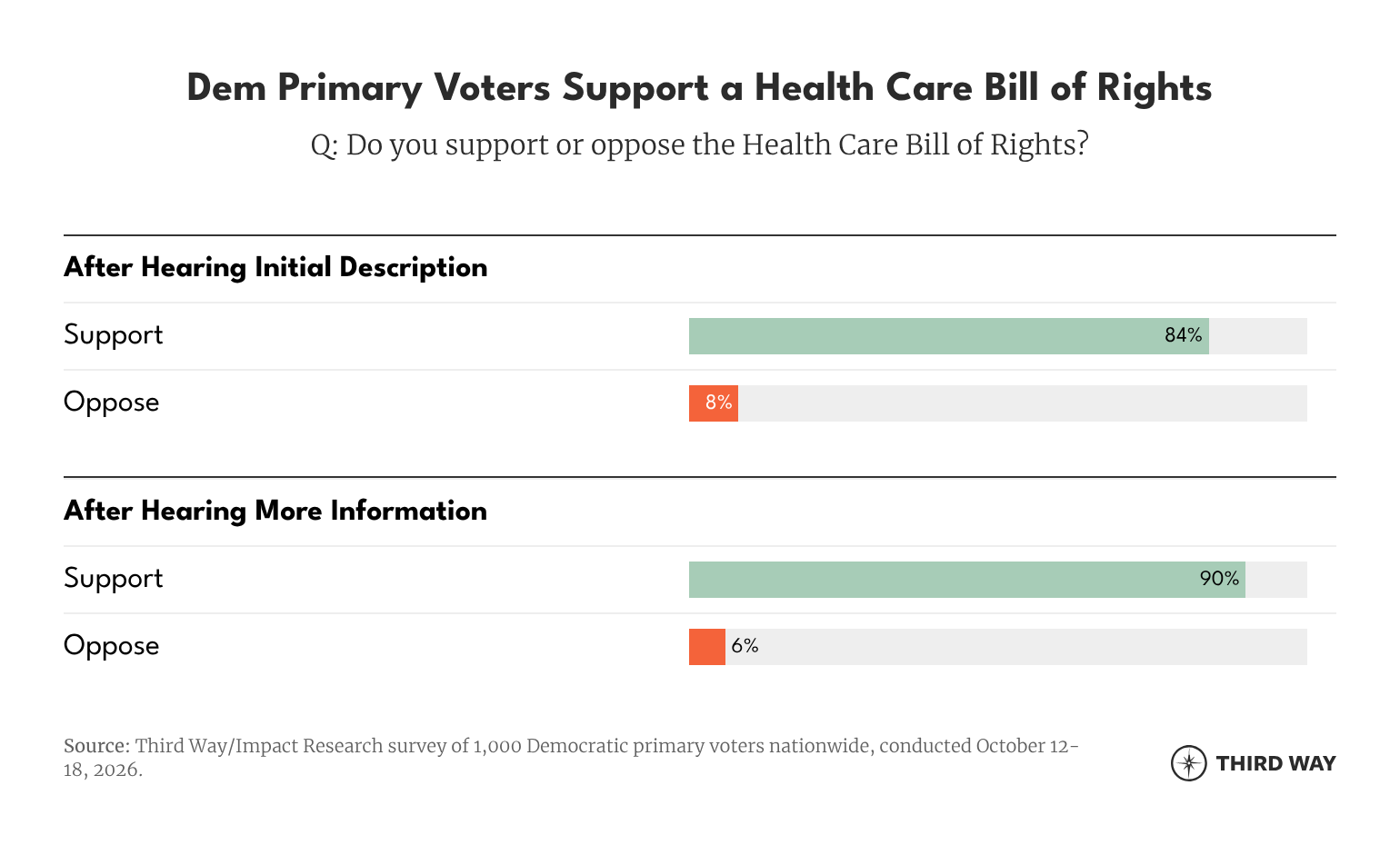
The Health Care Bill of Rights is overwhelmingly popular. We wanted to test how voters would feel about a new approach—one that would establish a set of sweeping guarantees for every American, including limits on what patients can be charged, no more surprise billing, and an end to medical debt. This Health Care Bill of Rights would guarantee that everyone has coverage and fundamentally change the rules of the existing system to make coverage more affordable and reliable.
After hearing an initial description, 84% of Democratic primary voters supported the approach. And after learning more about its guarantees, support rose to 90%, including 48% who strongly supported it (a 15-point jump). Support also crossed ideological lines, reaching 90% among very liberal voters and 87% among moderates and conservatives. Even among voters who initially preferred Medicare for All, support for the Health Care Bill of Rights reached 86% after they learned more about its guarantees. That overlap is important: support for Medicare for All doesn’t mean voters are wedded to a single-payer system. Many are open to other ways of achieving the same fundamental goals. (Q21, Q25)
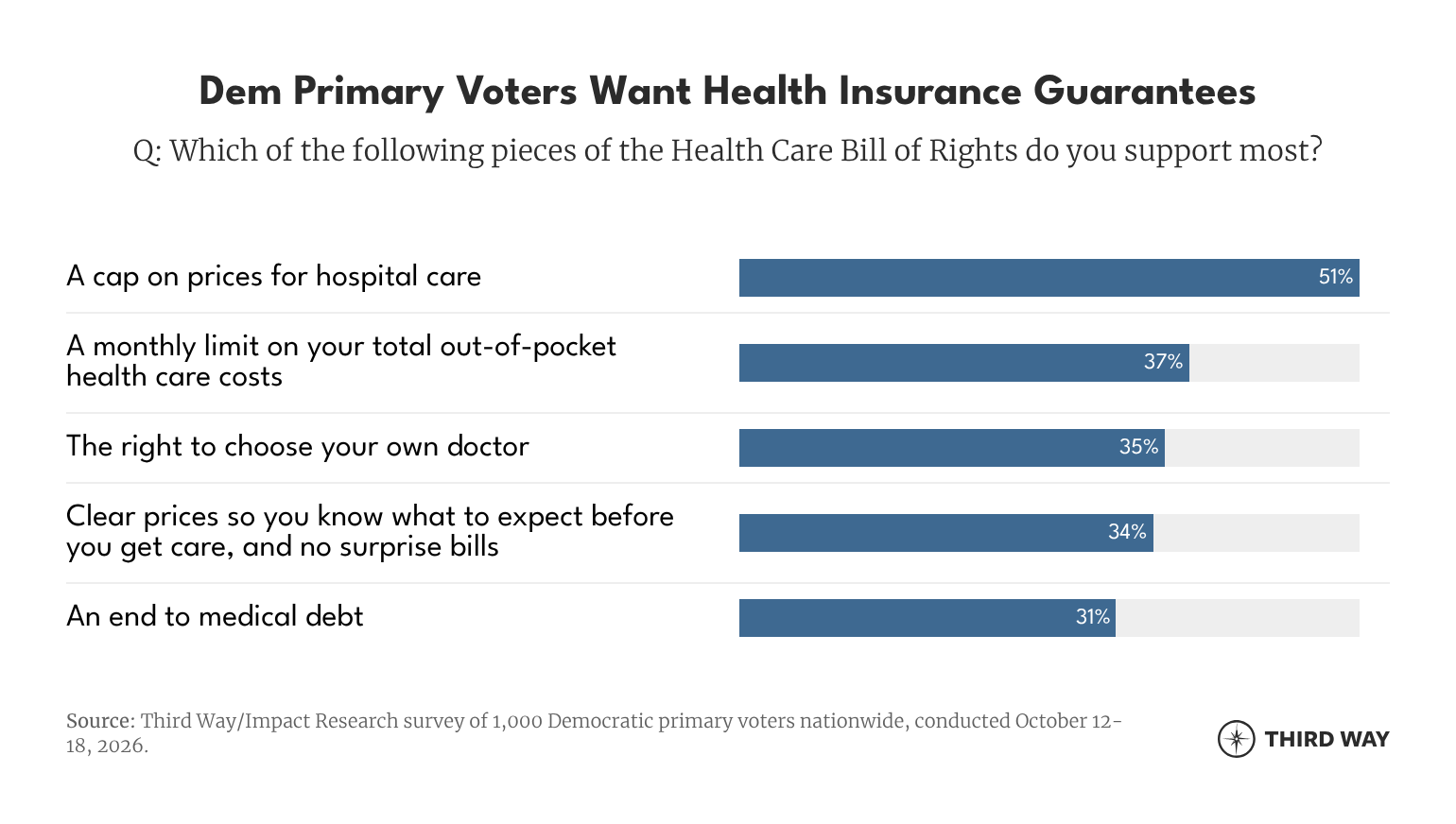
Voters want guarantees that make their coverage actually work. When asked to choose their top three priorities from the core provisions of the Health Care Bill of Rights, 51% selected caps on hospital prices, followed by monthly limits on out-of-pocket costs (37%), the right to choose their doctor (35%), and clear prices with no surprise bills (34%). And 87% found the argument that too many Americans have insurance but can’t afford to use it convincing. The findings show that voters want more than an insurance card. They want coverage that delivers affordable care when they need it. (Q20, Q24)
Voters want universal coverage as part of a Bill of Rights. We also tested several additional guarantees that could be included in a Health Care Bill of Rights. The most popular was automatically enrolling every American in health coverage so that no one is left uninsured, selected by 70% of respondents. The finding suggests that voters see universal coverage as achievable without replacing existing insurance with a single government plan. (Q22)
Voters want to keep their insurance, but they don’t want insurance companies calling the shots. Insurance companies denying or delaying care are a top concern for 44% of Democratic primary voters. And 54% selected strict limits on insurers denying doctor-recommended care as one of the guarantees they most wanted included in the Health Care Bill of Rights. The distinction is important: voters can value their existing coverage while wanting much tougher rules on how insurance companies treat patients. (Q17, Q22)
Democratic Voters Have Serious Questions About Single Payer
Even Democratic primary voters have serious concerns about Medicare for All—starting with government control over their care. Medicare for All speaks to legitimate frustrations with a system that is too expensive, too complicated, and too often fails patients. But support for its goals doesn’t mean voters are comfortable with everything that replacing the existing system would entail.
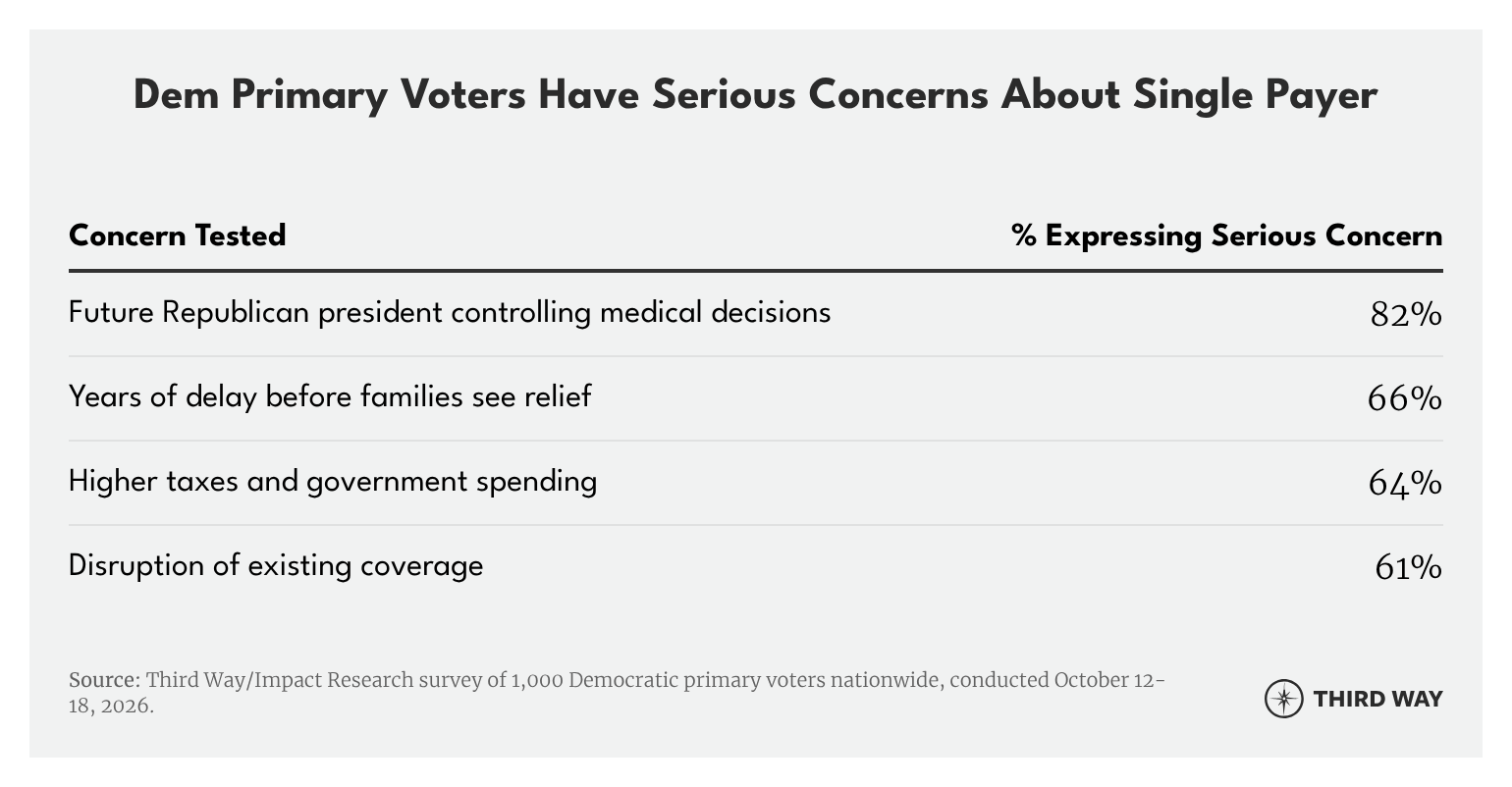
We wanted to understand whether Democratic primary voters had concerns about Medicare for All, even if they supported its goal of universal coverage. So, we tested several potential drawbacks of replacing private insurance with a single government plan. The most concerning criticism was that a future Republican president could gain control over decisions affecting reproductive care, vaccines, and other medical treatments. An overwhelming 82% of Democratic primary voters considered this a serious concern, including 52% who said it was very serious. (Q31)
Voters also worry that Medicare for All would mean higher taxes, massive disruption, and years of delay. Government control wasn’t the only concern that resonated with Democratic primary voters. Two-thirds (66%) expressed serious concerns that transitioning to Medicare for All could take years, delaying relief for families struggling with health care costs today. Nearly as many were concerned about higher taxes and government spending (64%) and the disruption of replacing existing health coverage (61%). These concerns underscore a fundamental challenge for Medicare for All: voters want major changes to health care, but they are wary of the costs, disruption, and delays that could come with replacing the entire system. (Q31)
Support for Medicare for All falls after voters hear arguments against it. After learning about the Health Care Bill of Rights, nearly 6-in-10 Democratic primary voters preferred it over Medicare for All, while roughly a third preferred Medicare for All. After hearing criticisms of Medicare for All, support for the Health Care Bill of Rights climbed to nearly 7-in-10, while support for Medicare for All dropped to less than a quarter. Notably, 59% preferred a Health Care Bill of Rights that included a public option over Medicare for All, compared with 48% who initially chose a public option on its own. (Q19, Q28–29, Q32–33)
The Political Opportunity for Democrats
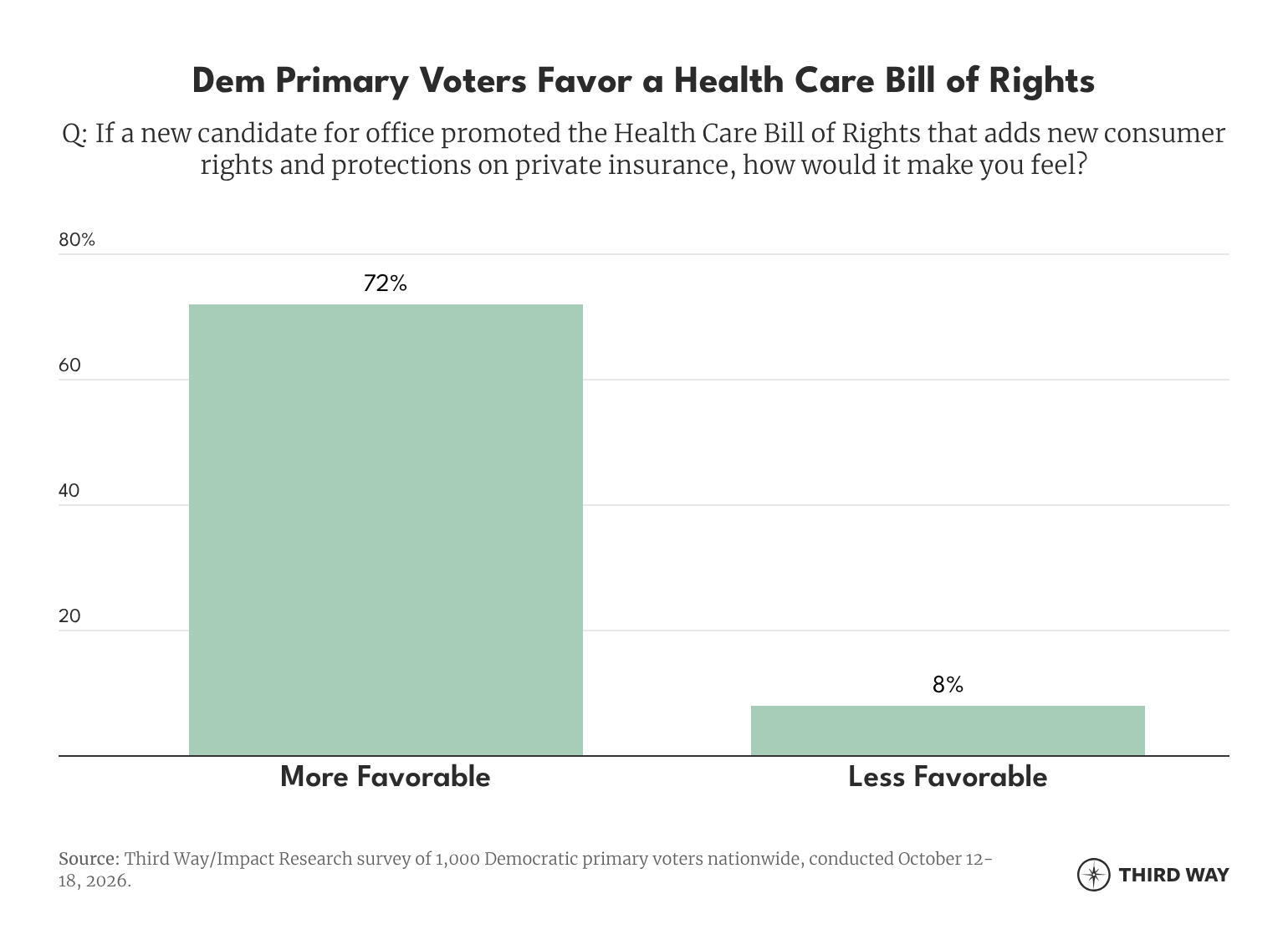
Democratic primary voters are receptive to candidates who offer an alternative to Medicare for All. Nearly three-quarters (72%) said they would feel more favorable toward a candidate who proposed a Health Care Bill of Rights. And 64% responded favorably to a candidate who explicitly criticized both the current insurance system and Medicare for All. When asked which approach they believed would be more popular with voters nationwide, roughly two-thirds chose the Health Care Bill of Rights over Medicare for All. These findings suggest that Democratic primary voters see room for an ambitious health care agenda that doesn’t require replacing private insurance. (Q34–35, Q37–38)
A Health Care Bill of Rights gives voters something tangible to believe in. It would guarantee health coverage for every American, put limits on what patients pay, protect people from surprise medical bills and insurance company denials, and preserve their ability to choose their doctors. Rather than replacing everyone’s insurance with a single government plan, it would establish stronger protections across the health care system. (Q20–22, Q24)
Bottom Line: A Health Care Bill of Rights can deliver on shared goals.
Supporters of Medicare for All and a Health Care Bill of Rights share the same fundamental goals: universal coverage, affordable care, and stronger protections for patients. The question is how to achieve those goals. Our polling shows that Democratic primary voters want sweeping change, but they don’t believe achieving those goals requires replacing the entire health care system.
A Health Care Bill of Rights offers a different path. It would establish enforceable guarantees that put patients first while preserving the coverage Americans already have. The promise is simple: keep what works, fix what doesn’t, and guarantee every American health care they can actually afford and use.


Latest Publications
The Heartland Battle Over Hospital Prices: Why Wisconsin Is Losing
Making Health Coverage Work for Everyone
By the Numbers: A Health Care Bill of Rights for Working America
Americans Blame the Government for High Health Costs and Want It to Rein in the Industry
Never Miss an Update
Sign up for updates on the pragmatic, center-left ideas shaping the future of American policy.