Memo Published October 13, 2026 · 7 minute read
The Heartland Battle Over Hospital Prices: Why Wisconsin Is Losing

Wisconsin is losing the battle against high hospital prices. It has the highest prices in the Midwest and the fourth-highest prices nationally.1 A new study shows that Wisconsin hospitals charge insurers 26% more than Illinois hospitals for the same types of inpatient care. As a result, Wisconsin families pay about $1,000 more annually than families in neighboring Illinois.2
These findings raise a critical question: Have Wisconsin’s hospitals become so powerful that insurers can no longer negotiate a fair price? Every service studied costs more in Wisconsin. Even hospitals owned by the same health system charge more in Wisconsin than in Illinois.
Other states are fighting back. Ohio has challenged anticompetitive hospital practices. Indiana capped hospital prices as a last resort. Meanwhile, Minnesota has built stronger tools to scrutinize costs and consolidation. The stakes are also rising as employer health care costs are projected to increase 10% in 2027.3
Wisconsin’s neighbors are showing that states can rein in high hospital prices—and providing Wisconsin and the nation with a path forward.
The $1,000 Wisconsin Hospital Mark-Up
A new University of Wisconsin–Madison study compares what two major commercial plans pay for the same inpatient services at similar hospitals in Wisconsin and Illinois. Wisconsin hospitals charge 26% more than their counterparts in Illinois.4 Even Advocate Health, which operates in both states, charges 23% more for the same services in Wisconsin than in Illinois.
That markup costs a Wisconsin family with employer coverage an estimated $1,058 annually. In 2025, family coverage averaged $27,537, of which about $5,193 went toward inpatient care. Paying Illinois inpatient prices would reduce that portion by about 20%. The savings could be larger if comparable outpatient data were available.
Notably, Wisconsin’s higher prices do not translate into better quality. The Leapfrog Group, which evaluates hospital safety and quality, ranks Illinois 21st and Wisconsin 30th.5 High prices and hospital consolidation have also fueled public concern. For example, the merger between Froedtert Health and ThedaCare received limited scrutiny and was followed by the closure of a maternity center.6 Meanwhile, some financially successful hospitals that provide relatively little charity care continue to fundraise aggressively. Children’s Wisconsin, for example, spent 0.4% of its budget on direct financial assistance to patients in 2024.7 That share is well below the levels reported by many peer organizations in other states.8
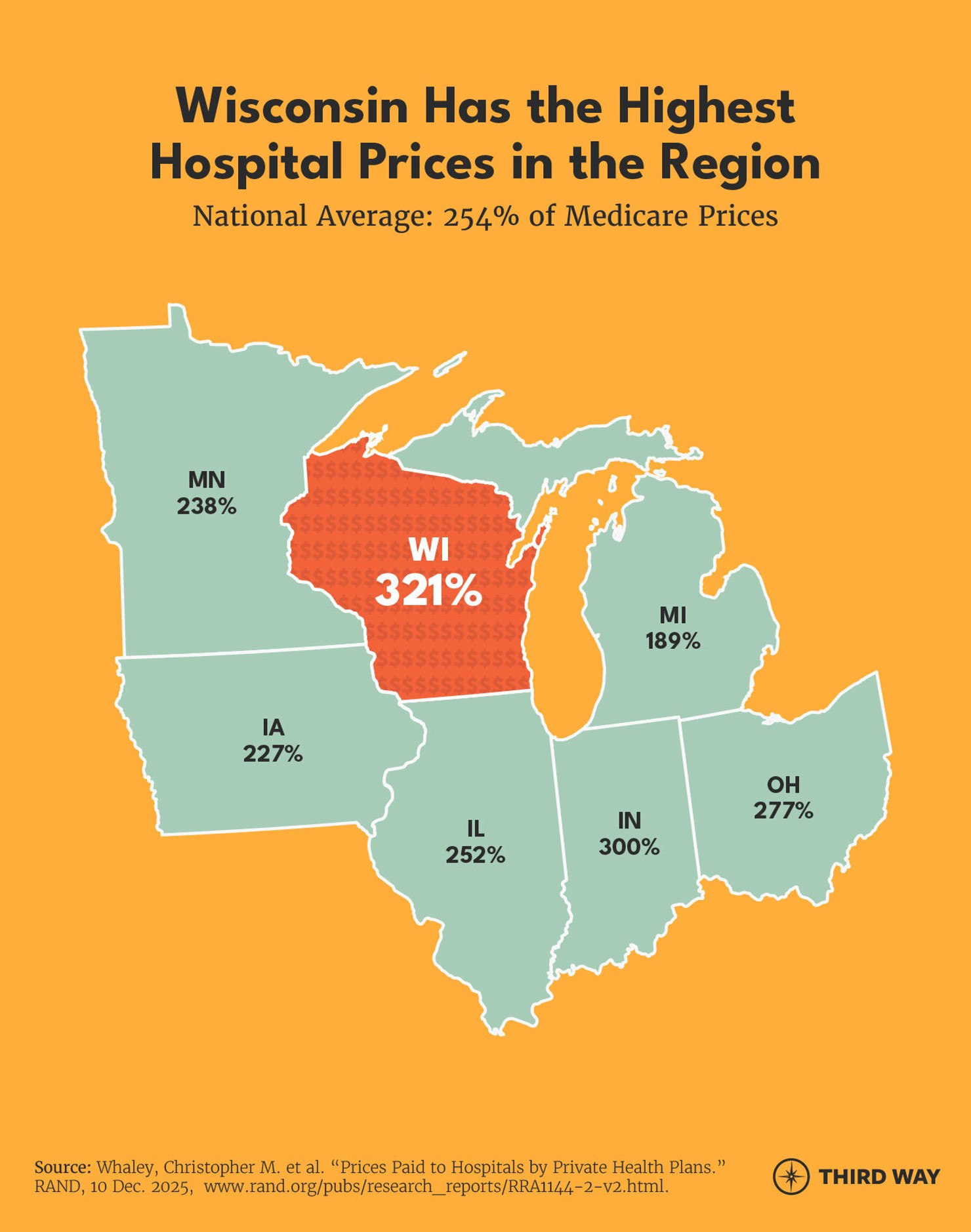
Illinois is not an outlier. Wisconsin also has the highest hospital prices among other nearby states. RAND reports that Wisconsin’s commercial hospital prices are 321% of Medicare rates, compared with 254% nationally. Wisconsin’s rate is 21 percentage points higher than Indiana’s, 83 points higher than Minnesota’s, and 132 points higher than Michigan’s.9
What’s Driving Up Prices
Weak competition among hospitals contributes to Wisconsin’s high prices. Wisconsin’s hospital market is 24% more concentrated than Illinois’s, with large systems controlling a bigger share of the market.10 Many of Wisconsin’s largest health plans are also owned by hospital systems, allowing the same organizations to control both insurance coverage and the hospitals and physicians in their networks. That gives integrated systems additional leverage when competition is weak.11
Nationally, a lack of competition increases hospital prices by 12%.12 The effects on quality are more complicated. Research finds that, in concentrated markets, high-priced hospitals do not offer patients a better chance of survival. In competitive markets, however, patients at high-priced hospitals are 37% less likely to die.13
Hospitals can also leverage their market power during contract negotiations with health insurers to drive up prices. They can demand higher prices not only from hospitals that dominate a particular area but also from other hospitals and physician practices they own elsewhere in the state. For example, a hospital system can insist on an all-or-nothing contract covering all its facilities and clinicians. As a result, areas of a state with less market concentration can still end up paying non-competitive prices.
Ohio provides an example of how anticompetitive contract practices can make matters worse. Early in 2026, the Ohio Attorney General and the U.S. Department of Justice sued OhioHealth, a system of 15 hospitals and more than 200 ambulatory care sites in central Ohio, over contract provisions that blocked insurers from encouraging patients to seek lower-cost providers.14 They alleged that OhioHealth had used its market power to impose contract terms that restricted or prevented insurers from offering innovative health plan features that saved money for employers and employees. Those tactics included an all-or-nothing demand that locked all OhioHealth providers into a health plan’s network regardless of cost or quality.
The Heartland Battle Against High Hospital Prices
Several Heartland states are directly taking on high hospital prices. Wisconsin, by contrast, has struggled even to enact stronger disclosure rules.
Ohio has strengthened hospital price-transparency enforcement. Hospitals must publish payer-specific prices and consumer-friendly information, and the state can penalize noncompliance.15 Ohio restricts facility fees at certain hospital-acquired outpatient sites and bans them for telehealth.16 The state is also using antitrust enforcement against restrictive hospital contracts. The 2026 lawsuit by the Ohio Attorney General and the U.S. Department of Justice has produced a settlement, which awaits court approval.17 The settlement would void existing contracts with anti-competitive clauses and prevent OhioHealth from pursuing them in the future.
Indiana once looked like Wisconsin, with some of the nation’s highest hospital prices. Employers and lawmakers made hospital affordability a sustained political priority. Business leaders helped launch RAND’s price-transparency work, and Indiana then required hospitals to disclose prices using Medicare as the benchmark.18 Prices at its largest nonprofit systems fell between 2023 and 2024, but not at all hospitals.19 As a last resort, after other efforts had failed, Indiana required nonprofit hospital systems to offer employers direct contracts at no more than 260% of Medicare in 2025.20 Most recently, Indiana leveraged Medicaid payments to pressure hospitals to lower commercial prices.21 The state has also banned anticompetitive hospital contracting practices. Hospitals cannot prevent insurers from encouraging patients to use lower-cost providers or require health plans to include every provider in a hospital system.22
Minnesota has built stronger tools to identify and tackle rising health care costs. Its Center for Health Care Affordability analyzes waste, market reforms, and affordability policies.23 Minnesota also requires advance notice of major health care mergers, acquisitions, and joint ventures, allowing the attorney general to scrutinize transactions before competition erodes.24 The state requires disclosure of facility fees, upfront patient prices, and hospital 340B revenue.25 Its attorney general has also negotiated limits on hospital charges to uninsured patients.26
Illinois uses several approaches. It regulates facility fees and upfront price disclosures, oversees hospital finances, and limits charges and debt collection for uninsured patients.27 Illinois recently passed legislation, similar to Minnesota’s, requiring hospitals to disclose their 340B revenue.28
Michigan. Michigan’s low hospital prices are due to a combination of several factors. They include the bargaining power of the dominant Blue Cross Blue Shield health plan, local union and employer leadership, and tight regulation of hospital expansion.29 State antitrust actions, however, have challenged the Michigan Blues plan's market power.30
Wisconsin, by contrast, has no Medicare-based hospital price benchmark or comparable facility-fee limits. It requires hospitals to report price increases that push gross patient revenue above inflation, but bipartisan legislation to strengthen transparency failed last session.31
Potential National Savings
These state approaches could produce significant savings if adopted nationally. Estimates of nationwide savings based on these state efforts are $45 billion to $46 billion annually, with significant savings to the federal government as well.
Anti-competitive practices. The Council of Economic Advisers estimates that prohibiting anticompetitive hospital contracts could generate $45 billion in annual savings nationwide.32 This estimate is based in part on records from litigation in Ohio and other states because the terms of contracts between insurers and hospitals are otherwise confidential.
Price caps. The Urban Institute estimates that capping hospital prices at 250% of Medicare could generate $46 billion in annual nationwide savings.33 That benchmark is slightly below Indiana’s 260% cap. Federal budget savings would be $11 billion annually.
Same service, same price. For comparison, if Medicare paid the same amount for services regardless of whether they are delivered in a hospital or a doctor’s office (also known as site-neutral payments), the federal government would save $16 billion annually on average over a ten-year period.34
Conclusion
For Wisconsin—and federal policymakers in Washington—the path forward is clear: The fight against high hospital prices is winnable. Other Heartland states are already demonstrating what can be done. Without action, however, families will continue paying the price. Policymakers should act now before hospital costs climb even higher.