Blog Published August 3, 2026 · 4 minute read
Blocked Clean Energy Projects Raise Energy Costs in Massachusetts


Energy prices are surging nationwide, including in Massachusetts, where utility bills have grown by 30.43% since 2021, driven by overreliance on expensive natural gas and rapidly rising energy demand. One of the best ways to combat rising energy costs is to expand the supply of clean energy: it would help meet new demand for electricity from data centers and other energy-intensive industries, and it’s both less expensive and, often, easier to build than natural gas infrastructure.
But the Trump Administration and Republicans in Congress have made it more difficult to build the clean energy we need, using every tool at their disposal to slow or block renewable energy projects. In Massachusetts, clean energy project cancellations are estimated to have resulted in the loss of more than 17,000 jobs and over $8 billion in lost investment.
Trump Administration Blocking Energy Projects in Massachusetts
Washington has directly contributed to rising energy costs by blocking new clean energy deployment, even going so far as to pay project developers to shut down projects or pause construction shortly before completion. In the face of high energy demand, the federal government has chosen to restrict, rather than expand, new energy buildout.
The Administration has also actively pursued the cancellation of grants and funding intended for clean energy projects in blue states and has admitted as much in legal documents, essentially weaponizing access to energy infrastructure throughout Trump’s second term.
Executive orders, agency rulemakings, and administrative decisions have been used to systematically target renewable energy projects, with significant consequences for consumers. The Administration’s efforts to block Revolution Wind, a more than 700 MW offshore wind project off the coast of Rhode Island, resulted in costly project stoppages that will trickle down to New England ratepayers. Project developer Ørsted said Revolution Wind work stoppages cost the project almost $1.5 million a day. The more expensive the project, the more expensive the energy it generates for consumers. As a result, Massachusetts ratepayers will bear the cost of the Administration’s obstruction of this major clean energy project.
Congress has made matters worse. The ‘One Big Beautiful Bill Act’ (OBBBA) was signed into law in July 2025 and is forecast to cut clean energy generation in half over the next ten years. Modeling shows the bill will increase household energy bills by up to $200.
Courts have slowed some of the administration’s anti-renewable actions, but it’s challenging for developers to invest in new clean energy deployment when the policy environment is this volatile. Why invest significant resources in Massachusetts when the federal government could simply cancel your lease or revoke vital grants and loans?
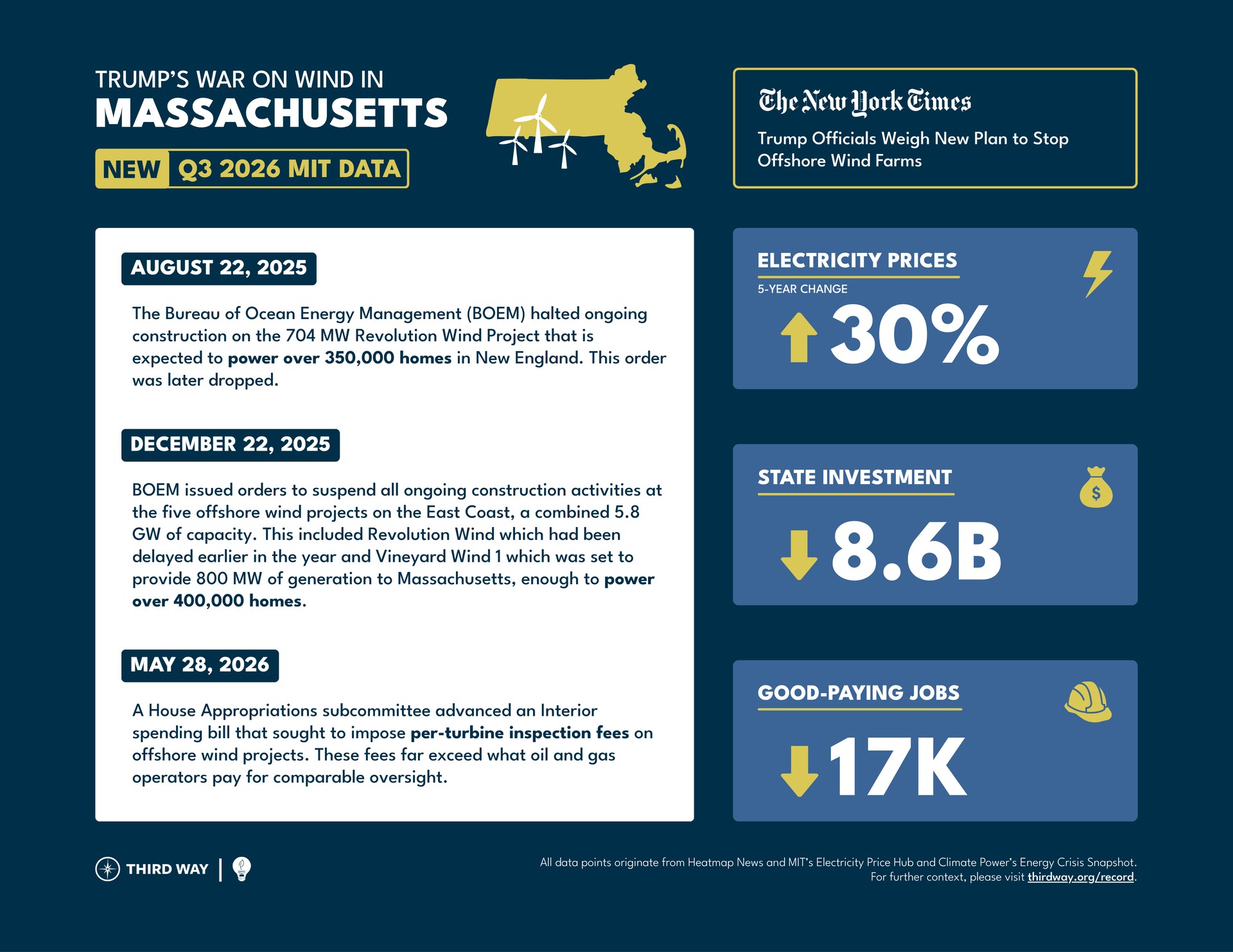
Timeline of Project Cancellations in Massachusetts
August 22nd, 2025: The Bureau of Ocean Management (BOEM) issued a stop work order on Revolution Wind to halt ongoing construction on the 704 MW project that is expected to power over 350,000 homes in New England. This order was later dropped and construction allowed to resume.
December 22nd, 2025: BOEM issued additional Stop-Work Orders on Offshore Wind Projects Under Construction, suspending all ongoing construction activities at the five offshore wind projects under construction on the East Coast, including suspending construction on Vineyard Wind 1 and implementing a second pause on Revolution Wind. In their justification, the Department of Interior cited a Department of Defense report claiming the projects caused radar interference, despite all projects having previously completed extensive national security reviews during their initial permitting process. These projects combined will provide a total of 5.8 GW of additional capacity, enough to power 2.7 million homes.
May 28th, 2026: A Republican House Appropriations subcommittee advanced an Interior spending bill that sought to impose per-turbine inspection fees on offshore wind projects. These fees far exceed what oil and gas operators pay for comparable oversight. If passed into law, these additional inspection fees would result in higher costs for offshore wind and, by extension, for consumers.
Impact of Project Cancellations in Massachusetts
The Trump administration has tried and failed to halt clean energy’s momentum. But renewables remain a smart, cost-effective, and reliable investment—wind and solar are, in fact, the fastest-growing sources of electricity in the world.
Still, the cancellation of renewable energy permits and funding for clean energy projects creates tremendous uncertainty for investors and has serious consequences for everyday Americans—raising energy costs, canceling construction and project development jobs, destabilizing local economies, and worsening greenhouse gas emissions.