Blog Published July 8, 2026 · 11 minute read
Trump’s War on Solar & Wind: One Year Since OBBBA
Takeaways
- Since our last update, offshore wind has remained the most visible target of the Trump administration. Still, these projects have won several victories in court.
- Despite federal obstacles, renewable energy continues to grow as an economical way to meet rising demand. Even supporters of President Trump have pushed back on his attacks.
- The Trump administration's market manipulation and regulatory uncertainty have already put over $14 billion in clean energy and manufacturing investment at risk during Q1 of 2026, prompted over $2.5 billion in offshore wind payouts, and added ~$18 million a day to projects facing unnecessary stop-work orders.
Introduction
When the ‘One Big Beautiful Bill Act’ (OBBBA) passed one year ago, experts forecasted it would reduce clean power generation by 53-59% and increase household energy bills by up to $192 over the next ten years.
And yet, despite skyrocketing energy demand, the Trump Administration has continued its tirade against wind and solar projects.
As laid out in Part 1 of this timeline, executive orders, agency rulemakings, and administrative decisions have been misused to systematically target renewable energy projects, delaying projects in development and under construction.
The courts have slowly caught up with President Trump’s actions, but the remaining uncertainty is a major issue for developers across the country. As electricity demand and costs continue to climb, policymakers cannot afford to stand in the way of new energy deployment.
This updated timeline shows both the administration’s actions over the last eight months, as well as wins for the industry as a whole.
December 2025
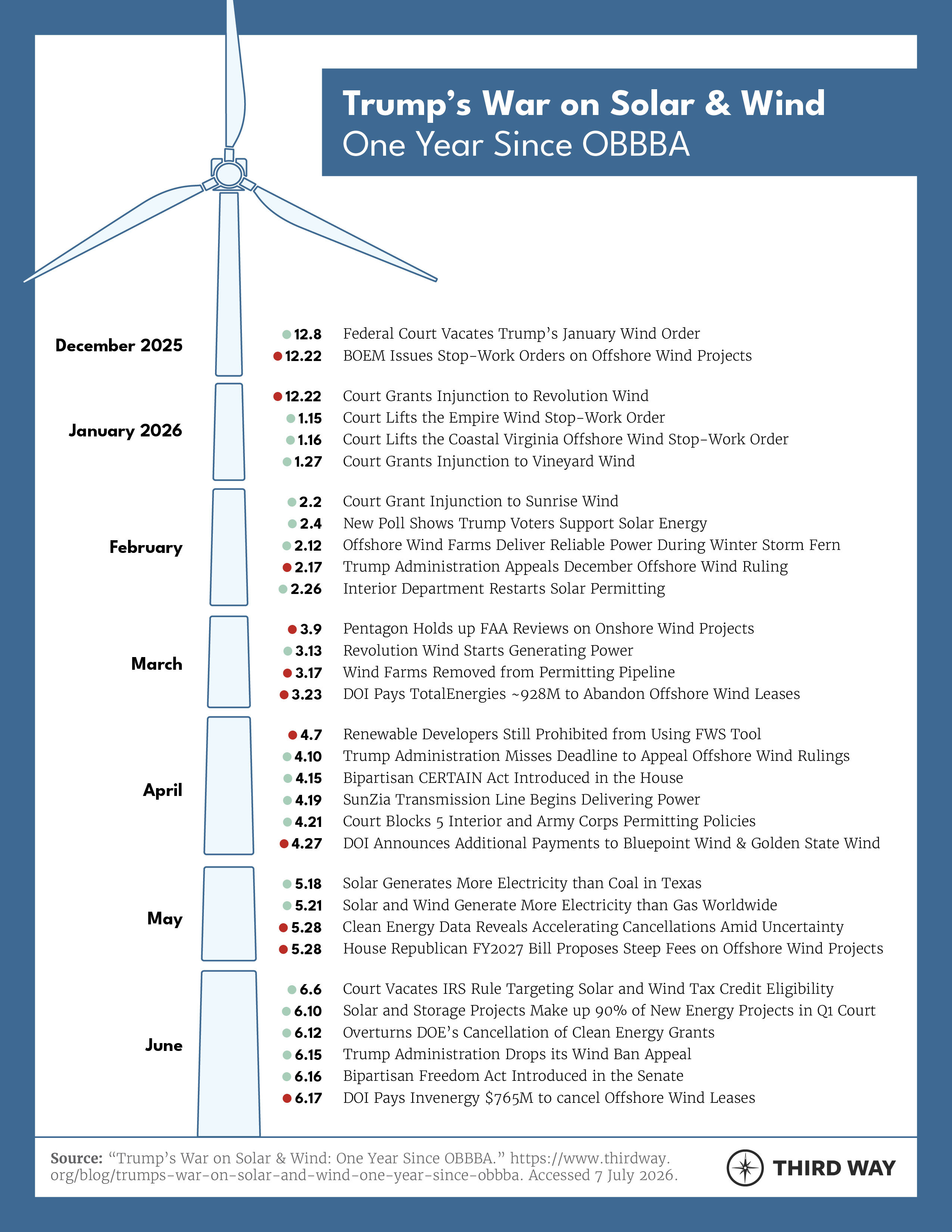
Federal Court Vacates Trump’s January Wind Order (Dec. 8, 2025): Judge Saris ruled in favor of 17 states and DC, vacating the administration’s blanket pause on wind energy authorizations. The court found that federal agencies had treated a temporary pause as permanent without providing a reasoned explanation and restored agencies’ obligations to process wind permits.
BOEM Issues Stop-Work Orders on Offshore Wind Projects Under Construction (Dec. 22, 2025): The Bureau of Ocean Energy Management (BOEM) issued orders to suspend all ongoing construction activities at the five offshore wind projects under construction on the East Coast. This included Empire Wind, Revolution Wind, Sunrise Wind, Vineyard Wind 1, and Coastal Virginia Offshore Wind (CVOW), a combined 5.8 GW of delayed capacity. In their justification, DOI cited a DOD report claiming radar interference, despite all the projects having completed extensive national security reviews during their initial permitting process.
January 2026
Court Grants Injunction to Revolution Wind (Jan. 12, 2026): Judge Lamberth granted a preliminary injunction to Revolution Wind, allowing construction to resume on the project off the coast of Rhode Island. Revolution Wind was 87% complete at the time of the shutdown, and the shutdown was estimated to cost the developer $1.44 million a day. This rebuttal came after a previous stop-work order on the project issued on August 22, 2025, which was later dropped.
Court Lifts the Empire Wind Stop-Work Order (Jan. 15, 2026): Judge Nichols lifted the stop-work order on New York’s 810MW Empire Wind project. This injunction marked the second time a stop-work order has been overturned by the courts on this specific project, the first of which cost developers a total of $200 million. At the time of the December order, Empire Wind was ~60% complete.
Court Lifts the Coastal Virginia Offshore Wind Stop-Work Order (Jan. 16, 2026): Judge Walker lifted the Stop-Work Order on Dominion Energy’s 2.6 GW Coastal Virginia Offshore Wind project. The cost of the 26-day delay totaled $228 million.
Court Grants Injunction to Vineyard Wind (Jan. 27, 2026): Judge Murphy lifted the stop-work order on Vineyard Wind, which was 95% complete at the time of the shutdown. The project delays cost Copenhagen Infrastructure Partners and Avangrid Renewables, the project's co-owners, an estimated $2 million per day.
February
Court Grants Injunction to Sunrise Wind (Feb. 2, 2026): Judge Lamberth lifted the final stop-work order on Sunrise Wind, a 924 MW project off the coast of New York and Rhode Island. The project was 45% complete at the time of the BOEM order. Before the delay, the Orsted project was expected to start generating power this fall and eventually produce enough electricity for 600,000 homes once fully operational.
For those keeping score, offshore wind goes 5/5 against the Trump administration. All projects targeted by the December 22nd shutdown have been allowed to continue construction.
New Poll Shows the Trump Voters Support Solar Energy (Feb. 4, 2026): A survey commissioned by First Solar and conducted by President Trump’s own campaign pollster Fabrizio, Lee, & Associates found that 51% of GOP voters favor utility-scale solar. That number surged to 70% for projects with American-made panels. 68% agreed that the US “needs all forms of electricity generation, including utility solar, to lower electricity costs", which runs directly counter to the administration’s actions to restrict new renewable projects.
Offshore Wind Farms Deliver Reliable Power During Winter Storm Fern (Feb. 12, 2026): Data from January showed that South Fork Wind and Vineyard Wind, the two operational offshore wind farms, performed as well as gas-fired plants and better than coal during Winter Storm Fern.
Trump Administration Appeals December Offshore Wind Ruling (Feb. 17, 2026): In a response to the December 8th ruling vacating the administration’s blanket pause on wind projects, the DOJ filed a notice of appeal. Interior Secretary Burgum separately stated the administration’s intentions to fight all five individual injunctions as well.
Interior Department Restarts Solar Permitting (Feb. 26, 2026): The Interior Department began to review at least 20 commercial-scale solar projects after extensive permitting delays following President Trump’s inauguration. This includes the 6.2 GW Esmeralda 7 Solar Project in Nevada.
March
Pentagon Holds up FAA Reviews on Onshore Wind Projects (Mar. 9, 2026): In a letter to the Department of Defense, American Clean Power Association (ACP) disclosed that the de facto moratorium on land-based wind development had negatively impacted 250 projects in over 30 states, threatening nearly 30GW of energy that could be used to power millions of homes.
Revolution Wind Starts Generating Power (March 13, 2026): The 704 MW project, which had been shut down two different times by the administration in the past year, began delivering electricity to New England, enough to power 350,000 homes and businesses.
Wind Farms Removed from Permitting Pipeline (March 17th): A review of BLM’s active project list revealed that most of the wind farms under consideration during the Biden administration had been quietly removed from the permitting pipeline. Only one project, Two River Wind in Wyoming, remains active.
DOI Pays TotalEnergies ~$928M to Abandon Offshore Wind Leases (Mar. 23, 2026): DOI announced a settlement with TotalEnergies, a French energy company, to refund $928 million in lease fees. In exchange, TotalEnergies committed to relinquishing its New York Bight and Carolina Long Bay offshore wind leases and reinvesting the refunded money into oil, natural gas, and LNG production. Senate EPW Ranking Member Whitehouse launched an investigation on April 9th questioning the legality of this action.
April
Renewable Developers Still Prohibited from Using FWS Tool (Apr. 7, 2026): Developers were still barred from use of a government website and Fish and Wildlife Service tool called Information for Planning and Consultation (IPaC) that helps to identify endangered species in the project’s vicinity.
Trump Administration Misses Deadline to Appeal Offshore Wind Rulings (Apr. 10, 2026): In an act of concession, and contrary to previous pledges from Secretary Burgum, the Trump administration allowed the deadline to pass without seeking a stay of the five offshore wind construction injunctions: Revolution Wind, Empire Wind, Coastal Virginia Offshore Wind, Vineyard Wind, and Sunrise Wind.
Bipartisan CERTAIN Act Introduced in the House (April 15, 2026): A bipartisan group of eight House members led by Rep. Peters (D-CA) and Rep. Evans (R-CO) introduced the ‘Create Expedited Reviews to Transform American Infrastructure Now’ (CERTAIN) Act. The bill is designed to quell the political oscillation that has stalled energy infrastructure across administrations. It sets firm and enforceable timelines for permitting decisions and protects permits from being arbitrarily revoked.
SunZia Transmission Line Begins Delivering Power (Apr. 19, 2026): After 20 years of permitting delays and litigation, the 550-mile SunZia Transmission line began delivering power to customers. The project’s 916 turbines generate 3.5 GW of wind power and serve nearly 3 million consumers in Arizona and California.
Court Blocks 5 Interior and Army Corps Permitting Policies (Apr. 21, 2026): Judge Dasper issued a preliminary injunction in Renew Northeast v. DOI. Expert testimony cited in the ruling estimated that the five policies from 2025 put approximately 57.2 GW of projects and $905 million in investment at risk of cancellation or significant delay:
- The Interior Secretary review bottleneck (July 15, 2o25)
- IPaC database ban as a result of the DOI Memo (July 15, 2025)
- Capacity density permitting order (August 1, 2025)
- Army Corps energy density guidance (September 22, 2025)
- Zerzan M-Opinion on Outer Continental Shelf permitting (May 1, 2025)
DOI Announces Additional Payments to Bluepoint Wind & Golden State Wind (Apr. 27, 2026): DOI announced it would pay an estimated $900 million combined to terminate two offshore wind leases, Bluepoint Wind off the coast of New Jersey and Golden State Wind off the coast of California. Modeled after the first deal with TotalEnergies, the payments were dependent on the developers’ commitment to redirect investment away from offshore wind.
May
Solar Generates More Electricity than Coal in Texas (May 18, 2026): Projections showed that for the first time, utility-scale solar (78 billion kWh) will generate more electricity than coal (60 billion kWh) in Texas.
Solar and Wind Generate More Electricity than Gas Worldwide (May 21, 2026): Reporting from Ember spotlighted that for the first month ever, wind and solar generated more electricity than gas worldwide for the month of April. Wind and solar combined to total 531 TWh, a 22% share of global electricity, versus gas’s 477 TWh, a 20% share.
Clean Energy Data Reveals Accelerating Cancellations Amid Uncertainty (May 28, 2026): E2 data from Q1 of 2026 revealed that the instability in the policy environment has accelerated project cancellations and manufacturing facility closures. While new generation announcements increased due to the impending tax credit deadline on July 4th, announcements for new manufacturing facilities slowed.
- 38 solar, wind, and battery projects canceled, representing 8 GW of lost capacity, $13 billion in abandoned investment, and 33,000 jobs lost.
- 7 manufacturing facilities were closed or downsized, eliminating another 8,100 jobs and representing another $1.35 billion in lost investment.
House Republican FY2027 Bill Proposes Steep Fees on Offshore Wind Projects (May 28, 2026): A House Appropriations subcommittee advanced an Interior spending bill that sought to impose per-turbine inspection fees on offshore wind projects. These fees far exceed what oil and gas operators pay for comparable oversight.
June
Court Vacates IRS Rule Targeting Solar & Wind Tax Credit Eligibility (June 6, 2026): Judge Kollar-Kotelly vacated IRS Notice 2025-42, which had eliminated the long-standing 5% safe harbor rule used to establish eligibility for clean energy tax credits. While this ruling technically restores the safe harbor in advance of the OBBBA’s July 4, 2026 deadline, the Trump administration is likely to appeal.
Solar and Storage Projects Make up 90% of New Energy Projects in Q1 (June 10, 2026): In a recent report, SEIA announced new solar additions in Q1 of 2026 amounted to a total of 7.8GW, with an additional 9.7 gigawatt-hours of energy storage capacity despite changing tax policy and regulatory uncertainty.
Court Overturns DOE’s Cancellation of Clean Energy Grants (June 12, 2026): Judge Mehta vacated DOE’s cancellation of 11 clean energy grants across Connecticut, New York, and Colorado. The court ordered DOE to reinstate the $82.1 million in funding that was reportedly rescinded because grant recipients were located in states that voted for Democrats in 2024.
Trump Administration Drops Its Wind Ban Appeal (June 15, 2026): In another major concession, the Justice Department voluntarily withdrew the case, causing the First Circuit to dismiss the administration’s appeal. This makes the December ruling vacating President Trump’s wind permitting freeze final and legally binding.
Bipartisan Freedom Act Introduced in the Senate (June 16, 2026): Senators Cotton (R-AR) and Cortez Masto (D-NV) introduced the ‘Forbidding Regulatory Elimination of Energy Development Operations and Management’ (FREEDOM) Act. The bill seeks to prohibit any president from unilaterally pausing or canceling energy projects that have already received federal permits. The bipartisan sponsorship is indicative of concern in both parties about current executive overreach in energy permitting.
DOI Pays Invenergy $765M to cancel Offshore Wind Leases (June 17, 2026): DOI announced a third offshore wind lease buyout, pledging to pay $765 million to Invenergy to relinquish four leases off the coast of New York, California, and Maine. The leases represented up to 7.2 GW of future capacity. For those keeping score, this brings the administration’s total to more than $2.5 billion across the three wind lease buyout agreements.
Conclusion
Time and time again, the Trump administration has failed to halt clean energy’s momentum. It remains a smart, cost-effective, and reliable investment for the American consumer. It’s also essential in the face of rising costs, surging demand, and a grid in desperate need of modernization.
Though significant headwinds remain, the resilience of the wind and solar industries demonstrates their permanent role in the US energy mix. In fact, wind and solar are the fastest-growing sources of electricity in the world.
However, this administration’s actions have increased costs, delayed projects, and created investor uncertainty. Removing the current regulatory instability and unnecessary red tape for new projects is essential to building affordable energy projects moving forward.
In order for President Trump to keep his campaign promise to lower prices, he needs to get out of the way of renewable energy growth.