Strengthening the Hospital Safety Net Through Accountability

More from this series Fixing America's Broken Hospitals
Takeaways
- Public financing for uncompensated care is fragmented and poorly coordinated, with at least 10 federal, state, and local sources.
- This patchwork means some hospitals receive too little support for their patients, while others receive more support than they need.
- Republican health care cuts have made the problem worse by ending health care coverage for millions, which increases uncompensated care.
- Congress should improve accountability with a hospital-by-hospital assessment of uncompensated care needs and public resources and redirect excess support to hospitals facing shortfalls.
America’s hospital safety net has a simple problem: public support does not match patient need. Federal and state governments spend more than $100 billion a year on uncompensated care, yet Hospitals are not required to demonstrate whether the public support they receive matches the uncompensated care they provide.1 As a result, some hospitals lack the money to stay open or maintain essential services, while others use public charity-care funding to increase their profits.
Medicaid, the largest funder of uncompensated hospital care, was hit hard by recent Republican budget cuts. Those cuts did little to target wasteful spending, however, treating all hospitals alike regardless of patient needs. Nor did they fix underlying problems with how hospital funding is distributed. Instead, they increased uncompensated care by taking coverage away from millions of people. As Congress looks to reverse the cuts, it should also direct hospital payments where they are needed most.
This report identifies the failures of the current system and proposes a transparent, hospital-by-hospital approach using Medicaid and the many other sources of funding. The goal is simple: ensure public support follows patient needs rather than historical formulas and disconnected programs.
This report is part of a series called Fixing America’s Broken Hospitals, which seeks to explore and modernize a foundation of our health care system. A raft of structural issues, including lack of competition, misaligned incentives, and outdated safety net policies, have led to unsustainable practices. The result is too many instances of hospitals charging unchecked prices, using questionable billing and aggressive debt collection practices, abusing public programs, and failing to identify and serve community needs. Our work will shed light on issues facing hospitals and advance proposals so they can have a financially and socially sustainable future.
The Problem: Fragmented Funding for Uncompensated Care
Uncompensated care begins with a simple problem: millions of patients cannot afford care because they lack insurance or their coverage leaves them with unaffordable bills.2 Hospitals ultimately absorb the costs of providing that care. Medicare requires hospitals to screen and treat emergency patients regardless of their ability to pay, and hospitals also provide nonemergency care to patients who cannot afford it.
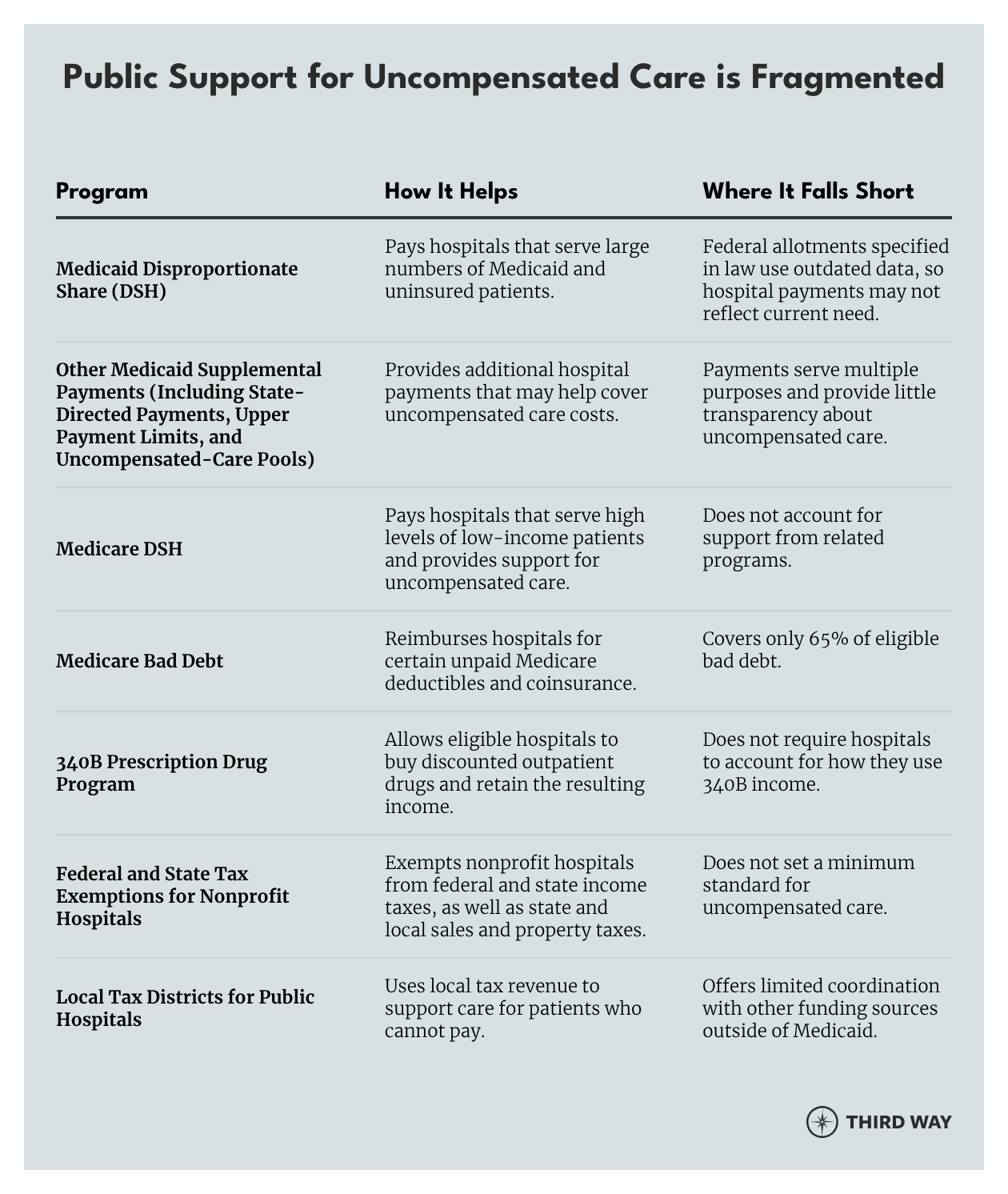
Public support for uncompensated care is anything but simple. At least 10 federal, state, and local programs help hospitals cover uncompensated care, but they are poorly coordinated. Other programs, such as the Federally Qualified Health Center program, provide access to physicians for patients who cannot afford care.
The purposes of these support programs are also complicated. They often include offsetting lower reimbursements from government programs and improving the quality and access to care generally. The result is a mismatch between resources and needs: some hospitals receive too little, while others receive more than they need. The table below shows what each program contributes and where it falls short.
Provider taxes are another major source of hospital financing. They allow states to use taxes on health care providers to draw federal Medicaid matching funds for supplemental payments without relying on other state revenue. That structure has drawn criticism, and recent Republican cuts severely restricted its use. Reforming provider taxes should be part of sorting out a better way to fund uncompensated care.3
Public Support May Exceed Uncompensated Care Costs
Public resources may exceed the uncompensated-care costs reported by nonprofit hospitals that states designate as Medicaid disproportionate share hospitals (DSH), for which the most complete data is available. In 2022, the latest year available, these hospitals reported a total of $55 billion in net uncompensated care after accounting for supplemental payments from Medicaid and Medicare. The total breaks down into $14 billion for direct patient financial assistance and $41 billion for underpayments from means-tested government programs like Medicaid.4 Yet their estimated tax exemptions were worth $24 billion, and the 340B Prescription Drug Program generated an estimated $44 billion in income—a form of public support that does not require direct government expenditure.5 The combined public support for uncompensated care exceeded reported charity-care costs by roughly $14 billion.
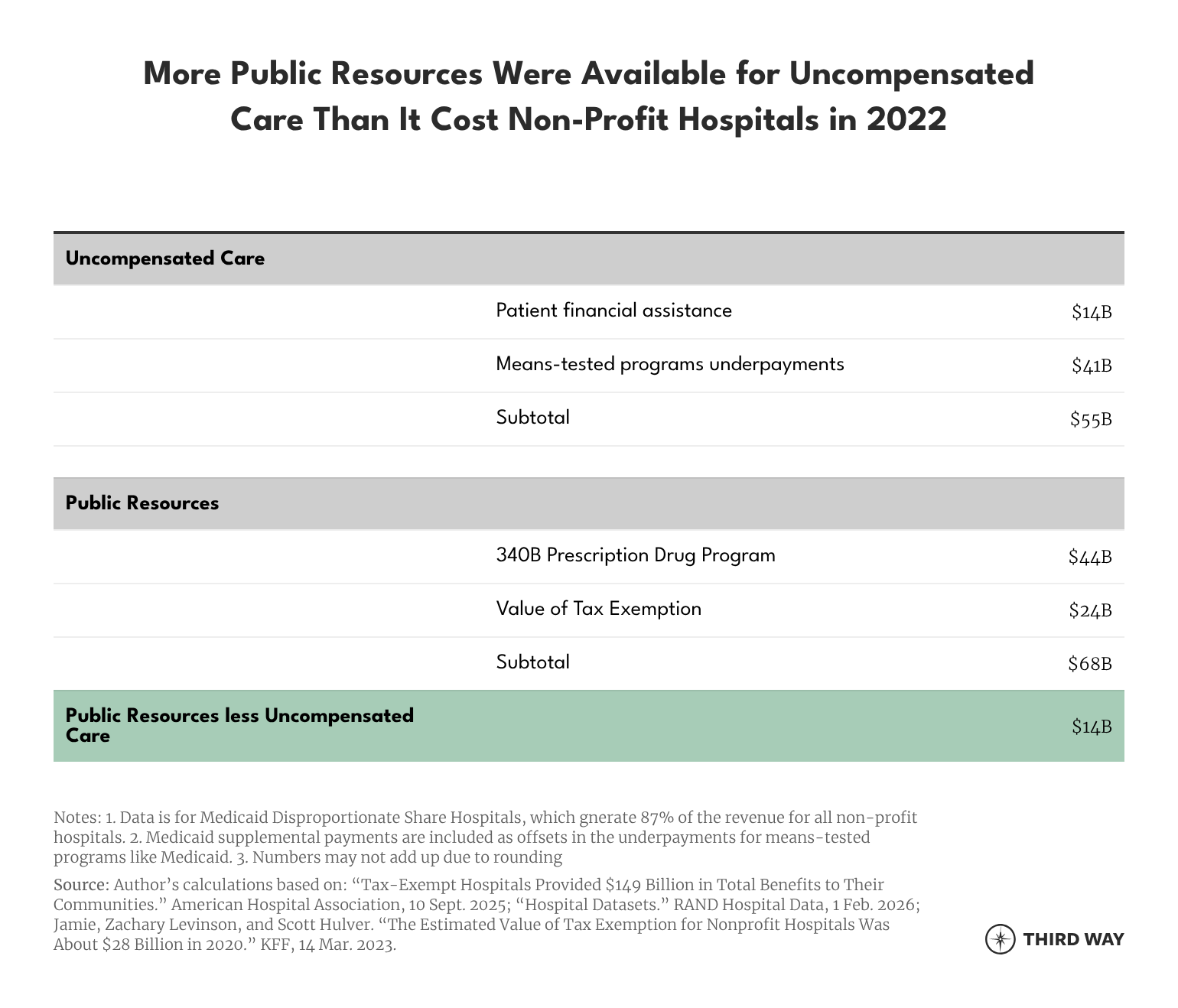
These estimates have three important limitations. First, federal law does not specify how much of a hospital’s tax exemption or 340B income must support uncompensated care. How much should count toward uncompensated care is ultimately a policy choice for lawmakers. DSH hospitals also claimed about $56 billion in 2022 for other community benefits, which include community health services, medical training, and research.6 Public resources do not cover every community benefit, and hospitals do not report these benefits using standardized, verifiable methods.7 Second, nonprofit hospitals' IRS filings do not follow sufficiently precise or consistent standards to ensure that every offset to uncompensated-care costs is captured or that hospitals consistently calculate uncompensated care based on costs rather than charges. Third, they do not include hospitals’ estimates of Medicare funding shortfalls because that issue is beyond the scope of uncompensated care financing.8
Public Resources Do Not Match Hospital Needs
A rough analysis of Minnesota hospitals shows how sharply resources and needs can diverge. In 2024, Allina Health, a 12-hospital system in Minnesota and Wisconsin, received an estimated $77 million more than its uncompensated care costs and government-program shortfalls.9 By comparison, Gillette Children's, a hospital and outpatient care network specializing in children with complex conditions, received nearly $9 million less than its uncompensated-care costs and government-program shortfalls.10
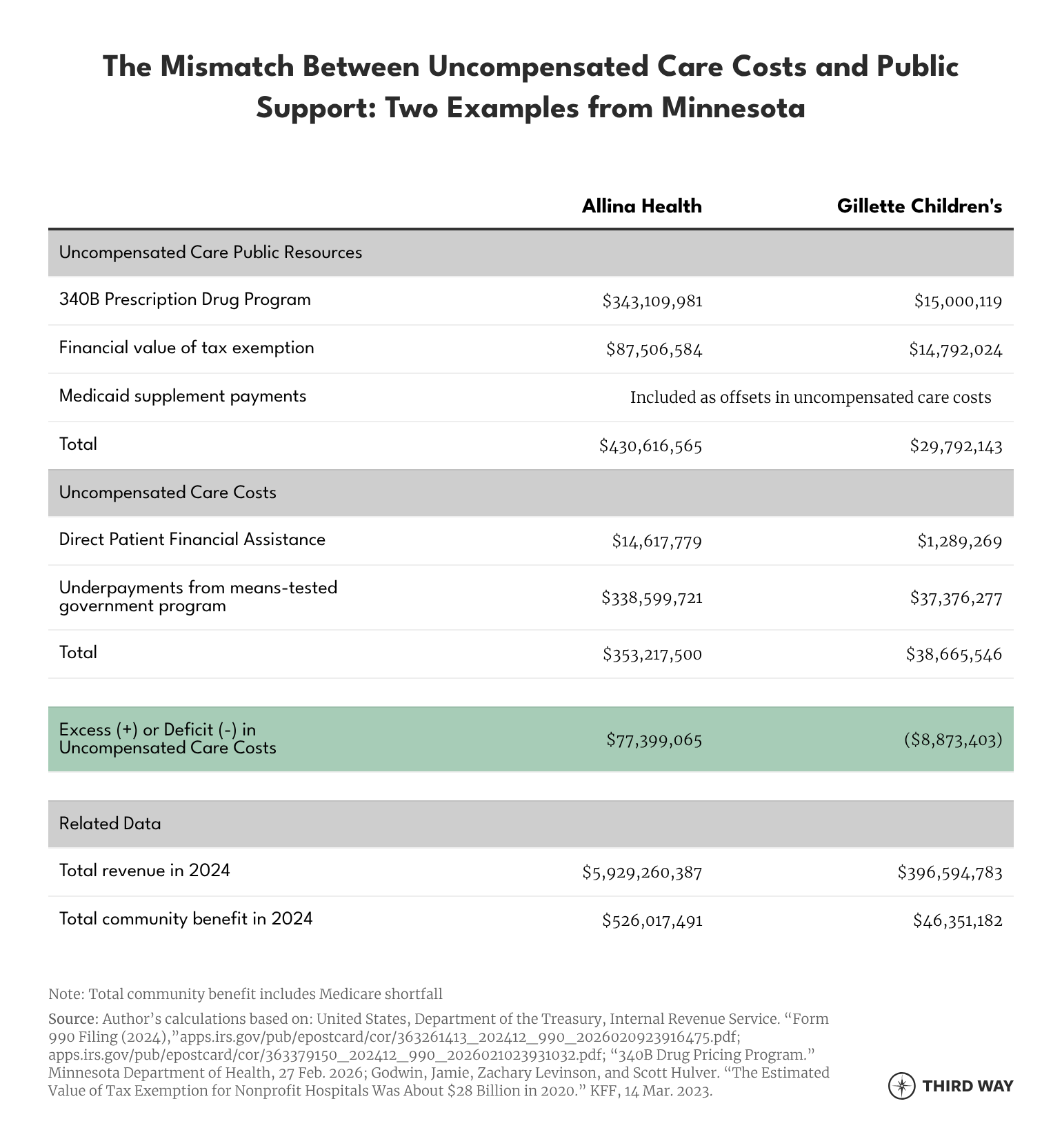
This type of comparison is currently possible only in Minnesota, the first state to require hospitals to disclose 340B revenue. Elsewhere, hospitals generally combine that revenue with broader operations. Allina’s disclosure excludes its Wisconsin 340B revenue, so its estimated surplus is likely understated. Nonprofit hospitals are also expected to report shortfalls based on costs rather than charges.11 Reporting requirements, however, have not kept pace with the size and complexity of hospital systems.12 House legislation that has advanced from committee would require more detailed reporting, including 340B revenue.13
Republican Cuts Deepen the Mismatch
Republican health care cuts reduce support for uncompensated care while increasing hospitals’ need for it. The law cuts Medicaid by $1.1 trillion over 10 years, increases the number of Americans without health coverage, and sharply restricts provider taxes and related hospital payments.14 Rather than simply capping how much states can pay hospitals, which would limit their ability to increase payments using provider-tax revenue, the law prohibits new provider taxes and lowers the limits on provider taxes and supplemental Medicaid payments in Medicaid expansion states. This penalizes states that have expanded Medicaid to working-class adults and discourages the remaining nine states with virtually no coverage for working adults from expanding coverage.15 None of these limits reflect the number or needs of patients a hospital serves.
States are now searching for replacement revenue. Several states, for example, are raising cigarette taxes to offset Medicaid cuts.16 Such measures will fill part of the gap, but they are not a comprehensive solution.
The Solution: Customized Accountability for Uncompensated Care
Congress should fix the fragmentation with a hospital-by-hospital accounting system. Each hospital's support would reflect its uncompensated care burden, the adequacy of its Medicaid payments, and all other public resources available to address that burden.
Medicaid DSH audits provide a starting point. Federal law requires states to obtain an independent audit of every hospital receiving DSH payments.17 Auditors use Medicare cost reports and other hospital records to calculate eligible uncompensated-care costs and determine whether DSH payments exceed each hospital’s limit.18 Hospitals must return excess payments.
Congress should expand this framework to include every major source of uncompensated-care support, including 340B income and the value of nonprofit tax exemptions. It should also establish a common definition of uncompensated care that includes Medicaid underpayments, medically necessary care for uninsured patients, and unaffordable cost sharing for insured patients.
Hospitals with excess support would return funds to Medicare and Medicaid in proportion to each program’s contribution. Those funds would then be redirected to hospitals with unmet needs. Unlike today's DSH allotments, payments would follow the needs of the patients each hospital serves rather than predetermined allocations.
Three standards would determine whether each hospital has enough public support without allowing it to claim more than it needs.
- Medicaid Payment Standard. Total Medicaid payments, including supplemental payments, would be considered adequate up to 114% of Medicare rates as of Fiscal Year 2024.19 Amounts above that threshold would count toward the hospital’s uncompensated-care budget. Congress could adjust the threshold if Medicare payments fall further below hospital costs as measured by the Medicare Payment Advisory Commission.
- Charity Care Standard. Nonprofit tax exemptions support community benefits beyond charity care. Because nonprofit hospitals report that roughly half of their community-benefit spending goes to charity care, at least half the value of each hospital’s tax exemption should count toward its uncompensated care. That level should be set after a thorough economic analysis of the public benefits of other community-benefit activities, which are likely less valuable than hospitals claim. The IRS should establish consistent accounting standards for other community benefits based on that economic research.20
- 340B Income Standard. A substantial share of 340B income should count toward a hospital’s uncompensated care budget. For example, if a hospital’s tax exemption already covers its other community benefits, all of its 340B income would count. Hospitals with excess support would not return 340B income, which would conflict with the program’s design; they would instead repay Medicare or Medicaid.
Patient protections should accompany the accounting system. Every Medicare-participating hospital should screen patients for financial assistance, simplify the enrollment process, and provide free or discounted care to patients based on their income.21
Finally, Congress should carefully monitor how a new accounting system and redistribution affect each program. One key question is what new incentives for federal agencies, states, hospitals, and others might arise. Another is how to ensure that redistributions between hospitals do not impede cash flow, particularly for rural and urban safety-net hospitals serving vulnerable communities.
Policy Steps
Congress should test the accounting system before requiring hospitals to return or redistribute funds. Implementation should proceed in four steps.
- Congress should direct the Medicaid Advisory Committee to develop accounting and accountability standards that can serve as the basis for legislation, HHS regulations, and federal oversight. The standards should incorporate the committee’s recommendations for reporting Medicaid supplemental payments.22
- As Congress moves to reverse the Medicaid cuts, it should give states greater flexibility to support hospitals that voluntarily adopt the new standards. Participating states, for example, could make hospital payments modestly above the standard federal limit.
- Congress should incorporate the accountability system into Medicaid DSH reforms and establish a permanent limit on supplemental payments. This would ensure that Medicaid payments do not exceed the Medicare rates at which the average hospital would break even, as determined by the Medicare Payment Advisory Commission. That threshold would have been 114% of Medicare rates in Fiscal Year 2024.23 It should also account for hospitals’ capital needs to maintain essential public services, such as trauma care, particularly at safety-net hospitals when Medicare payment rates are used as a benchmark.24
- Within two years of reversing the Medicaid cuts and enacting related reforms, every hospital should produce an audited uncompensated care budget. Mandatory repayments and redistributions would begin two years later, after HHS and hospitals have tested the system and resolved implementation challenges.
Conclusion
America does not lack resources for uncompensated hospital care; it lacks a system that directs them where they are needed most. Congress should reverse Republican Medicaid cuts and replace today’s fragmented funding system with a transparent, hospital-by-hospital accounting of uncompensated-care costs and public support. Hospitals receiving more than they need should return the excess for redistribution to those facing genuine shortfalls. Combined with strong financial-assistance standards, this approach would protect patients, strengthen essential hospitals, and ensure that public dollars go toward patient care—not hospital profits.
Endnotes
Author’s calculations based on: United States, Congress, Medicaid and CHIP Payment and Access Commission. “Medicaid Base and Supplemental Payments to Hospitals.” Apr. 2024, www.macpac.gov/wp-content/uploads/2024/05/Medicaid-Base-and-Supplemental-Payments-to-Hospitals.pdf. Accessed 3 Nov. 2026; “National Trends.” Community Benefit Insight, www.communitybenefitinsight.org/?page=national_analysis.home. Accessed 3 Nov. 2026.
For the purposes of this report, uncompensated care includes charity care that hospitals provide to patients who cannot pay their bills and undercompensated care from Medicaid payments that do not cover their costs.
Kendall, David. “Medicaid Provider Taxes: A Framework for Reform.” Third Way, 17 Feb. 2026, www.thirdway.org/report/medicaid-provider-taxes-a-framework-for-reform. Accessed 3 Nov. 2026.
Author’s calculations based on: “Tax-Exempt Hospitals Provided $149 Billion in Total Benefits to Their Communities.” American Hospital Association, 10 Sept. 2025, www.aha.org/guidesreports/2025-09-10-tax-exempt-hospitals-provided-149-billion-total-benefits-their-communities. Accessed 3 Nov. 2026; “Hospital Datasets.” RAND Hospital Data, 1 Feb. 2026, www.hospitaldatasets.org/. Accessed 3 Nov. 2026.
Author’s calculations based on: “Tax-Exempt Hospitals Provided $149 Billion in Total Benefits to Their Communities.” American Hospital Association, 10 Sept. 2025, www.aha.org/guidesreports/2025-09-10-tax-exempt-hospitals-provided-149-billion-total-benefits-their-communities. Accessed 3 Nov. 2026; “Hospital Datasets.” RAND Hospital Data, 1 Feb. 2026, www.hospitaldatasets.org/. Accessed 3 Nov. 2026; DSH Hospitals’ 340B Profit Often Exceeds Charity Care Spending, AIR 340B, Mar. 2024, 340breform.org/wp-content/uploads/2024/03/AIR340B-Charity-Care-Report-03.25.24.pdf. Accessed 3 Nov. 2026.
Author’s calculations based on: American Hospital Association. “Tax-Exempt Hospitals Provided $149 Billion in Total Benefits to Their Communities.” American Hospital Association, 10 Sept. 2025, www. aha.org/guidesreports/2025-09-10-tax-exempt-hospitals-provided-149-billion-total-benefits-their-communities. Accessed 3 Nov. 2026; Hospital Datasets. Hospital Datasets. www.hospitaldatasets.org/. Accessed 3 Nov. 2026.
United States, Congress, Government Accountability Office. “Tax Administration: IRS Oversight of Hospitals’ Tax-Exempt Status.” 26 Apr. 2023, www.gao.gov/products/gao-23-106777. Accessed 3 Nov. 2026.
Owsley, Kelsey and Tatiane Santos. “Evaluating Not-For-Profit Hospital Community Benefit Spending: Transparency, Accountability, and Fair Share Spending.” Medical Care, 8 Jan. 2025, pmc.ncbi.nlm.nih.gov/articles/PMC12173320/. Accessed 3 Nov. 2026.
Author’s calculations based on: United States, Department of the Treasury, Internal Revenue Service. “Form 990 Filing (2024),” apps.irs.gov/pub/epostcard/cor/363261413_202412_990_2026020923916475.pdf, Accessed 3 Nov. 2026. “340B Drug Pricing Program.” Minnesota Department of Health,27 Feb. 2026, www.health.state.mn.us/data/340b. Accessed 3 Nov. 2026; Godwin, Jamie, Zachary Levinson, and Scott Hulver. “The Estimated Value of Tax Exemption for Nonprofit Hospitals Was About $28 Billion in 2020.” KFF, 14 Mar. 2023, www.kff.org/health-costs/the-estimated-value-of-tax-exemption-for-nonprofit-hospitals-was-about-28-billion-in-2020/. Accessed 3 Nov. 2026.
Because IRS Form 990 filings do not separately report Medicare DSH and bad-debt payments, these estimates are incomplete. Author’s calculations based on: Internal Revenue Service. Form 990 Filing (2024), https://apps.irs.gov/pub/epostcard/cor/363379150_202412_990_2026021023931032.pdf; Minnesota Department of Health. “340B Drug Pricing Program.” Minnesota Department of Health, www.health.state.mn.us/data/340b. Accessed 3 Nov. 2026; Godwin, Jamie, Zachary Levinson, and Scott Hulver. “The Estimated Value of Tax Exemption for Nonprofit Hospitals Was About $28 Billion in 2020.” KFF, 14 Mar. 2023, www.kff.org/health-costs/the-estimated-value-of-tax-exemption-for-nonprofit-hospitals-was-about-28-billion-in-2020/. Accessed 3 Nov. 2026.
United States, Department of the Treasury, Internal Revenue Service. “Instructions for Schedule H (Form 990),” 30 Apr. 2026, www.irs.gov/instructions/i990sh. Accessed 3 Nov. 2026.
Patel, Elena, and Brian Cadman. “The Governance Costs of Hospitals without Owners: When Size Outgrows Nonprofit Regulations.” Brookings, 15 July 2026, www.brookings.edu/articles/nonprofit-hospital-tax-exemption-governance-oversight/. Accessed 3 Nov. 2026.
United States, Congress, House. “H.R. 9504.” Congress.gov, 119th Congress, 2nd Session, www.congress.gov/bill/119th-congress/house-bill/9504/text. Accessed 3 Nov. 2026.
Kendall, David. “Medicaid Provider Taxes: A Framework for Reform.” Third Way, 17 Feb. 2026, www.thirdway.org/report/medicaid-provider-taxes-a-framework-for-reform. Accessed 3 Nov. 2026.
“What Is the Medicaid Coverage Gap and Who Does It Affect?” HealthInsurance.org, www.healthinsurance.org/faqs/what-is-the-medicaid-coverage-gap-and-who-does-it-affect/. Accessed 3 Nov. 2026.
“Dissecting the Deepest Cuts: New Restrictions on Raising Revenue for State Medicaid Budgets.” Families USA, www.familiesusa.org/resources/dissecting-the-deepest-cuts-new-restrictions-on-raising-revenue-for-state-medicaid-budgets/. Accessed 3 Nov. 2026.
United States, Department of Health and Human Services, Centers for Medicare & Medicaid Services. “Medicaid Disproportionate Share Hospital (DSH) Payments,” www.medicaid.gov/medicaid/financial-management/medicaid-disproportionate-share-hospital-dsh-payments. Accessed 3 Nov. 2026.
United States, Department of Health and Human Services, Centers for Medicare & Medicaid Services. “Medicaid Disproportionate Share Hospital (DSH) Payments,” www.medicaid.gov/medicaid/financial-management/medicaid-disproportionate-share-hospital-dsh-payments. Accessed 3 Nov. 2026.
A full rate comparison would need to address Medicaid services without directly comparable Medicare codes like maternity care. Author’s calculation based on a –12.1% fee-for-service Medicare margin. United States, Congress, Medicare Payment Advisory Commission. “Report to the Congress: Medicare Payment Policy,” Mar. 2026, p. xvi, www.medpac.gov/wp-content/uploads/2026/03/Mar26_MedPAC_Report_To_Congress_SEC.pdf. Accessed 3 Nov. 2026.
Zare, Hossein and Gerard Anderson. “The Significance of Definitions in Determining the Level of Community Benefits for Nonprofit Hospitals.” The Milbank Quarterly, 26 July 2025, https://onlinelibrary.wiley.com/doi/10.1111/1468-0009.70041. Accessed 3 Nov. 2026.
Kona, Maanasa. “State Options for Making Hospital Financial Assistance Programs More Accessible.” Commonwealth Fund, 2024, www.commonwealthfund.org/blog/2024/state-options-making-hospital-financial-assistance-programs-more-accessible. Accessed 3 Nov. 2026.
United States, Congress, Medicaid and CHIP Payment and Access Commission. “Improving the Transparency of Medicaid and CHIP Financing,” June 2024, www.macpac.gov/wp-content/uploads/2024/06/MACPAC_June-2024-Chapter-1-Improving-the-Transparency-of-Medicaid-and-CHIP-Financing.pdf. Accessed 3 Nov. 2026.
Author’s calculation based on a –12.1% fee-for-service Medicare margin. United States, Congress, Medicare Payment Advisory Commission. “Report to the Congress: Medicare Payment Policy,” Mar. 2026, p. xvi, www.medpac.gov/wp-content/uploads/2026/03/Mar26_MedPAC_Report_To_Congress_SEC.pdf. Accessed 3 Nov. 2026.
“Define Essential Health Systems in Federal Law,” America’s Essential Hospitals, 16 Jan. 2026, essentialhospitals.org/define-essential-health-systems-in-federal-law/. Accessed 3 Nov. 2026.

Also in this Series
Latest Publications
Which Patients Are Eligible for a 340B Discount?
Accountability in the 340B Drug Pricing Program
POLL: Dem Primary Voters Want a Health Care Revolution. Just Not the One You Think.
The Heartland Battle Over Hospital Prices: Why Wisconsin Is Losing
Never Miss an Update
Sign up for updates on the pragmatic, center-left ideas shaping the future of American policy.