Beyond the God Gap
Introduction
Nowhere do stereotypes predominate more than in the realm of how religion informs politics. Often those unfamiliar with various religions believe that there is an irreconcilable gulf between themselves and people of faith. Americans of faith are “religulous,” according to a leading liberal. On the other side of the divide, some prominent conservatives accuse liberals of waging “a war on Christmas.” Moreover, even members of different religious groups often look askance at one another when they line up on opposite sides of an issue, both believing their faith mandates a particular stance. Too often, false assumptions, caricatures, and tired paradigms rule the day. And when they do, they hinder civil discourse and obscure common causes on important policy issues.
The goal of Beyond the God Gap: A New Roadmap for Reaching Religious Americans on Public Policy Issues is to move beyond the stereotypes and be a guide for understanding the largest denominational families in the American religious landscape: three major Protestant Christian families (white evangelical Protestants, white mainline Protestants, and African American Protestants) and Roman Catholics (both Latino and non-Latino Catholics). While these groups are not exhaustive, and we do not include here smaller religious groups, such as Latino Protestants, Jews, Muslims, Buddhists, and others, together these major groups account for approximately three-quarters of the U.S. population.1
Beyond the God Gap is intended to be a practical, quick-reference guide that not only lays out attitudes on specific cultural and domestic policy issues—such as abortion, gay and lesbian issues, aid to the poor, crime, and immigration—but also casts light on underlying theological beliefs and culture that animate those attitudes and influence approaches to politics in general. We do not pretend that bridging these divides will be easy. But there is more commonality than is often expected, and with commonality, there is opportunity. Our goal is that this roadmap will be useful to a wide range of organizations and individuals who want to understand and engage these religious groups for common work on important issues.
White Evangelical Protestants
Introduction: The World of White Evangelical Protestants
“Am I a Soldier of the Cross?”
Am I a Soldier of the Cross? -By Isaac Watts Am I a soldier of the cross, Are there no foes for me to face? Sure I must fight if I would reign; |
Hymns often capture the essence of religious groups. This is particularly true for evangelicals, whose early growth was fueled by new hymns that sought to capture a new brand of “heart religion” that emphasized a personal relationship with God and individual vigilance to live a Christian life in a sinful world. One example is Isaac Watts’ popular hymn, “Am I a Soldier of the Cross?”
Three broad themes, contained in this hymn, are critical for understanding evangelical political engagement
- An emphasis on the cross and the sacrificial death of Jesus (“the Lamb”) for the sins of each individual and the responsibility of each person to respond directly to God.
Evangelicals’ theological emphasis on individualism carries over into their approach to public engagement. Evangelicals generally believe that individuals are responsible for their own actions, and that social problems can best be solved by creating the right relationships between individuals rather than transforming social institutions.2 This viewpoint—strong individualism and a wariness of large institutions—powerfully shapes the kinds of solutions evangelicals find compelling.
- A call to live out a pure life in a broken, often hostile world.
Evangelicals see the world as a place of struggle where they are called to live out a Godly life that serves as an example to others.
- The importance of the Bible as a support and guide in these struggles.
It is difficult to overstate the importance of the Bible as a guide to religious and political life among evangelicals. Appeals to evangelicals that cannot be grounded in scripture often fall flat.
Tensions within white evangelical Protestantism: being “in the world” but “not of it.”
The biblical command to be “in the world” but “not of it” is central for evangelicals (John 17:14-15) and structures how they perceive their relationship to society. Paradoxically, evangelicals think both that they are a persecuted minority group and that they are part of mainstream society. For example, fully 77% of evangelicals consider themselves part of mainstream culture, but nearly identical numbers believe that they must fight to get their voice heard (76%) and believe the mainstream media attacks their moral and spiritual values (75%) (Greenberg and Berktold 2004).
Paradoxically, evangelicals think both that they are a persecuted minority group and that they are part of mainstream society.
Overall, this tension underwrites two styles of public engagement: a dominant defensive posture animated by a desire to protect threatened values and a secondary more open style of public engagement driven by a desire for broader social reform, which has become more prominent, especially among an emerging evangelical center and younger evangelicals.3 Understanding the interplay of these tensions is important for understanding white evangelical Protestant engagement in public life.
Religious Belief and Behavior
White evangelicals are highly religious, and believe in a personal God.
White evangelical Protestants are second only to black Protestants in their high levels of religious observance. A strong majority (65%) report attending worship services at least once a week, and a significant number (32%) report attending multiple services each week. More than 8-in-10 (83%) white evangelicals say that religion is “very important” in their life, and 6-in-10 say they pray several times a day (Pew RLS 2007). Most (61%) white evangelicals believe that the Bible is the word of God and should be interpreted literally (Pew RLS 2007).
Nearly all white evangelicals believe in God with a high degree of certainty (93% absolutely certain), and more than 8-in-10 (83%) say that God is a person with whom one can have a relationship (Pew RLS 2007).
There is an important emerging coalition of evangelical Centrists and Modernists.
In order to get a more complete picture of the religious orientation of white evangelicals, we combined several measures to create a composite religious orientation scale.4This analysis reveals that there is more diversity among white evangelicals than is often reported. For example, a coalition of Centrists and Modernists represents a solid majority (56%) of evangelicals. Overall, we found that 15% of white evangelicals are Modernists, 41% are Centrists, and 44% are Traditionalists. It is noteworthy that younger evangelicals (age 18-34) are less likely to be Traditionalists (36%) and more likely to be Centrists (45%) and Modernists (19%) (PRR FAPS 2008).5

Evangelical Traditionalists exhibit high levels of formal religious engagement and have orthodox beliefs. Evangelical Modernists, on the other hand, are much less likely to engage in traditional religious practices and to hold traditional religious beliefs, while evangelical Centrists fall somewhere in between these poles.
White evangelicals are less likely than others to affirm religious pluralism.
A strong majority (70%) of white evangelicals believe that it is necessary to believe in God to be moral and to have good values. Younger white evangelicals are much more evenly divided, although more agree than disagree (55% to 45% respectively) (PRR FAPS 2008).
Across the religious spectrum, Americans generally affirm pluralism, although white evangelicals do so at lower levels than other religious groups. Seven-in-ten Americans who identify with a particular faith believe that there is no one path to salvation but that many religions can lead to eternal life, compared to 56% of white evangelicals (Pew RLS 2007).
Voting and Political Engagement
White evangelicals have strongly supported Republican candidates in recent elections, but young adults show signs of change.
The white evangelical vote represents a significant portion of the voting population. White evangelicals make up 22% of the adult population and nearly a quarter (23%) of all voters in 2008 (Pew RLS 2007; NEP 2008).
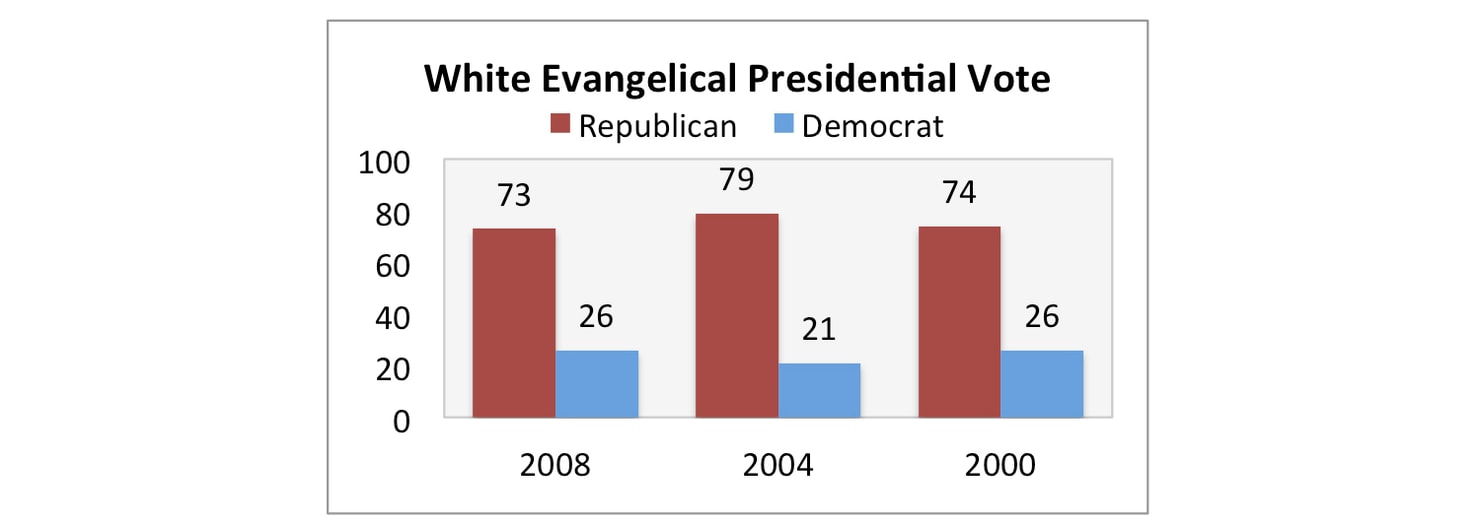
In recent elections, white evangelicals have strongly favored Republican candidates. In 2000, nearly three-quarters (74%) of white evangelicals supported George W. Bush over Al Gore (Green, 2000).6 Four years later, white evangelicals supported Bush by an even larger margin over John Kerry (79% to 21% respectively). In the 2008 election, John McCain, despite his well-publicized differences with the Christian right, still captured 73% of the white evangelical vote (NEP 2004, 2008).
Among young white evangelicals (age 18 to 29), however, there was a notable shift between 2004 and 2008. In 2004, Kerry won only 16% of the young white evangelical vote. In 2008, Obama doubled his support among this group, capturing nearly one-third of their vote (32%) (NEP 2008).
Religious observance plays a role in white evangelicals’ voting preferences.
Although strong support for Republican candidates remains, there are markedly different voting preferences between evangelicals who attend church regularly and those who do not. Among white evangelicals who attend church once a week or more, more than 8-in-10 (84%) supported McCain, compared to only 16% who supported Obama in the 2008 election. However, among white evangelicals who attend church less regularly, support for Obama more than doubled to 34%, and support for McCain dropped to 67%, a decrease of 17 points (Pew Post-election Survey 2008).7
White evangelicals are much more likely than other religious groups to identify as conservative and Republican.
More than two-thirds (67%) of white evangelicals say their political views are conservative. About one-fifth (18%) identify as moderate, and only 15% identify as liberal (ANES 2008).
As recently as 1988, evangelicals were split evenly between the two political parties. Currently, nearly twice as many white evangelicals identify with or lean towards the Republican Party as with the Democratic Party (59% to 31% respectively). Only 1-in-10 say they are politically independent (ANES 2008).
Evangelicals are prone to believe individuals rather than institutions are the best catalysts for change.
While there are no significant differences in partisanship between younger evangelicals and evangelicals overall, young evangelicals (age 18 to 29) are less likely than evangelicals as a whole to identify as politically conservative (47% to 56%) and more likely to identify as liberal (14% to 10%) (Pew RLS 2007).
Though white evangelicals believe the Republican Party is friendlier to religion than the Democratic Party, Obama is changing minds and closing the gap.
Public perceptions about the two political parties’ stances towards religion differ markedly. A strong majority (67%) of white evangelical voters believe that the Republican Party is friendly towards religion, compared to 27% who believe the Democratic Party is friendly towards religion. Only 4% of white evangelical voters say the GOP is unfriendly towards religion, while 28% say the Democratic Party is unfriendly (Pew RPS 2008).
White evangelical voters, however, see Barack Obama as significantly more friendly to religion than his party. Nearly 4-in-10 (39%) white evangelical voters say Obama is friendly towards religion—twelve points higher than white evangelical perceptions of the Democratic Party. Only 20% of white evangelical voters perceived Obama to be unfriendly to religion. More than two-thirds (69%) of white evangelical voters said McCain was friendly toward religion, on par with evangelical voters’ perceptions of the Republican Party’s friendliness to religion (PRR Post-election Survey 2008).8
White evangelicals are much more supportive of mixing religion and politics than the general public.
The general population is divided about whether churches and houses of worship should express their views on day-to-day social and political questions, or whether they should keep out of political matters (50% to 46% respectively). Among white evangelicals, however, nearly two-thirds (65%) believe that churches should be active in political matters. Nearly three-quarters (73%) of younger evangelicals (age 18-29) support churches being active in political matters (Pew RLS 2007).
Income levels among white evangelicals tend to be lower than that of the general population.
Overall, more Americans are worried about public officials becoming too close to religious leaders than about public officials not paying enough attention to religion (53% to 41%). Among white evangelicals, it’s the opposite; more than twice as many worry more about officials ignoring religion as worry about officials becoming too close to religious leaders (64% to 31%) (PRR FAPS 2008). In addition, a solid majority (55%) of white evangelicals also say there have not been enough expressions of religious faith by political leaders (Pew RPS 2008).
The Role of Government
Smaller government, but protector of morality.
As noted above, evangelicals are prone to believe individuals rather than institutions are the best catalysts for change. A majority of white evangelicals say they would prefer a small government providing fewer services to a bigger government providing more services (53% to 36%). Although white evangelicals prefer a smaller government, a majority (51%) believe government should do more to protect morality in society (Pew RLS 2007). Reflecting the evangelical emphasis on the individual, white evangelicals are more likely than the general public to believe that people can get ahead if they are willing to work hard (72% vs. 67%) (Pew RLS 2007). While a majority of white evangelicals believe the government should do more to provide aid the poor (53%), this level of support is lower than nearly all other religious groups (Pew RLS 2007).9
There is a significant generation gap in attitudes about government. Younger evangelicals age 18 to 29 are nearly 2.5 times more likely to prefer bigger government than older evangelicals age 65 or older (58% vs. 25%). A majority (56%) of young white evangelicals also believe that government should be doing more to protect morality in society (Pew RLS 2007).
Education and Income
White evangelical Protestants are less likely to have a college degree than the general population (21% to 27%). A majority (56%) of white evangelicals have a high school education or less, compared to half of all Americans (Pew RLS 2007).
Income levels among white evangelicals tend to be lower than that of the general population. For instance, 25% of white evangelicals have household incomes of $75,000 or higher, compared to 31% of the total population (Pew RLS 2007).
Outlook on Selected Issues
Abortion
The abortion issue is more important to white evangelicals than it is to any other major religious group, although it is notable that it typically ranks below other issues such as the economy and the war in Iraq (PRR FAPS 2008).

Seven-in-ten believe abortion should be illegal in all or most cases, compared to only 22% who believe abortion should be legal in all or most cases. However, a majority of evangelicals (54%) can be characterized as “abortion grays,” those who say abortion should be neither always legal nor always illegal (Pew 2009).
Nearly half (49%) of white evangelicals believe political leaders can stay true to their core beliefs on abortion while working to find common ground (PRR FAPS 2008). Among white evangelical voters, when the substance of common ground on abortion is spelled out, an overwhelming majority (86%) agree that elected leaders on both sides of the abortion debate should work together to find ways to reduce the number of abortions by enacting policies that help prevent unintended pregnancies, increase economic support for women who wish to carry their pregnancies to term, and expand adoption (PRR Post-election Survey 2008).
In May 2010, the National Association of Evangelicals passed a policy resolution expressing “interest in working together to dramatically reduce the incidence of abortion in the United States …. Any serious attempt to reduce the number of abortions must therefore come to terms with unplanned pregnancy, the pandemic of extramarital sex and the complex issues surrounding contraception.”10
Gay and Lesbian Issues
Two-thirds (67%) of white evangelicals believe homosexuality should be discouraged by society (Pew RLS 2007), and 8-in-10 believe that sex between two people of the same gender is always wrong (GSS 2008). Moreover, two-thirds of evangelical regular churchgoers report hearing about homosexuality in church, and those messages are overwhelmingly negative.

Nonetheless, white evangelicals generally support protections for individual gay and lesbian people. Nearly two-thirds (63%) of white evangelicals favor laws that would protect gay and lesbian people from job discrimination, and 67% say gay people should be allowed to serve in the military.
On the other hand, white evangelicals generally oppose policies related to family recognition. Two-thirds (66%) of white evangelicals say that gay couples should not be allowed to adopt children (ANES 2008). On the issue of legal recognition for same-sex relationships, only 10% of white evangelicals support allowing gay couples to marry and 27% support civil unions, while nearly 6-in-10 (58%) say there should be no legal recognition of a gay couple’s relationship (PRR FAPS 2008). White evangelical support for marriage doubles to 20% when given a religious liberty reassurance that “no church or congregation would be required to perform marriages for gay couples” (PRR FAPS 2008).
In contrast to views on abortion, there are significant generational differences among white evangelicals on gay and lesbian issues. A majority (52%) of young white evangelicals support either marriage or civil unions, compared to 37% among all evangelicals (PRR FAPS 2008). White evangelical young adults (age 18 to 34) are more than twice as likely as white evangelicals overall to support allowing gay and lesbian couples to marry (24% to 10%). Additionally, nearly 3-in-10 (28%) support civil unions for same-sex couples. Support for marriage jumps 11 points to 35% with a religious liberty reassurance (PRR FAPS 2008).
Immigration
White evangelicals are new allies in supporting comprehensive immigration reform. In October 2009, the National Association of Evangelicals, the umbrella group representing over 45,000 churches in over 40 different denominations, released a resolution in support of immigration reform that protects America’s borders, treats immigrants with respect, and includes an earned path to citizenship for undocumented immigrants, which includes uniting families.11
Policies that are designed to encourage individual responsibility as a piece of institutional reform will have a stronger appeal with evangelicals.
Recent polling demonstrates that white evangelicals in the pews have more concerns about the impact of immigration than other Americans, but these concerns do not translate into opposition to a comprehensive approach to immigration reform. For example, a majority (53%) of evangelicals say immigrants are a burden on the country because they take American jobs, housing, and healthcare. However, despite these concerns, by a 2-to-1 margin, white evangelicals support a comprehensive approach to immigration reform that creates a path to citizenship for undocumented immigrants over opposing arguments focused on enforcement alone (61% to 30%) (PRRI Immigration Survey 2010).
Strategic Insights
Progressives face a number of challenges, but also have some important opportunities to connect to white evangelical Protestants.
Among the challenges:
- White evangelicals are strongly suspicious of large government solutions and are often averse to sweeping structural reforms. Policies that are designed to encourage individual responsibility as a piece of institutional reform will have a stronger appeal with evangelicals.
- White evangelicals have become highly partisan over the last 30 years and strongly support Republican candidates. At the national level, they may view solutions proposed by progressives or anyone in the Democratic Party with suspicion.
There are also significant opportunities:
- Evangelicals and progressives could make significant inroads on shared policy goals by simply talking to one another. There is more common ground than one would think—more open conversations that leave old assumptions aside could produce significant results.
- White evangelicals are not a monolithic group that marches in lockstep with Christian right organizations.
- There is an important emerging coalition of evangelical Centrists and Modernists that together constitute a majority of evangelicals who are considerably more open to finding common cause on a range of important issues.
- Many white evangelical leaders and pastors are open to expanding their agenda and building new bridges through personal relationships.
- Over the past few years, evangelicals have taken up progressive causes such as foreign aid and eliminating HIV/AIDS in Africa. White evangelicals can become newfound allies on additional issues such as comprehensive immigration reform, abortion reduction, legal rights for gay and lesbian individuals, and domestic anti-poverty programs. However, the approaches on these policies must include a high degree of personal responsibility.
- Younger white evangelicals under the age of 35 are a group with growing potential for outreach on a number of critical issues. On the one hand, they are as Republican and as opposed to the legality of abortion as evangelicals overall. On the other hand, compared to older evangelicals, younger evangelicals are:
- less likely to identify as conservative;
- more supportive of government solutions to social problems; and
- more supportive of relationship recognition for gay and lesbian couples (52% supporting either marriage or civil unions).
White Mainline Protestants
Introduction: The World of White Mainline Protestants
“God of Grace and God of Glory”
God of Grace and God of Glory -By Harry E. Fosdick God of grace and God of glory, Cure Thy children’s warring madness, Set our feet on lofty places, |
White mainline Protestants are historically the bedrock of the establishment culture in America.12 Mainline Protestants have a long tradition of formal liturgy and hymns that reflect their worldview, such as the well known “God of Grace and God of Glory.”13
Three key tenets of mainline Protestant theology can be seen in these verses:
- An accent on a majestic God who works through history and institutions such as the church and government, rather than a personal God who works primarily through individuals.
- A responsibility to both God and fellow human beings to work toward realizing “the kingdom of God,” a vision of peace and justice that includes reforming society and tackling social problems such as war, greed and materialism, and the liberation of all people.
- An understanding of history, including biblical revelation, as evolving, developing and progressing.
Mainline Protestants: Declining and irrelevant or a sleeping giant?
Mainline Protestants are arguably the most ignored and least understood of the major religious groups in the American religious landscape. They are the third largest religious tradition in the United States—accounting for 40.7 million American adults and 19% of all voters in 2008 (Pew RLS 2007, NEP 2008).14 Mainline Protestants have played a prominent role in American history and civic life; the Pilgrims, the builders of most old tall steeple churches in urban centers, and many white Christian leaders in the Civil Rights movement were all mainline Protestants. Nearly two-thirds (64%) of U.S. Presidents have been affiliated with mainline Protestant denominations.15
Today, mainline Protestants are often overlooked by the media and pundits for at least two reasons. First, mainline Protestants have suffered significant losses in membership from their apex in the 1960s. Second, mainline Protestants have not been prominent in the public eye. Their reputation as the “quiet hand of God”16 is due in large part to a less combative theological and cultural posture that in turn leads to a more diffuse public presence. Rather than rallying around one or two issues, mainline Protestants engage a wide array of issues, such as the war in Iraq, the environment, and poverty issues. Moreover, mainline Protestants often engage in public advocacy work not primarily through their churches or denominational bodies, but through a wide range of organizations with which they are involved.
Mainline Protestants are arguably the most ignored and least understood of the major religious groups in the American religious landscape.
It is also important to note that mainline Protestants retain considerable influence beyond their numbers. With relatively high socioeconomic status, mainline Protestants wield not only significant financial capital, but considerable social capital.17 Each of these factors makes mainline Protestants an important political constituency.
Religious Belief and Behavior
White mainline Protestants are less likely than other religious groups to attend religious services, and are less likely to hold literal views of the Bible.
About one-quarter (26%) of white mainline Protestants report attending religious services at least once a week, but only 6% say they attend more than once a week. An additional 46% report attending once or twice a month or a few times a year. Forty-four percent of mainline Protestants report that religion is very important to their lives, and 48% say they pray at least once a day (Pew RLS 2007).
About 7-in-10 (69%) mainline Protestants are absolutely certain they believe in God, and nearly 6-in-10 (59%) believe God is a person with whom it is possible to have a relationship (Pew RLS 2007).
On the whole, mainline Protestants are not biblical literalists. Only 21% believe that the Bible is the actual word of God and should be read literally word for word (Pew RLS 2007).
A plurality of mainline Protestants are religious Modernists; few are religious Traditionalists.
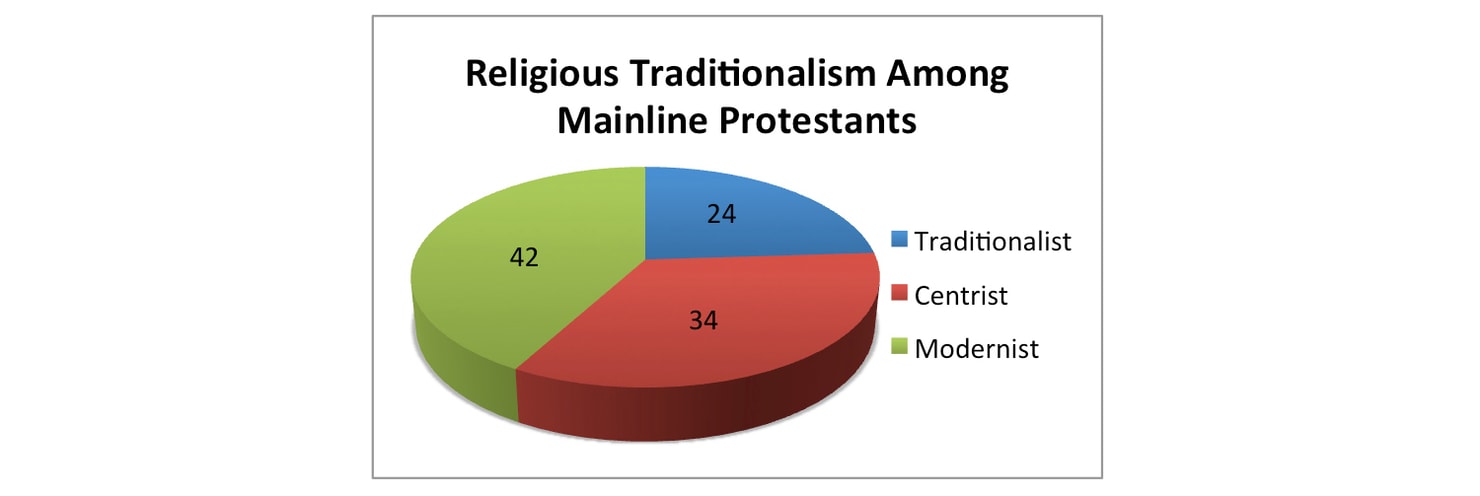
According to our composite religious orientation scale, a plurality (42%) of mainline Protestants are religious Modernists, about one-third (34%) are religious Centrists, and only about one-quarter (24%) are religious Traditionalists.18 Younger mainline Protestants (age 18-34) are equally as likely as mainline Protestants overall to be Traditionalists (25%), less likely to be Centrists (27%), and more likely to be Modernists (48%) (PRR FAPS 2008).
Mainline Protestants strongly affirm religious pluralism.
Mainline Protestants are much more open than other religious groups to the legitimacy of the views of other religious groups. While strong majorities of other religious groups agree that it is necessary to believe in God to be moral, mainline Protestants are evenly split on the question (49% agree and 49% disagree) (PRR FAPS 2008). Mainline Protestants are also more likely to believe (85%) that there is no one path to salvation, but that many religions lead to eternal life, compared to 7-in-10 religious Americans overall (Pew RLS 2007). Younger mainline Protestants hold even stronger opinions affirming religious pluralism. For example, a solid majority (61%) of mainline Protestants age 18-34 disagree that it is necessary to believe in God to be moral (PRR FAPS 2008).
While strong majorities of other religious groups agree that it is necessary to believe in God to be moral, mainline Protestants are evenly split on the question.
Voting and Political Engagement
Mainline Protestants have moved from a solid Republican base to a swing contituency in recent national elections.
Once the religious bedrock for the GOP, mainline Protestants now constitute sizeable portions of each party’s vote and have become a potential swing constituency in many states.
In 2000, George W. Bush beat Al Gore by 20 points among white mainline Protestants (60% to 40%) (Green 2000).19 In 2004, the GOP advantage was cut in half, with 55% of mainline Protestants preferring Bush and 45% preferring Kerry (NEP 2004).20 In the most recent election between Barack Obama and John McCain, the mainline Protestant vote did not move significantly. McCain maintained an 11-point advantage over Obama, despite the fact that Obama outperformed McCain among nearly every other religious group and was affiliated with a mainline Protestant denomination, the United Church of Christ. Among mainline Protestants, religious observance had only a marginal effect on the vote (Pew Post-election Survey 2008).

Mainline Protestants mirror the general population in terms of political ideology, but a majority now identify with the Democratic Party.
Like the general population, mainline Protestants are fairly evenly divided in their political ideology, with a slight conservative lean. Four-in-ten identify as conservative, 33% identify as moderate, and 27% identify as liberal (ANES 2008).
Mainline Protestants have historically had strong attachments to the Republican Party, but the last decades are showing signs of a shift. In 1960, roughly half of all mainline Protestants identified as Republican or reported that they leaned towards the Republican Party (ANES, cited in Pew Research Center Trends 2005). By 2008, however, only about 4-in-10 (42%) mainline Protestants identified as Republican, compared to nearly half (47%) who identified with the Democratic Party. About 1-in-10 (11%) identified as Independent (ANES 2008).
Mainline Protestants believe the Republican Party is more friendly to religion than the Democratic Party, but saw Obama and McCain as equally friendly to religion.
Mainline Protestant views on political parties’ friendliness to religion largely mirror the general voting public. More American voters believe that the Republican Party is friendly to religion than believe the Democratic Party is friendly to religion (59% to 38%), and mainline Protestant voters’ opinions are similar (62% to 38%) (Pew RPS 2008).21

In the last election, however, Obama strongly improved on his party’s image and largely closed the religion gap among mainline Protestant voters. Fifty-five percent of mainline Protestant voters perceived Barack Obama to be friendly to religion, compared to 61% who perceived John McCain to be friendly to religion (PRR Post-election Survey 2008).
Mainline Protestants are more concerned than other religious groups about public officials being influenced by religious leaders.
Mainline Protestants are more wary than the general population about the involvement of churches in political matters. Half of the general population believes churches should express their views on political questions, compared to 46% who say churches should keep out of political matters. A majority (52%) of mainline Protestants, however, say churches should keep out of political matters, compared to 43% who say churches should express their views (Pew RLS 2007).
However, mainline Protestants are more strongly concerned about relationships between public officials and religious leaders. Nearly two-thirds (63%) of mainline Protestants worry more about public officials becoming too close to religious leaders, compared to only one-third (31%) who worry more about public officials not paying enough attention to religion (PRR FAPS 2008).
The Role of Government
Mainline Protestants favor smaller government, and have strong concerns about government being too involved in morality issues.
The American public is essentially split between those who favor a larger government providing more services and those who favor a smaller government providing fewer services (46% to 43%). Among mainline Protestants, a majority (51%) favor smaller government (Pew RLS 2007).
Nearly 6-in-10 mainline Protestants worry about government becoming too involved in issues of morality, as compared to 52% in the general public (Pew RLS 2007).
Mainline Protestants are more wary than the general population about the involvement of churches in political matters.
There is a significant generation gap between older and younger mainline Protestants on views of government.
Unlike older mainline Protestants, a strong majority (63%) of young mainline Protestants (age 18 to 29) say they prefer a bigger government that provides more services. Interestingly, young mainline Protestants are much more divided about government’s role in moral issues. Half say they worry the government is getting too involved in the issue of morality, compared to 43% who say the government should be doing more to protect morality (Pew RLS 2007).

Education and Income
Mainline Protestants have higher levels of education than general population. Thirty-one percent of mainline Protestants have a college degree, compared to 27% of the general population. Only 10% of mainline Protestants have less than a high school education, compared to 14% of the total population (Pew RLS 2007).
Similarly, mainline Protestants have higher income levels than the general population. Thirty-six percent of mainline Protestants have household incomes of $75,000 or higher, compared to 31% of the total population. Just 24% of mainline Protestants have household incomes under $30,000, compared to 31% of the general population (Pew RLS 2007).
Outlook on Selected Issues
Abortion
Mainline Protestants are more supportive of abortion rights than all other major religious groups and the general public.
A solid majority of mainline Protestants lean strongly pro-choice, with 54% believing abortion should be legal in all or most cases, compared to only 35% who believe abortion should be illegal in all or most cases (Pew 2009).

An overwhelming majority (79%) agree that elected leaders on both sides of the abortion debate should find common ground to reduce the number of abortions by preventing unintended pregnancies and increasing economic support for women who wish to carry their pregnancies to term, and expanding adoption (PRR Post-election Survey 2008).
Gay and Lesbian Issues
Mainline Protestants are more supportive of protections for gay and lesbian people than other religious groups and the general public.
A majority (56%) of mainline Protestants believe that homosexuality should be accepted by society (Pew RLS 2007), and mainline Protestants are much less likely than other regular churchgoers to hear negative messages about homosexuality in church (PRR FAPS 2008).
Eighty-six percent of mainline Protestants support allowing gay and lesbian people to serve in the military, and 78% support laws that would protect gay and lesbian people from job discrimination. About 6-in-10 (58%) mainline Protestants believe that same-sex couples should be allowed to adopt children (ANES 2008).
Mainline Protestants are more supportive of protections for gay and lesbian people than other religious groups and the general public.
On the issue of marriage, mainline Protestants are more supportive than other religious groups and the general population, but fall well short of majority support. More than one-third (34%) of mainline Protestants support allowing gay and lesbian couples to marry, and nearly the same number (36%) support civil unions for same-sex couples (PRR FAPS 2008). When mainline Protestants are provided a religious liberty reassurance that “no church or congregation would be required to perform marriages for gay couples,” support for marriage equality increases 19 points to majority (53%) support (PRR FAPS 2008).22
Nearly half (48%) of young (age 18-34) mainline Protestants support marriage for same-sex couples, with 61% supporting marriage when offered a religious liberty reassurance (PRR FAPS 2008).

Immigration
Like the general public, mainline Protestants want practical approaches to immigration reform, but they also want solutions that reflect their values. They support a path to citizenship over alternative proposals by a roughly 2-to-1 margin (65% to 31%). Mainline Protestants also see four values as very important guides to immigration reform: enforcing the rule of law and promoting national security (87%), ensuring fairness to taxpayers (83%), protecting the dignity of every person (80%), and keeping families together (76%) (PRRI Immigration Survey 2010).
Mainline Protestants, however, are divided in their views of the contributions of immigrants to the country. A plurality (45%) report that immigrants strengthen the country because of their hard work and talents, compared to 41% who say that immigrants are a burden to the country because they take American jobs, housing, and health care (PRRI Immigration Survey 2010).
Strategic Insights
White mainline Protestants represent an important, but often ignored, religious group in American public life. But they represent 18% of the population, 19% of voters, and a constituency with outsize influence and social capital. This complex group is not without its challenges, but overall the wind is blowing in a promising direction among this group.
Mainline Protestants are a swing constituency that is largely moving in a progressive direction.
Main challenge:
- There remains a disparity between the views of mainline Protestants on many issues and their voting behavior. For example, despite holding progressive views on a number of issues, mainline Protestants voted for McCain over Obama in 2008 by a significant margin.
Opportunities:
- Mainline Protestants have a history of engagement on Civil Rights and social justice issues, and a theological outlook that is open to structural reforms.
- Mainline Protestants are a swing constituency that is largely moving in the progressive direction.
- Mainline Protestants are the religious group most supportive of abortion rights and gay and lesbian rights.
- Mainline Protestants generally support the separation of church and state and are concerned about excessive entanglement between public officials and religious leaders.
- Mainline Protestants are pragmatists who balance their generally socially liberal views with a practical outlook about what would work.
African American Protestants
Introduction: The World of African American Protestants
“Lift Every Voice and Sing”
Lift Every Voice and Sing -By James W. Johnson Lift every voice and sing, till earth and Heaven ring, God of our weary years, God of our silent tears, |
Hymns have always held a place of prominence in the African American church. The Civil Rights movement, for example, was animated by the “Freedom Songs,” including “Lift Every Voice and Sing,” which became known as “the Black National Anthem.”
Several central strands of African American Protestant religiosity can be seen in these refrains:
- An image of God as protector, comforter, and liberator.
- Faith that combines personal salvation and moral purity on the one hand and liberty, equality, and justice on the other.
- A commitment to a public role for the church in realizing these ideals in the nation.
- The importance of remembering God’s acts of faithfulness in the past as a source of strength in the present.
- The world as a place of struggle and challenge, but also of hope.
The African American Church: liberal but with “conservative vibrations.”
The centrality of the black church for African Americans is difficult to overestimate.23 In the African American community, in addition to its primary spiritual role, the church has often served as the hub of social, cultural, and political activity and also as a lens for viewing the world (Lincoln and Mamiya 1990, 8). There are, however, two competing theological currents flowing through black churches today. As one African American minister put it during a focus group discussion, the black church is liberal, but it also has “conservative vibrations” (Jones and Cox 2010).
As one African American minister put it during a focus group discussion, the black church is liberal, but it also has “conservative vibrations.”
The dominant, historic current places the accent on the “social gospel,” emphasizing communal religiosity, political engagement, and the public role of the church in addressing economic and social injustice. This approach is often expressed in the idiom of black liberation theology, which emphasizes “liberation as the heart of the gospel of Jesus Christ” (Cone, 1986). The other more conservative current places the accent on individual salvation and private morality, stressing the role of the church to help individuals live better spiritual lives. This current also expresses itself at times in the form of a “prosperity gospel,” which emphasizes individual financial security, family fulfillment, and freedom.24
These competing inclinations do not necessarily divide one group of churches from another, but instead coexist, sometimes uncomfortably, not only within churches but also within individuals. The struggle and interplay of these currents are critical for understanding African American Protestant attitudes on public policy issues.
Religious Beliefs and Behavior
African American Protestants practice their faith at higher levels than any other major religious group, and a majority believes the Bible should be read literally.
Black Protestants report extraordinarily high levels of religious engagement and largely hold traditional religious views.
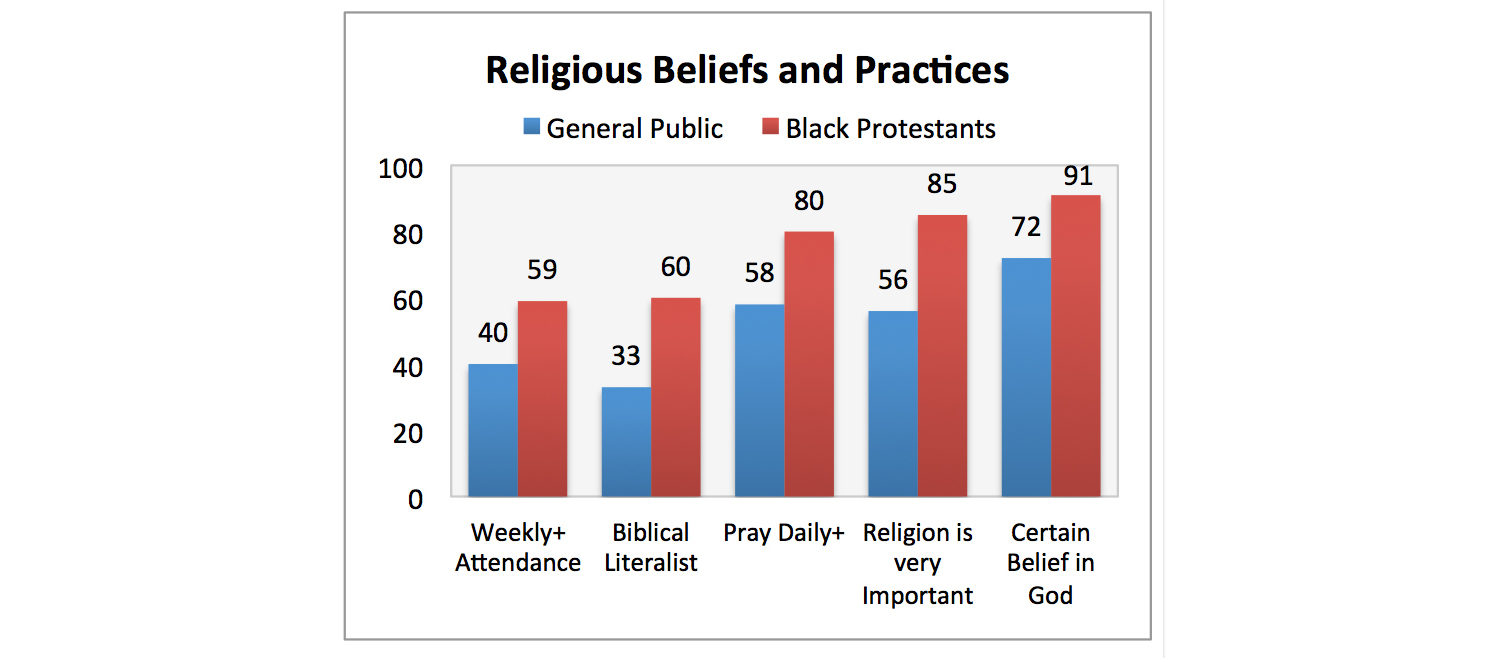
Black Protestants report extraordinarily high levels of religious engagement and largely hold traditional religious views. In fact, black Protestants register even higher levels of religious engagement than white evangelical Protestants. Black Protestants are also more likely than any other religious group to say religion is a very important part of their life (85%) (Pew RLS 2007).
Roughly 6-in-10 (59%) attend religious services at least once a week, and 30% say they attend more than once a week. Eight-in-ten black Protestants pray every day, and the vast majority of this group (62%) pray several times a day. Only 4% of black Protestants say they seldom or never pray (Pew RLS 2007).
A majority of black Protestants (6-in-10) are biblical literalists, saying that the Bible is the word of God and should be interpreted literally, word for word. Nearly all black Protestants are certain about their belief in a personal God. More than 9-in-10 (91%) black Protestants say that they are absolutely certain in their belief about God, and 71% believe God is a person with whom one can have a relationship (Pew RLS 2007).
Most African American Protestants link morality with religion and are less likely than the public to affirm religious pluralism.
More than any other group, African American Protestants link morality with religion. More than three-quarters (78%) of black Protestants agree that it is necessary to believe in God to be moral and have good values, and a majority (56%) completely agree (PRR FAPS 2008).25 About 6-in-10 (59%) black Protestants believe that many religions lead to eternal life, compared to 7-in-10 religious Americans overall. More than one-third (34%) of black Protestants believe that their religion is the one true faith leading to eternal life (Pew RLS 2007).
Voting and Political Behavior
Since the election of FDR in the 1930s, African Americans have strongly supported Democratic candidates.
In 1936, African Americans realigned their partisan affiliation from the Republican Party of Lincoln to the Democratic Party of FDR with his “New Deal.” Since that time, and even more so with the passage of 1964 civil rights legislation and the 1965 Voting Rights Act under President Lyndon Johnson, African Americans have perennially supported Democratic candidates and progressive causes, and have been the bedrock of progressive coalitions. In the last few presidential elections, Democratic candidates captured roughly 9-in-10 black Protestant votes. In 2000, 93% of black Protestants supported Al Gore over George W. Bush. In 2004, John Kerry received 86% of the black Protestant vote. Although numbers for black Protestants in the 2008 election are not yet available, Barack Obama received 95% of the votes from African Americans and there are typically no significant differences between black Protestants and African Americans overall (VNS Exit Poll 2000; NEP Exit Poll 2004, 2008). Religious observance has little effect on vote among African American Protestants.
African American Protestants more strongly identify as Democrats than as liberals.
Nearly 9-in-10 (88%) African American Protestants identify with or lean toward the Democratic Party, compared to only 1-in-20 who identify with or lean toward the Republican Party (Pew RLS 2007).
Although black Protestants overwhelmingly lean Democrat, there is significant variation by age. For example, among African American Protestants age 65 or older, 77% identify as Democrat, compared to only 57% of those under 30 years of age—a 20-point gap (Pew RLS 2007).
In terms of ideology, black Protestants are less likely than the general population to identify as conservative (27% vs. 42% respectively) and more likely to identify as moderate (37% vs. 29% respectively) and liberal (36% vs. 29% respectively) (ANES 2008).

African American Protestants believe the Democratic Party is more friendly to religion than the Republican Party.
Among black Protestants, unlike the general population, a majority (56%) view the Democratic Party as being friendly to religion, compared to just 7% who view the Democratic Party as unfriendly. In contrast, less than one-third (31%) of black Protestants say the GOP is friendly towards religion, while about 1-in-5 (22%) say they are unfriendly (Pew RPS 2008).
Black Protestants were even more polarized in their perceptions of the two presidential candidates’ friendliness to religion. More than 7-in-10 (71%) black Protestants thought Barack Obama was friendly towards religion, while fewer than 1-in-5 (18%) said John McCain was friendly towards religion (PRR FAPS 2008).26
African American Protestants are more likely than any other group to believe churches should be politically active and are less concerned than the public about close relationships between public officials and religious leaders.
Consistent with the important public role the church has played in African American communities, nearly 7-in-10 (69%) black Protestants say churches should express their views on political questions. Younger black Protestants (age 18-29) are even more supportive (76%) of an active church role in politics (Pew RLS 2007).
Most (57%) black Protestants worry more about public officials not paying enough attention to religion than they do about public officials becoming too close to religious leaders (33%) (PRR FAPS 2008).
The Role of Government
African American Protestants overwhelmingly support a bigger government offering more services.
Black Protestants overwhelming support a larger, more active government, in sharp contrast to the general public and other religious groups, which are more divided on this issue. Nearly three-quarters (72%) of black Protestants favor a bigger government providing more services over a smaller government providing fewer services. Eight-in-ten black Protestants believe the government should do more to help Americans in need, 18 points higher than the general population (Pew RLS 2007).

Black Protestants are divided over the role government should take in protecting morality in society. A plurality (48%) say the government should do more to protect morality, compared to 43% who say they worry more that government is getting too involved in moral issues (Pew RLS 2007).
Education and Income
African American Protestants tend to have lower levels of educational attainment than the general population. Eighteen percent of black Protestants have a college degree, compared to 27% of the general population. A majority (57%) of black Protestants have a high school education or less, compared to half the general population (Pew RLS 2007).
African American Protestants also have lower income levels than the general public. Almost half of African American Protestants (45%) have household incomes under $30,000, compared to 31% of the total population. Only 17% of black Protestants have household incomes of $75,000 or more, compared to 30% of the general population (Pew RLS 2007).
Outlook on Selected Issues
Gay and Lesbian Issues
African American Protestants have more reservations than those in the general public about whether homosexuality should be accepted in society. Approximately 4-in-10 (39%) black Protestants believe that homosexuality should be accepted by society, compared to 48% who believe it should be discouraged. Like young people generally, young black Protestants (age 18 to 29) are more likely to believe homosexuality should be accepted rather than discouraged (50% vs. 42%) (Pew RLS 2007).
Moreover, African American Protestants are more likely than most other religious groups to hear negative messages about homosexuality in church. Two-thirds of black Protestants report hearing about homosexuality in church, a rate much higher than regular church attenders overall (54%) and identical to white evangelical Protestants. Among black Protestants who report hearing about the issue in church, 64% report that their clergy say homosexuality should be discouraged, compared to 36% who report hearing either neutral or positive messages about homosexuality (PRR FAPS 2008).
Most black Protestants support policies protecting gay and lesbian people from discrimination, but they are more divided on the issue of relationship recognition. For example, more than 6-in-10 (63%) black Protestants support laws that would protect gay and lesbian people from job discrimination (Pew RLS 2007). However, a majority (57%) oppose allowing gay and lesbian couples to adopt children (ANES 2008). And nearly half say they support either marriage (27%) or civil unions (20%), compared to a similar number (48%) who do not favor any legal recognition for same-sex couples (PRR FAPS 2008).27
Crime and Justice
While African Americans overall believe in a positive role for government, they see the criminal justice system as a mixed blessing: as both protector and oppressor. Nearly seven-in-ten (69%) African Americans say putting more cops on the street would be “very effective” at reducing crime, compared to 58% of Americans overall. And there is a strong belief both in personal responsibility and in a second chance. A majority (65%) of African Americans believe that criminals “are responsible for their own actions, even if they had a bad upbringing,” and 62% believe violent criminals can be rehabilitated, compared to 55% of the general population (Cooper and Secrest 2007).28
While African Americans overall believe in a positive role for government, they see the criminal justice system as a mixed blessing: as both protector and oppressor.
On the other hand, only 25% of African Americans say the criminal justice system is always or usually fair. Similarly, 41% are much more likely to support a candidate who said the criminal justice system is racially biased, compared to 15% nationally (Cooper and Secrest 2007).
Strategic Insights
African American Protestants have a decidedly progressive outlook on the role of government and economic issues, but the realm of cultural issues presents both challenges and opportunities.
Challenges:
- On cultural issues, African American Protestants are pulled by two currents: the liberal current of the social gospel that emphasizes liberation and social and economic equality, but also by the conservative current of a prosperity gospel that emphasizes individual salvation, moral purity, and financial security. Appeals that emphasize the social gospel tradition could be effective, but the influence of the conservative current should not be forgotten.
- Although African American Protestant support for marriage for same-sex couples mirrors the general population, they are less likely to support civil unions and more likely to say there should be no legal recognition for gay couples.
African American Protestants are pulled by… the liberal current of the social gospel… but also by the conservative current of a prosperity gospel…
Opportunities:
- African American Protestants break the often-held stereotype that high levels of religiosity are always correlated with conservatism and Republican Party identification. For example, African American Protestants resemble white evangelical Protestants in their religious profile, but their voting behavior could not be more different. The religiosity of African American Protestants supports many progressive views.
- African American Protestants are more supportive than any other religious group of a larger government offering more services. Black Protestants are very supportive of structural solutions to social problems like poverty, crime, and discrimination.
- There may be an opportunity to build bridges from African American Protestant support for protections for gay and lesbian Americans in the workplace and the military, to stronger support for other gay and lesbian issues, such as adoption and marriage.
Roman Catholics
Introduction: The World of Roman Catholics
“One Bread, One Body”
One Bread, One Body Refrain: Gentile or Jew, Many the gifts, Grain for the fields, |
Liturgy and music play a prominent role in Catholic worship and in forming Catholic sensibilities about the world. One of the more popular modern liturgical hymns, often played during the observance of the Eucharist (the receiving of the bread and wine), is “One Bread, One Body.”
Several key strains of Catholic theology are discernable in these short verses:
- An emphasis on the unity of a diverse global community.
- The importance of the institutional church as a live expression of God’s presence.
- The centrality of embodied, sensual liturgical experience: kneeling, receiving the bread and the wine, hearing and singing the music, and smelling the incense.
- A commitment to equality and shared resources for the common good.
While the walls between Catholics and Protestants have become more permeable over the second half of the twentieth century, there are still important traits that generally demarcate Catholic and Protestant worldviews and continue to inform distinctive approaches to politics. Sociologist Andrew Greeley has usefully described the Catholic religious imagination as a “sacramental” imagination:
Catholics live in an enchanted world, a world of statues and holy water, stained glass and votive candles, saints and religious medals, rosary beads and holy pictures. But these Catholic paraphernalia are more hints of a deeper and more pervasive religious sensibility which inclines Catholics to see the Holy lurking in creation. As Catholics, we find our houses and our world haunted by a sense that the objects, events, and persons of daily life are revelations of grace (Greeley 2000).
An ethic of life vs. Catholic Social Teaching: Two competing theological streams in Catholic life.
There are two competing theological currents in Catholic life, which in turn serve as the foundation for different forms of public engagement: one based on an “ethic of life” that emphasizes individual morality, family, and the sanctity of life, and another based on “Catholic Social Teaching,” which upholds the idea of “the common good.”29 The emphasis on the former has served as one of the key bridges between conservative Catholics and white evangelical Protestants, particularly on the issues of abortion and gay and lesbian issues. Catholic Social Teaching, on the other hand, has been perhaps Catholicism’s most unique contribution to American public life, emphasizing a strong social conscience, broad reform of social institutions, a critique of the excesses of unchecked capitalism, support for the labor movement, and central concepts such as social justice and the common good.
American Catholics are a faith in transition—white Catholics are well-integrated into mainstream American life, while the influx of Latino Catholics are shifting the center of gravity of American Catholic life.
American Catholics constitute a vital segment of America’s diverse and dynamic religious landscape. For over 30 years, Catholics have accounted for about 1-in-4 American adults and have been a potent force in American politics. They remain the single largest denomination in the United States. The last five decades have witnessed considerable Catholic integration into mainstream American society. Neither John Kerry’s nor Joe Biden’s Catholicism was a major factor in their recent campaigns, a departure from the campaign of John F. Kennedy, the first Catholic president, when he was compelled to explain his political independence from the church in his famous speech to the Greater Houston Ministerial Association.30 Notably, we currently have a Catholic majority (5 of 9 justices) on the Supreme Court, including Chief Justice Roberts. To put this in perspective, there have only been 12 Catholic Supreme Court justices in the history of the United States, and five of those are currently sitting on the bench.
Nearly half (46%) of all immigrants coming to the U.S. are Catholic. The result has been a Catholic population that is becoming increasingly more diverse.
The two major social dynamics affecting the American Catholic community are native-born attrition and the counterbalancing force of Latino immigration. More than 1-in-10 Americans are former Catholics, making Catholics the “biggest losers” in the dynamic American religious marketplace (Pew RLS 2007). Despite losing a significant number of native-born adherents, the Catholic share of the U.S. population has held fairly steady over the last three decades, primarily due to immigration. Nearly half (46%) of all immigrants coming to the U.S. are Catholic.31 The result has been a Catholic population that is becoming increasingly more diverse (Pew RLS 2007).
Approximately 3-in-10 (29%) Catholics are Latino. However, among Catholics under the age of 30, nearly equal numbers are white (47%) as are Latino (45%). In contrast, among Catholics over the age of 65, the vast majority (82%) are white.

The ethnic transformation of American Catholicism has also had a marked effect on its geographic base. Historically, Catholics were predominantly found in the Northeast. A majority of white Catholics continue to live in the Northeast (36%) and Midwest (31%). Nearly three-quarters of Latino Catholics, however, live either in the South (32%) or West (42%). In the western United States, for example, Latino Catholics now constitute the majority of the Catholic population. These shifting demographic dynamics have resulted in an important ethnic regionalism among Catholics and must be central to strategic thinking about this group (Pew RLS 2007).
Religious Belief and Behavior
Overall, Catholics practice their faith at rates similar to the general public but are less likely to be biblical literalists.
Like the general population, roughly 4-in-10 (41%) Catholics report attending religious services at least once a week. A majority (56%) of Catholics say religion is very important to their lives, a number identical to the general population. However, Catholics are less likely than the general public to believe that the Bible is the word of God and should be interpreted literally (23% vs. 33% respectively) (Pew RLS 2007).
Roughly 7-in-10 (72%) Catholics say they are absolutely certain of their belief in God. Six-in-ten Catholics believe that God is a person with whom one can have a relationship, compared to about 3-in-10 (29%) who say that God is an impersonal force (Pew RLS 2007).
There are few differences between white and Latino Catholics in religious practices, but Latino Catholics are more likely to be biblical literalists and to say religion is very important to their lives.
Overall, there are few differences in the patterns of religious attendance and prayer among white and Latino Catholics, but Latino Catholics are significantly more likely than white Catholics (66% vs. 52%) to say that religion is very important to their lives (Pew RLS 2007).32 Latino Catholics are also more than twice as likely as white Catholics to embrace a literal interpretation of the Bible (36% vs. 16%) (Pew RLS 2007).
Interestingly, white Catholics are significantly more likely than Latino Catholics to be absolutely certain in their belief in God (74% vs. 66%) and to believe in a personal God (65% vs. 47%) (Pew RLS 2007).
A strong majority of Catholics hold a Centrist or Modernist religious orientation.
Half of all Catholics are religious Centrists, more than one-quarter (28%) are religious Modernists, and only about 1-in-5 (22%) are religious Traditionalists. Younger Catholics (age 18-34) are less likely than Catholics overall to be Traditionalists (16%), equally as likely to be Centrists (51%), and more likely to be modernists (33%) (PRR FAPS 2008).

Older white and Latino Catholics favor preserving traditional religion, while younger white Catholics favor adjusting it in light of new circumstances.
A plurality (42%) of Catholics overall take the centrist position that the church should adjust traditional beliefs and practices in light of new circumstances, compared to 36% who say that the church should preserve its traditional beliefs and practices on the one hand, and 15% who believe the church should adopt modern beliefs and practices on the other. Among white Catholics, nearly half (48%) say the church should adjust traditional beliefs, and one-third support the church preserving tradition. Latino Catholics reverse these preferences: only 30% say the church should adjust traditional beliefs, and 41% say the church should preserve traditional beliefs and practices (Pew RLS 2007).
There are no significant generational differences in religious traditionalism among Latino Catholics, but among white Catholics, those age 65 or older are significantly more likely than younger Catholics to support the church preserving traditional beliefs and practices (43% vs. 30% respectively) (Pew RLS 2007).
Catholics link morality with religion, but are more likely than other religious groups to affirm religious pluralism.
Nearly two-thirds (64%) of Catholics overall and 57% of younger Catholics (age 18 to 34) believe that it is necessary to believe in God to be moral and have good values. (PRR FAPS 2008).
Nearly 8-in-10 (79%) Catholics, compared to 7-in-10 Americans, believe that many religions can lead to eternal life; only 16% say their religion is the one true faith leading to eternal life (Pew RLS 2007).
Latino Catholics also generally embrace religious pluralism, but at lower levels than white Catholics.
White Catholics are much more likely to adopt a pluralistic view of religion than Latino Catholics. Eighty-six percent of white Catholics say that many religions can lead to eternal life, a view shared by 63% of Latino Catholics. Nearly 3-in-10 (28%) Latino Catholics say that their religion is the one true faith leading to eternal life (Pew RLS 2007).
Voting and Political Engagement
White Catholics are a swing group leaning toward Republican candidates, while Latino Catholics vote solidly for Democratic candidates.
Historically a solid Democratic voting constituency, Catholic voters have evolved into an important swing group. This drift in voting patterns is driven by two competing dynamics: a significant shift in white Catholics towards supporting Republican Party candidates and the rise of Democratic leaning Latino Catholics.
In 2000, Catholics overall slightly favored Democratic candidate Al Gore over Republican candidate George W. Bush (51% vs. 49%). However, white Catholics preferred Bush by six points (53% vs. 47%), while Latino Catholics preferred Gore nearly 2-to-1 (66% vs. 34%) (VNS Exit Poll 2000).
In 2004, Bush edged out Catholic Democratic candidate John Kerry among Catholic voters overall (52% vs. 47%). Bush significantly outperformed Kerry among white Catholics (56% to 43%). While nearly 6-in-10 Latino Catholics voted for Kerry, Bush improved his vote share among Latino Catholics by five points, from 34% in 2000 to 39% in 2004 (NEP 2004).
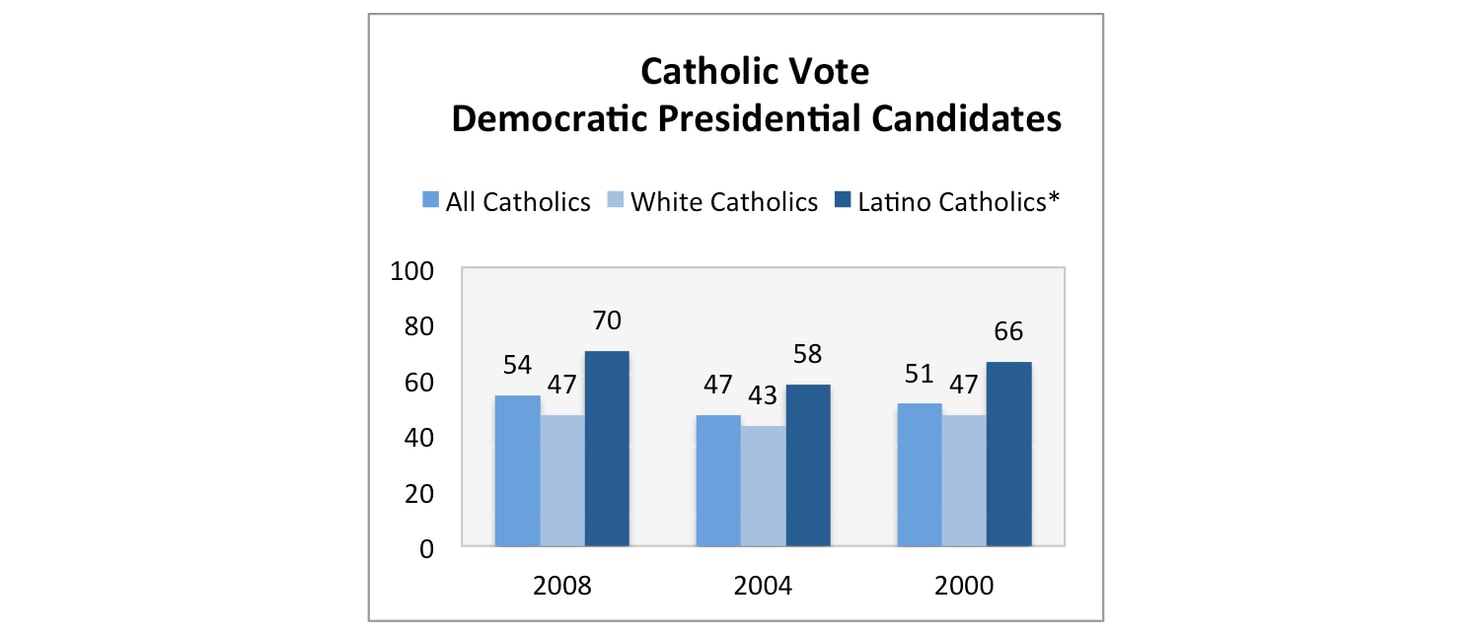
In the 2008 election Democratic candidate Barack Obama handily defeated Republican candidate John McCain among Catholic voters (54% vs. 45%). However, McCain managed to retain the Republican edge among white Catholic voters, outperforming Obama by five points (52% to 47%) (NEP 2008). Religious observance plays a role in Catholic voting patterns. For example, McCain slightly edged out Obama among Catholics who attend church at least once per week (51% to 49%), but Obama won a solid majority (60%) of the votes of less frequently attending Catholics (Pew Post-election Survey 2008).
While Latino Catholic numbers are not currently available at the time of this writing, an estimate based on available data for overall Catholics and white Catholics indicates that approximately 7-in-10 Latino Catholics supported Obama (NEP 2008).33
Since the election of John F. Kennedy, Catholics have shifted from a solid Democratic constituency to a swing constituency.
Catholics historically have had a strong attachment to the Democratic Party. In 1960, with the election of the first Catholic President John F. Kennedy, nearly three-quarters (73%) of Catholics identified as Democrats. That same year, only 18% of Catholics identified with the GOP and about 1-in-10 (8%) identified as strict Independents. Since that high-water mark, the Democratic Party has gradually lost its dominance among Catholics overall. In 2008, Catholic identification with the Democratic Party had dropped to 51%, Republican Party identification had more than doubled to 38%, and the number of Independents remained level at 10% (ANES 1952-2008).
Despite the dramatic shifts in party affiliation among Catholics over the last forty years, their ideological outlook has remained fairly stable. Catholics largely mirror the general population in political ideology, although they are slightly less likely to identify as liberal. A plurality (42%) of Catholics identify as conservative, more than one-third (36%) identify as moderate, and about one-quarter (23%) identify as politically liberal (ANES 2008).
Latino Catholics are significantly more likely than white Catholics to identify as Democrat and are less likely to identify as conservative.
This apparent linear drift in partisanship and ideology, however, masks striking underlying differences among white and Latino Catholics. Among white Catholics, Republicans slightly outnumber Democrats (47% to 42%), with 11% identifying as Independent. Among Latino Catholics, nearly 7-in-10 (69%) identify as Democrats, and only 19% identify as Republican, a 50-point partisan gap. Only 11% of Latino Catholics report that they are political Independents (ANES 2008).
This drift in voting patterns is driven by… a significant shift in white Catholics towards supporting Republican Party candidates and the rise of Democratic leaning Latino Catholics.
There are also sizable differences between Latino and white Catholics in their political ideology. Nearly half (48%) of white Catholics identify as conservative, one-third identify as moderate, and about one-fifth (19%) identify as liberal. Among Latino Catholics, only 30% identify as conservative, a plurality (43%) identify as moderate, and 28% identify as liberal (ANES 2008).
Catholics mirror the general public in seeing the Republican Party as more friendly to religion than the Democratic Party, but they saw Obama as more friendly to religion than McCain.
A majority (55%) of Catholic voters perceive the Republican Party to be friendly to religion, compared to 39% who say the Democratic Party is friendly to religion (Pew RPS 2008).34
During the presidential election, Obama significantly improved upon his party’s image on this topic, while McCain was perceived similarly to his party. Half of Catholics thought Obama was friendly towards religion, an 11 point improvement over Catholic perceptions of the Democratic Party; only 6% thought he was unfriendly. Slightly fewer (47%) Catholics thought McCain was friendly towards religion, a level slightly lower than his party; about 1-in-10 (11%) said he was unfriendly (PRR Post-election Survey 2008).
There are no significant differences between white and Latino Catholics’ perceptions of the Democratic Party, but there are significant perception differences with regard to the GOP. A majority (54%) of white Catholics say the GOP is friendly towards religion, compared to only 37% of Latino Catholics (Pew RPS 2008).
Latino Catholics are more supportive of mixing religion and politics than white Catholics, but both share concerns about excessive entanglement of public officials and religious leaders.
Like the general public, Catholics, both white and Latino, are evenly divided about whether churches should express their views on day-to-day social and political questions, or whether they should keep out of political matters (48% each) (Pew RLS 2007). While white Catholics are divided over whether there have been too few (33%), the right amount (32%), or too many (29%) expressions of religious faith and prayer by political leaders, a plurality of Latino Catholics (40%) say there have been too few expressions of faith and prayer by political leaders (Pew PRS 2008). However, a strong majority (61%) of Catholics—a number significantly higher than the general population (53%)—say they are more worried about public officials who are too close to religious leaders than about those who do not pay enough attention to religion (PRR FAPS 2008).

The Role of Government
Latino Catholics strongly prefer a bigger government offering more services and protecting morality, while white Catholics prefer a smaller, less involved government.
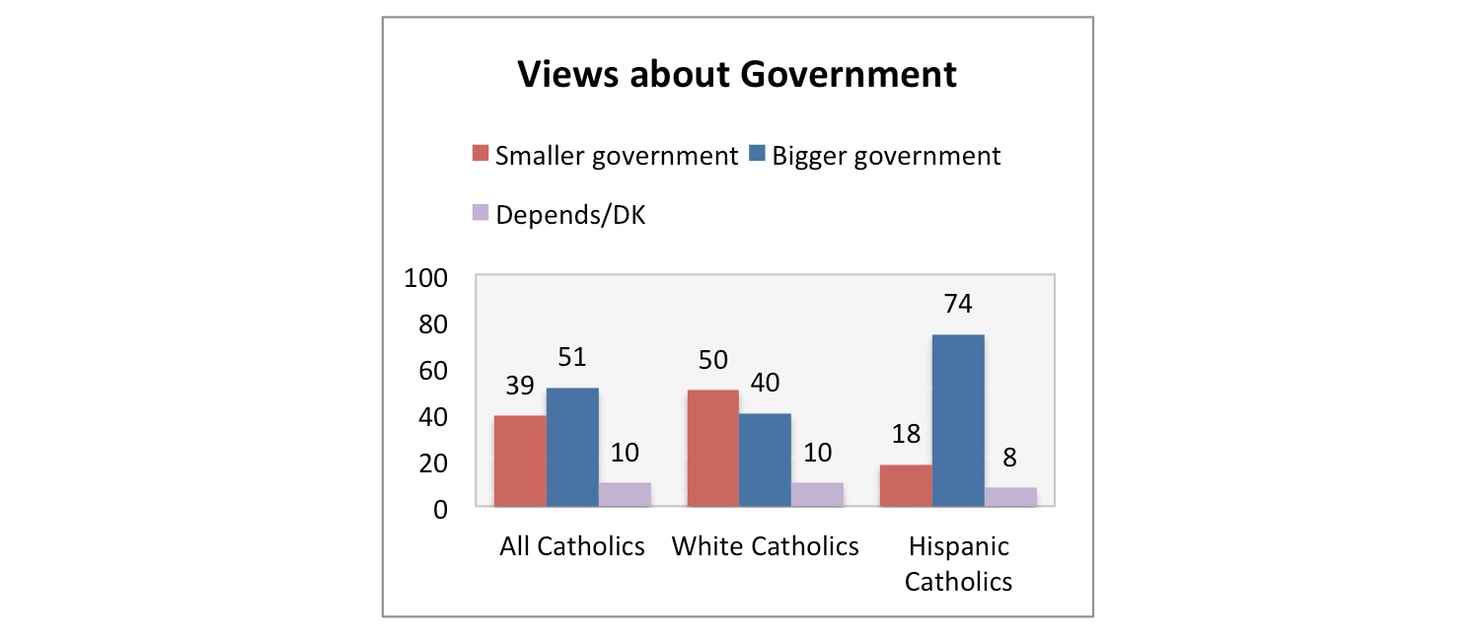
A slim majority (51%) of Catholics overall prefer larger government to smaller government (39%). However, there are striking differences between Latino and white Catholics. Among white Catholics, half say they prefer smaller government and fewer services, compared to 4-in-10 who prefer larger government and more services. Latino Catholics overwhelmingly prefer larger government (74%), with only about 1-in-5 (18%) saying they want smaller government (Pew RLS 2007).
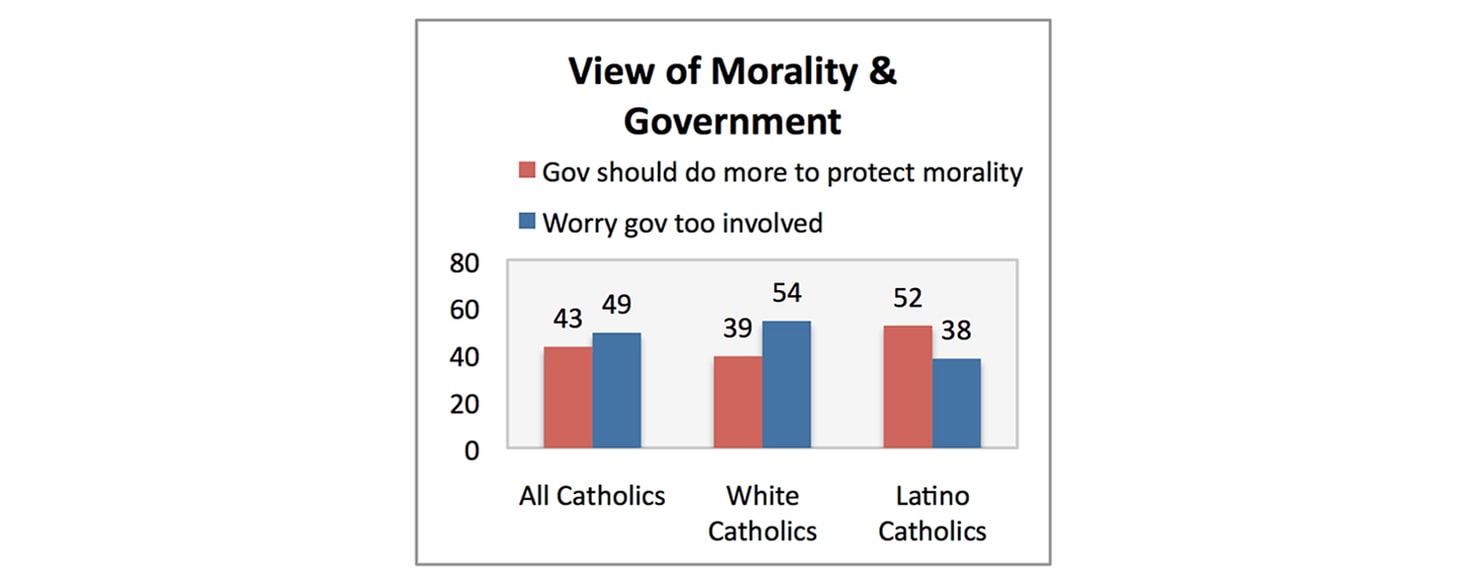
Catholics are somewhat split over the role government should take in protecting morality in society. Nearly half (49%) of Catholics say they worry the government is getting too involved in moral issues, compared to 43% who say the government should do more to protect morality. Among white Catholics, a majority (54%) say they worry about too much government involvement in the issue of morality, compared to 39% who say the government should do more. Latino Catholics reverse these concerns, with only 38% saying they worry about too much government involvement in moral issues, and a slim majority (52%) saying the government should be more involved in protecting morality (Pew RLS 2007).
Education and Income
Education levels of Catholics overall closely mirror that of the general population. For example, 26% of Catholics have college degrees, a number nearly identical to the general population (27%). However, among Latino Catholics, just 9% have a college degree (Pew RLS 2007).
The income levels of Catholics are also very similar to the income levels of the general population. One-third of Catholics have a household income level of $75,000 or higher, compared to 30% of the total population. Among Latino Catholics, however, just 14% have a household income level of $50,000 or more (Pew RLS 2007).
Outlook on Selected Issues
Abortion
Catholics are largely divided on the issue of abortion. Forty-three percent of Catholics believe abortion should be legal in all or most cases, compared to 46% who say abortion should be illegal in all or most cases. Among Catholic voters, when the substance of common ground on abortion is spelled out, 8-in-10 agree that elected leaders on both sides of the abortion debate should work together to find ways to reduce the number of abortions by enacting policies that help prevent unintended pregnancies, increase economic support for women who wish to carry their pregnancies to term, and expand adoption (PRR Post-election Survey 2008).
But there is a large difference between white and Latino Catholics. White Catholics are evenly divided, with 47% saying abortion should be legal in all or most cases and a nearly identical number (46%) saying abortion should be illegal in all or most cases. Latino Catholics are no more likely than white Catholics to oppose the legality of abortion overall (48% to 47%), but they have two distinctive traits. They are less likely to be supportive of the legality of abortion and are more likely to refuse to give an opinion on this issue; only 33% say abortion should be legal in all or most cases, but nearly 1-in-5 (19%) do not give their opinion on the issue (Pew 2009).

Gay and Lesbian Issues
Catholics are more likely than the general public to say homosexuality should be accepted by society and less likely than other churchgoers to hear about homosexuality in church (Pew RLS 2007).
A strong majority (58%) of Catholics believe that homosexuality should be accepted rather than discouraged by society (58% vs. 30%) (Pew RLS 2007). Catholics are also less likely to hear about the issue of homosexuality in church than churchgoers overall. Fewer than 4-in-10 (37%) Catholics who attend services regularly (at least once or twice a month) say their clergy mention the issue in church, compared to 54% of all regular churchgoers. However, of those who report hearing about the issue, nearly three-times as many report hearing negative messages rather than positive or neutral messages (PRR FAPS 2008).
Catholics are more likely than the general public to say homosexuality should be accepted by society and less likely than other churchgoers to hear about homosexuality in church.
Catholics are strong supporters of most policy issues concerning gay and lesbian people. Approximately three-quarters (77%) of Catholics support allowing gay and lesbian people to serve in the military, and laws that would protect gay and lesbian people from job discrimination (75%). A solid majority (55%) of Catholics believe that gay and lesbian couples should be allowed to adopt children (ANES 2008).
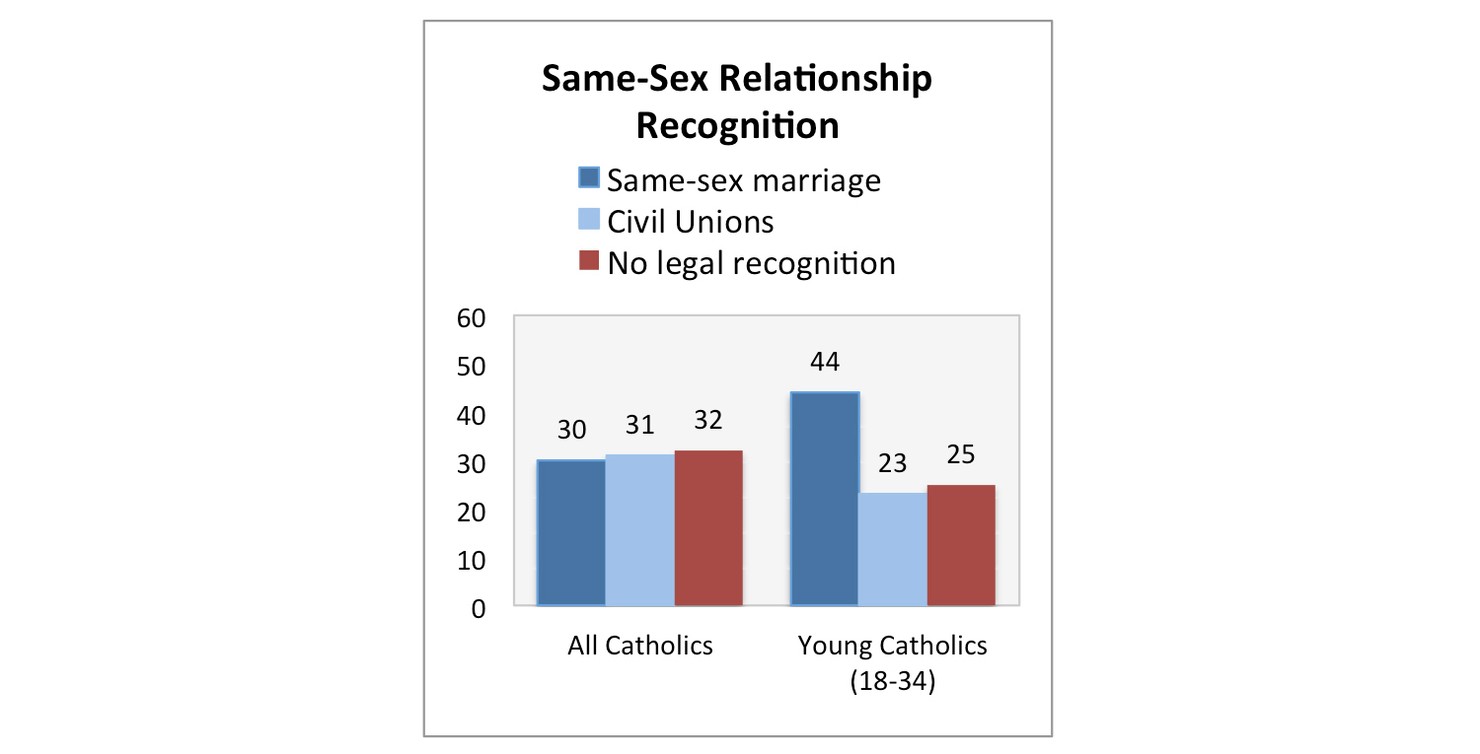
On the issue of relationship recognition for same-sex couples, Catholic views largely mirror the general public. Approximately 6-in-10 Catholics support either marriage (30%) or civil unions (31%), compared to approximately one-third (32%) who say there should be no legal recognition of a gay couple’s relationship (PRR FAPS 2008).
Although initial support for allowing gay and lesbian couples to marry among Catholics is well below a majority, when offered a religious liberty reassurance that “no church or congregation would be required to perform marriages for gay couples,” support increases from 30% to 47%, a 17-point jump (PRR FAPS 2008).
Two-thirds of young Catholics (age 18-34) favor some legal recognition of a gay couple’s relationship. More than 4-in-10 (44%) young Catholics support marriage, and another 23% support civil unions. Only one-quarter of young Catholics say there should be no legal recognition of any kind. When young Catholics are offered a religious liberty reassurance, support for marriage rises from 44% to 64%, a 20-point jump (PRR FAPS 2008).

Immigration
Both the Catholic hierarchy and Catholics in the pews are supportive of a comprehensive approach to immigration reform. This supportive stance on immigration is largely a factor of the Catholic immigrant experience and the large number of recent Catholic immigrants living in the United States.
Nearly 7-in-10 (69%) Catholics support a comprehensive approach to immigration reform that creates a path to citizenship for undocumented immigrants, compared to only 27% who support alternative proposals that focus on enforcement alone and denying access to social services. But like other religious groups, there are caveats. Catholics believe that four values are very important as guides to immigration reform—two of which fall on the tougher enforcement side of the ledger and two on the compassionate morality side: enforcing the rule of law and promoting national security (91%), ensuring fairness to taxpayers (92%), protecting the dignity of every person (82%), and keeping families together (83%) (PRRI Immigration Survey 2010).
Catholics believe that four values are very important as guides to immigration reform—two of which fall on the tougher enforcement side of the ledger and two on the compassionate morality side…
Like the general public, Catholics, however, remain evenly split in their opinions about the impact of immigrants on society. Forty-five percent say that immigrants today strengthen the country by their hard work and talents, compared to an equal number who say that immigrants today are a burden on our country because they take American jobs, housing and health care (PRRI Immigration Survey 2010).
Strategic Insights
As a large swing constituency, Catholics present a number of challenges and opportunities. A key to understanding both is grasping the critical cultural and political distinctions between white and Latino Catholics.
Challenges:
- Although at the macro level Catholics often mirror the general population on public policy issues, this similarity often masks significant differences between Latino and white Catholics. As the proportion of Latino Catholics continues to increase, understanding the unique footprints of each of these subgroups will become even more critical.
- Catholics have been moving over the last few decades from a solid Democratic constituency to a swing constituency. While progressive candidates have been strongly supported by Latino Catholics, they have had some difficulty among white Catholics. Reconnecting to white Catholics on key issues should be a priority.
Opportunities:
- Catholics retain in their theology and church culture a strong emphasis on social justice, the common good, and community.
- The largely conservative stance of the Catholic hierarchy on many cultural issues should not be mistaken for the stand of rank and file Catholics. Catholics mirror the general public more than the Catholic hierarchy on these issues—and sometimes are even more progressive than the general public.
- Catholics are more supportive of protections for gay and lesbian Americans and more accepting of homosexuality than the general public. Catholics strongly support protections for gay and lesbian people in the workplace and the military, and support allowing gay and lesbian couples to adopt children. Their views on marriage largely mirror the general public.
- Catholics are especially strong supporters of comprehensive immigration reform that creates a path to citizenship for undocumented immigrants. These views are likely influenced by the connection both white and Latino Catholics retain to their own families’ immigration stories. On this issue, the Catholic hierarchy is also aligned with congregants.
Works Cited
American National Election Study (ANES). 1952-2008. Conducted by the University of Michigan and Stanford University.
Cone, James H. 1986. Speaking the Truth: Ecumenism, Liberation, and Black Theology. Grand Rapids, MI: Eerdmans.
Cooper and Secrest Associates. 2007. National Crime Survey. Sponsored by Third Way. Conducted by Cooper and Secrest Associates, Washington, D.C.
Davis, James Allan and Smith, Tom W. General Social Surveys (GSS), 1972-2008 [machine-readable data file]; Sponsored by National Science Foundation. --NORC ed.-- Chicago: National Opinion Research Center [producer]; Storrs, CT: The Roper Center for Public Opinion Research, University of Connecticut [distributor], 2009.
Emerson, Michael O. and Christian Smith. 2000. Divided by Faith: Evangelical Religion and the Problem of Race in America. Oxford: Oxford University Press.
Foley, John C. 1978. “One Bread, One Body.” OCP Publications.
Fosdick, Harry Emerson. 1930. “God of Grace and God of Glory.” Copyright Elinor Fosdick Downs.
Greeley, Andrew M. 2000. The Catholic Imagination. Berkeley: University of California Press.
Green, John C. 2000. The American Religious Landscape Survey. Akron, OH: Bliss Institute of Applied Politics, University of Akron.
Greenberg, Anna, and Jennifer Berktold. 2004. Evangelicals in America Survey. Sponsored by Religion & Ethics Newsweekly. Washington, D.C.: Conducted by Greenberg, Quinlan, Rosner Research. March 16—April 4.
Harris-Lacewell, Melissa. 2004. “Black Churches: Liberation or Prosperity?” Sightings. Chicago: The Martin Marty Center, The Institute for the Advanced Study of Religion at the University of Chicago. October 14.
Johnson, James Weldon. 1921. “Life Every Voice and Sing.” Copyright Edward B. Marks Music Company.
Jones, Robert P. 2008. Progressive & Religious: How Christian, Jewish, Muslim, and Buddhist Leaders are Moving Beyond the Culture Wars and Transforming American Public Life. Lanham, MD: Rowman & Littlefield Publishers.
Jones, Robert P. and Daniel Cox. 2008. Faith in American Politics Survey (PRR FAPS). Sponsored by Faith in Public Life. Conducted by Public Religion Research, Washington, D.C.
______. 2008. Post-election Survey (PRR Post-election Survey). Sponsored by Faith in Public Life, Catholics in Alliance for the Common Good, and Sojourners. Conducted by Public Religion Research, Washington, D.C.
______. 2009. “What New Hampshire Reveals about Religion and Same-Sex Marriage.” June 5. Washington, D.C.: On Faith at Newsweek/Washington Post, at http://newsweek.washingtonpost.com/onfaith/guestvoices/2009/06/what_new_hampshire_reveals_about_religion_and_same-sex_marriage.html.
______. 2010. Religion, Values, and Immigration Reform Survey (PRRI Immigration Survey). Sponsored by the Ford Foundation. Conducted by Public Religion Research Institute, Washington, D.C.
______. 2010. “Liberal, with Conservative Vibrations: African Americans and the Struggle over Legal Rights for Gay and Lesbian Couples,” in Clyde Wilcox and David Rayside, eds. Religion, Sexuality, and Politics in Canada and the United States. University of British Columbia Press.
Lincoln, C. Eric and Lawrence H. Mamiya. 1990. The Black Church in the African American Experience. Durham, NC: Duke University Press.
National Election Pool (NEP). 2004, 2008. Exit Poll. Sponsored by the National Election Pool (comprised of ABC, CBS, CNN, FOX, NBC and the Associated Press). Conducted by Edison Media Research and Mitofsky International, Somerville, NJ.
National Evangelical Association. 2009. “Immigration 2009,” at: http://www.nae.net/resolutions/347-immigration-2009
Pew Forum on Religion and Public Life. 2007. Religious Landscape Survey (Pew RLS 2007). Conducted by the Pew Forum on Religion and Public Life, Washington, D.C.
______. 2009. “The Religious Affiliation of U.S. Presidents,” at: http://pewforum.org/docs/?DocID=386.
Pew Forum on Religion and Public Life and the Pew Research Center. 2008. Religion and Politics Survey (Pew RPS 2008). Conducted jointly by the Pew Forum on Religion and Public Life and the Pew Research Center, Washington, D.C.
Pew Hispanic Center and Pew Forum on Religion and Public Life. 2007. Changing Faiths: Latinos and the Transformation of American Religion. Conducted by International Communications Research.
Pew Research Center. 2005. Trends 2005. Washington, D.C.: Pew Research Center.
______. 2008. Post-election Survey. Conducted by the Pew Research Center, Washington, D.C. November 6-9.
U.S. Census Bureau. 2007. American Community Survey. Washington, D.C.
Voter News Service (VNS). 2000. Exit Poll. Sponsored by Voter News Service (comprised of ABC News, CNN, CBS News, FOX News, NBC News and the Associated Press).
Watts, Isaac. 1724. “Am I a Soldier of the Cross?” Public Domain.
Wuthnow, Robert and John H. Evans. 2002. The Quiet Hand of God: Faith-based Activism and the Public Role of Mainline Protestantism. Berkeley: University of California Press.
Endnotes
The groups covered in Beyond the God Gap represent the following proportion of the U.S. population: white evangelical Protestants (26%), Roman Catholics (24%), white Mainline Protestants (18%), and African American Protestants (7%) (Pew RLS 2007).
Emerson and Smith clearly outline the strong influence of individualism on white evangelical public engagement (Emerson and Smith, 2000, p. 76 ff).
The dominant public posture of evangelicals is captured in what sociologist Nathan Glazer has called the “defensive offensive” evangelicals launched in the 1970s, fueled by the sense that their values and social world were being threatened by hostile outside forces. The most prominent of these forces were the continuing reverberations from the upheavals of the Civil Rights movement, especially in the South, along with a series of Supreme Court decisions that established a right to abortion and prohibited government-sponsored prayer and religious symbols in public schools.
Here, and in all parallel sections, we used a statistical method called factor analysis to identify and isolate a single underlying factor from four basic questions of religious behavior and beliefs: frequency of attendance at religious services, frequency of prayer, beliefs about the Bible, and beliefs about whether one must believe in God to be moral. We also used a measure of the salience of religion to guide groupings along the factor scale. This method is an adaptation of a procedure developed by Dr. John Green, Director of the Bliss Institute for Applied Politics at the University of Akron.
Here and in following sections, FAPS refers to the “Faith and American Politics Survey,” sponsored by Faith and Public Life and conducted by Public Religion Research.
The VNS 2000 exit poll did not include a question that reliably identified born-again or evangelical Christians.
In all citations of the Pew post-election poll, percentages reflect proportions of two-party vote.
The Pew data was based on registered voters who always or almost always vote in elections. The PRR Post-election data was based on Americans who voted in the 2008 election.
Only Mormons ranked below evangelicals at 49%.
National Association of Evangelicals Abortion Resolution, May 2010, www.nae.net/government-affairs/policy-resolutions/446-abortion-2010.
National Evangelical Association, Immigration 2009, October 2009, available at: http://www.nae.net/resolutions/347-immigration-2009.
In this report, when we refer to “mainline Protestants,” we follow the practice in most political surveys of restricting the category to white mainline Protestants only. While this approach has the advantage of maintaining consistency with political polling, it screens out minority mainline Protestant laity. When mainline Protestants are defined using denominational affiliation regardless of race, mainline Protestants are 91% white (Pew RLS 2007).
“God of Grace and God of Glory” was written by Rev. Harry E. Fosdick in 1930, a liberal Baptist minister most well known as the first minister at the historic ecumenical Riverside Church in New York City. Fosdick was also famous for his sermon, “Shall the Fundamentalists Win?”, which made the case for liberal theology in the midst of the fundamentalist controversies of the early twentieth century. His appointment to Riverside Church landed him on the front page of Time Magazine on October 6, 1930.
We calculated a population estimate of mainline Protestant adults by taking 18.1% of the population estimate of 225.1 million adults (age 18 or older) in the American population (American Community Survey, U.S. Census Bureau 2007).
See “The Religious Affiliation of U.S. Presidents,” the Pew Forum on Religion and Public Life. http://pewforum.org/docs/?DocID=386.
As characterized by Wuthnow and Evans in (2002).
The financial resources of the mainline denominations are considerable, topping $116.8 billion in 1997. This number includes $11 billion in annual spending in 1997, $63.5 billion in property assets, $7.6 billion in cash, securities, and other assets, $2.7 billion in seminary endowments, and $32 billion in pension funds (Wuthnow and Evans 2002).
See endnote 4 for further explanation of this scale.
The VNS 2000 exit poll did not contain a question that could reliably distinguish between white evangelical and white mainline Protestants. For 2000 election results, we rely on John Green’s American Religious Landscape Study (Green 2000).
The drop in support for Bush between 2000 and 2004 elections may partly be explained by the precipitous decline in presidential approval during his first four years in office. Bush’s approval among mainline Protestants fell more than 40 points from 90% approval in September 2001 to just under half (49%) by the end of 2004.
The Pew data was based on registered voters who always or almost always vote in elections. The Post-election data was based on Americans who voted in the 2008 election.
Mainline Protestants, for example, was the religious group most opposed to California’s Proposition 8, and one key feature of each of the six states that currently allow same-sex couples to marry is that mainline Protestants outnumber their more conservative evangelical Protestant counterparts. See Robert P. Jones and Daniel Cox, “What New Hampshire Reveals about Religion and Same-Sex Marriage,” On Faith at Newsweek/Washington Post (June 5, 2009), at http://newsweek.washingtonpost.com/onfaith/guestvoices/2009/06/what_new_hampshire_reveals_about_religion_and_same-sex_marriage.html.
Although “the Black church” is useful heuristic shorthand, this term encompasses a wide variety of churches. Approximately 85% of African Americans identify as Protestant, primarily in eight majority-Black denominations: African Methodist Episcopal (AME), African Methodist Episcopal Zion (AMEZ), Christian Methodist Episcopal (CME), Church of God in Christ (CGC), Full Gospel Baptist Church Fellowship (FGBCF), National Baptist Convention USA (NBC), National Baptist Convention of America (NBCA), and Progressive National Baptist Convention (PNBC). Approximately 6% identify as Roman Catholic (Pew RLS 2007).
Political scientist Melissa Harris-Lacewell has characterized the prosperity gospel as an approach where “Christ is an investment strategy and a personal life coach whose power can be accessed by believers to improve their finances, protect their families, strengthen their faith, and achieve personal authenticity” (Harris-Lacewell 2004).
Black Protestant data from PRR FAPS 2008 is based on a small number (n<100) of cases and should be viewed with some caution.
Results of attitudes on friendliness toward religion in this section are given for black Protestants in the general population rather than for black Protestant voters due to small sample sizes.
Note that the black Protestant findings on relationship recognition above rely on a small (n<100) sample size (PRR FAPS 2008). However, these numbers were benchmarked against the ANES, which asked an analogous three-part question and found nearly identical results among black Protestants (n=216): support for marriage was 29%, support for civil unions was 21% and support for no legal recognition was 47% (ANES 2008).
Due to limitations in sample size, findings in this section are based on African Americans overall rather than the subset of African Americans who identify as Protestant. The Third Way National Crime Survey contained an oversample of 125 African Americans (Cooper and Secrest 2007).
For a more in-depth discussion of the Catholic imagination and its implications for Catholic approaches to policy, see Robert P. Jones, Progressive & Religious (Jones 2008).
Kennedy stated, “I believe in an America where the separation of church and state is absolute; where no Catholic prelate would tell the President -- should he be Catholic -- how to act, and no Protestant minister would tell his parishioners for whom to vote; where no church or church school is granted any public funds or political preference, and where no man is denied public office merely because his religion differs from the President who might appoint him, or the people who might elect him.” For video and transcript, see http://www.americanrhetoric.com/speeches/jfkhoustonministers.html.
This is especially true of Mexican immigrants who account for the largest share of the foreign-born population. Close to three-quarters (72%) of all Mexican immigrants are Catholic.
In this section, for ease of explication we will use the term ‘white Catholic’ to refer to all non-Latino white Catholics.
We calculated this estimate of approximately 7-in-10 support for Obama among Latino Catholics by calculating their portion of a weighted average from available numbers: overall Catholics are 27% of voters and 54% supported Obama; white Catholics are 19% of voters and 47% supported Obama; and non-white Catholics are 8% of voters and XX% supported Obama. Solving for XX% yields 70.6%. Overall Latino support for Obama (67% Obama vs. 31% McCain) also suggests Latino Catholic support for Obama was at least two-thirds (NEP 2008).
The Pew data was based on registered voters who always or almost always vote in elections. The Post-election data was based on Americans who voted in the 2008 election.


Latest Publications
The Immigration Enforcement Revolution: How a Historic Funding Surge Is Reshaping American Criminal Justice
Battleground Democrats Aren’t Ducking the Immigration Fight
On Immigration, Battleground Voters Want Both Order and Opportunity
Restoring Confidence in the Supreme Court
Never Miss an Update
Sign up for updates on the pragmatic, center-left ideas shaping the future of American policy.