Polling Published October 9, 2026 · 11 minute read
On Immigration, Battleground Voters Want Both Order and Opportunity
In the states that will help decide the next presidential election, Donald Trump has lost voters on immigration. But that backlash has not yet translated into trust for Democrats. So what must they do to reestablish themselves as responsible in the minds of voters on this issue?
This September, Third Way worked with Normington Petts to survey 700 registered voters in the seven presidential battleground states of Arizona, Georgia, Michigan, Nevada, North Carolina, Pennsylvania, and Wisconsin. This survey also included an oversample of 200 Hispanic voters. The results reveal a battleground electorate looking for something different from what either side of the immigration debate has been offering. Voters dislike Trump’s enforcement approach, but they remain deeply skeptical that Democrats can handle immigration or secure the border. At the same time, they overwhelmingly embrace an immigration vision that combines enforcement and greater order with legal pathways and status for undocumented immigrants who have lived here for years, worked hard, and played by the rules, as well as a way for new immigrants to come here legally to build a better life.
The main takeaways:
- Battleground voters dislike Trump’s immigration enforcement, but they aren’t sold on Democrats’ ability to handle the issue.
- The broadest voter agreement comes from an approach that combines order with opportunity.
- Voters reject the extremes of the immigration debate—and they show little appetite for relitigating the failures of both parties.
Trump’s Enforcement Is Unpopular With Battleground Voters. Yet Democrats Still Aren’t Trusted.
Presidential battleground voters are unhappy with the immigration enforcement they are seeing today. A full 58% disapprove of Trump's immigration enforcement, such as ICE raids, including 44% who strongly disapprove.
But Democrats have not inherited the issue as a result. Republicans retain a 13-point advantage on immigration, 48% to 35%, and a massive 30-point advantage on border security, 55% to 25%. For perspective, Democrats held a trust advantage on seven of the other eight issues we tested, including the economy and inflation (typical Trump strengths). The exception was crime, where Republicans lead by 16 points.
Even Hispanic battleground voters, who are more negative toward ICE than the electorate as a whole, are essentially split on which party they trust on immigration: 43% Republicans, 40% Democrats.
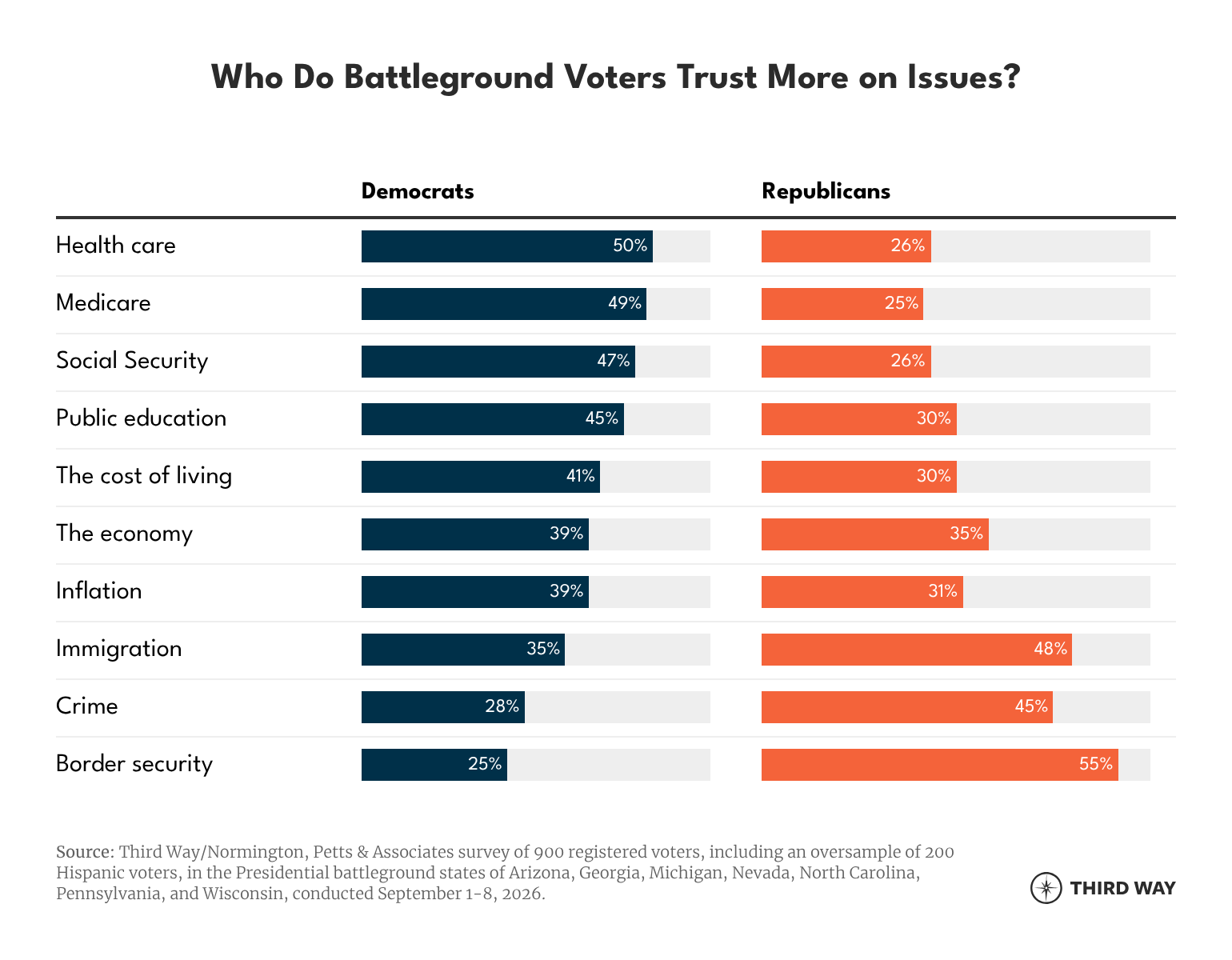
This is an important warning against overreading recent national polling showing Democratic gains on the issue. In the states most likely to determine the next presidential election, voters can dislike what Republicans are doing and still doubt Democrats would do much better.
The words voters associate with each party help explain Democrats’ lingering trust problem. Asked for the first word that comes to mind on Democrats and immigration, 65% of battleground voters are negative. “Too soft” is the largest category, followed by incompetence (10%), charges of lawlessness or corruption (8%), open borders (8%), and inaction (7%). Compassion was the most common positive word, registering at 10%, mostly from Democratic voters.
Republicans receive a sharply different mix of reactions. Voters frequently describe their approach as cruel or overly aggressive, but they also associate Republicans with strength, effectiveness, enforcement of the law, and border control.
Voters seem to be saying that results matter more than intent, so despite some mixed feelings about what Republicans have wrought during Trump 2.0, they are still seen more favorably than Democrats in that regard. In order to regain trust, Democrats will have to show voters they can keep the system under control.
ICE Is Unpopular—but Democrats Should Be Careful About What That Means
ICE itself is underwater with battleground voters: 39% view the agency favorably and 53% unfavorably. Unsurprisingly, it is deeply unpopular with Democrats and Hispanic voters. An overwhelming 76% of Democrats found ICE “very unfavorable.” And the disapproval is even higher among Hispanic Democrats, 94% found ICE “very unfavorable.”
But there is an important reality check in these numbers: ICE is viewed slightly more favorably than either political party. The agency’s 39% favorability rating is slightly higher than the Republican Party’s 36% and the Democratic Party’s 33%. Among Hispanic voters, ICE’s favorable rating (37%) is also slightly higher than the Democratic Party’s (33%), though the two are about equally underwater with that group.
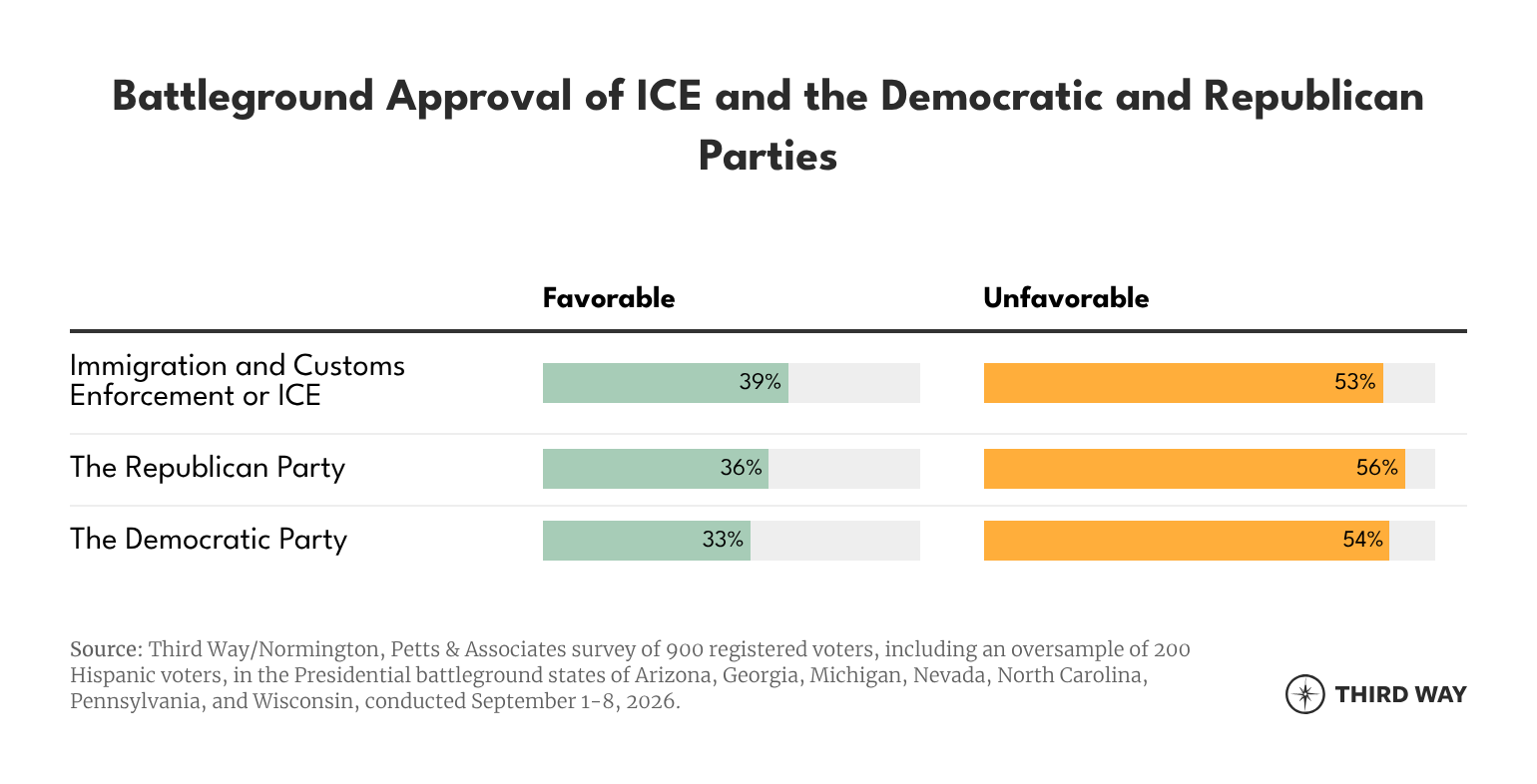
That does not make ICE popular. All three institutions are deeply underwater. But it should temper the assumption that the agency itself has become so broadly discredited that opposition to ICE is automatically a political winner.
Nor does dissatisfaction with ICE translate neatly into support for abolishing it. Asked which position comes closest to their own, six in ten battleground voters want major change: 33% say the agency requires major reforms and 27% favor abolishing it, while 40% say ICE should continue deporting people who are here illegally.
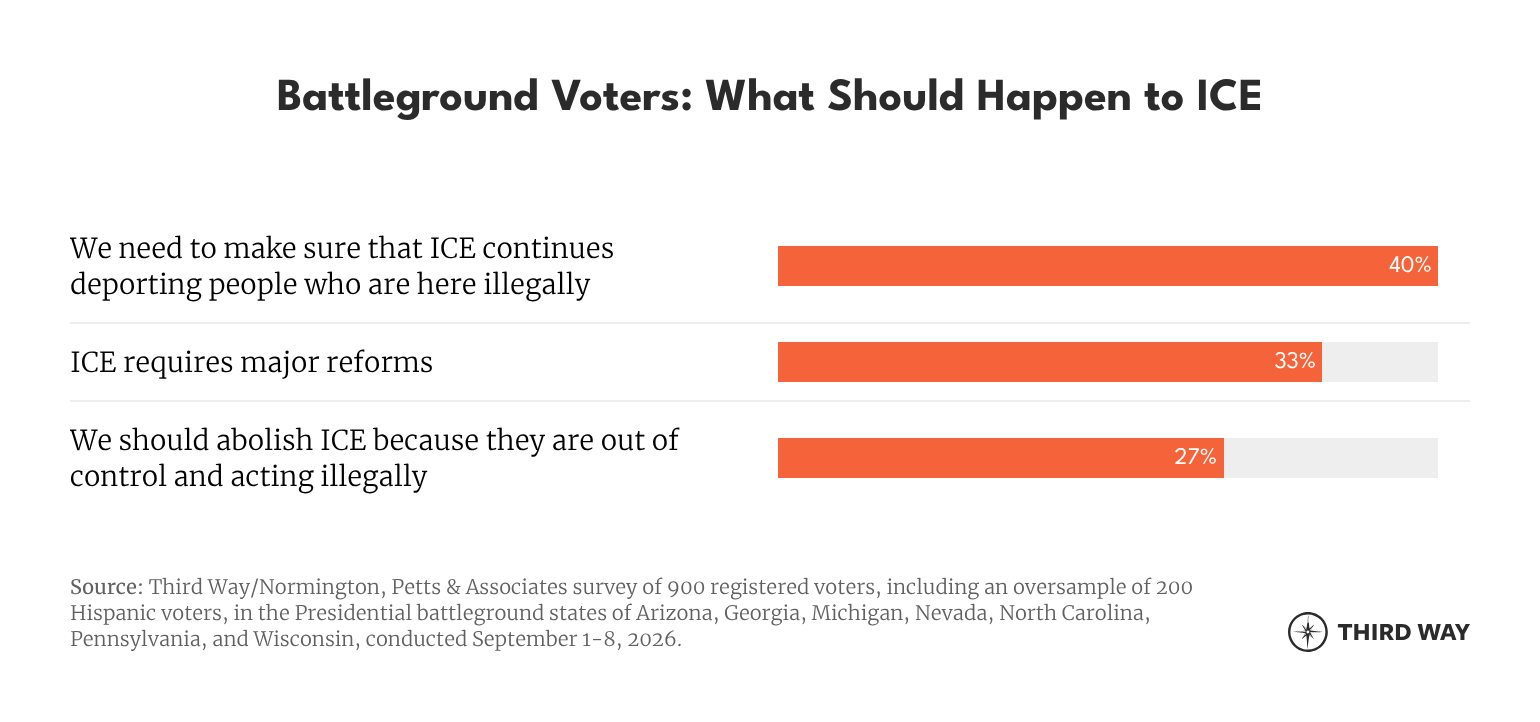
Democrats themselves are closely divided between abolition and reforms: 51% favor abolishing ICE, while 42% prefer major reforms. Independents land somewhere else entirely: a plurality (39%) want major reforms, compared with 28% who favor abolition and 33% who say ICE should continue deporting people who are here illegally.
Abolition does not generate consensus, but battleground independents and Democrats clearly want real change in how ICE carries out enforcement today. Two-thirds of battleground voters want limits on how local police cooperate with ICE: 45% say police should help only when someone has committed a violent crime, and 21% say never. And in the one statement we tested that named ICE, the phrase voters liked best was “target genuine threats.”
Immigration Feels More Like a National Problem Than a Local One
There is also a striking gap between how voters perceive illegal immigration nationally and how they experience it themselves in their local area.
Sixty-two percent of battleground voters call illegal immigration a serious problem at the national level. But only 33% say it is a serious problem in their own community. When we asked these same questions of registered voters nationally in March 2025, nearly the same split appeared: 76% called it a problem nationally and 45% called it a problem in their local communities.
That roughly 30-point gap suggests that voters’ immigration concerns are being shaped by the national conversation more than local experience. Even as the temperature on illegal immigration has turned down, it remains a powerful national concern even though voters do not see it as a pressing problem close to home.
The Immigration Vision Battleground Voters Want
To better understand what voters want moving forward on immigration, we tested nine different statements describing competing visions for our immigration system.
The results were surprisingly clear. The strongest statements were not those that chose between enforcement and generosity to immigrants. They combined the two.
Two messages earned 80% agreement, and a third earned 75%.
One began: “We are a nation of laws and a nation of immigrants. Always both.”
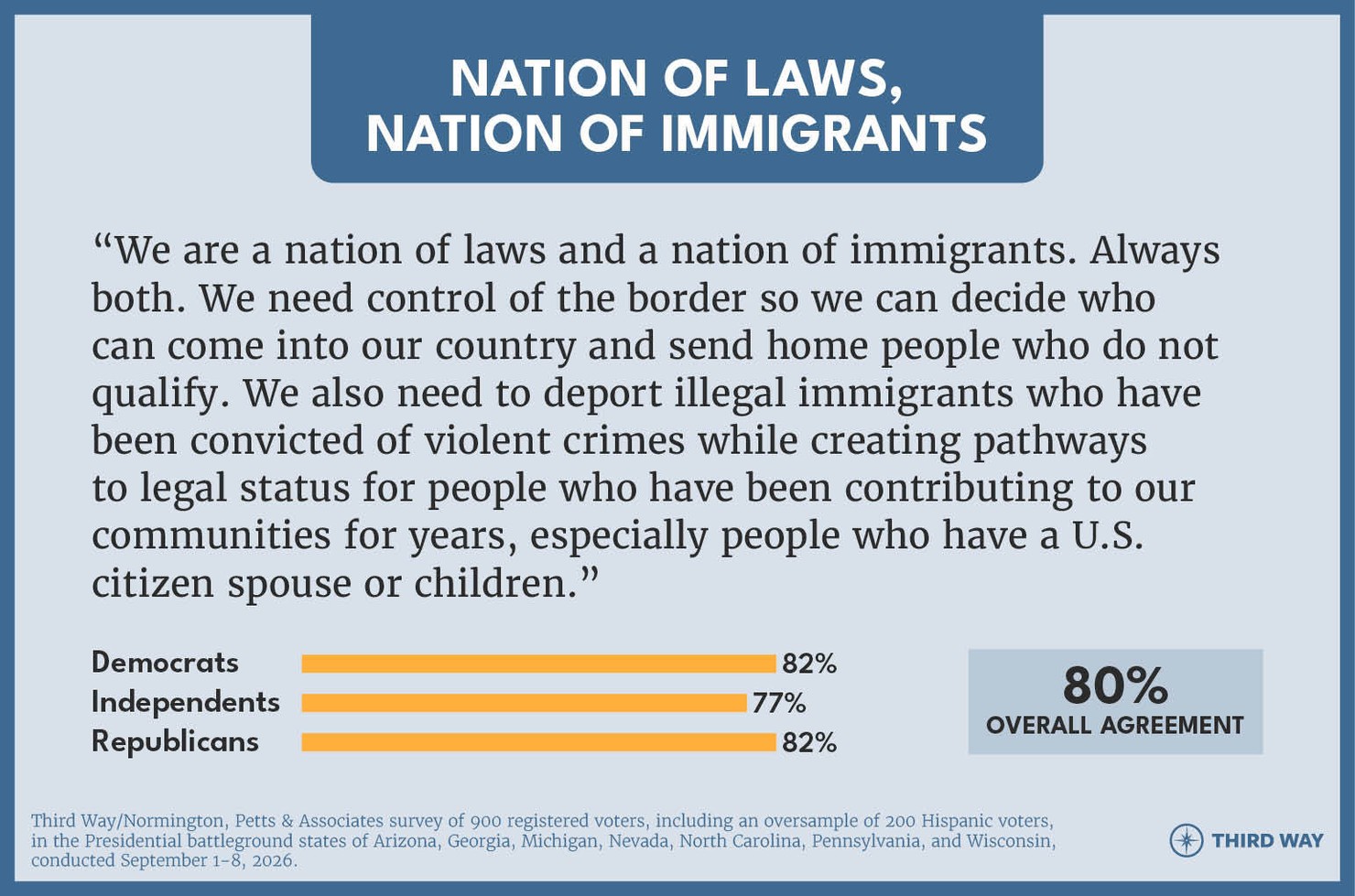
It paired control of the border and deportation of immigrants convicted of violent crimes with legal status for long-term resident immigrants who have contributed to their communities. Eighty percent of voters agreed, compared with just 15% who disagreed.
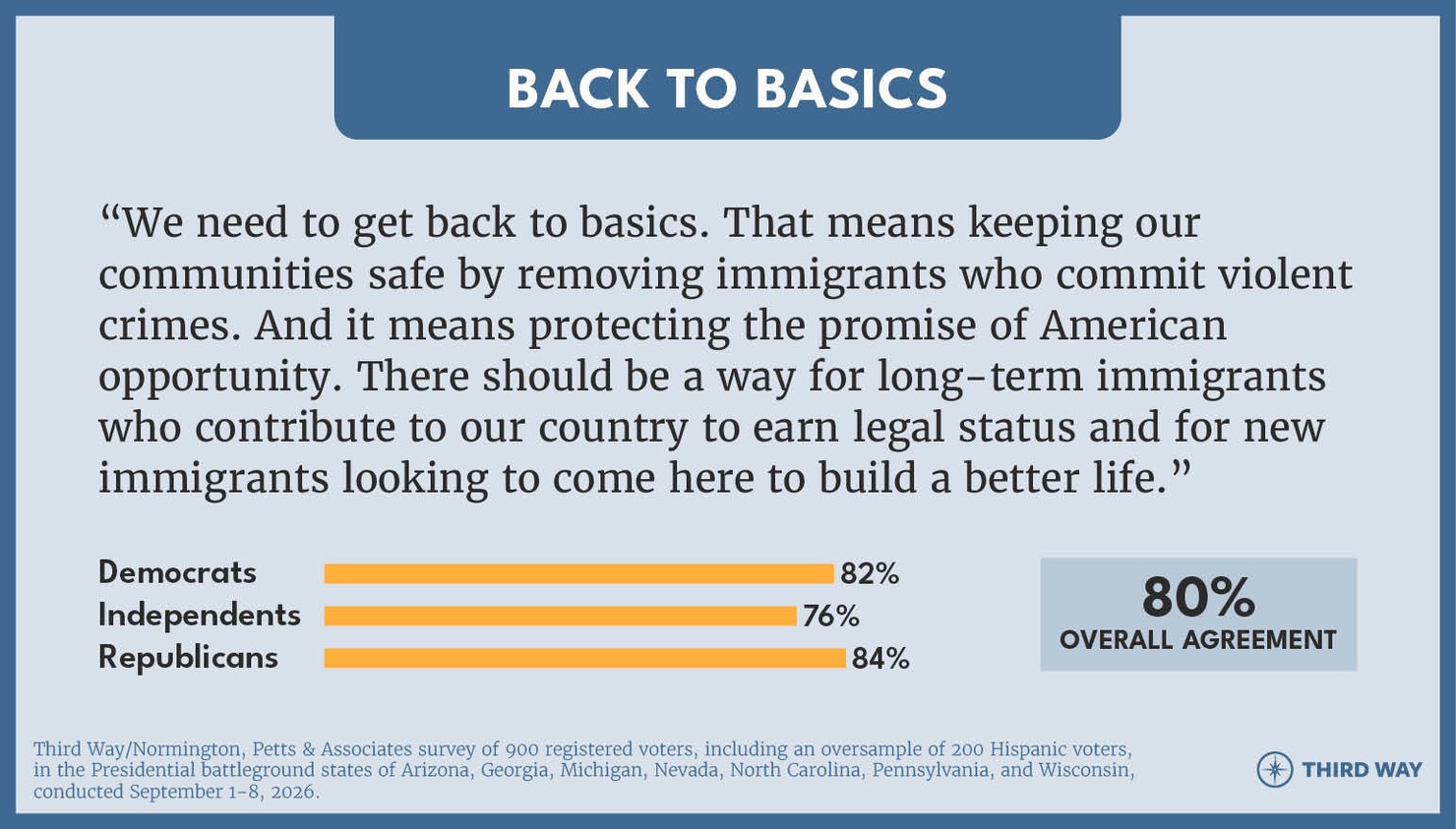
Another, also supported by 80%, started with public safety—removing immigrants who commit violent crimes—before making the case for legal status for long-term resident immigrants and opportunities for future legal immigrants.
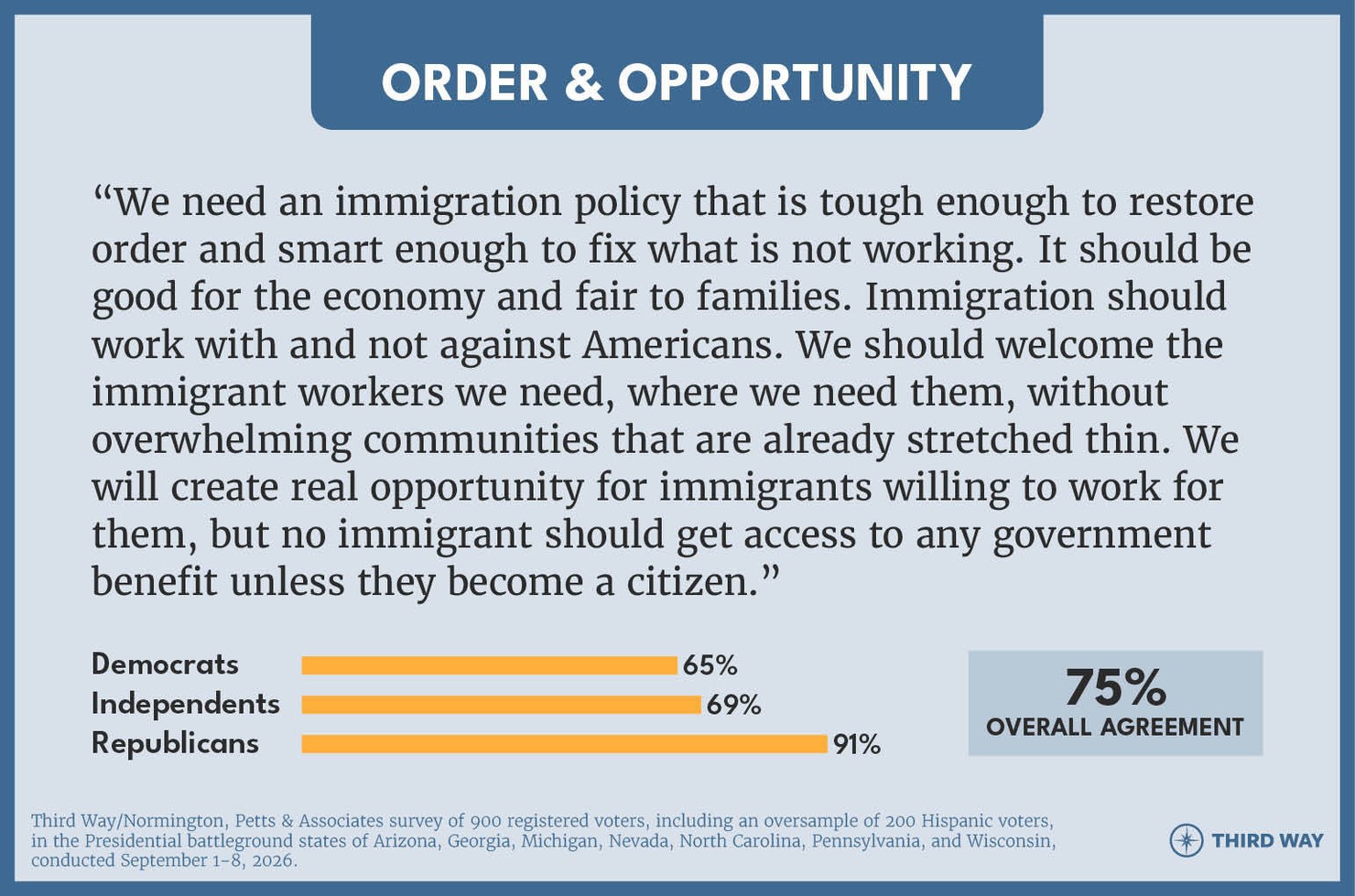
And 75% agreed with a statement calling for an immigration policy that is “tough enough to restore order and smart enough to fix what is not working,” one that welcomes needed workers without overwhelming communities and connects immigration policy directly to American economic and community needs.
These were not simply Democratic messages that Democrats liked. The two most popular messages drew broad agreement across partisan lines.
They showed that even on an issue as polarized as immigration, a balanced message can draw broad support across the political spectrum.
What the Strongest Messages Share
Across the highest-performing statements, several patterns emerged:
- They start with order. Voters gravitated to control and order, keeping communities safe, and fixing what is not working. Voters did not reject generosity or providing opportunity for existing or new immigrants. They embraced it when it came paired with clear rules and effective enforcement. Democrats need to be clear from the start that they are committed to bringing order to the border and protecting the public safety of Americans. If they do that, they can also welcome immigrants.
- They do not force voters to choose between control and decency. The best performing statements all offer a vision that is “both/and”—rejecting chaos and cruelty on the right as well as disorder and incompetence that has been associated with the left in favor of control, public safety, legal status for people who have lived here and contributed for years, and a welcome mat for those who come through an orderly, legal process. Messages that do not force voters to choose between enforcement and immigration have wide support from Democrats, Independents, and Republicans.
- They connect immigration to Americans’ interests. Two of the best-performing statements focus both on the well-being of the country and immigrants' contributions to it. One, in which 80% agreed, talks about "protecting the promise of American opportunity" and a way for long-term immigrants "who contribute to our country" to earn legal status. The other, at 75%, says explicitly that immigration should "work with and not against Americans" and ties it to the economy, families, the workers we need, and communities "already stretched thin." Voters want to know that their needs are top of mind for policymakers.
What Battleground Voters Don’t Want to Hear
The weakest-performing message was the hardest-line immigration approach we tested:
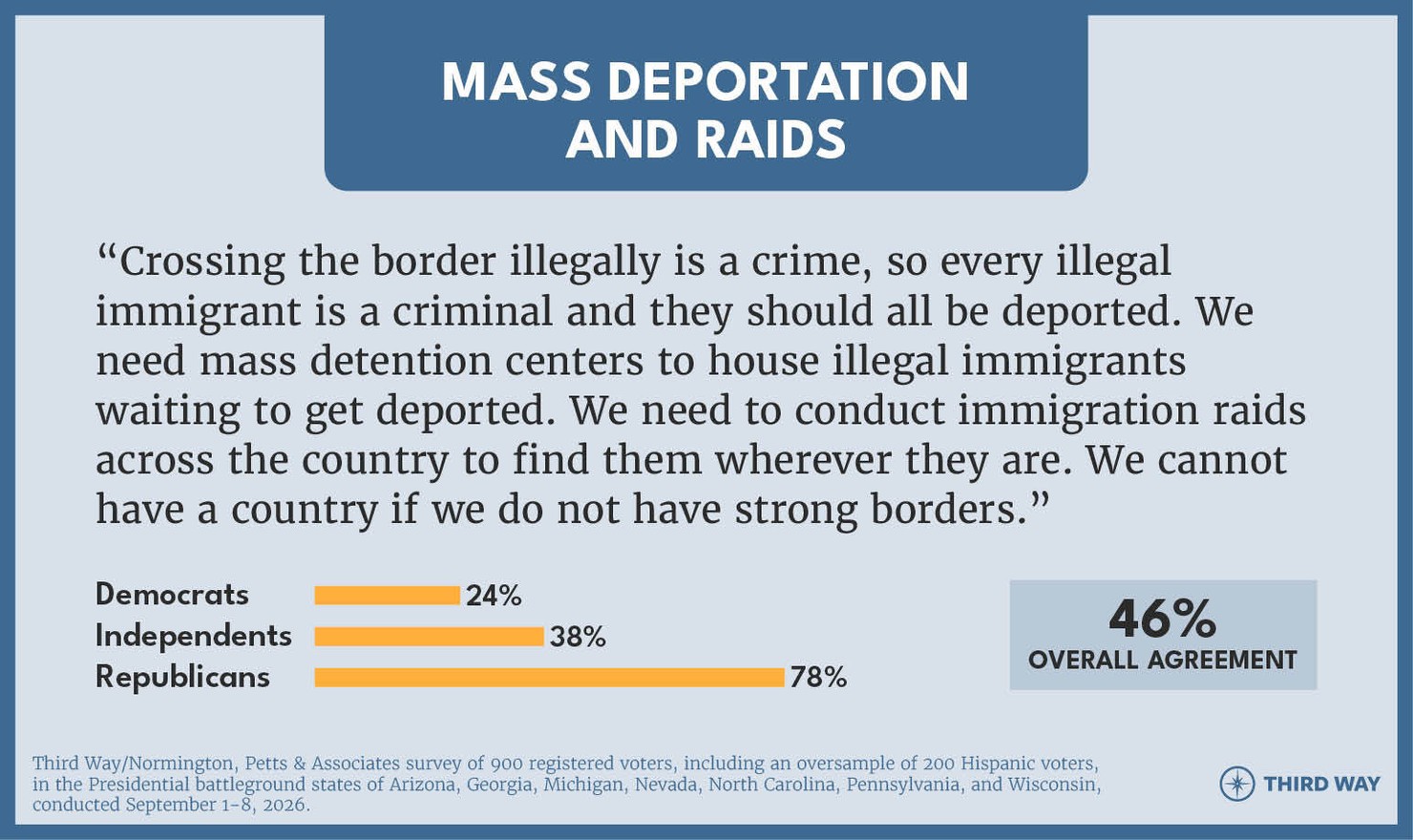
It reflected the maximalist position associated with the Trump administration—every illegal immigrant is a criminal, mass detention, nationwide raids, and more. And it was the only statement that more voters opposed than supported: 49% disagreed and 46% agreed. When voters were asked which of all nine statements they disagreed with most, 37% selected this one—more than twice the share choosing any other statement.
Between these reactions, and the 58% who disapprove of Trump’s current enforcement approach, the message is clear. Voters don’t reject enforcement. They reject the way this Administration is doing it.
Two more lessons point in a similar direction:
- Don't play the blame game. Battleground voters disliked references to both Biden and Trump. A statement explicitly arguing that “Biden got the border wrong” and “Trump got the right border results but the wrong way” was the second-most frequently rejected statement. The underlying policies in that statement were broadly similar to better-performing alternatives, but the difference was the decision to frame the argument around Biden and Trump. Democrats need to demonstrate a forward-looking immigration vision without relitigating past failures or which administration deserves the blame.
- Show compassion without leaning on the word. One statement explicitly called for “compassion” for long-term undocumented immigrants. It still earned 70% agreement, but it trailed the top messages by 5 to 10 points, and among voters who disagreed with it most, the compassion sentence was the phrase they most often highlighted in red. That does not mean that voters reject compassion. The top statements made the same humane case in plainer terms: legal status for people who have lived here for years and played by the rules. The lesson is not to abandon compassionate policies, but to describe them in concrete terms voters see as fair and earned, rather than explicitly asking voters to feel compassion for immigrants.
Voters Want a New Immigration Debate
Battleground voters have moved away from Trump’s cruelty and chaos on immigration, but they have not abandoned enforcement. Republicans retain a substantial advantage on immigration and an even larger one on border security. Voters continue to see Democrats as soft and ineffective. And outside the Democratic base, abolishing ICE is a minority position.
What voters do embrace is an immigration system that can do two things at once.
They want order: control of the border and consequences for people who pose genuine threats. They also support opportunity: legal status for undocumented immigrants who have lived here for years, worked hard, and played by the rules, and a way for new immigrants to come here legally to build a better life. The best-performing statements in this poll did not split the difference between two political extremes. They offered both, and so should Democrats.
There is strong bipartisan support for a balanced and fair vision for immigration in this country: voters see order and opportunity not as competing goals, but as parts of the same functioning immigration system. A Democrat who leans in to make that case will find willing ears from the vast majority of the battleground electorate.
About the Survey
Normington, Petts & Associates conducted this survey for Third Way among 700 registered voters in Arizona, Georgia, Michigan, Nevada, North Carolina, Pennsylvania, and Wisconsin from September 1–8, 2026, using text-to-web (21%) and online panel (79%) methods. The margin of error is ±3.7 percentage points. An oversample of 200 Hispanic voters brought the total number of Hispanic interviews to 308 (margin of error ±5.6). Data were weighted by sex, age, education, race, primary vote history, urbanicity, and 2024 presidential vote within region. Subgroup results carry larger margins of error.