Memo Published October 1, 2026 · 9 minute read
Restoring Confidence in the Supreme Court
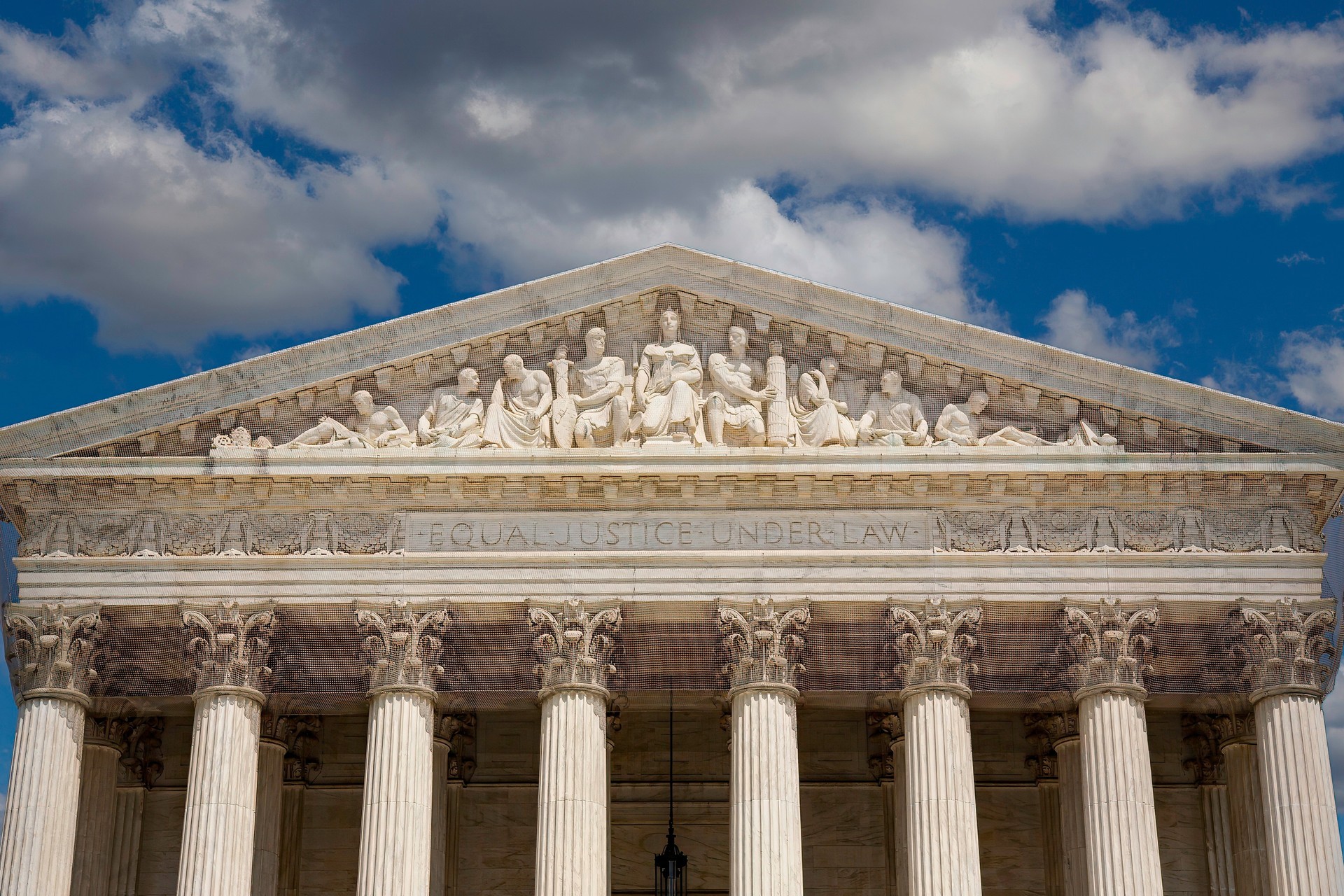
For over a decade, the Supreme Court of the United States has delivered opinions that have enraged the public, bewildered constitutional scholars, and upset precedent set by its own legal analysis. While controversial decisions are nothing new for the nation’s high court, the clear ideological motives displayed by the Justices in the current supermajority cast significant doubt on the legitimacy of our federal judiciary. As a result, the Supreme Court’s approval rating has steadily plummeted, and Americans are increasingly losing confidence in our legal system.
Congress has express authority, granted by the Constitution, to set the parameters necessary to ensure the Supreme Court fulfills its mandate to protect the rule of law and defend our democracy. According to Chief Justice John Roberts’ own admission, the Constitution’s “clear and unequivocal language is the strongest argument in favor of congressional power.” There have been several occasions in our democracy’s history where the Supreme Court found itself fundamentally misaligned with and mistrusted by the American people, and Congress took action to get the federal judiciary back on track. Our nation is once again at this crossroads, and it is time for Congress to reform the Supreme Court. Americans are eager to close this SCOTUS era—dominated by corporate entanglements, unethical enrichments, and partisan special interests—and restore balance, consistency, and fairness to the rule of law.
The Problem
The Supreme Court, and largely the entire federal judiciary, is arguably the least visible branch of the U.S. government. Americans know who the President is, and even some Members of Congress, but most struggle to recall a sitting Justice on the Supreme Court. While staying out of the public spotlight has traditionally been standard practice to reassure citizens of judicial impartiality, it has also enabled some Justices to nestle further into the shadows, beyond the reach of light and accountability.
Article III of the Constitution establishes the Supreme Court as an entity, but it leaves most details of the Court’s operations up to the discretion of Congress. The Constitution grants the legislative branch authority to set the number of Justices on the bench, define the scope of responsibilities for service on the Court, and determine the range of cases the Court may consider from the lower courts. Congress first established the size and scope of the federal judiciary with the Judiciary Act of 1789. And although changes to the courts that helped them adapt to an evolving nation were common throughout our country’s early history, Congress has not made any structural modifications to the Supreme Court since 1911.
There is no debate that the United States has progressed since the turn of the century, and the country deserves a legal system that reflects this modern era. The antiquated structure has not only stifled transparency, accountability, and forward thinking, but it has also allowed stagnation, partisanship, and corruption to flourish. Following the progress of the mid-20th century—when the Court delivered a series of societal reforms that expanded voting access, granted reproductive rights, and upended systems of racial and gender inequality—conservative special interest groups rallied to pack the federal bench with jurists who vowed not to decide cases based on existing law but to pursue an outcome-driven agenda to unravel these legal precedents. Their underhanded political maneuvers produced the current 6-3 conservative supermajority Supreme Court that has devastated pivotal voting rights laws, eliminated the constitutional right to reproductive freedom, and attacked LGBT equality. To the credit of organizations like the Heritage Foundation (authors of Project 2025), the Federalist Society, and Alliance Defending Freedom, a generation of Americans is being born into a country with fewer freedoms than their parents enjoyed.
When it wasn’t busy overturning decades of precedent and stripping away fundamental rights, the Roberts Court has been embroiled in controversial scandals that call into question the ethics of the legal authorities calling our nation’s most consequential balls and strikes. Ranging from surface-level appearances of impropriety to documented self-enriching pay-to-play, the Supreme Court’s low public approval rating can be largely attributed to the reality that many Americans believe the high court Justices are simply not just.
The Solution
Term Limits for SCOTUS Justices
To address the imbalance and unpredictability of the Supreme Court’s bench, Congress should pass term limits for judges who sit on the high court. The United States is the only constitutional democracy in the modern era that extends life tenure to its federal judges. Establishing parameters on the length of service for high court judges is not only a concept embraced by the rest of the free world, but one that consistently garners support among Americans across the political spectrum. According to a report by the Brennan Center for Justice analyzing public opinion around Supreme Court reform, 73% of respondents supported term limits for SCOTUS Justices. Furthermore, a 2024 Fox News poll found 78% of voters favor term limits, with support from Republicans growing steadily since 2022. Limitations on length of service are also widely accepted among state supreme courts, with only one state (Rhode Island) allowing judges to serve life tenure.
Congress should enact legislation that would create an eighteen-year term limit for active service on the Court, where only the nine most recently appointed Justices would hear appellate cases from the lower courts (the majority of SCOTUS cases). After eighteen years of sitting for all cases, Justices would then be elevated to senior status until retirement, tasked with only hearing cases of original jurisdiction, as consistent with the Constitution. This cycle would allow for the appointment of two Justices every presidential term, significantly equalizing a process that has grown so politicized that some Presidents had no opportunities for a SCOTUS nomination while others have appointed one nearly every year of their term. Lawmakers who have championed Supreme Court reform for years have already introduced such proposals in the House and the Senate.
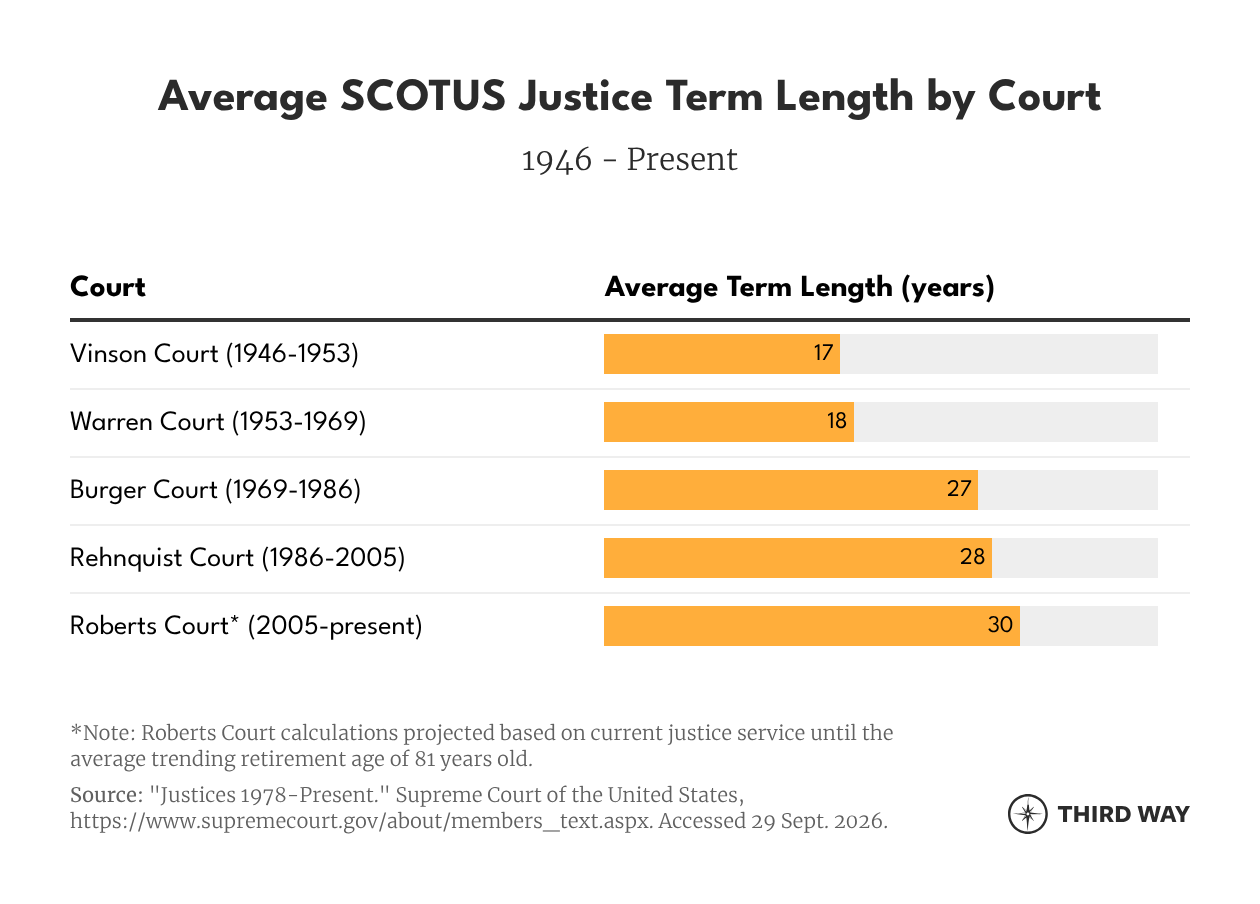
Implementing an eighteen-year term limit for SCOTUS Justices offers a common-sense solution to a literal age-old challenge. The average term length for SCOTUS Justices has steadily increased since the 1950s, with current Justices projected to serve an average of 30 years on the bench, if retirement age trends hold.
Very few professions encourage laboring into one’s twilight years, especially when physical and mental faculties have diminished. Moreover, the ability for Presidents to systematically select appointments to the Court would remove the elements of dramatic political theater that have dominated past SCOTUS appointments and restore integrity and stability to the solemn process. Americans deserve a Supreme Court comprised of the most astute and forward-thinking legal minds the country has to offer, not relics from the past too enamored by power to relinquish it. Enacting restrictions on SCOTUS Justices’ terms of service would restore that reality for generations to come.
Enforceable SCOTUS Code of Ethics
Throughout history, the Supreme Court has assumed the grueling task of policing its own behavior, a benefit afforded to no other judicial body in the country. Even lower court judges in the federal judiciary are required to adhere to a code of conduct, complete with actual enforcement mechanisms. Currently, no such rules apply to the Supreme Court, and prior to 2023, Justices refused to even entertain notions of holding themselves accountable. But after public reporting of Justices receiving expensive gifts from donors, displaying anti-democracy emblems, and being closely associated with conspirators of the January 6th insurrection, Chief Justice Roberts determined it necessary to establish rules. However, his Code of Conduct for Justices of the Supreme Court, released in November 2023, reads more like a helpful how-to guide for judicial etiquette than a manual of requirements for terms of service, offering no system of accountability or reprimand for violation.
This grave lack of oversight is inconsistent with the rule of law and offensive to our democracy. SCOTUS Justices can, and must, be held to the utmost ethical standards expected of every other public official with influence over our rights and freedoms. Congress must enact legislation installing ethics accountability guardrails for the Supreme Court, removing oversight and enforcement mechanisms from the bench and placing them where they belong—in the hands of the American people. This would require SCOTUS to adopt an adequate code of conduct, subject to the public notice and comment process; implement rules restricting the receipt of gifts and requiring disclosure of any income, reimbursements, or travel received by Justices and their staff; and create a comprehensive process for recusals, specifying the circumstances that warrant recusal and requiring written explanation for recusal decisions. Congress must also authorize an independent enforcement commission to investigate ethics violations and hold SCOTUS Justices accountable to the highest standards of the law.
Enacting a tangible mechanism for ethical oversight over the high court is imperative for the restoration of fairness in decisions around the nation’s most delicate constitutional challenges and the renewal of public confidence in the judiciary. Congressional leaders have already proposed bicameral legislation that would achieve this crucial endeavor, and lawmakers on both sides of the aisle should wield their constitutionally mandated power to implement these necessary reforms.
Conclusion
While there may have been a time in decades past when the Supreme Court could be trusted to hold itself to standards and expectations worthy of the highest court in the land, those days are dead and gone. The Roberts Court has cemented the fact that the Court’s modus operandi is no longer acceptable for a healthy democracy, and significant reforms are required to rein in the usurpation of unparalleled judicial authority. Congress must act with all deliberate speed to revive the Supreme Court’s legitimacy and restore the people’s faith in this vital