Report Published April 16, 2026 · 19 minute read
A System Out of Sync: Family Benefits in America
Olivia Newman & Rory Gaudette

Takeaways
- Many families rely on public benefits to support their basic needs but struggle to navigate a complex and fragmented system.
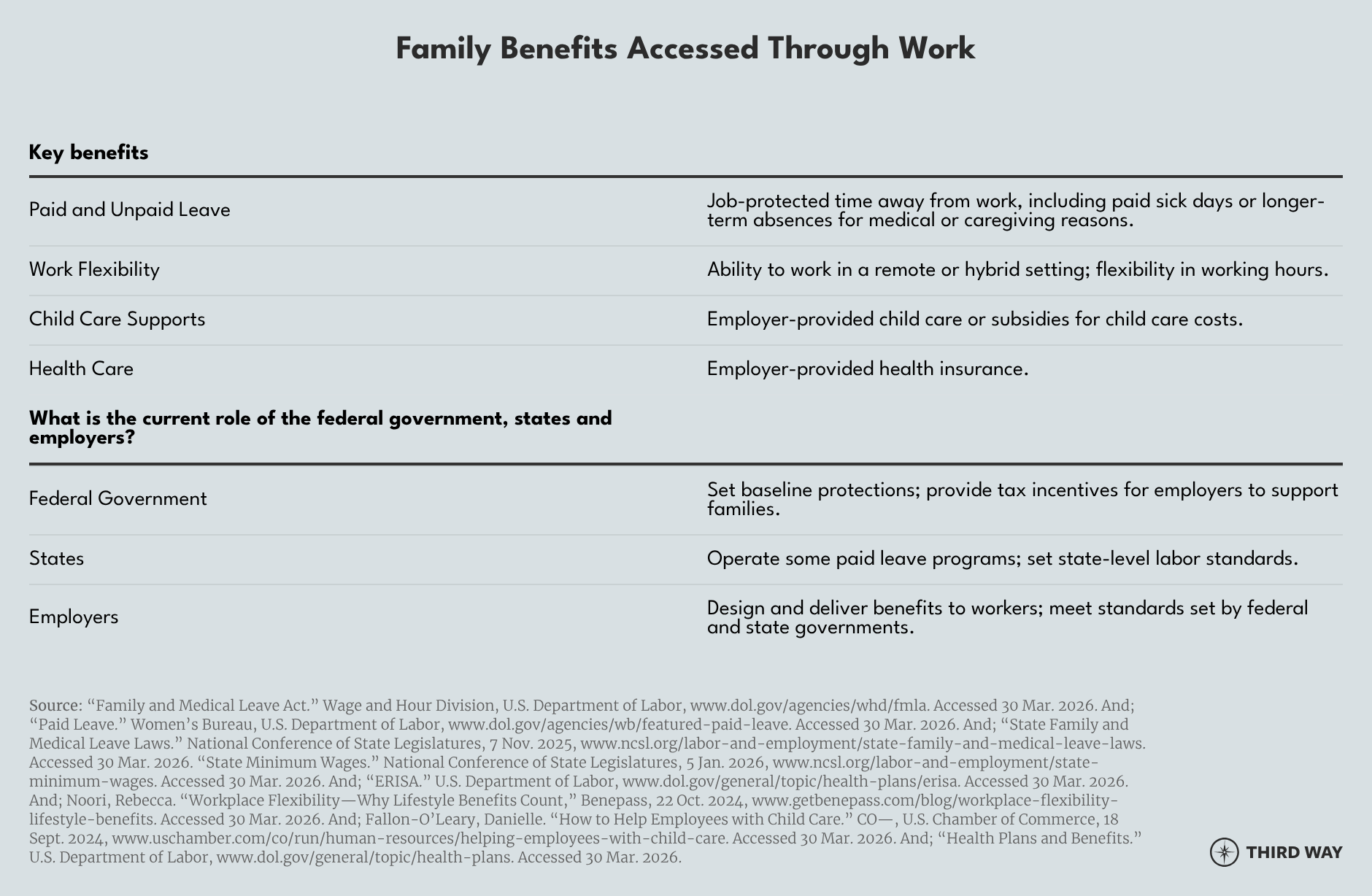
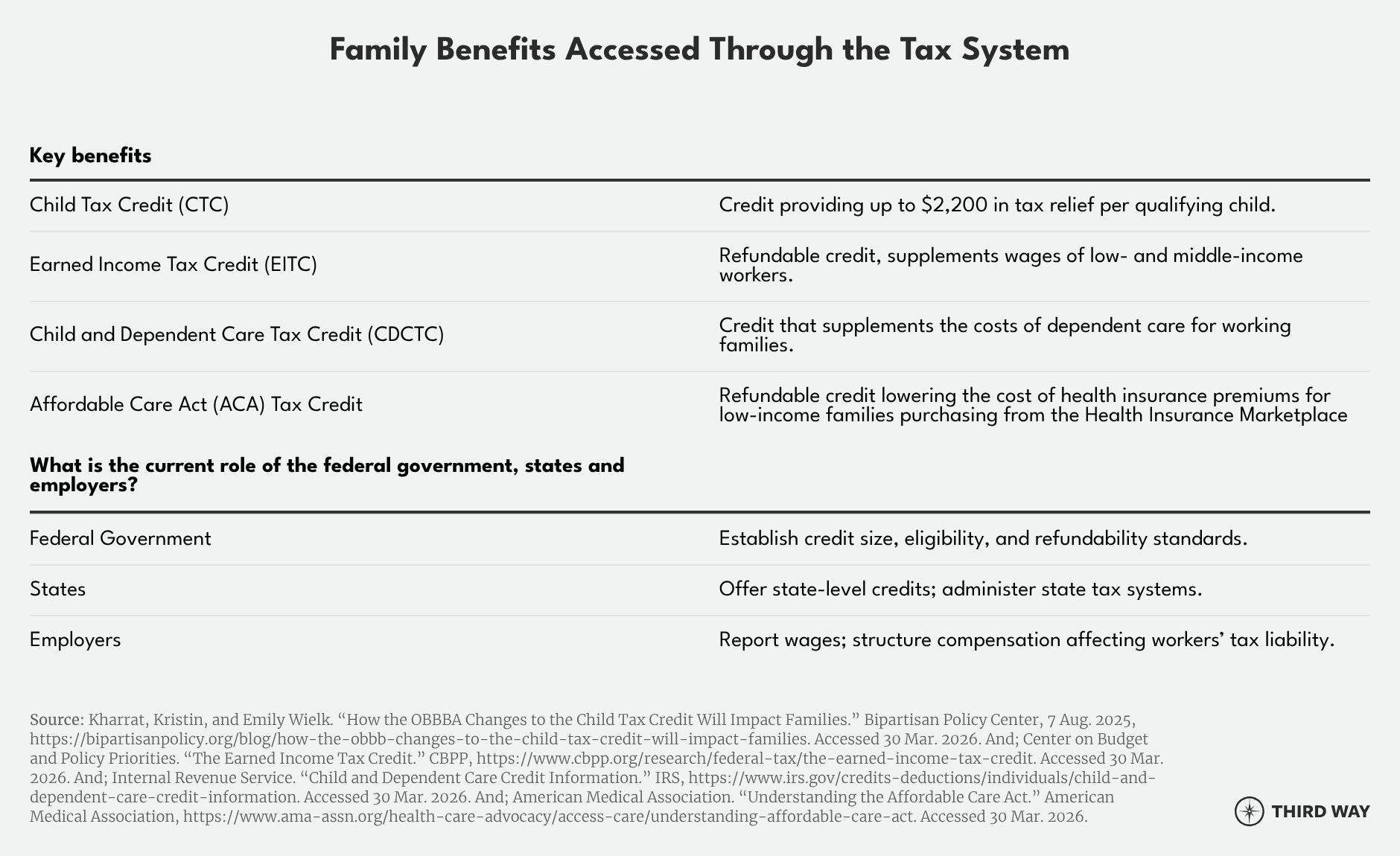
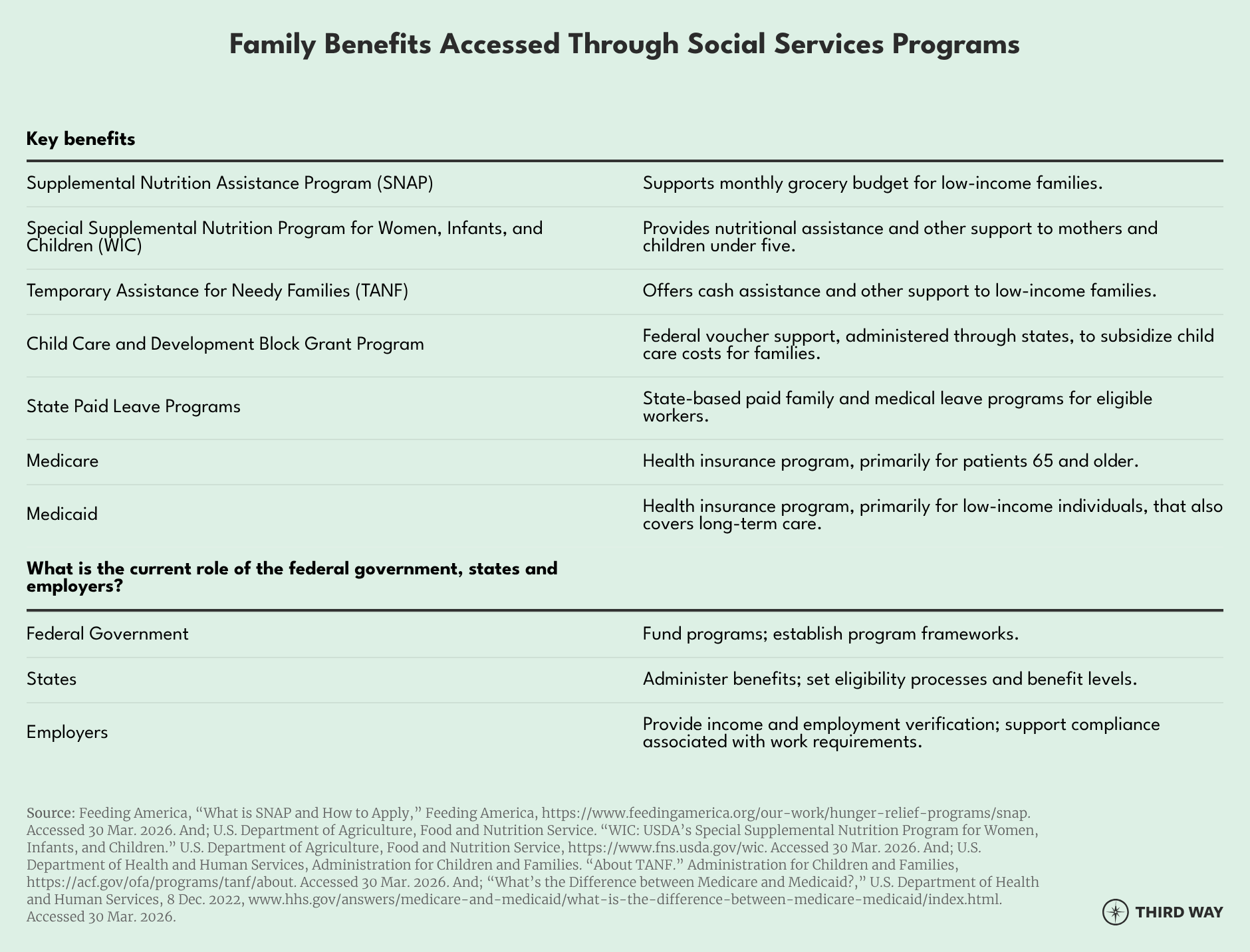
- Federal agencies, states, and employers dictate how and where families get benefits. Families access those benefits through their workplaces, the tax system, and social service programs.
- This patchwork of authorities creates alignment problems—including administrative complexity, misaligned eligibility rules, timing mismatches, and uneven access—that reduce the effectiveness of benefits for families.
- Policymakers can simplify and standardize the benefits system to improve support for families.
For nearly a century, children and families have been at the center of public and private assistance programs in the United States. From the 1935 Social Security Act to present-day tax credits, working families have relied on benefits to afford necessities, navigate caregiving, and weather unstable economic times.1 Yet these supports were built across different institutions and policy domains, often without coordination. The result is a fragmented system that can be difficult to navigate, uneven in who it reaches, and misaligned in how benefits are delivered.
This report outlines how families access benefits—through employers, the tax system, and social service programs—and examines four structural challenges that limit these systems’ effectiveness. We also offer important insights for policymakers to consider as they try to improve and better align these systems.
How Families Access Benefits
Although families may only see benefits when they access them, the behind-the-scenes journey to delivery involves many different institutions. The way benefits and programs are funded, administered, and delivered look wildly different. There are three entities that share responsibility for how and where families get benefits:
- The Federal Government: Funds many of the benefits available to families and establishes budgetary thresholds. It also sets national benefit and labor standards, such as the federal minimum wage.
- States: Frequently administer benefits to families and play a role in determining eligibility and benefit rates.
- Employers: Facilitate some benefits for families—such as health insurance and family leave—and verify workers’ eligibility for benefits.
In practice, families most often encounter benefits through three primary access points, which each function uniquely and serve distinct populations. They are:
- Work: Employers play a central role in providing a wide variety of family benefits to workers.
- Tax System: Tax-based incentives are used by millions of families to help cover the cost of raising children, manage caregiving responsibilities, and supplement lower incomes.
- Social Service Programs: These programs primarily target economically struggling families, helping them to meet their basic needs and weather unstable times.
Four Benefit Alignment Problems
While benefits target different populations and parts of the system, they collectively provide critical support to working families. Unfortunately, families continually encounter challenges that limit the effectiveness of benefits. Understanding these problems and their impacts is the first step to improving the system. Below we highlight how four key benefit alignment problems impact families and ways policymakers can address these issues.
1. Administrative Complexity
Even when benefits are designed well, administrative burdens can prevent eligible families from accessing and retaining support. Complex rules, duplicative paperwork, and frequent recertification requirements make it hard for families to get the benefits for which they qualify.
Where Families Face Barriers
Program rules are hard to follow. Families must often interpret a mix of federal, state, and employer policies to determine whether they qualify for key benefits. Paid leave policy reflects this complexity: access depends on interactions between the Family and Medical Leave Act (FMLA), state-level programs, and employer-provided benefits. FMLA guarantees unpaid leave only for eligible workers at covered employers. State programs vary widely in eligibility requirements, wage replacement rates, and application procedures. Employer policies add yet another layer of variation. This leaves workers to decipher what type of support they may be eligible for and where the benefits may come from, all while navigating stressful moments like the birth of a child or a serious illness.
Paperwork requirements can be toilsome. To receive benefits for programs such as Medicaid and the Supplemental Nutrition Assistance Program (SNAP), applicants must provide extensive documentation, including proof of income, household composition, and other financial records. This can be difficult for many families, especially those with fluctuating work schedules, unstable housing situations, or limited English proficiency. Even minor administrative issues, such as missed mail notices or difficulty uploading documents to online portals, can delay benefits or close cases for eligible families.2
The burden of renewal can lead to loss of coverage. Most benefit programs require periodic recertifications for families to maintain eligibility, but these can be tedious and burdensome. During the COVID-19 pandemic, administrators temporarily paused Medicaid eligibility renewals, allowing recipients to maintain their coverage without resubmitting documentation, a process that is normally required each year.3 After these changes, Medicaid enrollment increased by 32.4%. When renewals resumed in 2023, most of those gains disappeared, with estimates suggesting 70% of the disenrollments were due to procedural barriers.4
Administrative requirements like renewal processes impose what has been described as a “time tax” on families.5 Americans collectively spend billions of hours each year navigating government paperwork and administrative processes. For low-income families, the cumulative time spent filling out forms, locating documents, waiting on hold, and attending appointments can take multiple work days, with the burden falling most heavily on those with the least flexibility in their work schedules.
Policy Options
Create a common enrollment system. A unified enrollment platform, which could be federally run or guided by a national framework, would allow families to apply for multiple benefit programs through a single interface. This would reduce duplicative applications and eliminate the need to repeatedly submit the same documentation to different agencies.
Establish automatic enrollment across programs. Once a family’s eligibility is verified for one income-based benefit, that information could be used to determine eligibility for related programs via automatic enrollment. By ensuring one application triggers enrollment across related programs, families would be able to receive the full range of benefits for which they qualify.
Put one agency in charge of helping families across programs. Instead of requiring families to interact with multiple agencies with differing rules and procedures, policymakers could designate a lead agency responsible for coordinating access across programs. A central agency could facilitate case management and provide application support, helping families navigate the benefits system and reducing duplicative administrative work. Some states, including New Mexico and Minnesota, have already started centralizing the management of care programs to better support families. A federal agency could standardize these state-level efforts and widen their impacts.
Modernize systems, coupled with support. Modernizing benefit systems can improve access, but the creation of digital platforms alone is not enough. When states shifted unemployment insurance applications from paper to online, participation did not automatically increase as one might have expected.6 By contrast, successful support models combine digitalization with guidance and outreach efforts. The implementation of electronic filing systems and tax preparation assistance for the Earned Income Tax Credit (EITC) exemplifies this—helping to guide users through eligibility questions and calculations in online applications.7 Digital application tools should be combined with other outreach techniques to ensure families understand how to access and use benefit systems effectively.
2. Misaligned Eligibility Rules
Family benefit programs are administered by federal agencies, state governments, and employers—each of which sets its own eligibility criteria. As a result, programs often use different income limits, work requirements, and varying definitions of what constitutes a household. These inconsistencies can make it difficult for families to determine whether they qualify for assistance and create situations where even small increases in income lead to a sudden loss in benefits.8
Where Families Face Barriers
State variation can create confusing eligibility thresholds. Many federal programs give states significant flexibility in setting their own eligibility rules, which leads to wide variation in benefit access. Child care subsidies provided under the Child Care and Development Block Grant (CCDBG) illustrate this challenge.9 While federal rules prevent families earning more than 85% of their state median income (SMI) from receiving vouchers, states can adopt stricter thresholds. Illinois, for example, caps eligibility at 61% of SMI.10 In states like Illinois, not only do lower caps mean fewer families qualify for aid, but more families are at risk of experiencing “benefit cliffs” where even a tiny pay raise can cause a household to lose access to support.
Overlapping public and private insurance rules can raise costs for families. The US health insurance system combines public programs with employer-sponsored coverage, which can make navigating eligibility and costs difficult for families relying on both. For example, Medicaid typically serves low-income Americans. At the same time, many workers receive coverage through employer-sponsored plans that share premium costs between employers and employees.11 Some families attempt to combine these options to minimize costs—a parent may enroll their children in Medicaid while receiving insurance themselves from their employer.12 However, different eligibility rules and cost structures can create unexpected financial burdens. In some cases, policy changes affecting premium tax credits or Medicaid eligibility thresholds can increase premiums for families who previously relied on a mix of coverage sources.
Workers and employers must navigate inconsistent benefit rules in different states. When benefits are regulated primarily at the state level, workers who work or live across state lines may struggle to determine which rules apply. Paid family and medical leave (PFML) programs at the state level highlight this issue. Since the federal government has not implemented a comprehensive paid leave policy, states have created their own programs and policies with unique eligibility rules.13 Currently, eligibility for state PFML programs typically depends on where an employee works rather than where they live. For example, someone living in Minnesota but working primarily in Wisconsin may be denied paid leave to care for a sick family member because Wisconsin currently doesn’t offer a paid leave program.14
Eligibility for one benefit may cannibalize access to another. Different benefit programs can interact in ways that unintentionally limit the total amount of support families receive. Considering that around 16% of adults and 33% of children in the United States participate in multiple social safety net programs, these interactions pose serious risks.15 The rules for each benefit type often overlap and contradict one another, forcing many families to choose between social services. For example, families may qualify for both the Dependent Care Assistance Program (DCAP), which lets working parents use some of their pre-tax wages for child care, and the Child and Dependent Care Tax Credit (CDCTC), which lets families reimburse some child care expenses through the tax code.16 However, current rules require families to subtract DCAP contributions from their eligible benefit amount through the CDCTC. So, for a parent with one child, receiving $10,000 through DCAP could eliminate their eligibility for the CDCTC entirely.17 The interaction between these two provisions penalizes working families who want to take advantage of employer-sponsored child care benefits.
Policy Options
Ease benefit cliffs. Gradually phasing out benefits when income rises would prevent families from experiencing sudden and substantial drops in support. Maine implemented this exact approach when they modified rules in the Temporary Assistance for Needy Families (TANF) program to exclude an enrollee’s first month of income at a new job from impacting their eligibility.18 This helps smooth the transition for workers when taking on a new role. Similarly, federal policymakers could ensure that more benefit programs offer continuous, year-long coverage for recipients of all ages to help them weather income fluctuations or other life changes. Currently, Medicaid is federally mandated to provide continuous eligibility for children under 19, and some states have been approved for waivers to offer the same to certain adults.19 Enshrining this approach into other benefit programs would provide stability and security to families during times of change.
Encourage interstate coordination of benefit programs. Even in situations where states maintain control over their programs, federal policymakers can help them align eligibility rules and administrative standards to ease burdens on employers and workers. To address the complications arising from a patchwork of state paid leave programs, for example, the bipartisan House Paid Family Leave Working Group proposed the Interstate Paid Leave Action Network (I-PLAN).20 The network would help states develop shared definitions, best practices, and administrative standards for paid leave programs across the country.21 By implementing I-PLAN (and similar coalitions for programs like SNAP or TANF), federal policymakers can reduce regulation overlap and minimize confusion for families.
Review and align federal program regulations that conflict with one another. Policymakers can conduct a comprehensive review of federal benefit programs to find regulations that may unintentionally reduce access to support. In cases where program interactions minimize the impact of benefits—like the earlier example of DCAP and the CDCTC—legislators could revise rules so families can take advantage of both provisions.22
Expand access to benefit navigation. Even when regulations remain complex, the federal government can fund benefit navigators to help families understand how programs interact and avoid unintended losses of assistance.23 Navigators would guide applicants through eligibility rules and regulations to make informed decisions about which benefits best suit their needs.
3. Timing Mismatches
The effectiveness of family benefits often depends not only on how much support they provide, but also on when that support becomes available. The timing of benefits may not align with when families need assistance, as some are delivered only once per year while others require workers to meet employment tenure requirements. These timing gaps can leave families without support when they need it most.
Where Families Face Barriers
Annual tax benefits don’t support month-to-month financial stability. Tax credits like the Child Tax Credit (CTC) and EITC help working families navigate the costs of everyday life. Families primarily use these credits to purchase staples like rent, groceries, and child care.24 But because they are paid out annually rather than periodically, these credits aren’t as effective as they could be. For example, a single mother earning minimum wage receives 36% of her total post-tax annual income via the EITC and CTC, making a huge portion of her income unavailable until tax season.25 Receiving this support once a year means she is less equipped for expensive emergencies and more vulnerable to accumulating debt. For families that heavily rely on these credits, this timing mismatch could push them further into poverty.
Employment tenure requirements limit access to job-protected leave. Eligibility rules for job-protected leave can also create timing challenges. To be eligible for unpaid leave under FMLA, workers must be employed by their current employer for at least 12 months and have worked a minimum of 1,250 hours.26 These rules mean new hires, seasonal employees, and workers with irregular schedules are typically excluded. As a result, individuals experiencing major life events—such as the birth of a child or a family medical emergency—may find themselves ineligible for job-protected leave. This lack of support also makes it that much harder for workers to stay connected to the workforce in the long-term.27
Time limits on benefits can create an abrupt loss of support. Some programs limit how long individuals can receive benefits without meeting specific work requirements. For example, certain adults can receive SNAP benefits for only a total of three months over a three-year span unless they can demonstrate at least 20 hours of work a week. Historically, exemptions existed for particularly vulnerable groups and areas with limited job opportunities.28 The One Big Beautiful Bill Act (OBBBA) recently eliminated many of these exemptions and restricted states’ ability to waive time limits in struggling labor markets. As a result, many recipients will lose food assistance despite their continuing need.29
Policy Options
Lower federal tenure requirement for job-protected leave under FMLA. By lowering the eligibility requirements of FMLA, policymakers could expand access for workers who currently fall outside the program’s protections. Instead of the existing strict employer tenure and hours-worked requirements, lawmakers could consider modifying FMLA eligibility to focus on earnings collected over a period of time. For example, Ohio currently requires workers to earn at least $1,000 in the 12 months before they apply for unpaid leave.30 If workers pass that threshold, they can take leave regardless of how long they have been employed at their current company.
Allow payments to be issued throughout the year. Another timing gap could be addressed by allowing tax credits (like the CTC and EITC) to be issued throughout the year rather than as a single annual payment. Embedding opt-in periodic payments of these credits into the tax code would be a low-cost administrative change with high impact. It would stabilize month-to-month income for many households while ensuring they are better equipped to handle recurring and unexpected expenses.
Ensure benefit timelines align with families’ needs. More broadly, policymakers can review program timelines and eligibility thresholds to ensure that benefits are available when families need them most. Adjusting eligibility rules, reducing waiting periods, and aligning benefit delivery schedules with typical household expenses can help ensure that support arrives at the moments when families are most vulnerable.
4. Uneven Access
Access to benefits often depends on where in the country families live. While many programs are federally funded, states have a lot of power when it comes to determining eligibility, benefit levels, and how benefits are administered. As a result, families with similar incomes and needs may receive different amounts of support based on where they are located.
Where Families Face Barriers
Coverage gaps in non-expansion Medicaid states hurt middle-class families. The Affordable Care Act (ACA) allowed states to expand Medicaid to households earning up to 138% of the federal poverty level (FPL).31 Since the policy took effect, 40 states and Washington, DC have since adopted the expansion, improving health access and outcomes for millions.32 However, in the 10 states that didn’t expand Medicaid, 1.6 million people live in what’s known as a “coverage gap.” They earn too much to qualify for Medicaid but too little to afford private insurance or get existing ACA subsidies.33 As a result, a family of three living in an expansion state like Pennsylvania might qualify for Medicaid but become uninsured after moving to Florida.34
Benefit levels vary widely across states. State-level policymakers determine the size and structure of many benefits including SNAP, TANF, and state tax credits. This means there is significant geographical variation in support for families across the country. A family of three in Alabama, for instance, can receive a maximum of $215 per month in TANF benefits, while in Minnesota they would be eligible for up to $1,370.35 While the cost of living differs between these two states, the gap in aid actually widens when accounting for different economic circumstances.36
Differences also exist in state-level tax credits, with 31 states and DC offering their own EITCs and 17 states offering their own CTC.37 Some are non-refundable—if a family’s earnings are so low that they don’t owe taxes, they won’t receive the tax benefit. Additionally, families living in states without any state-level credits find themselves relying on federal versions alone.38
Patchwork paid leave policies leave many without coverage. Since there is not a comprehensive national paid leave policy, many states have adopted their own approaches. Currently, 20 states and Washington, DC mandate paid sick leave, and 13 states and DC require employers to provide paid family and medical leave.39 Workers living in these states can access paid leave regardless of whether their employer offers it, while workers in states without programs must count on their employers choosing to provide it voluntarily.40 The employers that have paid leave are usually large, well-funded, and mainly offer the benefits to full-time workers, leaving many workers without needed support.41
Policy Options
Make health insurance affordable for Americans in the coverage gap. Federal policymakers can help people stuck in the coverage gap access health insurance. House Democrats presented a few options in the 2021 Build Back Better Act (H.R. 5376). For example, lawmakers could establish a separate, federally managed Medicaid program to serve those in non-expansion states.42 The new initiative could function like the existing Medicaid program, using the same eligibility and drug pricing rules.43 Lawmakers could also lower the income qualification threshold for existing ACA subsidies. Right now, only households earning at least 100% of the FPL qualify for these subsidies.44 By lowering the eligibility floor, Congress can get low-cost or no-cost coverage to more families.45 Enacting either of these policies would expand health care access to millions of uninsured Americans.
Strengthen federal family tax credits. Improving federal tax credits could reduce disparities we see in support across states. Making the CTC fully refundable so that eligible families can receive a refund even if they don’t owe any taxes would ensure the lowest-income families get the full value of the benefit.46 Similarly, federal policymakers can increase EITC benefit levels for families with young children just as Maine, Colorado, and New York did.47 This could ensure that, regardless of where they live, eligible children have equal access to support that could lift them out of poverty.
Support the growth of state paid leave programs. Federal policymakers could also expand access to paid leave by supporting the development of state-level programs and initiatives. This could mean providing start-up funding for states to get through the costly implementation phase. Maryland, for instance, has pushed back its PFML start date three times, citing both state and federal budgetary issues as the reason for the delay.48 The federal government could also set baseline standards for benefit levels and eligibility. Federal support would encourage more states to participate, expanding coverage to more states and workers.
Conclusion
Benefits for families can improve public health, reduce financial insecurity, and boost the overall economy.49 However, the patchwork of federal, state, and private policies that regulate these benefits in the United States make navigating and accessing support much too difficult. With so many different access points and agencies with varying policies, families frequently face an overload of administrative tasks and confusing, misaligned eligibility rules. Struggles are further intensified by issues like timing mismatches and uneven benefit access, both of which exclude scores of families from obtaining much-needed support.
Federal policymakers have several opportunities to significantly improve the benefits system for families. By simplifying benefit applications and delivery, encouraging standardization around eligibility and access, and strengthening existing federal policies to better meet families’ needs, lawmakers can increase both benefit access and quality of life for families across the country.