Memo Published October 19, 2026 · 13 minute read
Voters are Clear: Costs are the Signal
This September, Third Way worked with GBAO to conduct a survey of 2,000 registered voters nationwide. This is the fifth iteration of our Signal project series, in which we evaluate issue salience to separate the signal from the noise amid the chaos of the second Trump administration.
Overall, we see a continuation of voters’ declining trust in and approval of the Trump administration, though this round of research saw rising opportunities for Democrats.
- Trump’s approval ratings continue to shrink, with a third of his voters now saying his presidency is going worse than expected.
- With high inflation and budget deficits, voters are most concerned with policy issues related to rising costs—from Iran and gas prices to rising healthcare premiums.
- Voters now trust Democrats more than Republicans on nearly all major issues, driven by advantages on economic issues, including traditional Republican strengths such as taxes and the national debt.
- If they gain power, voters want Democrats to enact strong, commonsense policies on today’s most pressing issues—not ideologically-charged policies associated with Democratic Socialists of America (DSA).
Fall 2026’s Political Moment
It’s no surprise that as the cost of living continues to rise, and with it voter pessimism and frustration, Trump’s approval rating continues to plummet. Across several measures, Trump’s Republican coalition is fracturing and losing trust in its leader, as reflected in the MAGA movement’s net favorability overall (-31) and declining favorability of MAGA even among conservative Republicans (+53 to +45).
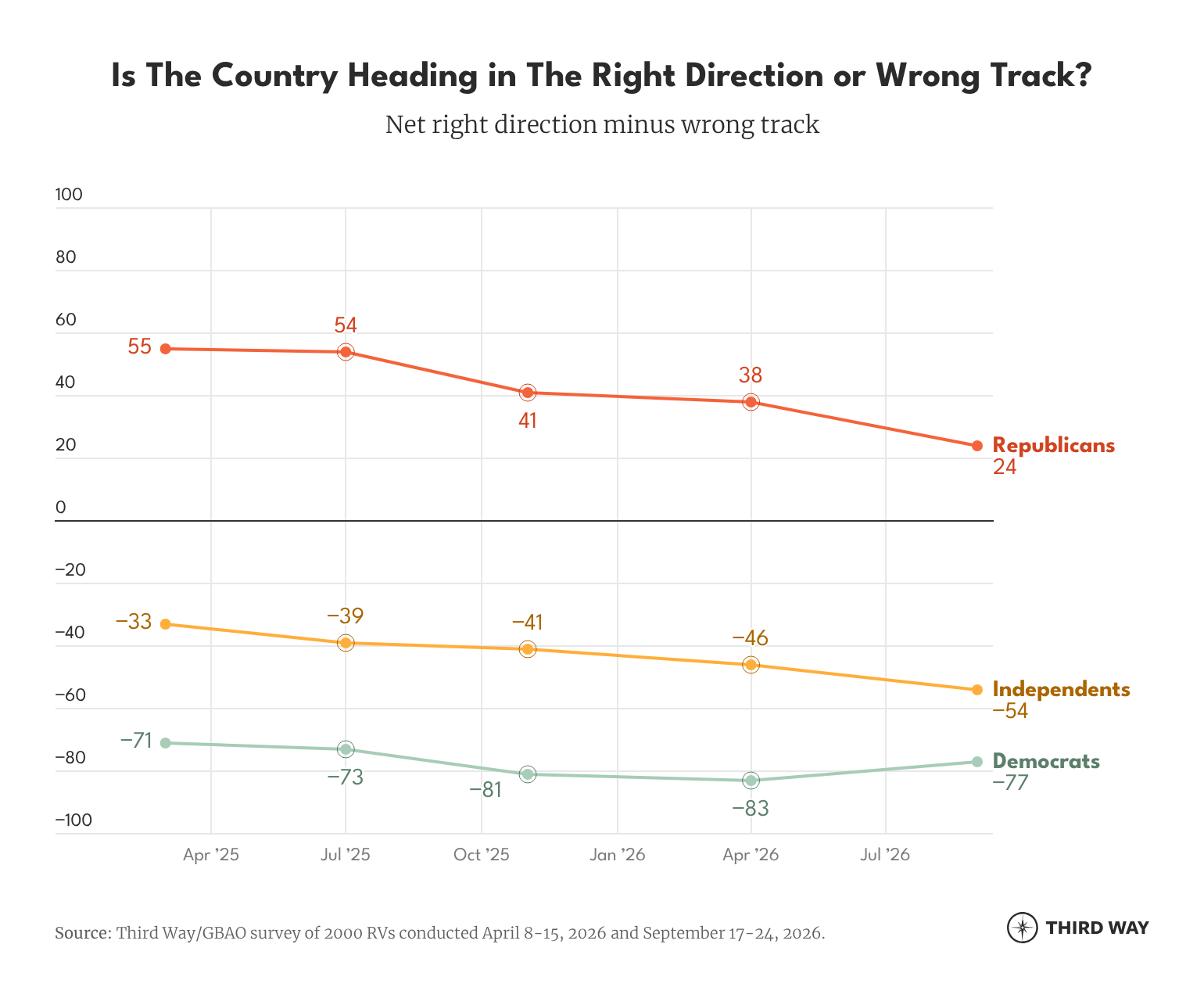
When asked whether they believe things in the U.S. are going in the right direction or off on the wrong track, respondents believe the country is off track by 36 points. This number has widened in every iteration of this series, up from a 30-point margin in April and a 15-point margin when we first began in March of 2025.
Democrats (-77) and Independents (-54) are much more likely to agree that the country is off track, while Republicans (+24) still believe the U.S. is generally on the right track. However, when comparing these figures to those in April, we see shifting attitudes. While Democrats are net 6 points more optimistic, moderate and conservative Republicans are both net 17 points more pessimistic. Moderate Republicans have even crossed the break-even point, going from +11 in April to -6 today. While we cannot precisely diagnose these shifts, they could be thanks to the belief that control of Congress could be changing in just a handful of months.
An increasing share of voters believe the Trump presidency is going worse than expected, from 50% in April to 56% today. In turn, a declining share thinking Trump’s second term has gone better than (19% to 16%) or about what they expected (29% to 28%).
A third (33%) of Trump’s 2024 voters now believe his presidency is going worse than expected, up from 22% in April. The share of conservative Republicans who feel the same also increased from 18% to 32%. Once again, these shifts among Trump’s base are primarily driving the overall increase.
Subsequently, Trump’s plummeting approval ratings, from net -21 in April to -25 today, are also primarily driven by his own voters. The presidential approval ratings among Democrats (-82) and Independents (-39) have remained abysmal, though relatively unchanged throughout the year. Conversely, the approval ratings of crucial demographics within Trump’s base have slid since April, including Trump ’24 voters (+61 to +50), Republicans (+59 to +51), conservatives (+58 to +46), non-white conservatives (+42 to +24), and white non-college men (+8 to -4). While Trump’s base still largely approves of the President, its fracture is pushing his approval ratings to record-low figures.
The economic moment is still one of increased costs more than any other economic malaise, but voters don’t think any part of the economy is doing well. The vast majority across party and income lines say the country is experiencing high inflation (90%). Majorities overall believe that the economy is not growing (67%), unemployment is increasing (63%), and we are in a recession (55%). While Democrats (84%), those making under $50,000 a year (72%), and Independents (64%) largely agree that the economy is not growing, Republicans (50%) are more mixed. Similarly, Democrats (79%), Independents (66%), those under 40 (76%), and those making under $50,000 (70%) agree unemployment is increasing, while a slim plurality of Republicans (46%) disagree. Notably, while a small majority of voters now believe the U.S. is in a recession, Democrats (66%), Independents (58%), those under 40 (65%), and those making under $50,000 (57%) are less likely to agree with this statement than with the previous two. Republicans remain more skeptical, with 40% agreeing the country is in a recession.
Regarding how the government operates, there is near universal agreement that there is corruption in the economy and government (87%), as well as growing government debt and deficit spending (87%).
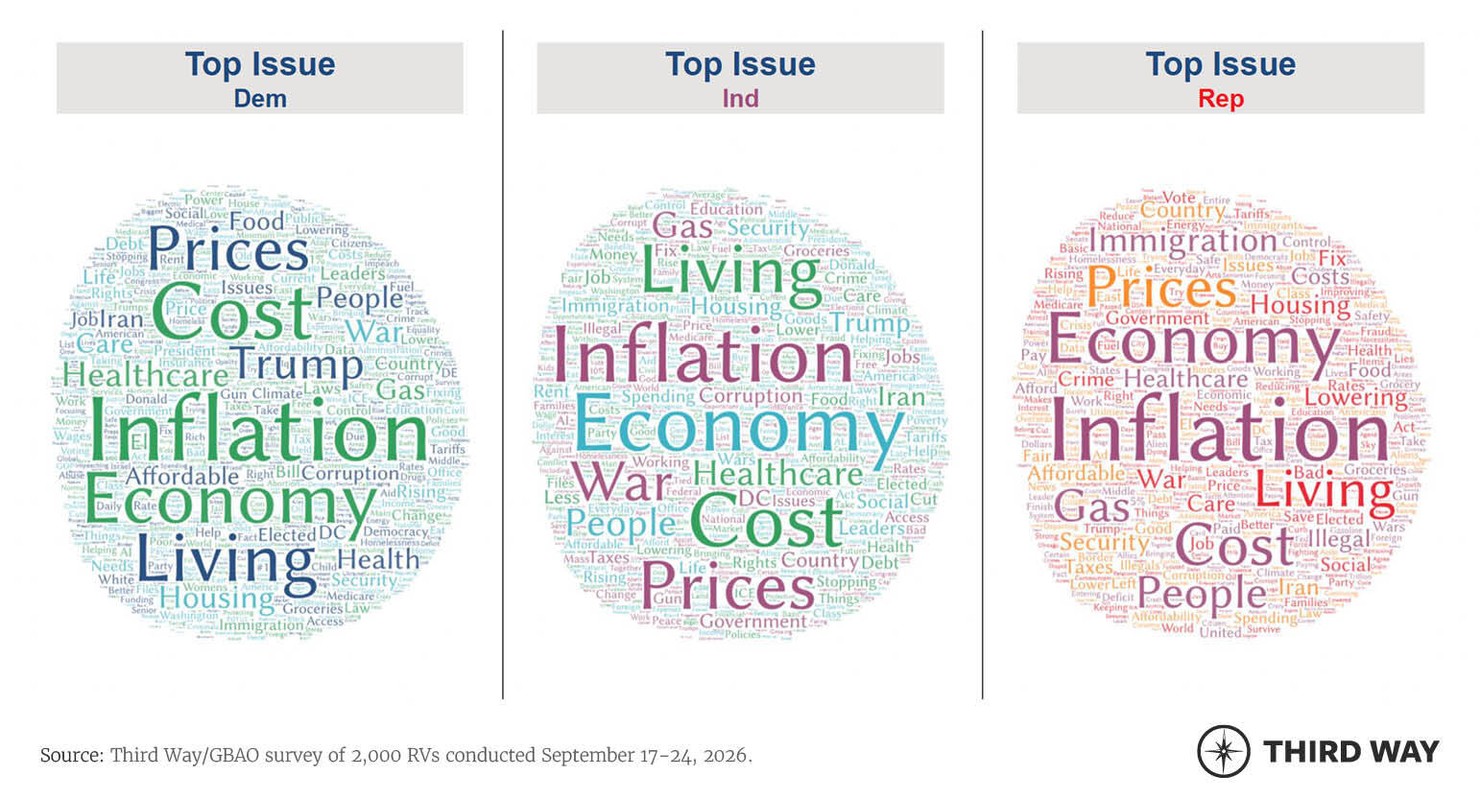
In line with our previous findings, when asked about the most important issues in an open-ended exercise, voters across the political spectrum continue to say “inflation” more than any other word. Terms related to inflation—prices, cost, economy—are also top priorities, while non-economic issues like immigration are becoming increasingly less salient.
What Voters Want
Our survey also used a MaxDiff exercise to test issue salience and how it evolves over time. As seen throughout this survey, messaging on economic woes rose to the top, with the Iran War once again breaking through to first place because of its lethal consequences for Americans and its impact on gas prices.
The four strongest messages were as follows, in order:
- Republicans in Congress are championing a war in Iran with no end in sight that costs over a billion dollars a day, resulting in nearly 800 American military deaths and injuries and record high gas prices for the rest of us. [Best among Independents, Republicans, and disillusioned Trump voters]
- Republicans in Congress voted to slash $1 trillion from Medicaid, threatening coverage for millions of children and hard-working people who can’t otherwise afford health insurance, while increasing premiums for other Americans by 20 percent. [Best among Democrats and those making under $50,000 per year]
- Republicans in Congress have made the largest cuts to food assistance in history, cutting healthy meals for millions of struggling Americans, including seniors and children who need low-cost school meals to function in school.
- Republicans in Congress voted for a budget bill that bankrupts America with $5 trillion in new debt, and bankrupts Americans by raising health insurance premiums and electricity bills, all while giving tax cuts to billionaires.
These findings are consistent with previous iterations of this series, which show economic issues are top of everyone’s mind. Conversely, the lowest testing messages—those on gerrymandering, AI safety, Canadian tariffs, and deportations—were less obviously correlated to economic issues.
The most salient issues have varied slightly over time but have centered on the prices that people feel most often in their day-to-day lives. In April, similar messaging on the Iran War was also the most salient, and messaging on Medicaid and the budget bill also placed in the top four. However, messaging on food assistance programs hasn’t placed in the top four since it was the most salient issue last November, when the federal government shutdown caused a lapse in funding for SNAP, compounding the SNAP cuts made through the One Big Beautiful Bill Act (OBBBA). Moreover, the issue of food security seems to rise in salience when tariffs are inflating grocery prices.
As the midterm elections ramp up, Democrats are prioritizing many of these top messages in their political advertisements. Since September 1, 29.1% of Democratic ad spending on U.S. House and Senate races has gone towards ads mentioning rising healthcare prices, according to AdImpact. One of the highest-spending ads on this issue is Sen. Jon Ossoff’s $2.4 million ad on his efforts to ban insurance companies from denying coverage and his work to cap insulin prices. Ads mentioning rising electric and utility costs accounted for 13.4% of recent Democratic ad spending, an issue championed by Ohio Senate candidate Sherrod Brown. Since September 1 alone, Brown’s campaign and associated external groups have spent upwards of $42 million attacking GOP Sen. Jon Husted for his apparent involvement in a FirstEnergy corruption scheme that increased Ohio’s electric and utility bills, including a new ad from WinSenate backed by a $7.4 million spend in just three weeks. Further, 7.5% of recent Democratic ad spending was devoted to ads mentioning the Iran war, including California battleground House candidate Marni von Wilpert’s recent ad featured in Third Way’s Ad Wars newsletter. SNAP and the OBBBA budget are less prominently featured, making up 0.26% and 0.12%, respectively, of recent Democratic ad spending.
What Are Democrats Getting Right?
Though Democrats still have a lot of work to do, their favorability and trust ratings are increasing in critical ways ahead of the midterm election.
Both the Democratic Party (-2) and Democrats in Congress (-10) are seeing major brand improvement, with their combined favorability going from net -18 in April to net -6 today. Washington’s unpopularity could be adding a penalty to Democrats in Congress at a time when the party brand as a whole is doing better. On the other hand, combined Republican favorability (-18) has plateaued after major slippage earlier this year. Unlike Democrats, Republicans don’t have a large delta between those in Congress and general party brand, which could be due to their complete control of the federal government.
The Democratic Party brand improvement is reflected in the generic ballot, where Democrats enjoy a 49-to-41 point lead over Republicans, a net two-point increase since the spring. This is lead is amplified by Democrats’ steadfast motivation to vote: when asked to rate their motivation to vote out of 10, 58% of Democrats answered 10, compared to only 45% of Republicans.
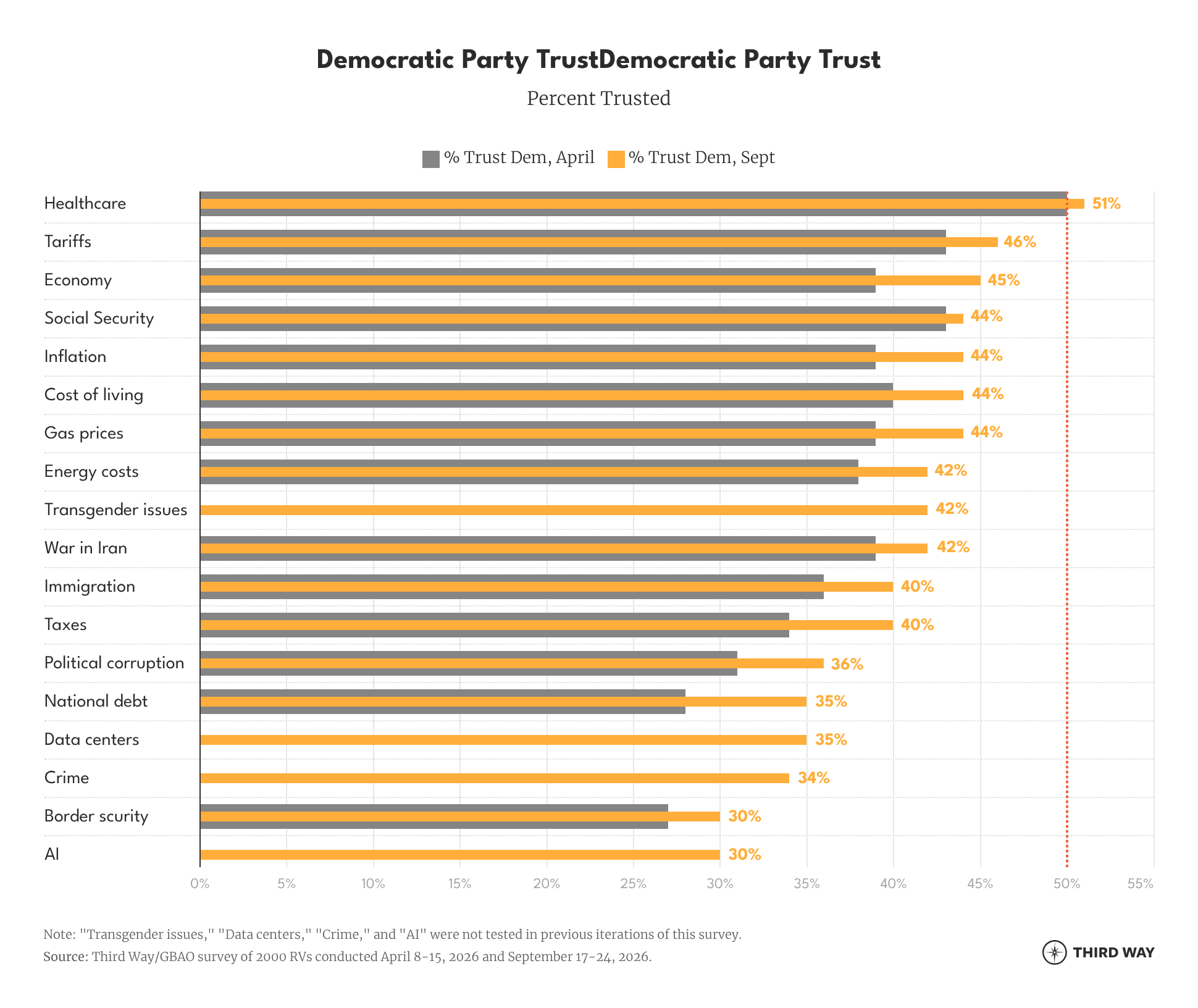
Democrats have also made crucial gains in trust on key issues since April and now have an advantage on the major issues voters care about most. They have held their significant advantage on healthcare (+24) and Social Security (+16), while strengthening their advantages on gas prices (+9 to +17), inflation (+6 to +15), tariffs (+8 to +15), cost of living (+9 to +14), the economy (+3 to +12), the Iran war (+5 to +12), energy costs (+6 to +12), and stopping political corruption (+4 to +9). Democrats have also overtaken the Republican advantage on two critical economic issues: taxes (-4 to +7) and the national debt (-5 to +7). Further, Democrats hold an advantage on three increasingly salient issues we tested for the first time in this series: transgender issues (+13), data centers (+11), and artificial intelligence (+6).
Notably, there are many issues, including some where Democrats hold a recent or marginal advantage, in which many respondents trusted neither party. A considerable portion of respondents said they trusted neither party in Congress to handle stopping political corruption (25%), artificial intelligence (23%), and the national debt (22%). This skepticism shows that Democrats still have a ways to go before voters confidently trust them to solve today’s increasingly pressing issues.
Nonetheless, among voters with a negative view of both parties (20% of respondents), Democrats have an even larger advantage on their major strongholds like healthcare (+34), the Iran war (+22), cost of living (+21), and the economy (+19). This highlights how today’s voters are primed to blame Republicans, and subsequently prefer Democrats over Republicans, even if they don’t have positive opinions about the Democratic Party.
Yet, even on the three issues where Democrats’ trust remains underwater, they are seeing growth. On Democrats’ worst issue, border security, they have seen a steady increase in trust, from net -31 in July of 2025 to net -21 today. On immigration, Democrats are nearly breaking even with Republicans at net -4, up from a net -10 in April. We also tested the issue of crime for the first time in this series, in which Republicans have a single-digit lead (+6), an advantage much smaller than in most publicly available polls over the past few years.
As voters increasingly trust Democrats to handle today’s top issues, and many anticipate the party will flip the House and possibly the Senate in November, attitudes about how they should use their newfound power have slightly shifted. When asked whether Democrats should work with President Trump wherever possible on high prices or stand up to him, for the first time in this series, respondents want Democrats to stand up to him by 7 points. This shift includes Independents, who preferred Democrats work with Trump by a 2-point margin in April but now prefer Democrats stand up to him by an 8-point margin.
Despite this shift, respondents strongly maintain that Democrats must focus on cost of living: when asked whether Democrats should prioritize investigating and possibly impeaching the President or focus on bringing down costs, respondents chose the latter by a 41-point margin. Democrats preferred prioritizing costs by 8 points and Independents by the same margin as voters overall. Together, these figures show increasing frustration with Trump and a desire to diminish his power in the policymaking process, but a consistently acute desire for a Democrat-led Congress to focus on affordability.
Top Democratic Policies
In this iteration of our series, we presented respondents with a list of positions that Democratic candidates might support and asked if such a position would make them more or less likely to vote for the candidate. The list was based on paid media in both Democratic and Republican ads talking about Democratic candidates for Senate and House.
We found that voters are likely to support Democrats who will work to tackle today’s biggest problems through a non-ideological lens. The policy proposal with the highest appeal was cracking down on the online exploitation of children (79% to 7%), which was most popular among Independents, moderates, Republicans, and all age groups, incomes, and races. Next, a government audit to root out waste, fraud, and abuse (73% to 11%) was extremely popular, and the highest ranked policy among conservatives. Liberals and Democrats overall were more likely to support the fourth-place policy, voting to end the war in Iran (70% to 13%). Respondents were also likely to vote for Democrats who supported a Congressional stock trade ban (62% to 13%) and increased funding for local police departments (61% to 19%).
Respondents wanted Democrats to take the rising issue of data centers seriously. Respondents supported a moratorium on new data center construction by a 56% to 21% margin, which is why this has become more common in both parties in the close stretch of the campaign season. However, voters showed a stronger desire at 68% to 15% more likely to vote for a Democrat who supported strong consumer and community protections for any new data centers, including protections against higher utility bills. These results suggest that while moratoriums remain popular, what voters are really looking for is long-term solutions.
Moreover, the policies that ranked much lower were largely those espoused by the Democratic Socialists of America (DSA), whose net favorability remains underwater at -18. Switching to a single government insurance had the support of 42% of voters, and it was 10 points underwater with Independents. Other ideologically charged policies fared far worse: respondents were far less likely to vote for a candidate who called themselves a socialist (22% to 44%), supported defunding police departments (24% to 60%), supported giving voting rights to non-citizens (22% to 63%), or supported abolishing prisons (17% to 67%).
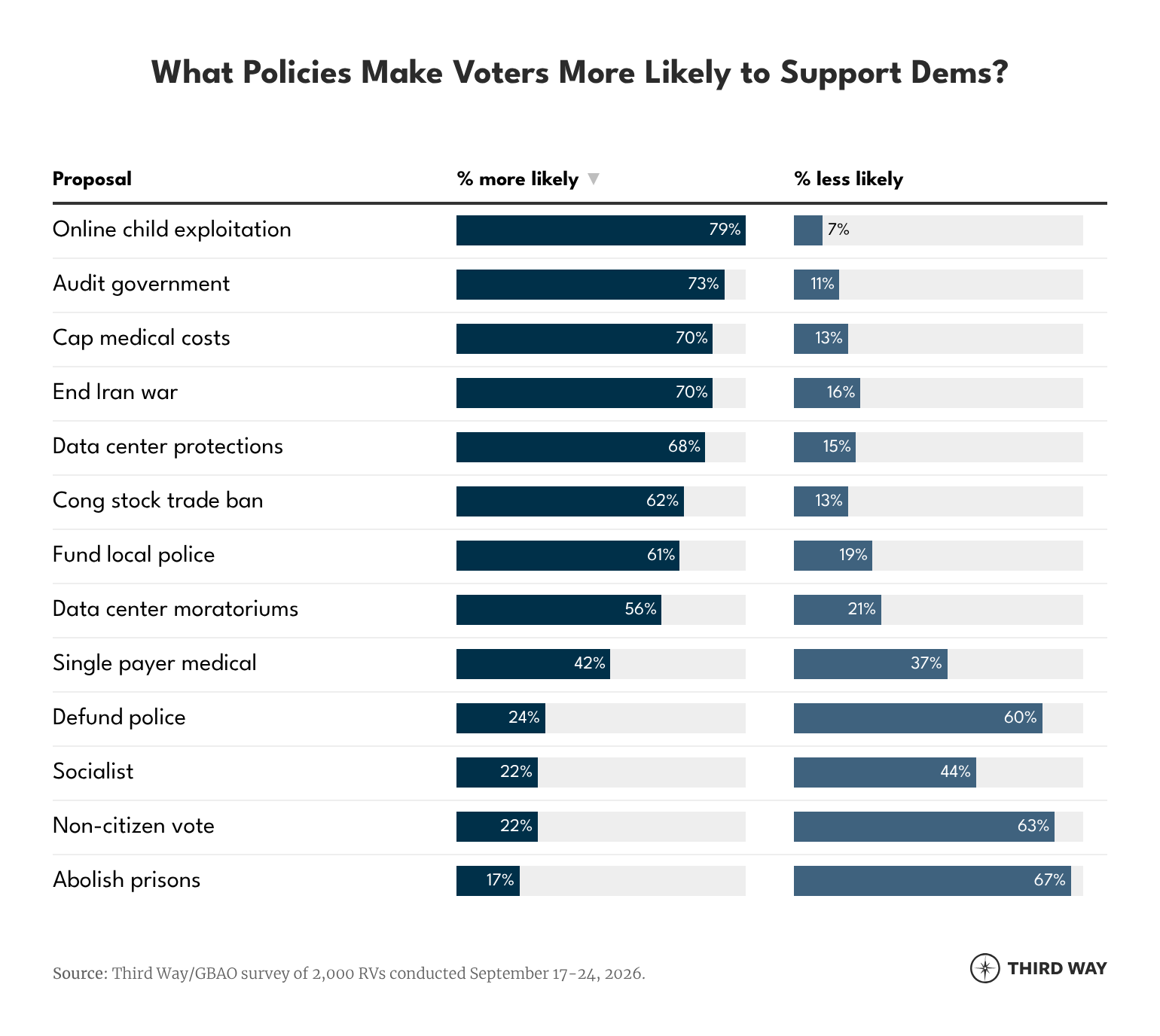
These findings show that voters do not want Democrats to support policies that are associated with the DSA. Instead, reaffirming our other findings, voters are attracted to Democrats who support strong, commonsense policy positions that would tackle our country’s biggest challenges and directly benefit Americans’ daily lives.
Conclusion
Taken together, this data shows that voters are frustrated with Trump, his misplaced priorities, and the Republican policy agenda that has raised the cost of living. Despite apprehensions, voters are beginning to turn to Democrats, increasingly trusting them to provide relief. If they take control of Congress, voters will support a Democratic agenda that prioritizes commonsense policies to lower costs, rather than one focused exclusively on combating Trump or pushing through unpopular, heavily ideological policies.
