How Republicans Lost Voters in 2026
This October, Third Way worked with Impact Research to conduct a survey of 1,001 likely voters in the congressional battlegrounds as well as two focus groups preceding the quantitative round.
The research was clear: Democrats should find solace in how deeply voters have rejected Trumpism and the Republican Party’s approach to the economy, prices, healthcare, trade, war, and even some social issues such as those impacting transgender Americans. However, it is also clear, in our research and much that has been publicly reported, that this midterm was a repudiation of those who caused inflation, wars, tariffs, and health care cuts, rather than a wholesale embrace of the Democratic Party.
Takeaways
- Donald Trump and his party have lost voters’ faith that they can manage the economy, which was a key part of his appeal from 2016 to 2024.
- Negative advertising against Republican congressional candidates solidified voters’ perceptions that Republicans had made things actively worse in the past two years.
- Despite punishing Republicans at the ballot box, a majority of voters call both parties too extreme.
- Voters want Democrats to focus on economic relief and pragmatic solutions instead of making the same mistakes they feel the Republicans did.
Trump and the Environment
This was a poll of battleground congressional districts, which lean to the right of the country. In 2024 in these districts, Donald Trump beat Kamala Harris by eight percentage points, compared to his 1.5-point national popular vote victory.
Yet in these districts, Trump’s favorability stands at -12 points, with 43% viewing him favorably compared to 55% unfavorably. His job performance is at -14 points, with 42% approving and 56% disapproving. Among those who were persuadable on the generic ballot, Trump has a 32% to 61% favorability and a 30% to 65% job approval rating. And worst of all for the President is his approval rating on the economy, which was his selling point in past elections: -18-points today, with 40% approving and 58% disapproving.
“I feel like he did fine in his first term as president, and then I have no idea what he decided to do this second term, but nothing is working. Like, literally nothing.”
– Focus group participant
The generic ballot in these districts stands at a 50% tie for each party, which is an eight-point movement towards the Democratic Party since the 2024 presidential election. There is also real movement among soured Trump voters. Voters who pulled the lever for Trump in 2024 who now have an unfavorable view of him (14% of all Trump voters in this survey) say they are supporting Republicans over Democrats in 2026 by only a 68% to 32% margin.
Our poll also asked for the favorability ratings of named candidates in each district. Named Democratic incumbents had net even favorability at 38% favorable and unfavorable. That was substantially better than Republican incumbents, who generally had higher name recognition, but it mostly came from the negative direction. They clocked in at a -11-point rating, with 37% viewing them favorably to 48% unfavorably. That incumbent difference can mainly be credited to Trump voters. Harris voters view Democratic incumbents favorably by a 68% to 8% margin, while Trump voters are twice as likely to hold an unfavorable view of Republican incumbents at 66% to 19%. Democratic challengers and Republican challengers have slightly better net approval ratings (+8 for Democratic challengers and +3 for Republican challengers), but that is mainly due to lower unfavorable ratings than those of their more prominent incumbent counterparts.
Who Voters Trust on the Issues
When it comes to who voters trust on the issues, Democrats have advantages on nearly every metric: ending the Iran War (+14), health care (+12), transgender issues (+11), data centers (+10), stopping corruption in government (+7), making the tax code more fair (+5), protecting democracy (+5), handling the Russia-Ukraine War (+4), AI (+4), and inflation and the economy (+2). Republican enjoyed advantages on two issues: immigration and border security (+13), and crime and public safety (+11). (Though keep in mind, this is a 2024 Trump +8 set of districts, so those gaps are likely much smaller nationwide.)
“Trump jumped the gun too fast. He didn't have things in place in The United States like the farmers or the manufacturers or producers of the things we were gonna be cut off by these tariffs. And that's what jacked up all these prices here… We should have had our own things in place first so that the Americans would not have to suffer this way with these high prices.”
– Focus group participant
Democrats even enjoyed some noticeable trust advantages on key 2026 issues among Trump voters who are now unfavorable towards him, including stopping corruption (+14), data centers (+21), ending the Iran War (+23), and even a shocking near tie on transgender issues (+1).
While Democrats have a lot to like on this issue trust battery, they still are viewed nearly as extreme as the Republicans. When asked if they viewed the parties as extreme, 57% say Republicans are extreme and 54% say the same of Democrats. Persuadable voters even are a bit more likely to say Democrats are extreme than say so about Republicans—66% and 57% respectively.
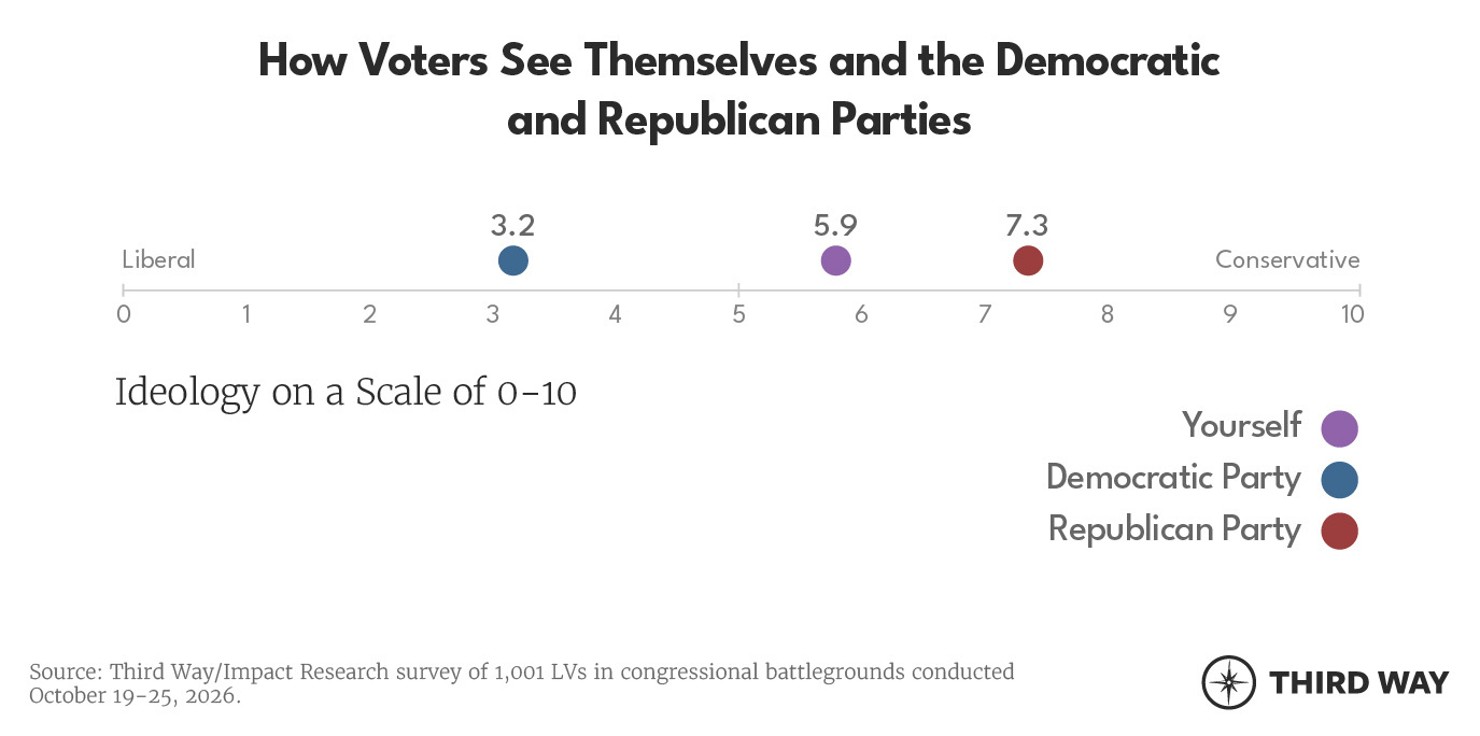
When it comes to their approach to politics, battleground voters place themselves in the middle ideologically, leaning slightly more conservative than liberal. The average personal rating is 5.9 on a scale of 0-10, where 0 is the most liberal and 10 is the most conservative. They give the Democratic Party an average rating of 3.2 and the Republican Party an average rating of 7.3, placing themselves on average slightly closer to Republicans ideologically (averaging 1.4 points to the left of Republicans) than Democrats (averaging 2.7 points to the right of Democrats). Put another way, only 8% of battle ground voters called themselves a 0 or 1 (completely liberal), while 36% said that’s how they would describe the Democratic Party. Only 25% of the sample plotted themselves on the left half of the spectrum (0-4), 24% said they were directly in the middle (5), and 49% identified as being on the right side of this scale. While they are leaning towards Democrats in this moment, these voters still believe the party is much further left than they are personally.
Simply put, Republicans lost this year based on not being trusted to handle the key issues of the day. Donald Trump’s favorability rating has never been worse on the economy, and that is what matters most to voters today.
The Impact of the Ad Wars
Both parties invest heavily in paid advertising, and these ads clearly had an impact on voters.
Respondents were asked if they recall seeing ads during the campaign and to describe what they remembered about them. The vast majority remembers seeing negative ads about Republicans when asked (69%). Positive ads were less memorable, with 45% of respondents saying they remembered seeing positive ads about Democrats.
“Democrats are coming and Republicans are both coming across extreme in their ads right now… They're gonna totally defund ICE. They're gonna totally end student loans. They're gonna tell they're gonna do all this extreme stuff that, you know, they can't totally do, and it's it's both sides doing it.”
– Focus Group respondent
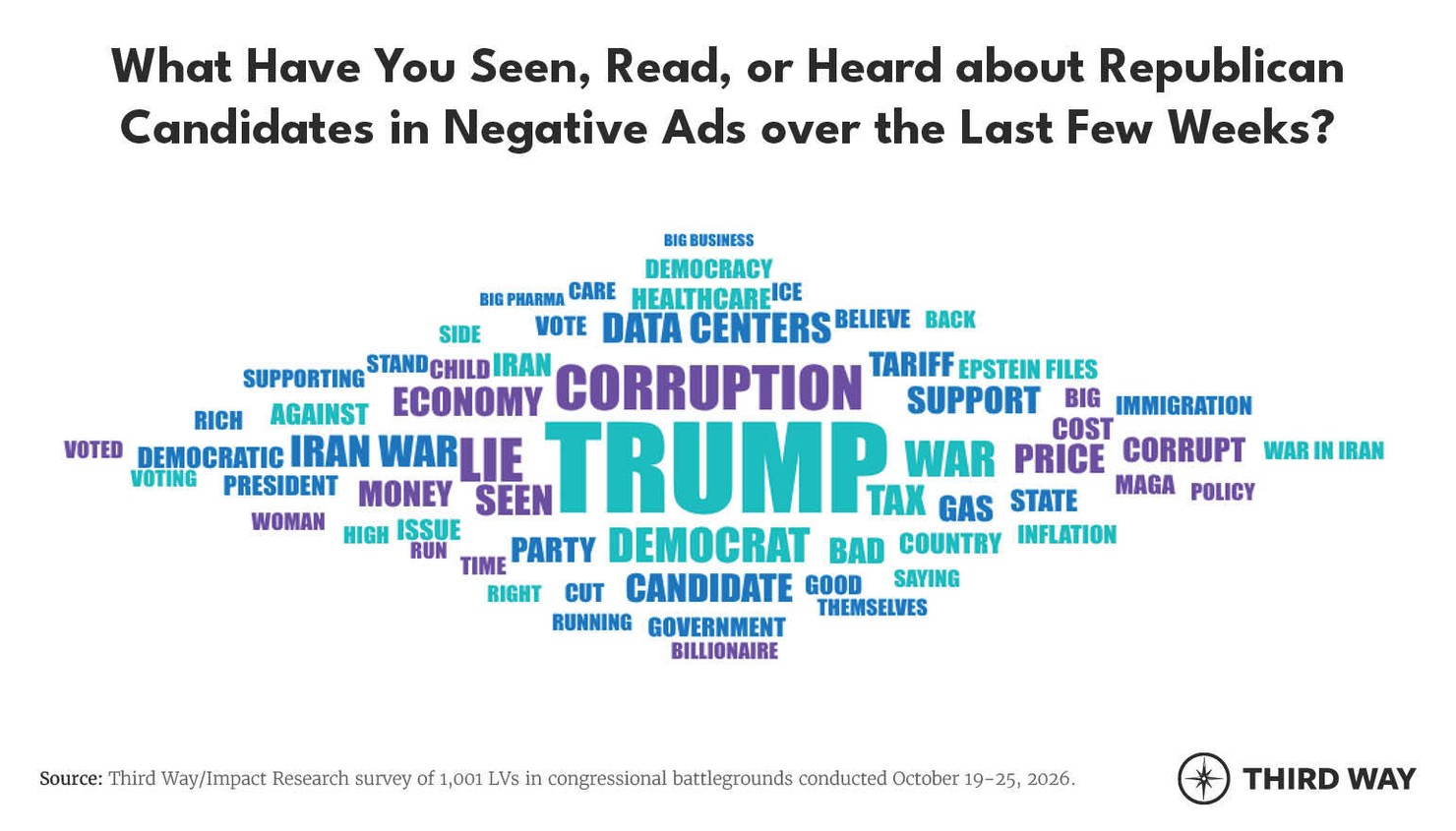
The negative ads against Republicans that had the most sticking power dealt with a few key issues, including the Iran War (32%), costs and the economy (29%), and corruption in government (28%). This was followed by tariffs (22%), immigration (19%), threats to democracy (19%), and data centers (16%). But the single most used word in this open-end exercise was TRUMP followed by words such as CORRUPTION and LIE.
Voters remembered positive Democratic ads focused on the issues Democrats would want them to. These include cost and the economy (28%), healthcare (21%), stopping government corruption (19%), the Iran War (17%) and data centers (17%).
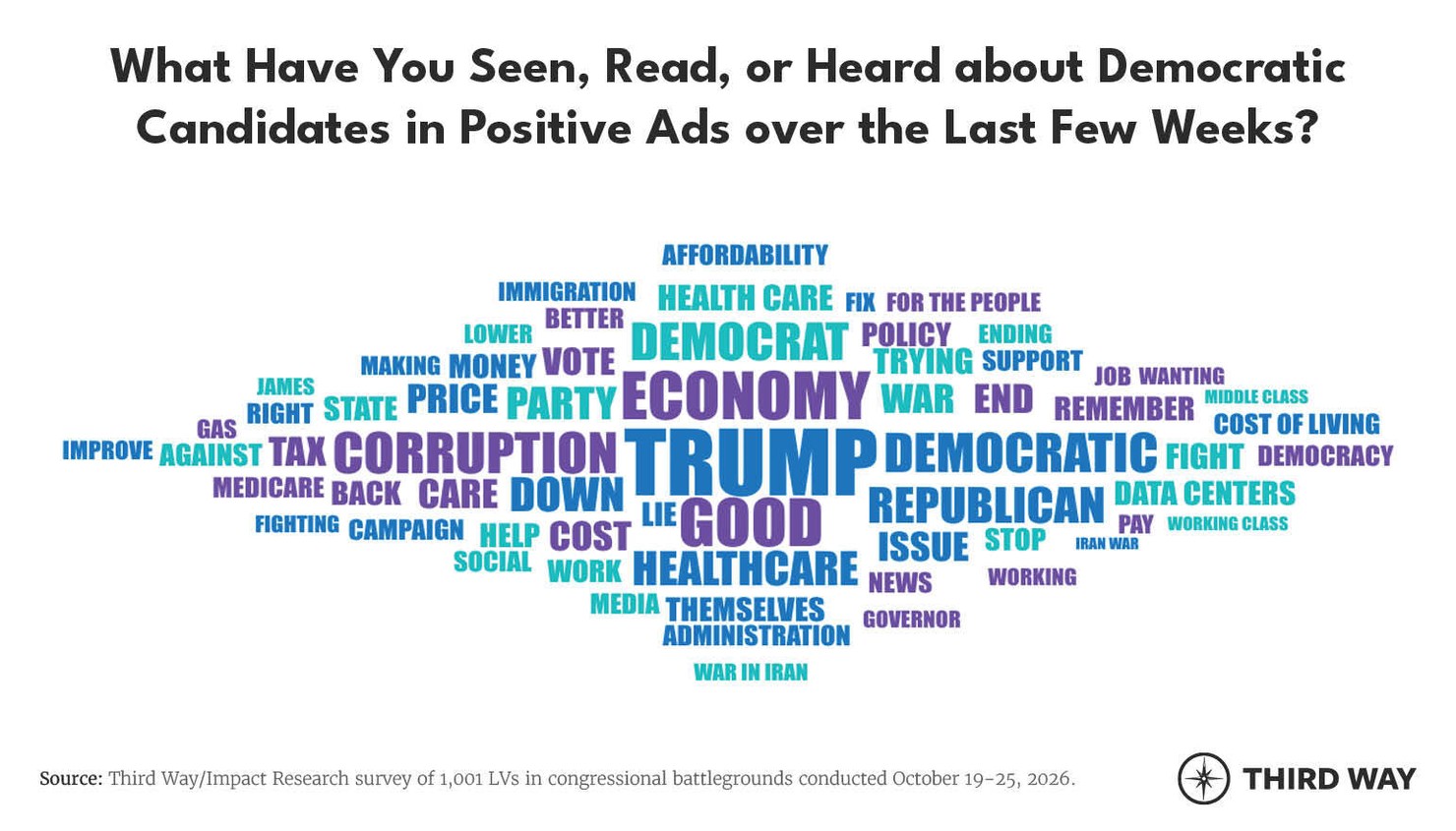
The ad recall is a reminder of why Republicans lost but also what Democrats promised to win. These positive Democratic ads should serve as a jumping off point as Democrats consider what is next with new levers of power.
What’s Next for Democrats
One message was clear when we asked about the future: voters are looking to Democrats to solve their problems and reverse Trump’s policy failures, but not for impeachment.
Respondents who said they might or definitely planned to vote Democratic say by a more than two-to-one margin that it is more important to put a check on Trump than it is to enact Democratic policy priorities. But putting a check on the President’s actions that are driving up costs does not mean impeachment to the voters who delivered Democrats majorities.
Among all voters, 73% say that Democrats should focus on finding solutions on affordability, compared to only 17% who want them to investigate Trump and his administration. And if investigations are on the table, 38% prefer looking into ways the Trump Administration did things that drove up costs, compared to just 18% who prioritize impeaching Trump for corruption. Those planning to vote for Democrats preferred finding solutions to affordability over investigations by a 65% to 33% margin, as well as investigating actions that increased costs over impeachment by 60% to 35%. Even those voting for Democrats want them to stay laser focused on costs.
Voters are also looking for the next Congress to take on corruption, but some accountability measures test better than others. Things like investigating corrupt stock trading by members of Congress (90% support), investigating price gouging by large corporations (79% support), investigating tax loopholes that benefit the wealthy and large corporations (70% support), and investigating the cover up of the Epstein files (68% support) enjoy broad support among all groups in these congressional battlegrounds, while impeaching Trump is unpopular.
Voters are also rejecting Trump soundbites in favor of real solutions. When asked if they preferred giving every American $5,000, as Trump suggested he’d do if Republicans won, compared to reversing some of his administration’s more unpopular price gouging actions, the latter options won out. Americans preferred ending the Iran War 70% to 11% over giving every American $5,000, and cutting Trump’s tariffs got 57% support compared to 23% support for the cash giveaway. These margins held up among persuadable voters and were even more popular with Trump voters who now view him unfavorably (80% to 10% on Iran War; 73% to 11% on ending tariffs).
“I don't know why we're there [in Iran]. I don't know why he did this and took us into war… I don't think we have any business being there.”
– Focus group participant
When it comes to an affirmative agenda for the Democratic Party, voters prefer pragmatic reforms over ideological ones. They preferred restoring Affordable Care Act subsidies and reversing Medicare and Medicaid cuts over Medicare for All by a 53% to 29% margin. And an all-of-the-above energy approach beat the Green New Deal by a similar 52% to 30% margin overall, with persuadable voters preferring all-of-the-above by 55% to 22%.
“I hope for affordable housing and groceries that they need to scale some of this back down and access to health care and just some things that have been radically changed. Of course, you go in there and you start radically changing stuff, then that impacts the programs that are trying to manage these long-term things, and it just creates chaos”
– Focus group participant
Conclusion
As the dust settles and results become more clear, it is evident that voters went to the polls to end President Trump’s iron fist control of the federal government. Democrats have their greatest opportunity in more than a decade to show voters they can be serious on the economy and deliver cost-of-living relief, and to demonstrate that they are mainstream not extreme to the voters who make up sustainable majorities. They would be wise to take these next two years to focus on those tasks as much as possible.