What Are Men Under 50 Prioritizing Heading Into the Midterms and 2027?

Third Way, American Institute For Boys and Men
Men’s struggles are real, measurable, and urgent. With a new Congress set to enter the halls of power in 2027, Third Way and the American Institute for Boys and Men partnered to take a look at the challenges facing men, and what policy priorities they want the federal government to address heading into the new year. Men are contending with poor health, uncertain long-term finances, and a lack of support, but they aren’t asking for special treatment. In fact, our research shows that they have clear ideas about how policymakers can help.
Third Way and the American Institute for Boys and Men worked with Global Strategy Group to conduct a nationwide survey in September 2026 of 1,001 men ages 18 to 49, who are registered voters, with an oversample to reach 494 young men 18 to 29 years old.
Men Feel Overlooked and Want Support
For many men, their frustration starts with a simple feeling: nobody is looking out for them, and their struggles don’t make it onto anyone’s agenda. A supermajority say that boys’ and men’s issues aren’t taken seriously (76%) and that dads do not receive enough support from their community and government (78%)—with bipartisan agreement across party affiliation. But they also recognize that issues facing boys and men (69%) exist alongside problems facing women and girls, with 71% saying that girls and women also face systemic problems.
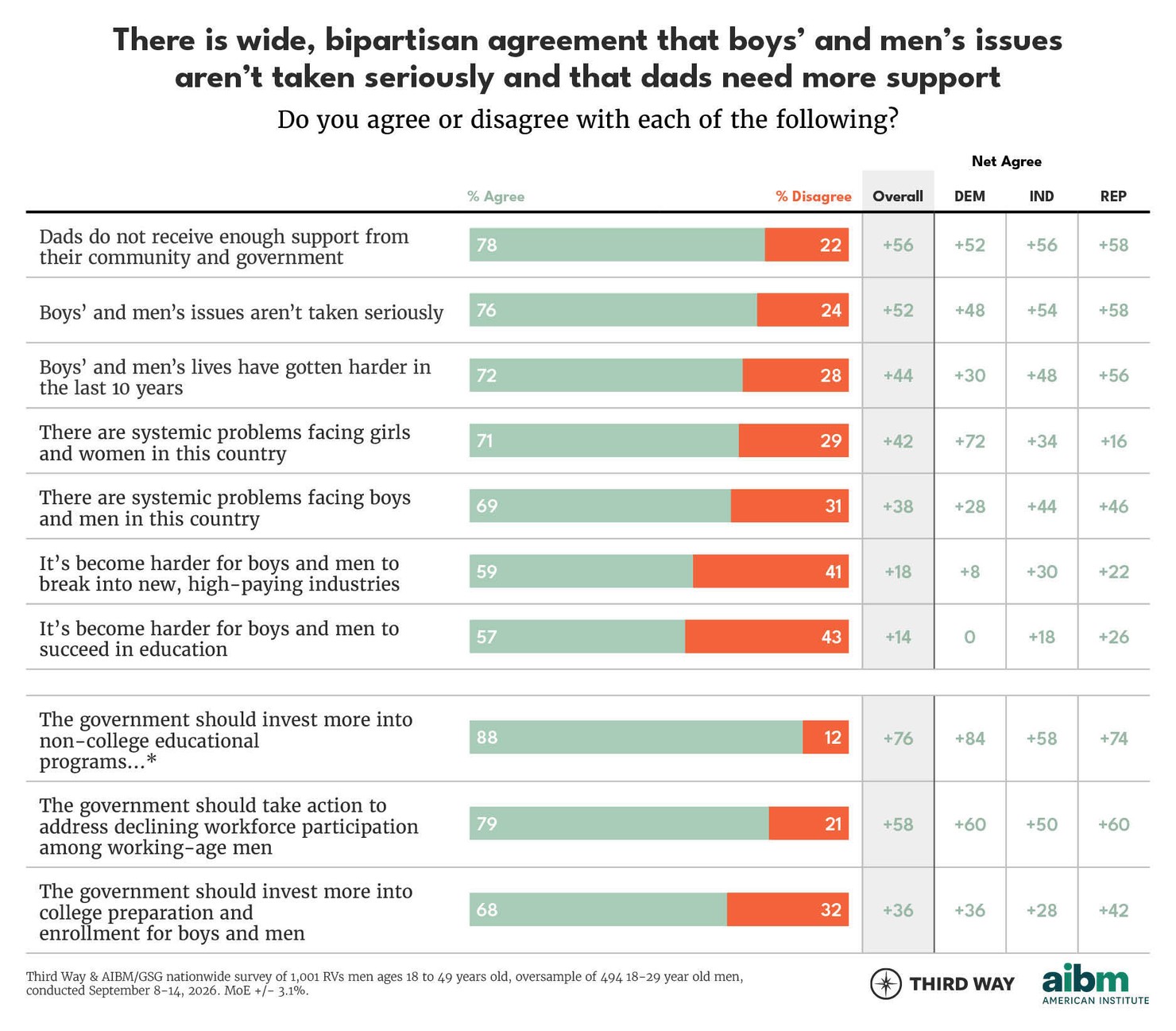
Men further agree that the government should invest more to support boys and men, including in non-college programs (88% agree), workforce actions (79%) and college-going interventions (68%).
As is, men across generations report that they’re often facing these struggles alone and with judgement from those around them. Over 90% of men say people respond with at least some judgement when boys and men are struggling (47% mostly judgement, 45% mix of support and judgement) and 80% say they were expected to figure out a path to success on their own when they were younger.
Men’s Top Issues and Economic Outlook
Men across age, demographic, and party affiliation above all else want Congress and the President to focus on addressing inflation and the cost of living (59%), followed by jobs and the economy (54%), and corruption in government (38%). Meanwhile, cultural issues such as LGBT issues, abortion, and vaccines rank at the bottom of men’s priority list.
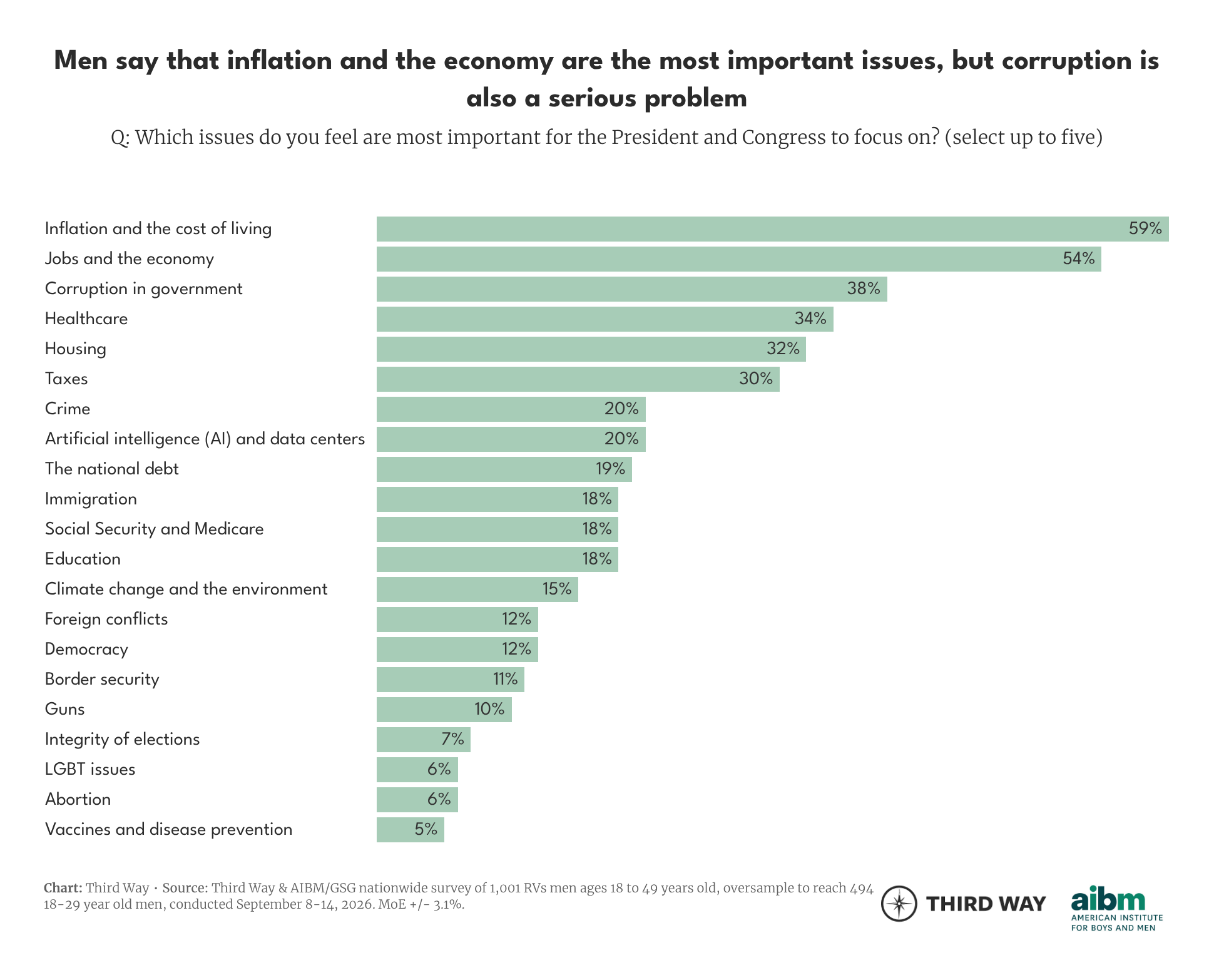
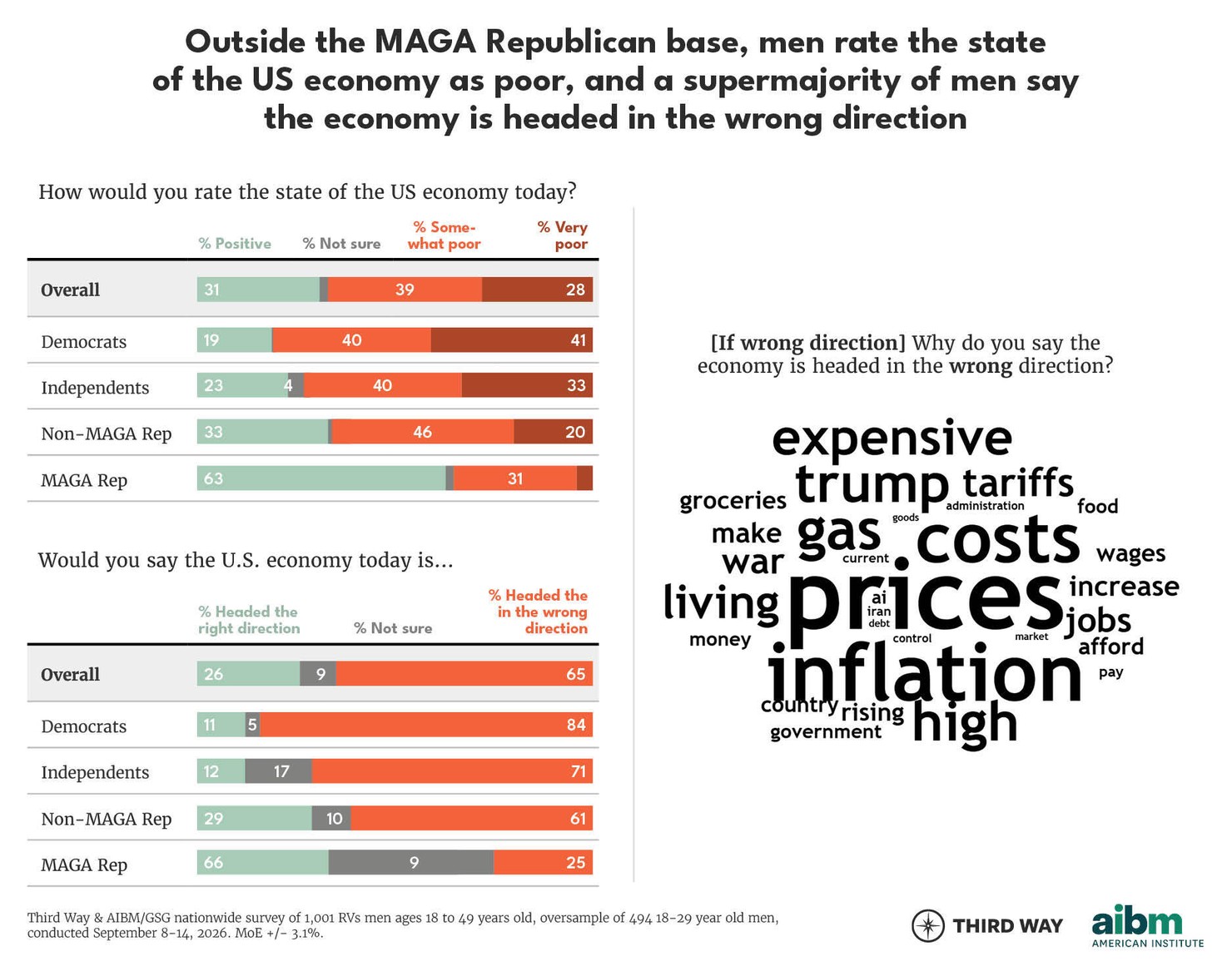
This is anything but shocking given the economic burden that men report feeling in the economy and their day-to-day lives. Sixty-seven percent of men say that the state of the U.S. economy is poor, and 65% say that the economy is continuing to head in the wrong direction. In their own words, men blame “prices” and “inflation” for what’s going wrong in the economy, including components that President Trump has touched: the war with Iran, gas, tariffs, and groceries.
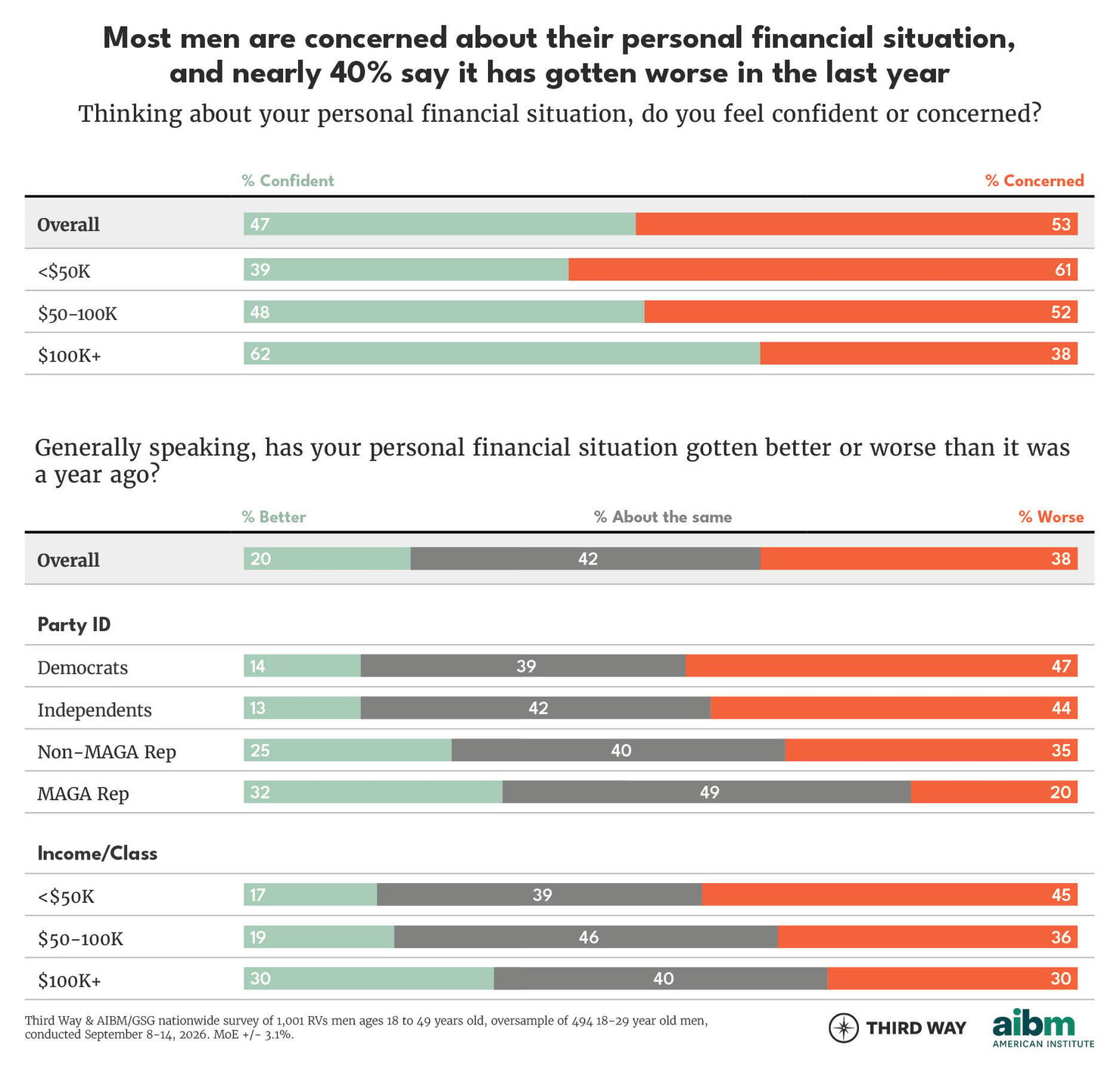
When we dive deeper into men’s personal finances, 53% report being concerned about their personal financial situation, including 61% of working-class men. And most men say their financial situation is the same (42%) or worse (38%) than it was a year ago—with pessimism most heavily concentrated among Democrats, independents, and white non-college men.
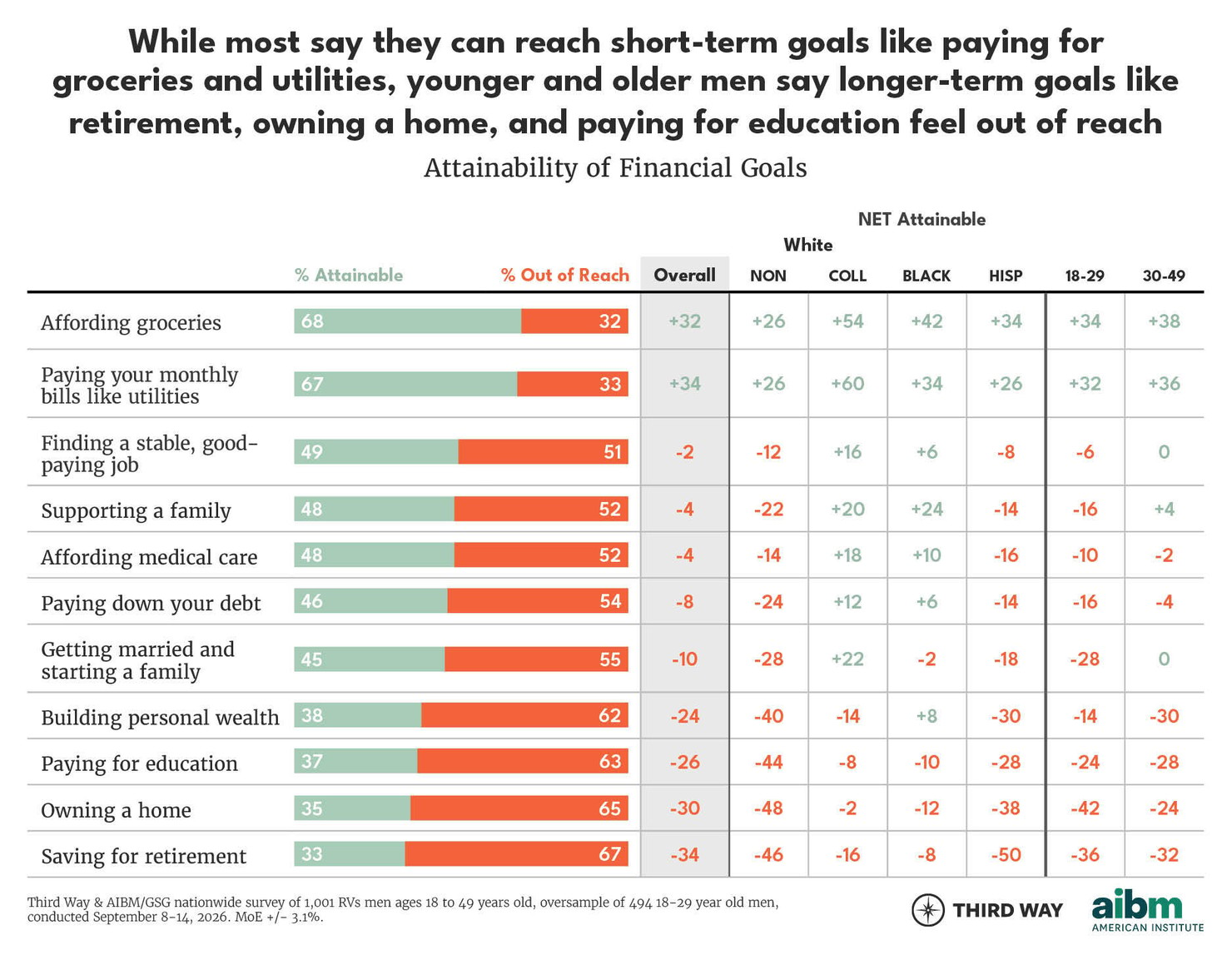
And while most men say they are able to afford the day-to-day essentials that their families need (57%) and can pay for groceries (68% attainable) and utilities (67%), rising prices have left most men unable to save and plan for the future. The vast majority say that long-term goals are out of reach, like retirement (67% out of reach), owning a home (65%), paying for education (63%), and building personal wealth (62%). These financial goals feel furthest out of reach for white men without college degrees, Hispanic men, and both younger and family-aged men.
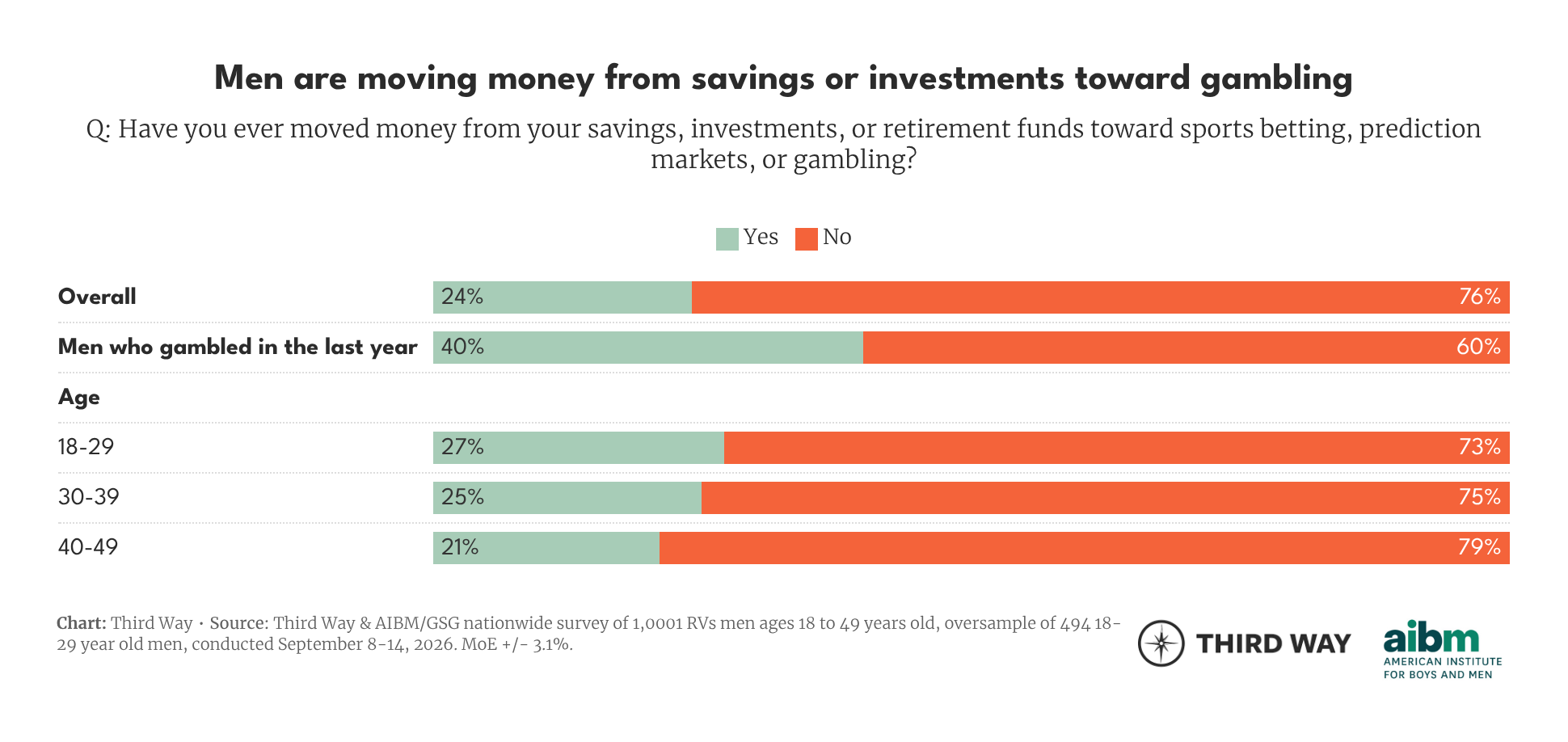
As long-term goals move further out of reach, men are turning toward riskier financial prospects like sports betting and prediction markets. Overall, more than half of men (55%) say they have gambled in the past year, and 24% of men have moved savings, investments, or retirement funds toward sports betting, prediction markets, or gambling–rising to 40% among men who gambled in the last year and 27% among young men under 30.
These economic concerns are all coming from an electorate of men that marginally leans toward identifying with the Republican Party by 2 points (42% Republican, 40% Democrat). Just 20% of men identify as MAGA Republicans, and among the 42% of men in this survey who voted for Trump in 2024, 24% said they regretted their vote for the president, with 33% of non-white men and 32% of young men regretting their vote.
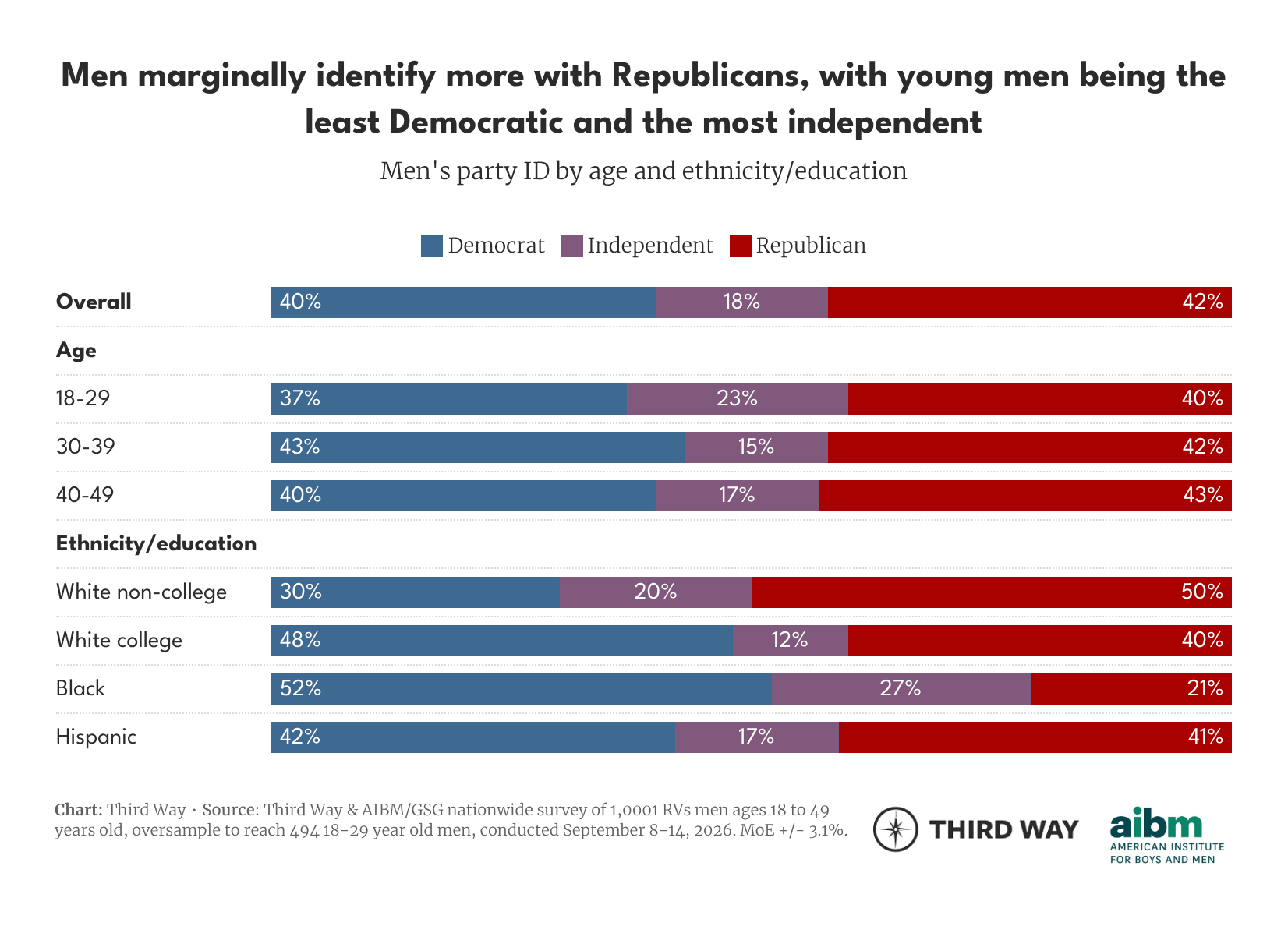
Similar to the men’s electorate at-large, young men lean Republican by a 3-point margin (40-37%), despite being more likely to vote for Democrats in the upcoming midterms. But young men are also notably more likely to identify as independents (23%) than middle- and family-aged men, and it suggests that they are not so much realigning toward the Democratic Party, as they are dealigning from both political parties. Neither party has locked in men’s loyalty, which gives lawmakers on both sides an opportunity to show they are taking men’s challenges seriously and can solve their problems.
The Challenges Facing Young and Family-Aged Men
When presented with facts on the challenges facing men and boys, from lower literacy rates to stagnant labor force participation, one challenge rose to the top: men’s health, especially mental health. Seventy-five percent of men said that addressing the high suicide rate, opioid deaths, and lower life expectancy of men is important, followed by addressing low wage increases for men without a college degree (58%), low male labor force participation (54%), and college-degree requirements for federal jobs (54%).
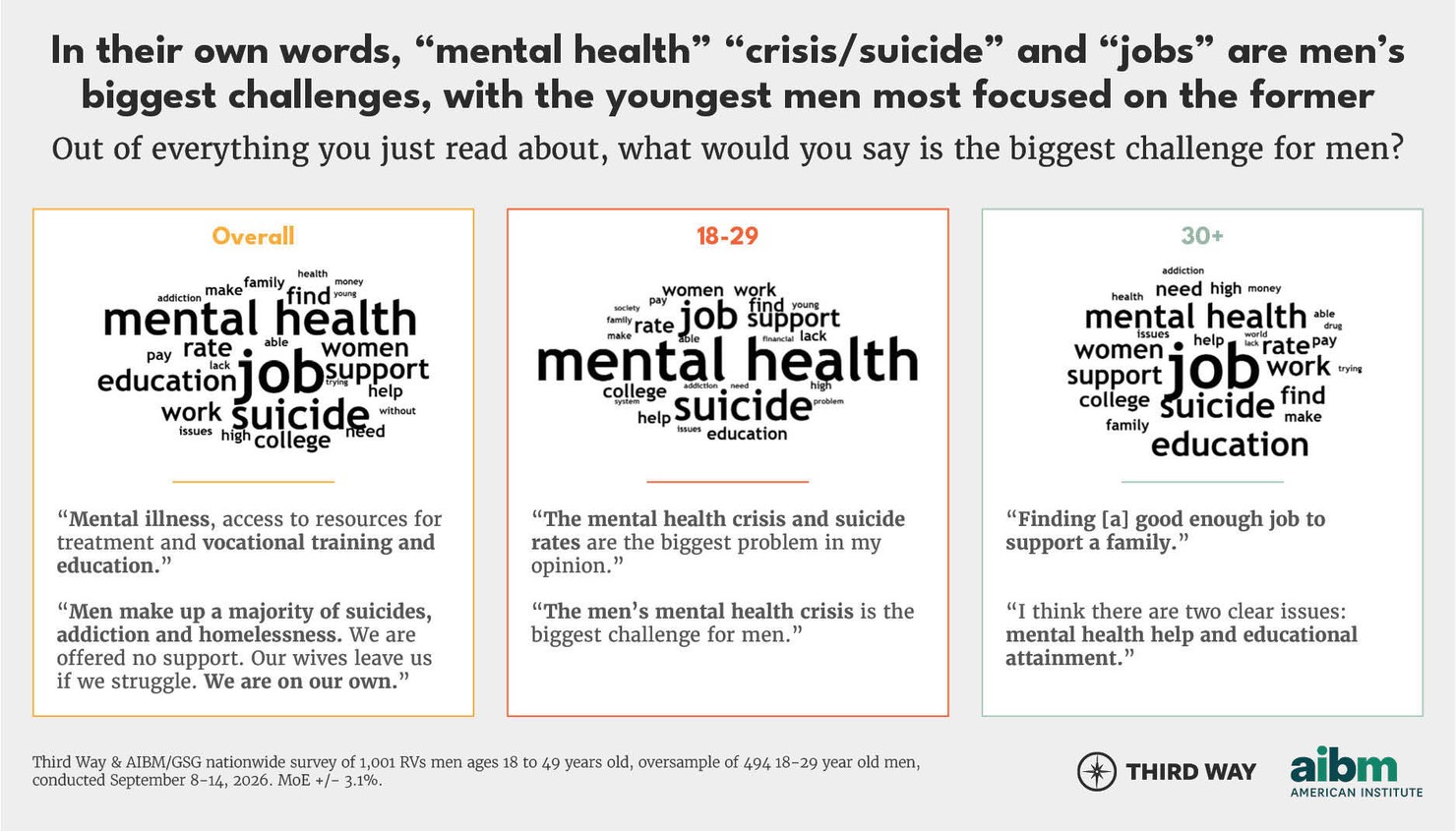
And when we asked respondents to describe men’s biggest challenges in an open-ended question, they pointed to the struggle to find and keep a job, mental health, suicide, and educational attainment. Younger men under 30 years old were especially concerned with mental health and suicide rates, while middle and family-aged men were most focused on finding a job to support their family.
Men’s Policy Priorities
Perhaps the most important findings from this research are the concrete ideas men want policymakers to pursue. At the top of the list are policies addressing mental health, boys’ learning challenges, apprenticeships, and the cost of raising and supporting a family.
Eighty-seven percent say training new therapists, teachers, and coaches with specific interventions for boys and men should be a priority (with 40% saying it’s an extremely high priority). This was followed by creating new programs to manage boys’ learning and behavioral challenges (85% priority), expanding apprenticeships, especially in fields like health and education (82%), and a slew of childcare policies.
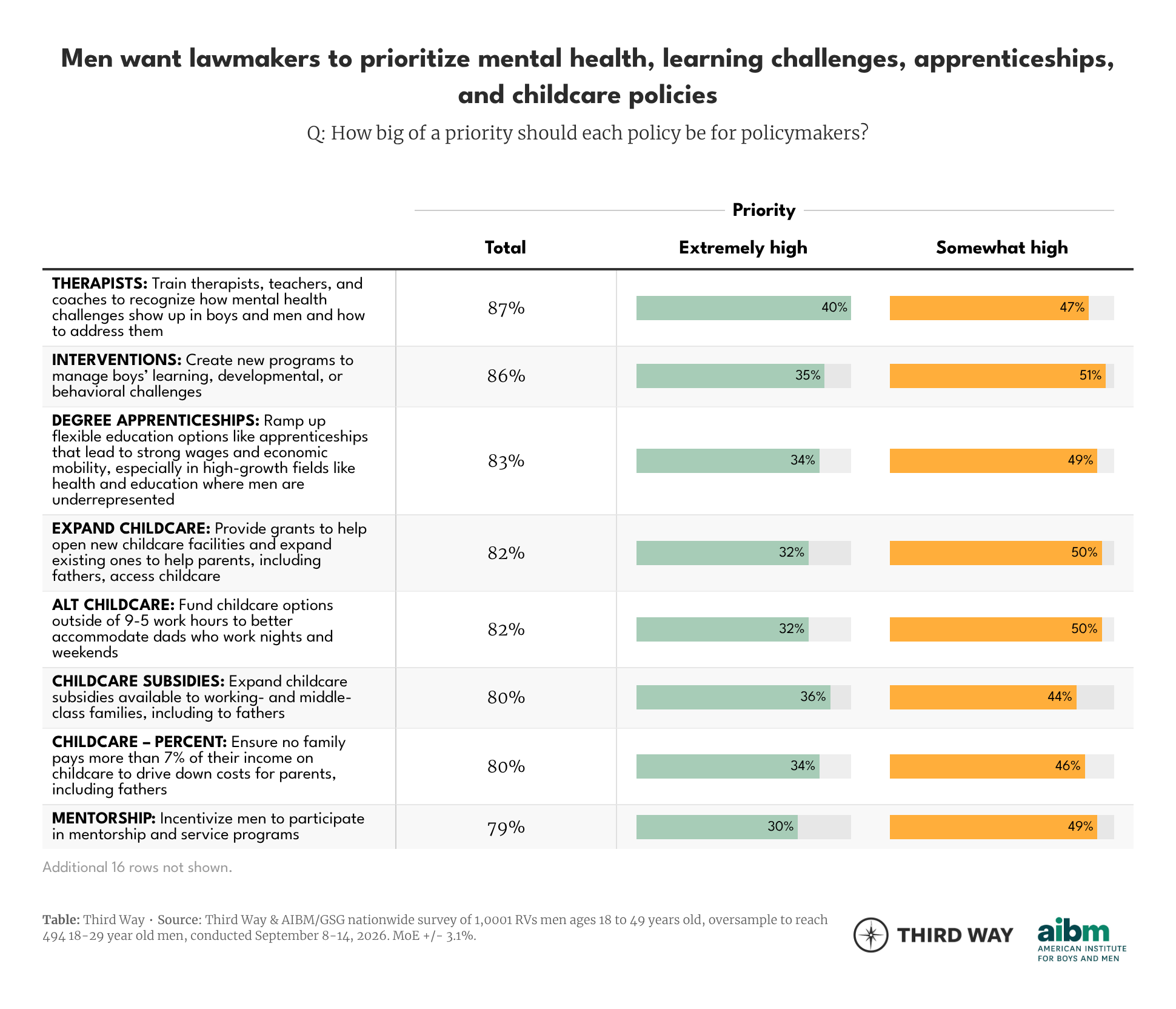
The most popular childcare measures include providing grants to open new childcare facilities (82% priority), funding childcare options outside of 9-5 work hours to better accommodate dads (82%), expanding childcare subsidies for working-class families (80%), providing direct financial support for caregivers at home (78%), and passing a national paid family leave program so every dad has time to spend with their child (77%).
Beyond each policy’s salience, we wanted to find out what political incentive lawmakers have to pursue these actions, so we asked respondents whether each measure sounds like a typical politician or not. The results show that there are several policies that are both a high priority for men and do not sound like something a typical politician would pursue. The upper right quadrant of the chart below shows that direct childcare support, a national paid family leave, and funding childcare options outside of 9-5 hours are in the sweet spot of policies, with 57-60% of men believing these are not policies a typical politician would support.
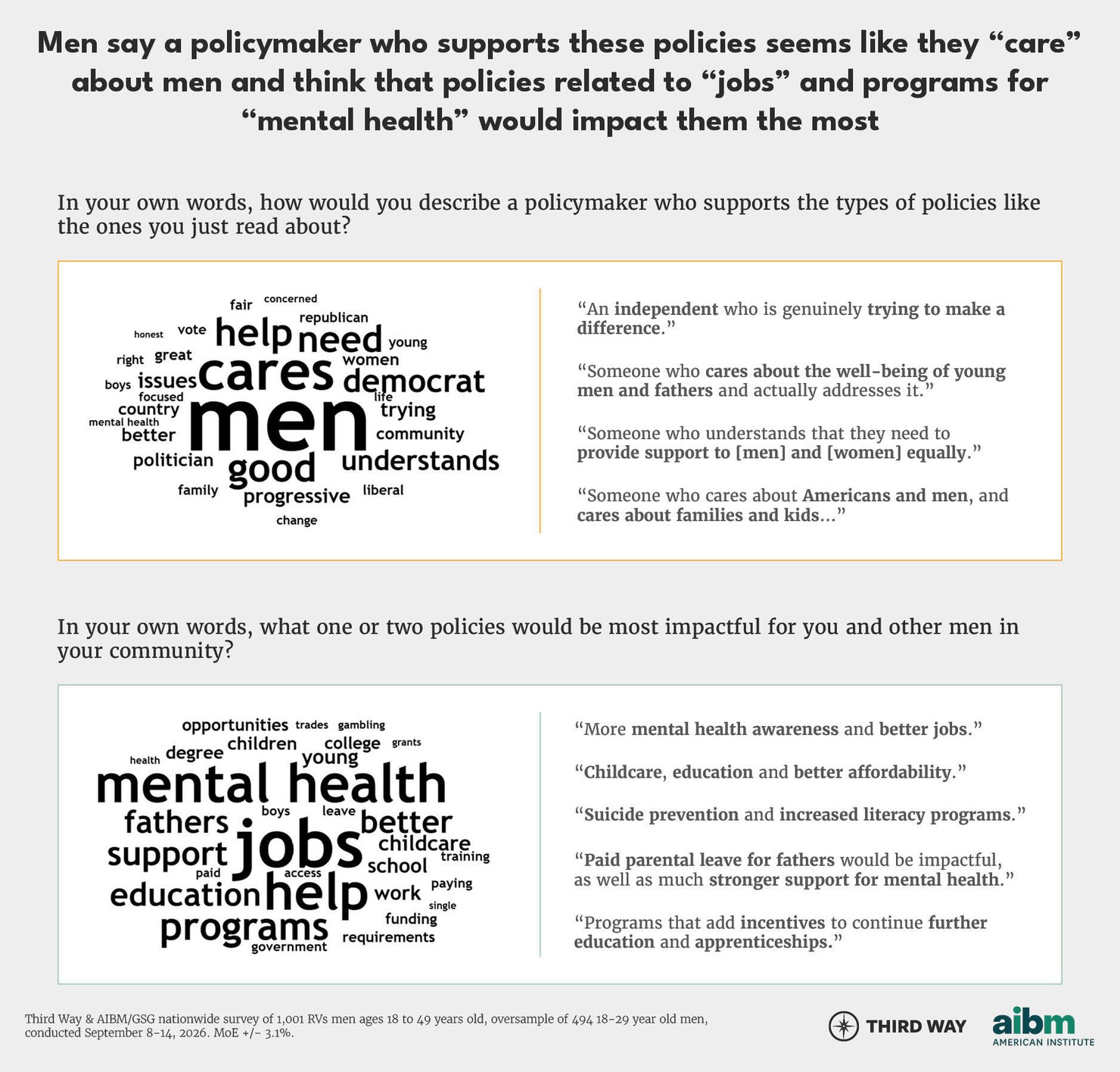
After reading these policies, men said that a policymaker who supported these measures showed a real commitment to addressing men’s struggles. One respondent described that policymaker like, “someone who cares about the well-being of young men and fathers and actually addresses it.” Another said it would be “someone who cares about Americans and men, and cares about families and kids...”
Conclusion
The conversation around men often focuses on what is going wrong, but the crux of this research was to ask them what would help make a meaningful difference in their lives. Their answers gave us a clear direction forward: more therapists and teachers trained to address boys’ and men’s mental health challenges; childcare that can fit into a dad’s schedule; paid leave to spend meaningful time with children; and good jobs that don’t require a college degree. With neither party holding men’s loyalty, the next Congress has an opportunity and incentive to listen to what men are saying and act on it.
*Additional findings on men’s views of health and education careers, and engagement with institutions and extracurriculars are available in the topline and crosstabs.
*Men ages 18-29 are referred to as “young men,” and 30-49 are referred to as “family-aged men.”
Methodology: Global Strategy Group conducted an online survey of 1,001 men ages 18-49 nationwide who are registered voters, with an oversample to reach a total of 494 men under 30, between September 8 and September 14, 2026. The survey has a confidence interval of +/- 3.1%. All interviews were conducted via web-based panel. Care has been taken to ensure the geographic, political, and demographic divisions of the population of men ages 18-49 nationwide are properly represented.