Memo Published February 10, 2026 · 13 minute read
Where Do Young Men Stand Ahead of the 2026 Midterms?
Takeaways
- Democrats lead the generic congressional ballot 61-31% among young men (18-29) who are likely to vote in 2026—closely aligning with how Democrats fared in the last two midterm cycles.
- Republican and Independent young men say they are significantly more likely to skip the 2026 midterms and opt to vote in the 2028 presidential election.
- Young men favor moderation in both parties: 55% want Democrats to become more moderate rather than more liberal (30%), and 67% want Republicans to become more moderate rather than more conservative (17%).
- Young men hold the greatest reservations about supporting Democrats who are out of touch with working people and Republicans who are corrupt and in the pocket of billionaires.
- By a 55-43% margin, young men prefer a presidential candidate who backs capitalism with guardrails over one who advocates moving toward socialism.
- When it comes to personal success, young men place the greatest value on providing for a family and financial independence—priorities most associated with Republicans.
Young men continue to occupy a central part of the conversation in the American electorate—and for good reason. In focus groups from last year, we found that Democrats have a significant challenge on their hands to reverse their slippage with young men, but neither party has cemented them as a reliable voter bloc. To further analyze where the young male electorate stands today, Third Way worked with HIT Strategies to conduct a nationwide mixed mode survey in December 2025 of 1,462 young men, 18 to 29 years old, who are registered to vote.
2026 Generic Congressional Ballot
After Donald Trump made significant inroads with young men in 2024, less than one year out from the 2026 midterms, our survey shows that Democrats lead the generic congressional ballot among registered young men by 16 points, with a notable 38% undecided. Democrats’ advantage expands to 18 points when undecided voters are pushed and grows to 30 points when looking just at those likely to vote in the midterms—breaking 61-36% for Democrats over Republicans.
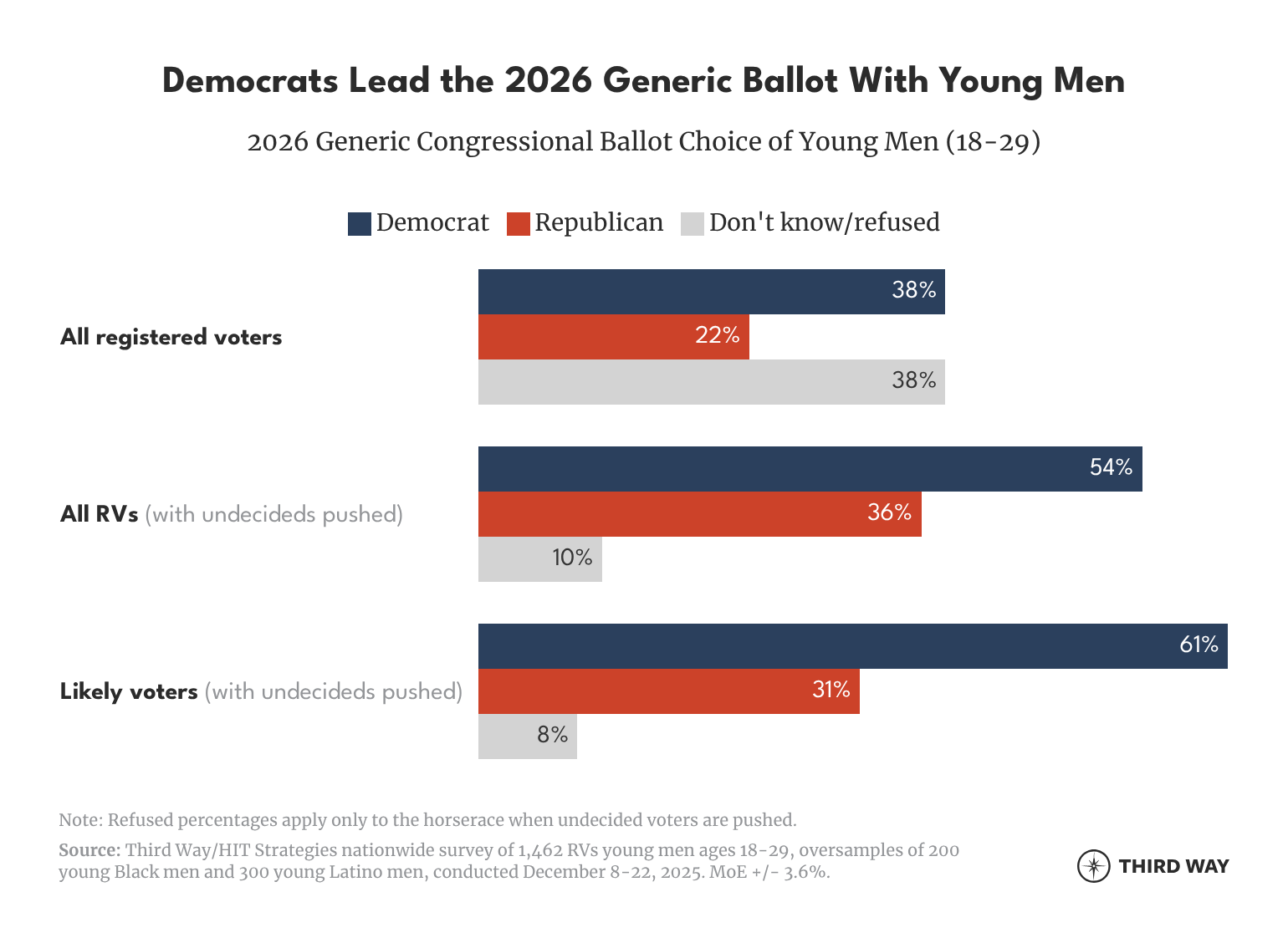
This closely aligns with how Democrats fared in the last two midterm cycles. In 2022, 58% of young men 18-to-29-years-old backed Democrats, and 62% supported congressional Democrats in the 2018 blue wave, according to Catalist.
Diving a layer into the data, we find some notable trends:
- Moderate and traditional conservative young men are the largest blocs of undecided voters up for grabs, with 57% of moderates and 38% of traditional conservatives undecided on the initial congressional ballot (before being pushed).
- Eight percent of young men who voted for Trump in 2024 say they will vote for a Democrat in 2026.
- Among young men who did not vote in 2024, 50% would vote for a Democrat, 37% for a Republican.
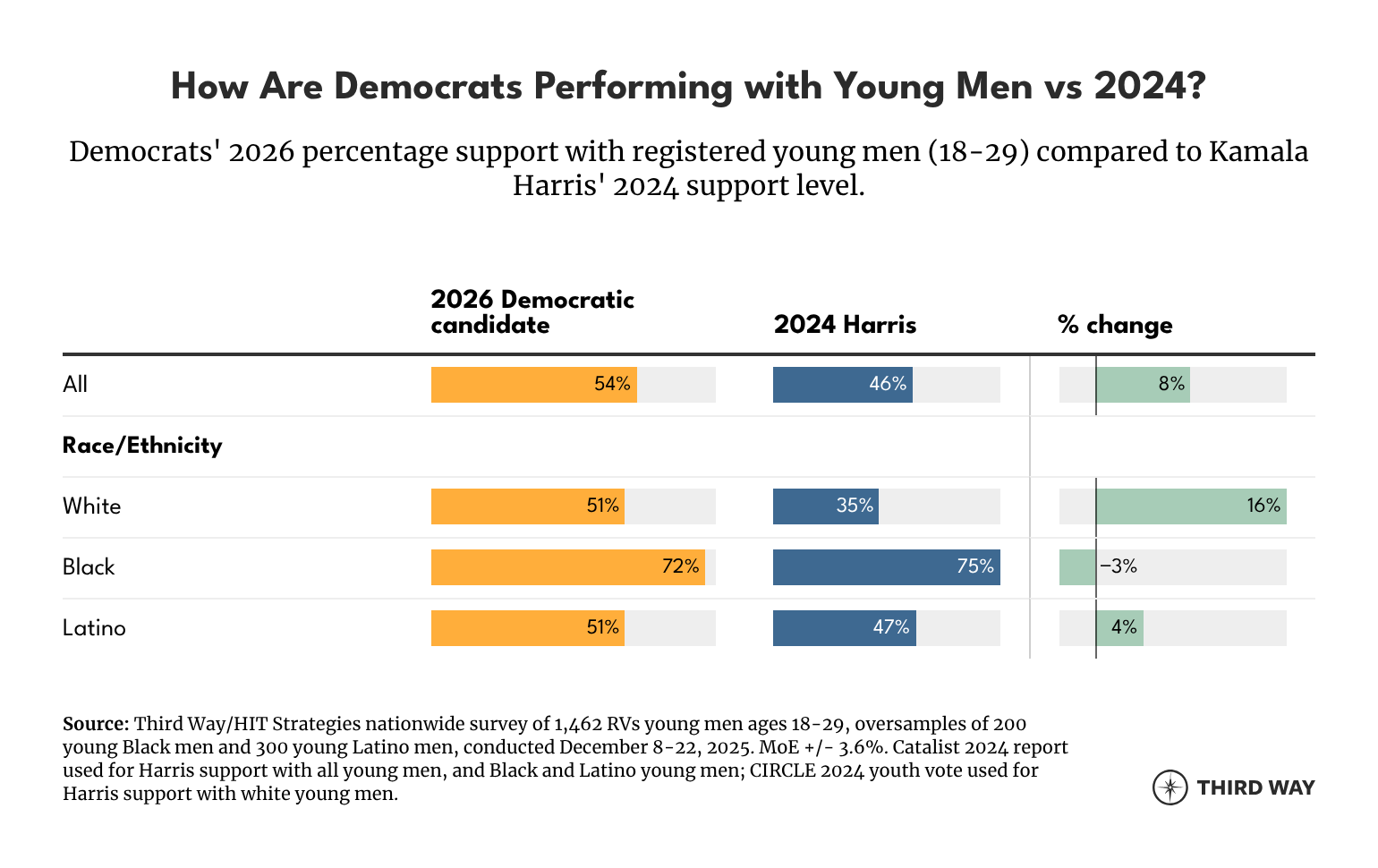
Diving into the racial and ethnic divide, we find that while Democrats have regained substantial ground with young white men compared to Harris’s 2024 support—a whopping 16-point improvement—they have yet to recover lost support among young Black men and have only marginally improved their standing with young Latino men by four points. It’s clear that these gains are uneven, underscoring why claims that Democrats have fully brought young men back into their corner may be premature.
In recent months, many pundits have been quick to claim that Democrats have solved their problems with young men. Our research suggests otherwise—and explains why the 2026 off-year electorate may be a one-time advantage for Democrats. Swingy, moderate, low-propensity young men who backed Trump in 2024 are much less likely than stalwart Democrats to show up and vote in 2026, creating an enthusiasm gap that favors Democrats in the short term—however, that gap could narrow as the election approaches. When we break down the young men electorate’s likelihood to vote in 2026 and 2028, we find that Republican and Independent young men say they are significantly more likely to skip the 2026 midterms and opt to vote in the 2028 presidential election.
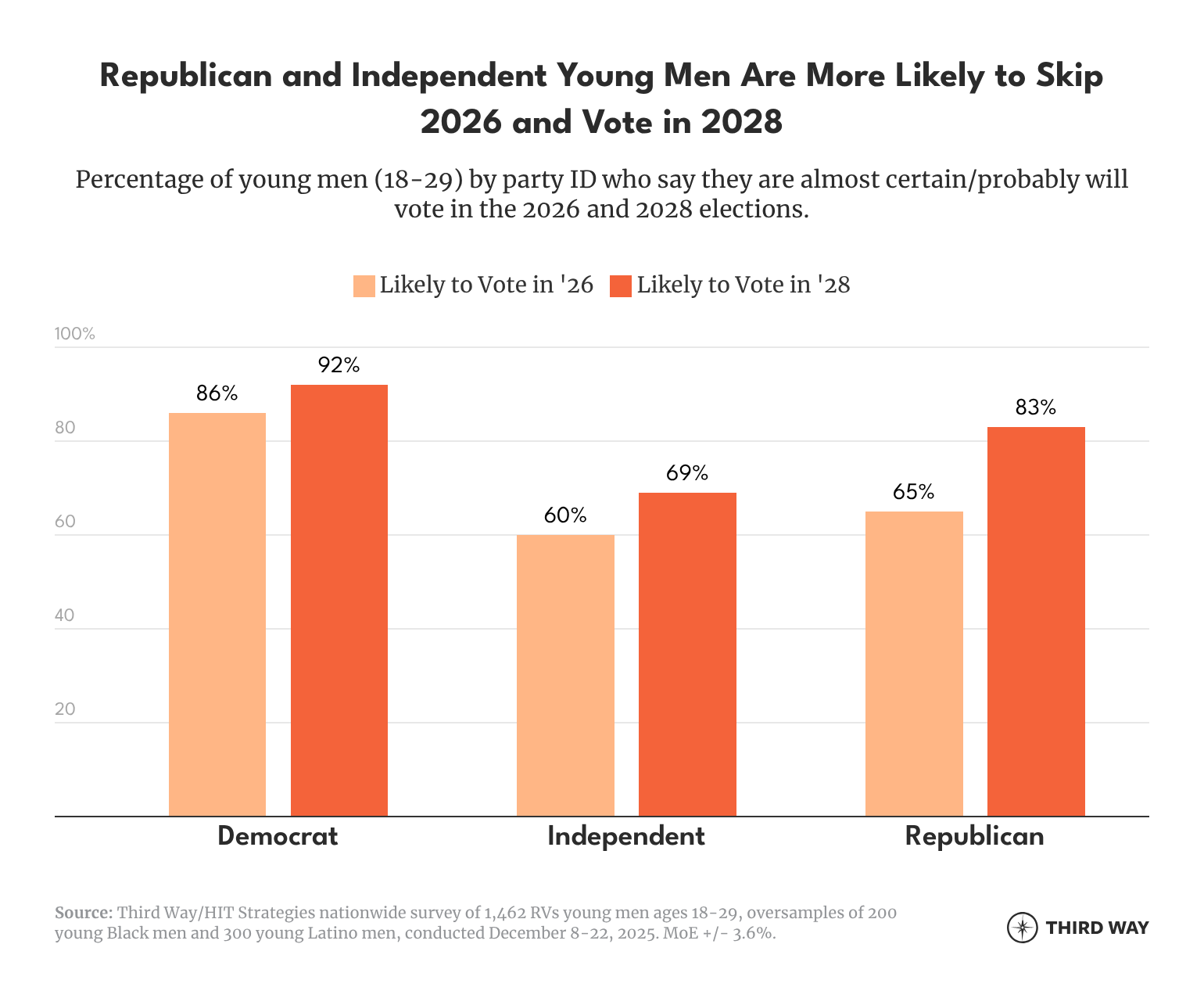
This pattern is consistent with Catalist data from the last four election cycles, which shows that Democratic support among young men declined by six points between the 2018 midterms and the 2020 presidential election and by 12 points between the 2022 midterms and the 2024 presidential election. While Democrats should feel hopeful and motivated for 2026, an off-year election that will primarily be a referendum on Trump, does not necessarily indicate that Democrats have solved all their vulnerabilities with young men, especially in presidential election years when a more moderate and conservative electorate will be turning out to vote.
Ideology & Direction of the Parties
In the aftermath of the 2024 election, a broad debate has emerged over the Democratic Party’s future ideological direction—and over whether the Republican Party has moved too far to the extreme in the early months of the Trump Administration. To gain a deeper understanding of these ideological currents, we asked respondents to place themselves, the political parties, and liberal and conservative activists on a 0 to 10 scale—where 0 represents “very liberal” and 10 represents “very conservative.” The results show that young men place themselves nearly dead center on the ideological scale, with a mean response of 4.8.
By comparison, the Democratic Party receives a mean score of 3.6 and the Republican Party a 7.5—placing young men just 1.2 points from Democrats, but 2.7 points to the left of Republicans. A 1.5-point gap might not be a lot, but these ratings act like a Richter scale, so when voters put themselves closer to Democrats than to Republicans, it’s a sign of a brewing political problem for the GOP. This is also significant movement from our 2024 post-election poll, when young men placed themselves closer to Trump than Harris on the ideological scale.
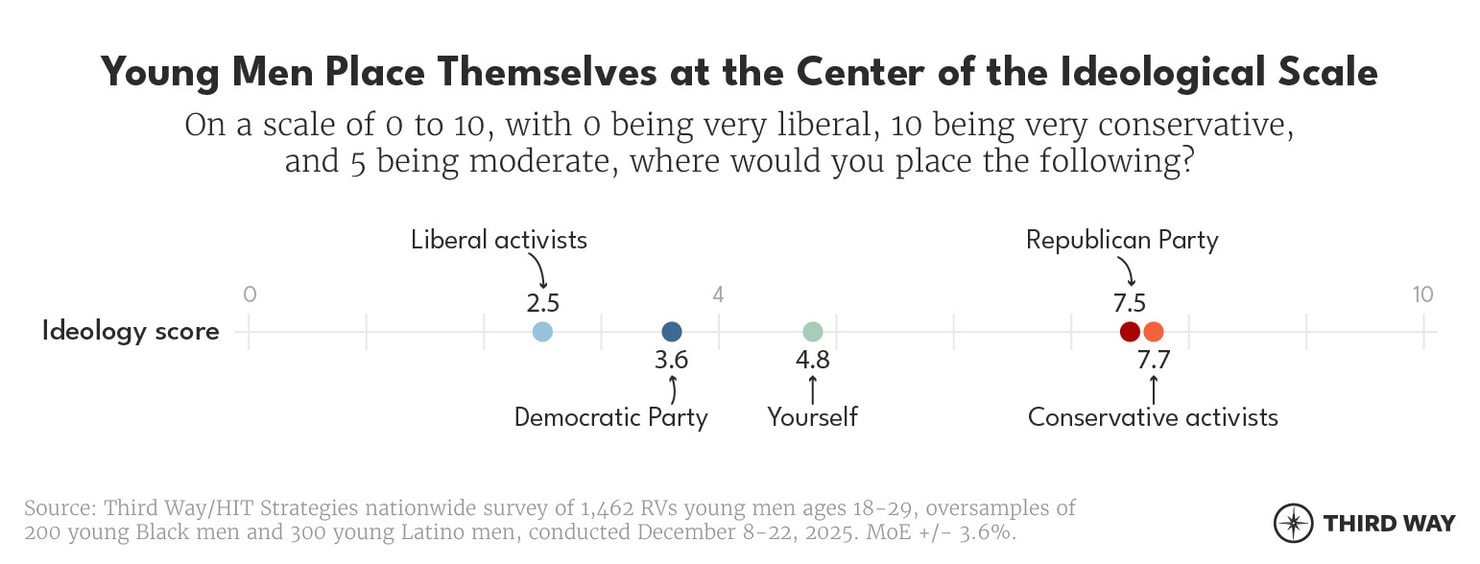
Meanwhile, we find that young men place liberal activists (2.5) and conservative activists (7.7) at roughly equal distances—about three points—from their mean ideology. Notably, liberal activists are perceived as significantly further to the left of the Democratic Party—by roughly one point—while the Republican Party is seen as nearly in complete lockstep with conservative activists. These perceptions suggest that young men view both the Republican Party and conservative activists as operating further outside the mainstream than the Democratic Party, but so are liberal activists.
To further examine how the political parties are viewed today, we asked respondents what ideological direction each party should pursue—and young men were unequivocal in their preference for moderation.
A 55% majority of young men want the Democratic Party to become more moderate, compared with 30% who want it to become more liberal and 13% who prefer the party stay the same. Strong majorities of young Latino (58%) and white men (55%), along with a plurality of young Black men (46%), favor Democrats moving toward the center rather than tacking further to the left.
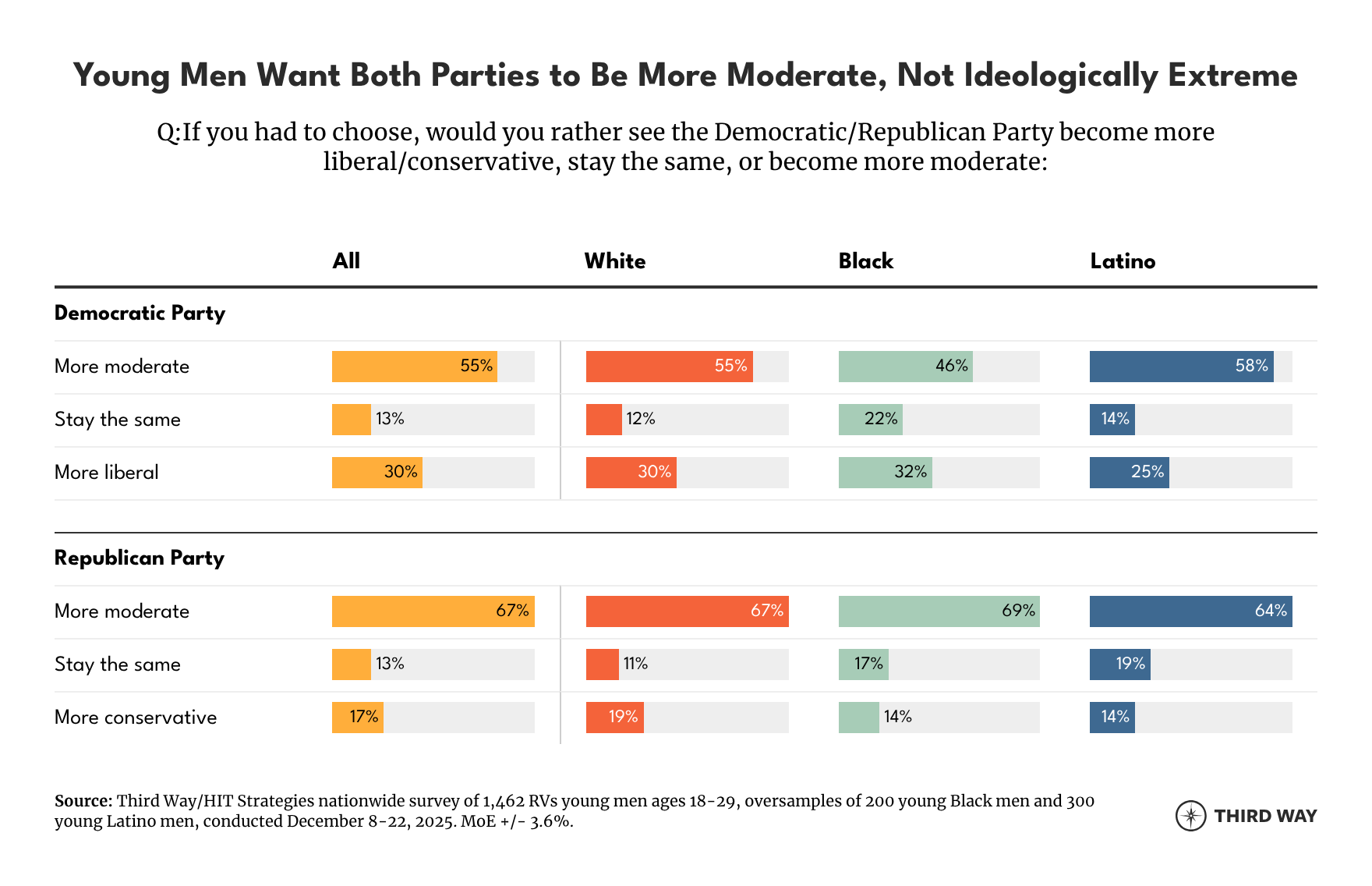
Meanwhile, a 67% supermajority want the Republican Party to become more moderate, compared with just 17% who want it to become more conservative and 13% who prefer the GOP to stay the same. Nearly two-thirds of both young white men and young men of color say they would prefer the Republican Party to become more moderate, suggesting broad concern among young men that the party has grown too ideologically extreme. As it turns out, this desire for moderation is closely tied to how young men think about their individual life goals and which party they associate those goals with.
Personal Goals & Perception of Parties & Activists
To assess how young men think about personal success, and how they associate this with politics, we asked what individual life goals they value the most. We found that across race and political affiliation, respondents place the highest priority on providing for family (88%), financial independence (82%), and having a fulfilling job (74%), which is consistent with findings from NBC News last year. On its face, this data shows that economic security and fulfilling a duty of care for family are central to young men’s identities. While respondents ranked marriage and religion lower among their explicit goals, many young men view these as inseparable from providing for their families—and as far more important life goals than simply getting rich or achieving status. And, as we note later, the two goals that young men value most are also the ones they most strongly associate with Republicans—priorities they don’t see represented in the Democratic Party.
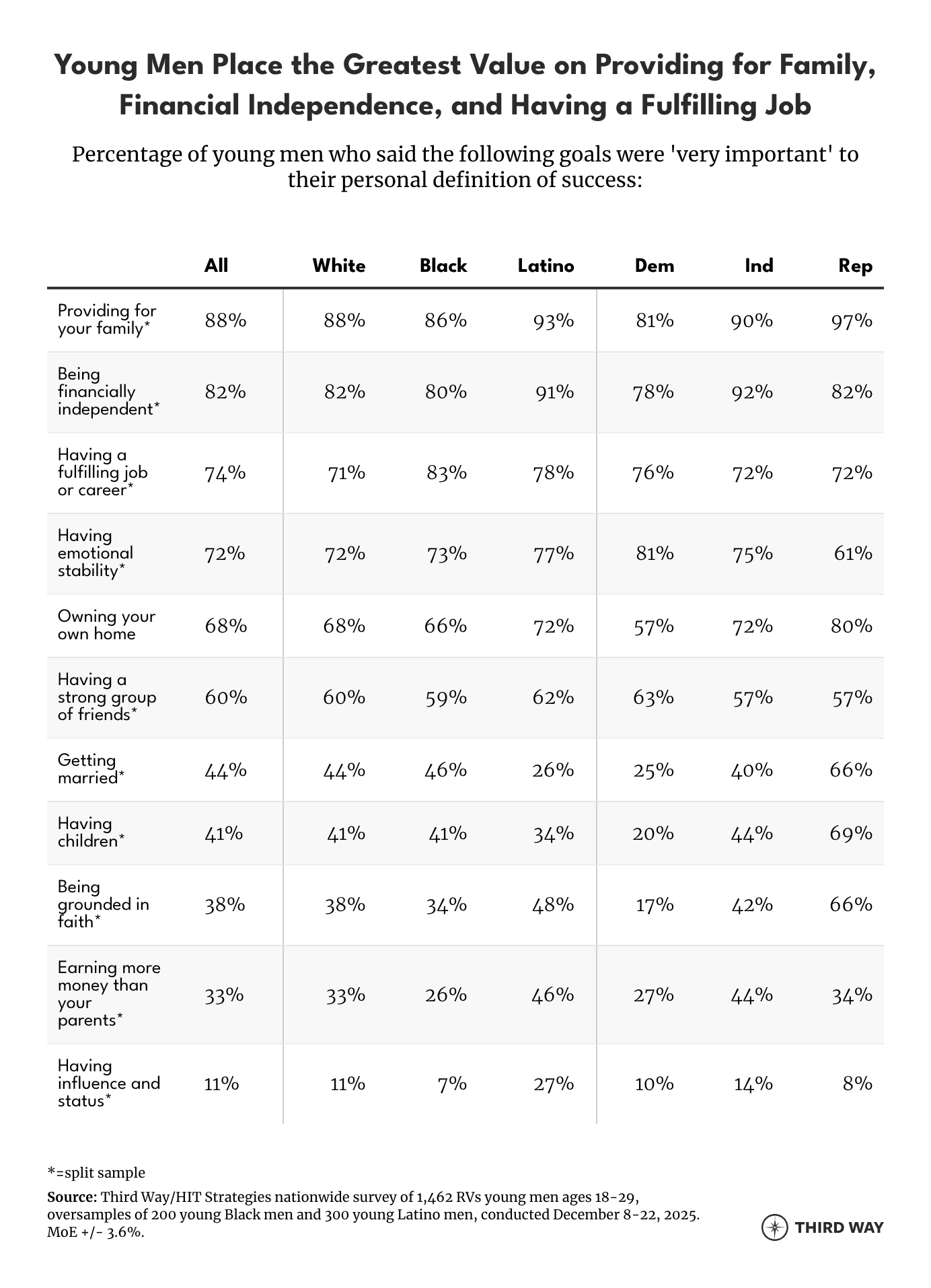
A closer look at the data reveals clear partisan divides around traditional economic and family values. Young Republican men place substantially greater importance on marriage (a 41-point gap compared with Democrats), having children (also a 41-point gap), and being grounded in faith (a 49-point gap). By contrast, young Democratic men place more emphasis on emotional stability than Republicans do—a 20-point gap—ranking it alongside providing for family as their top markers of success.
Looking across racial and ethnic groups, we see that young Latino men place higher value than their white and Black peers on financial independence, emotional stability, religion, earning more than their parents, and having influence. Meanwhile, young Black men place slightly more importance on having a fulfilling job than either white or Latino men.
To better understand who young men believe speaks to their most important life goals and concerns, we examined another dimension of today’s attention economy—an ecosystem that has never mattered more in American politics. We asked respondents who they perceive as talking most about key issues among liberal and conservative activists, as well as elected Democrats and Republicans.
We found that elected Democrats are most associated with economic affordability (27%), social and cultural issues (25%), and working-class issues (24%). However, Democrats are effectively absent when it comes to being associated with more masculine and identity-based topics, such as “how to be a good man” (9%), “finding a partner and starting a family” (9%), and “financial independence and career success” (18%). Republicans, by contrast, are perceived as connecting economic issues to personal identity and individual character. Elected Republicans have the strongest association with “financial independence and career success” (35%) and with finding a partner and starting a family (34%).
When we examine Democrats and Republicans side by side, Republicans are twice as likely to be associated with financial independence and individual character compared to Democrats, and there is a 25-point gap between the two when it comes to talking about starting a family. These findings are consistent with focus groups that Third Way conducted last year, which found that young men believe Republicans best represent men’s priorities of achieving financial independence and taking care of one’s family—and, as we showed earlier, young men place the greatest value on these for individual life goals.
Meanwhile, Democrats are more than twice as likely to be associated with social and cultural issues compared to Republicans. Democrats hold a 10-point lead when talking about affordability—though it does not dominate the Democratic brand the way certain individual goals do with Republicans—and they hold a slight four-point edge on working-class issues over Republicans.
By comparison, both liberal and conservative activists are perceived as more ideologically extreme versions of elected Democrats and Republicans, shaping how young men interpret each party’s brand and messaging. Conservative activists dominate the conversation around “how to be a good man” (53%) and starting a family (44%). Liberal activists, on the other hand, are most closely associated with social and cultural issues (44%), economic affordability (36%), and working-class issues (34%)—with social and cultural issues being nearly 10 points more associated with activists than economic issues. While liberal activists may be amplifying Democrats’ strength on affordability, they may also be increasing the party’s association with cultural issues—an area young men already link most strongly with the left—while diverting attention from messaging around individual aspirational life goals.
Vulnerabilities of the Parties & 2028
It's clear that young men have significant reservations about supporting both parties, so to better understand this relationship, we asked what the biggest factors are that would prevent these voters from voting for both Democratic and Republican candidates. The results show that young men are driven primarily by concerns about candidates who are out of touch with working people, ideologically extreme, and corrupt.
The greatest reservations that would prevent young men from voting for Democratic candidates are “being out of touch with the working class” (39%), “being inauthentic and unrelatable” (29%), and “being too ideologically extreme” (20%).
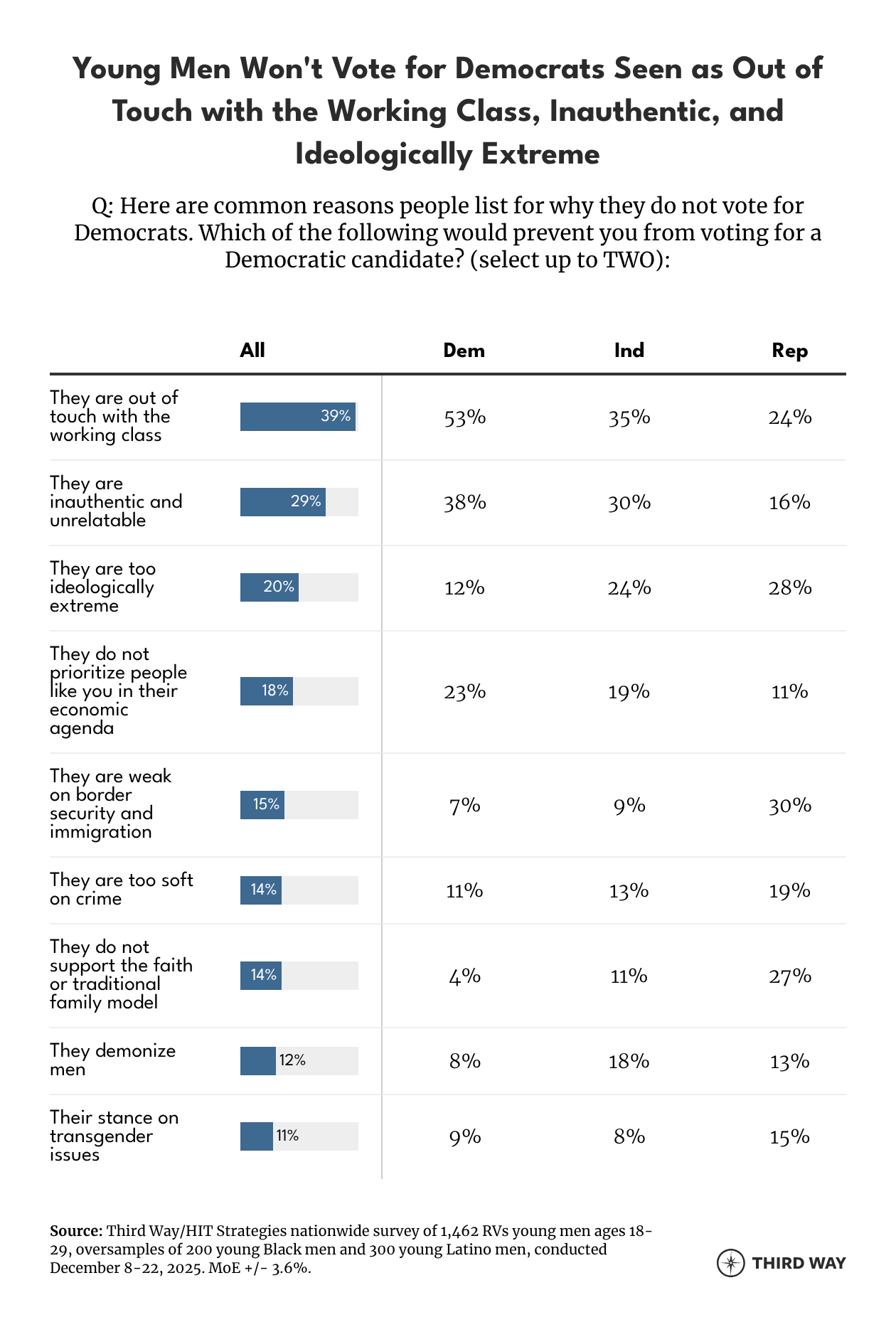
Importantly, reservations were markedly varied across party identification. Democratic young men are most concerned about Democrats who are out of touch with the working class and inauthentic. Independent and Republican young men place far greater weight on ideological extremism than Democrats do, while Republicans, unsurprisingly, express strong concerns about voting for a Democrat that is weak on border security and immigration.
Alternatively, the top reasons that would prevent young men from voting for a Republican candidate include being “corrupt and in the pocket of billionaires and big corporations” (44%), “allowing President Trump to seize new federal powers” (27%), and being “too ideologically extreme” (24%).
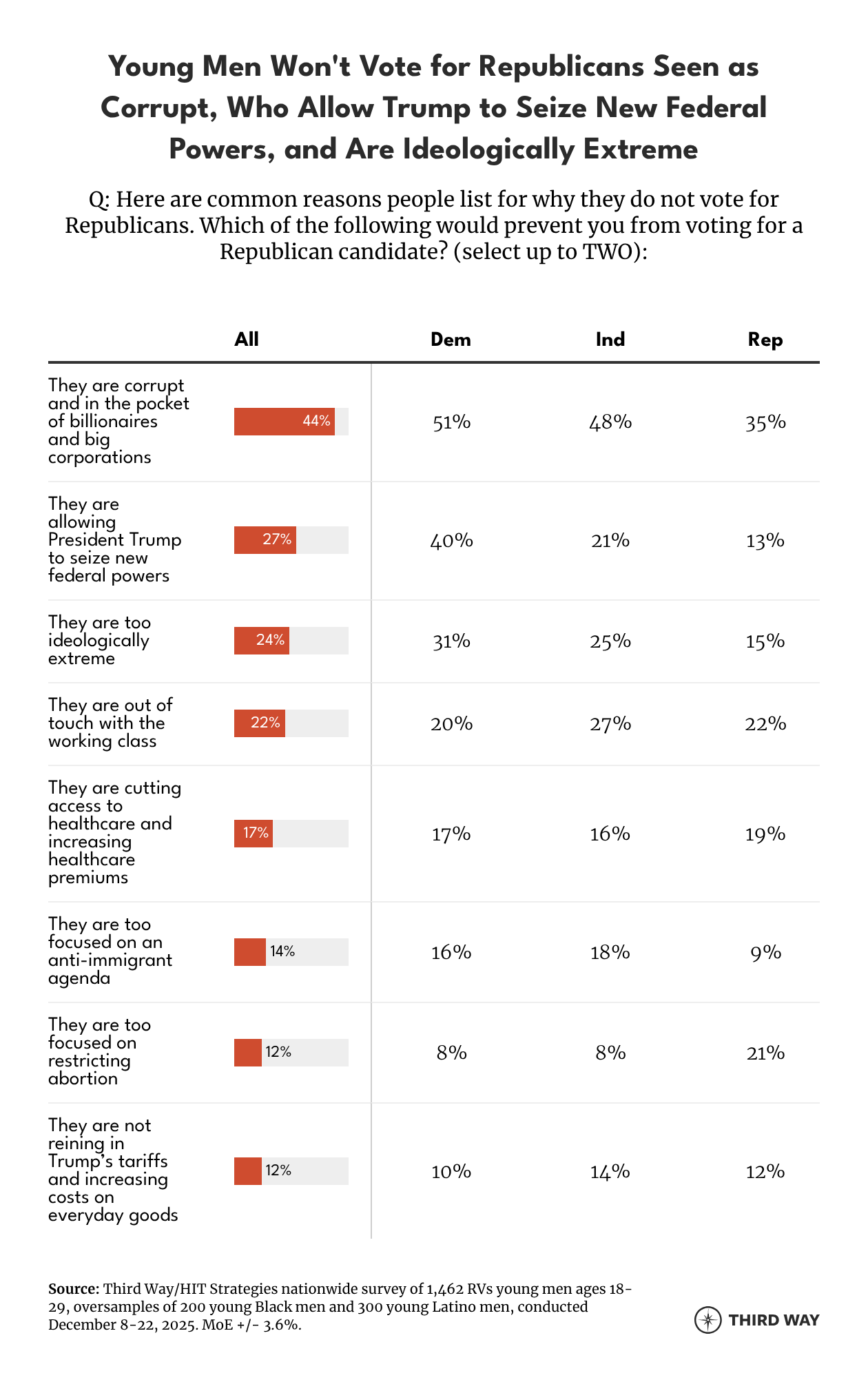
Across party lines, the most decisive dealbreaker for young men was the statement that Republicans are corrupt and beholden to billionaires. Beyond that concern, there were still notable differences across party identification. Democratic young men expressed significant concern about Republicans enabling Trump to seize new federal powers, suggesting this argument resonates strongly with the Democratic base but has far less traction beyond it. Among Independent and Republican young men, the second most frequently cited reason for not voting Republican was being “out of touch with the working class.” And, quite interestingly, among Republican men themselves, being “too focused on restricting abortion” and “cutting access to health care” ranked as the third and fourth most cited reasons.
Finally, we asked voters to think about the direction they would like a 2028 presidential candidate to take, both on their economic vision and on broader cultural beliefs. By a 55-43% margin, young men overwhelmingly back a presidential candidate whose vision for the country is focused on supporting capitalism with guardrails over one who advocates moving toward socialism. When asked whether they would prefer a candidate who fights for their cultural beliefs—even when those beliefs are not mainstream—or one who compromises and is willing to criticize their own party on cultural and social issues, young men favored the fighter by a 55–42% margin.
These two dynamics signal that young men are not seeking a far-left shift in the economic system, rather economic stability and accountability that protects the working class. They also prefer a leader who is authentic, independent, and has backbone to stand by their beliefs—rather than one who compromises without good reason or conviction.
Conclusion
In this survey, young men send a clear signal that they remain a true swing constituency—one not yet committed to either party over the long term. While high-propensity young men are willing to back Democrats in 2026, the broader young male electorate remains uncertain that Democrats share their values and aspirations or can be trusted to deliver for the working class. Across the board, young men want parties that move toward the center and candidates who are authentic, fight for working people, and are not beholden to powerful interests. This data should serve as a guiding framework for those seeking to engage young men in the years ahead.