Democrats Won Young Voters Without Running Left, and Can Again in 2028

Lucas Holtz, Santiago Mayer
Takeaways
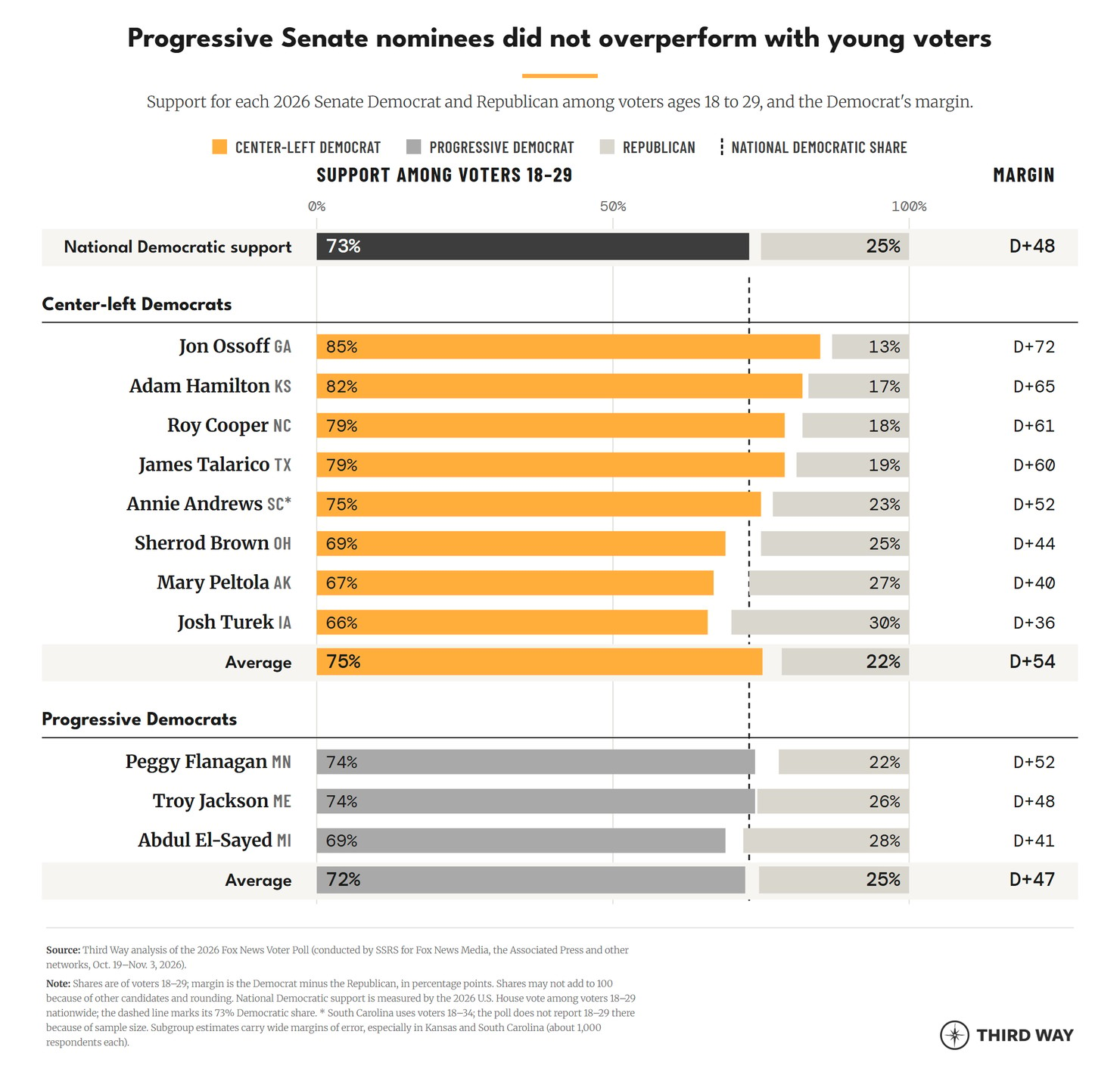
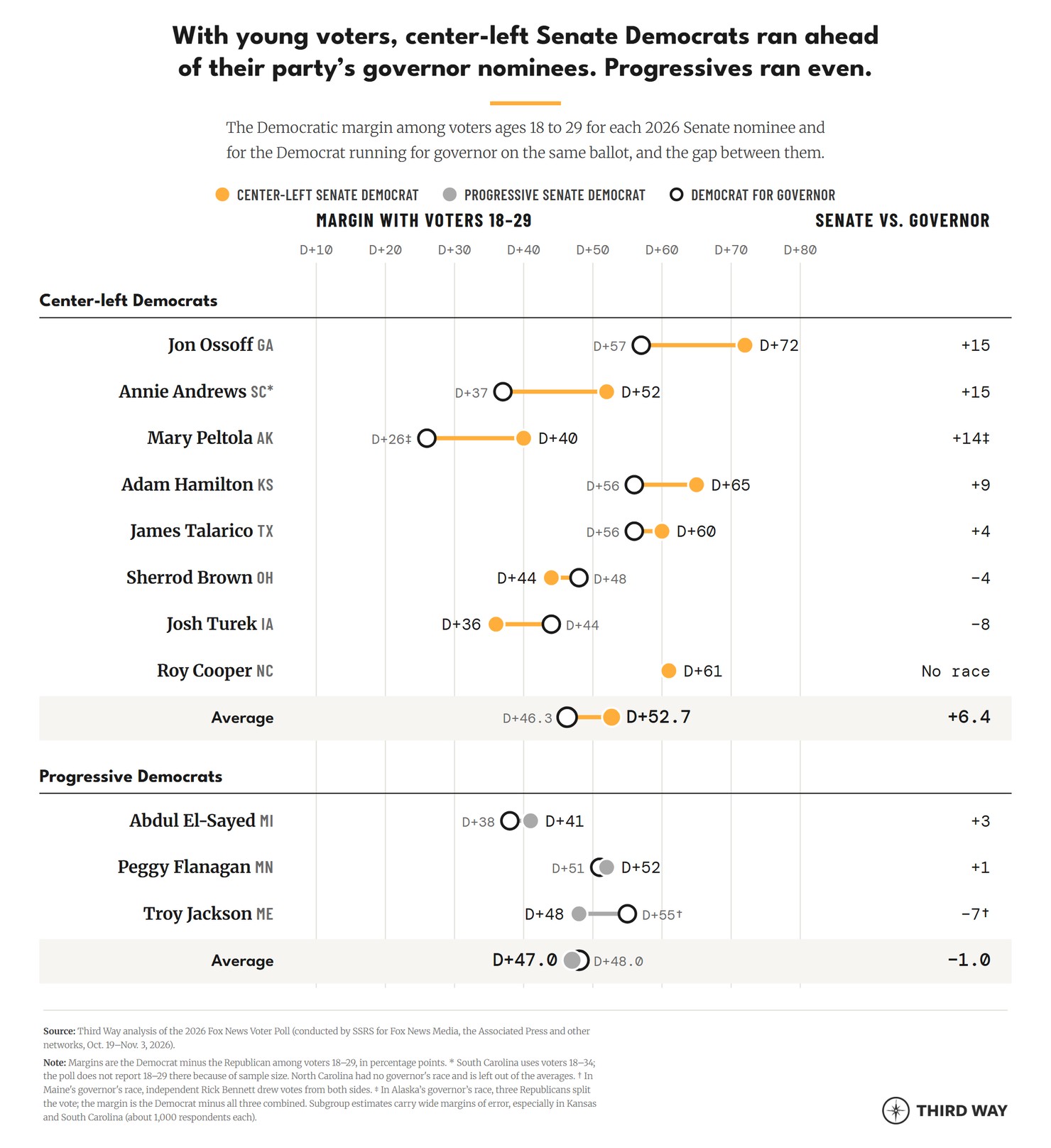
- Ossoff, Hamilton, Cooper, and Talarico performed best with young voters. Ossoff carried young voters by a 72-point margin, Hamilton by 65, Cooper by 61, and Talarico by 60. Center-left Senate nominees won young voters by an average 54-point margin, they ran six points ahead of their party’s candidates for governor, and six points ahead of the national D+48 average with young voters.
- Progressive Senate nominees did not do better with young voters. Progressive nominees won young voters by a 47-point margin, on-par with the average D+48 national youth vote, and they ran even with the governors in their states. Peggy Flanagan carried Gen Z by 52 points, Troy Jackson by 48 points, and Abdul El-Sayed by 41 points.
- Lessons for 2028. Democrats do not have to run to the far left in order to be authentic fighters for young voters and working people, or to challenge their own party’s status quo.
It was a terrific midterm election for Democrats across the country. Voters delivered an overwhelming rebuke and stopped Trumpism in its tracks. But Democrats should be clear-eyed about who the majority makers were in these midterms—especially those who made back inroads with young voters.
There are lessons to be drawn from every campaign, but the data shows that the most progressive statewide candidates had no distinct edge with young voters—most performing on par with the nationwide average—while Senate candidates who outperformed expectations did so by running center-left campaigns focused on affordability and accountability, taking on the status quo of the Democratic Party and the political system at-large, running mainstream on cultural issues, ending the war with Iran, and offering a bold, aspirational economic vision for the future.
Election Data
The 2026 midterm election data is in and it’s unequivocal: Gen Z voted on results, not ideology. The candidates who overperformed the generic ballot with voters 18 to 29 were center-left Democrats running authentic, combative campaigns that demonstrated an understanding of Gen Z’s frustrations with the political system and offered a vision for the country.
- Ossoff, Hamilton, Cooper, and Talarico performed best with young voters. Running campaigns focused on affordability, accountability, and taking on the status quo, Senate Democrats in Georgia, Kansas, North Carolina, and Texas delivered the widest margins with voters 18 to 29. Ossoff carried young voters by a 72-point margin, Hamilton by 65 points, Cooper by 61 points, and Talarico by 60 points. Center-left Senate nominees won young voters by an average 54-point margin—six points ahead of the national D+48 average with young voters.
- Progressive Democrats showed no edge with young voters. Progressive Democratic Senate nominees in Minnesota, Michigan, and Maine performed on-par with the average D+48 national youth vote (Democrats won young voters nationwide 73-25%) with Peggy Flanagan carrying Gen Z by a 52-point margin, Troy Jackson by 48 points, and Abdul El-Sayed by 41 points.
- Progressives ran even with their gubernatorial counterparts among young voters. Center-left Senate Democrats ran ahead of them. Among young voters, progressive nominees on average ran about even with their gubernatorial counterparts (-1 point on average), with Abdul El-Sayed (+3) and Peggy Flanagan (+1) marginally running ahead. Meanwhile, center-left Senate nominees ran on average five points ahead of the governors in their states with young voters. Led by Jon Ossoff (+15 point overperformance), Annie Andrews (+15), Adam Hamilton (+9), and James Talarico (+4).
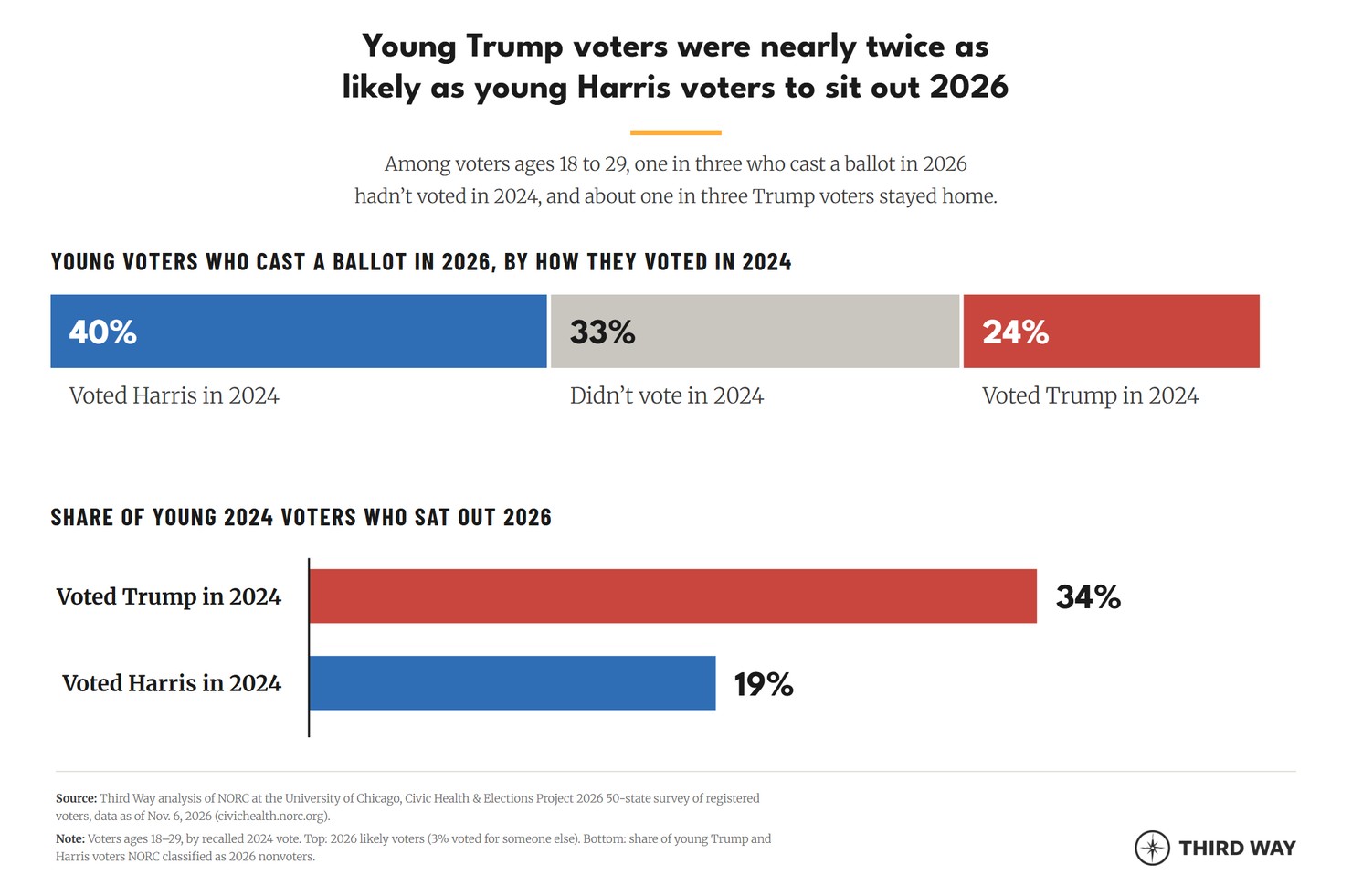
- Young voters are up for grabs. This election was a referendum on Trump, not an endorsement of the Democratic Party. Many of the young men and women who swung toward Trump in 2024 sat out the midterms—and their votes especially are up for grabs in 2028. Analysis of NORC’s 2026 Civic Health and Election Project shows that young Trump voters were about two times as likely as young Harris voters to sit out 2026. There is a wide swath of the young electorate, including the 33% who voted in 2026 and didn’t vote in 2024, whose votes are up for grabs in 2028.
- Bold economic messaging on kitchen table issues worked. Young voters ranked the economy (43%), the state of democracy (28%), and healthcare (11%) as their top issues. Democrats across the board ran on these issues rather than relying on climate change or gun violence as they had in the past. Jon Ossoff, who ran a campaign almost entirely on bringing costs down and holding the Trump administration accountable for its corruption, received the highest youth vote share among Democrats running in competitive races.
The Candidates
Looking at the campaigns that performed the best with young voters, namely Jon Ossoff, Adam Hamilton, and James Talarico, there are multiple factors that 2028 presidential candidates can seek to build off of:
- Jon Ossoff was the biggest overperformer with young voters in 2026. Perhaps nobody ran as hard on tackling political corruption as Senator Ossoff who framed this issue as the root cause of high costs in everyday life and healthcare—and he criticized both parties for participating in it. Ossoff specifically ran on banning congressional stock trading, saying that “corruption is why nothing works for ordinary people.”
- Adam Hamilton, the first Democratic Senator elected to Kansas since 1932, ran as an “independent-minded Democrat dedicated to leading from the center.” He ran on lowering costs for everyday people, rooting out corruption in DC, ending the war with Iran, and fighting Trump’s tariffs and health care cuts. He ran against the extremes on the left and right—including against socialism and open borders—and explicitly did not run on single payer Medicare for All.
- James Talarico, the first Democrat to win a Texas Senate seat since 1988, ran far ahead of the statewide House vote with a campaign laser-focused on addressing costs, tackling corruption, and breaking from the status quo of the Democratic Party. As Talarico put it, “We have an affordability crisis because we have a corruption crisis.” He ran on ending tariffs, capping prescription drug prices, and suspending federal gas and diesel taxes, while pledging to secure the border, backing an all-of-the-above energy agenda, and calling himself a capitalist who opposes “crony capitalism.”
Looking to 2028
Candidates looking for the support of young voters do not need to give in to demands from groups on the left. There is no evidence that embracing positions outside the mainstream increases support among young voters. In fact, the candidates who ran combative, bold, mainstream campaigns performed best with young voters in 2026.
- Young voters want Democrats to run on mainstream reforms. 63% of Gen Z voters expect life for the next generation to be worse than life today, so it’s unsurprising that the candidates who performed best with young voters (Ossoff, Talarico, and Hamilton) all ran campaigns that acknowledged how the status quo, and the political system at-large, has failed Gen Z. New York Times polling found that a 47% plurality of young voters want a mainstream Democratic Party. 2028 Democratic contenders should focus their messaging on mainstream anti-corruption and affordability reforms that’ll ensure Gen Z can get ahead in life like their parents and grandparents did, not on token progressive issues.
- Young voters are disaligning from both parties. Thirty-eight percent of 2026 Gen Z voters identify as independent, more than older generations, and 61% said their ballot was cast as a vote against Trump—not as an endorsement of Democrats. Gen Z feels left behind in the current economic system and wants substantial political change, but that does not mean a majority are firmly in Democrats’ camp.
- Lessons From 2019 and 2020: This election was a referendum on Trump, not a mandate to lurch to the left. Following the last midterm election under Trump, Democrats lurched to the left on issue after issue at the behest of the far left. And it culminated in harmful questionnaires and liable debate stages where dozens of viable candidates raised their hands in support of policies unpalatable with the majority of Americans. Democrats have not suddenly solved all of their longstanding problems with young voters, especially in presidential election years, and they risk losing the ground they have made back if they lurch to the left in 2027 and 2028.
Conclusion
The lesson from 2026 is clear: Democrats do not have to run to the far left in order to be authentic fighters for young voters and working people, or to challenge their own party’s status quo.
As Democrats approach the 2028 Democratic Presidential Primary, it is imperative to understand that, despite claims from advocacy groups, embracing progressive priorities outside the political mainstream is not the silver bullet to higher performance with young voters.