Center-Left Democrats Overperformed and Delivered the Majority

Third Way, Welcome
Takeaways
- Red-State Democrats—All Moderates—Overperformed and Delivered the Senate. As of Wednesday, center-left Senate Democrats had flipped Iowa, Kansas, North Carolina, Ohio, South Carolina and Texas from red to blue and held Georgia, a Trump state. On average they ran 21 points ahead of Harris’s 2024 margin and 5 points ahead of their party’s statewide House vote.
- Leftier Blue-State Democrats Underperformed. El-Sayed in Michigan, Flanagan in Minnesota, and Jackson in Maine, all ran on average 5 points behind their party’s statewide House vote. El-Sayed ran 2 points behind, Flanagan 3 points behind, and Jackson 10 points behind. And they ran just 5 points ahead of Harris in a blue environment—16 points less than successful center-left candidates in Trump-won states.
- Moderate Governors Won and Overperformed Their Senate Counterparts. In Maine, Hannah Pingree outran Jackson by 11 points, despite there being an independent in the governor’s race. In Michigan, Jocelyn Benson outran El-Sayed by 4 points. In Minnesota, Amy Klobuchar ran ahead of Flanagan by 3 points.
- Moderate Democrats Flipped Red Places Blue and Delivered the House. Center-left Democrats backed by Welcome PAC, NewDem Action Fund, Blue Dog PAC had flipped 31 Republican-held House seats–of races called so far. 25 of them are in districts Trump won, and on average these candidates ran 15 points ahead of Harris’s 2024 margin. That's a total of 81 red seats flipped since 2018.
The Democratic tsunami that swept across the nation on election night was powered by mainstream and moderate Democrats in deep ruby red states. These majority makers delivered a knockout blow to Trumpism, handing Democrats control of both the House and the Senate. The overperformers did not run as standard-bearers of the far left. They rejected the extremes, appealing to Americans in the middle by promising to deliver results for the middle class and working families in ruby red places that have not elected a Democrat in decades.
Here, we look at the Senate, where red-state moderates flipped 6 states to deliver the majority while leftier nominees in blue states fell behind their own party, and then in the House, where center-left Democrats have flipped 31 seats (so far) to take the majority in the House of Representatives.
Senate: Red-State Moderates Delivered the Majority While Leftier Blue-State Nominees Underperformed
Democrats entered 2026 down 47-53 in the Senate, needing to net four seats for a majority. As of Wednesday, center-left Senate candidates flipped 6 states from red to blue (North Carolina, South Carolina, Texas, Kansas, Iowa, and Ohio) and held Georgia. They won the Senate because mainstream Democrats ran far ahead of the party’s baseline in ruby red Trump states. Together, they ran on average 21 points ahead of Harris’s 2024 margin, and 5 points ahead of their party’s statewide House vote.
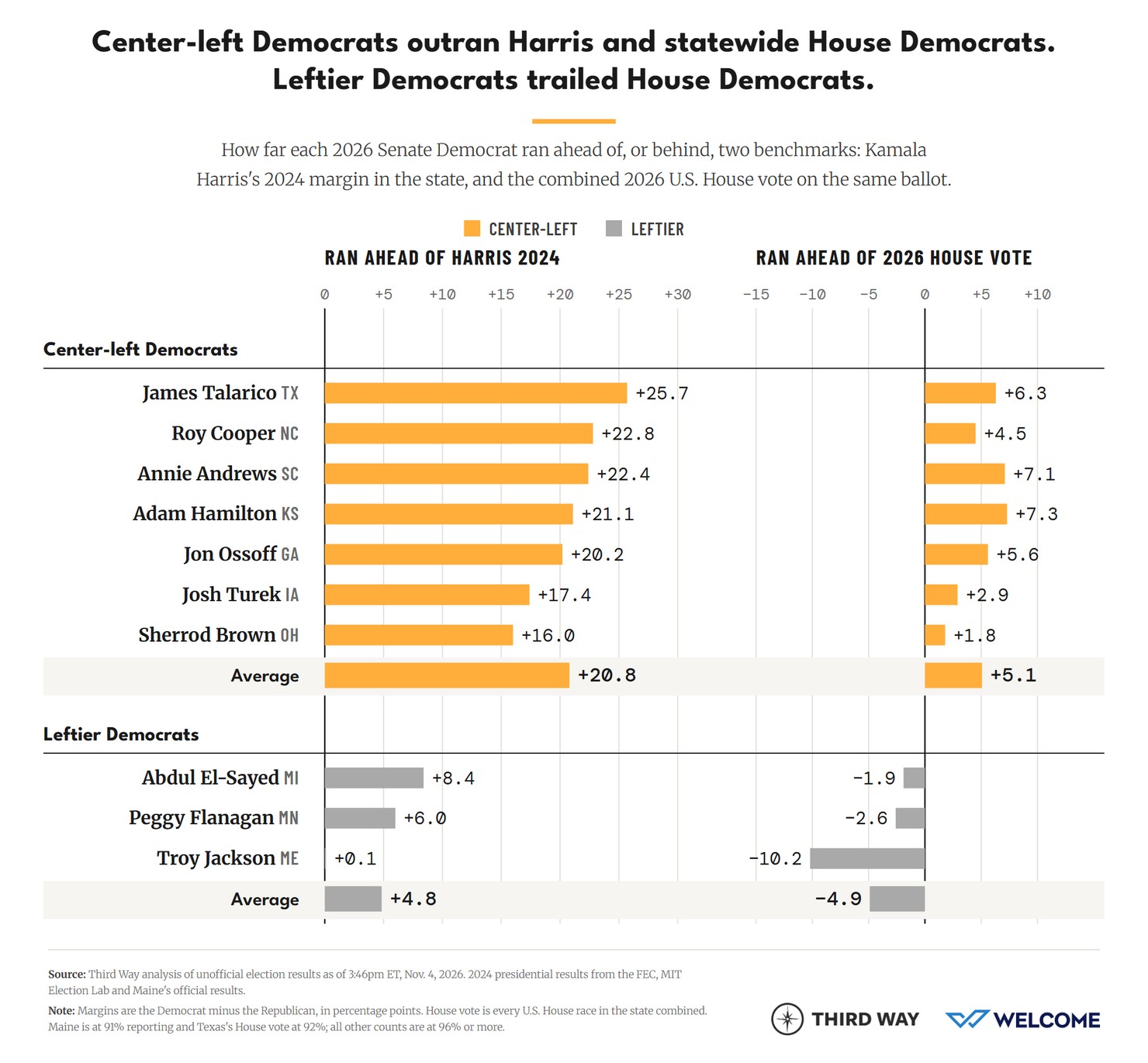
This is where the Senate majority was decided. In two purple states that Trump won, Jon Ossoff ran 20 points ahead of Harris and 6 points ahead of Georgia Democrats; Roy Cooper ran 23 points ahead of Harris and 5 ahead of state Democrats. Moderate Democrats overperformed in deep ruby red states, too. James Talarico (+26 vs Harris, +6 vs House Democrats), Annie Andrews (+22, +7), Hamilton (+21, +7), Turek (+17, +3), and Brown (+16, +2) ran ahead of typical Democrats to flip all their states from red to blue and deliver the Senate majority.
All of these candidates showed that the key to winning deep red states is not to run to the far left–it’s to run as authentic, mainstream candidates. In Texas, James Talarico, the first Democrat to win a Texas Senate seat since 1988, ran far ahead of the statewide House vote because he ran a campaign laser-focused on addressing costs, tackling corruption, and breaking from the status quo of the Democratic Party. He also pledged to secure the border, backed an all-of-the-above energy agenda, and called himself a capitalist who opposes “crony capitalism,” leaving the GOP with little room to paint him as a socialist.
Same with Adam Hamilton in Kansas, who ran as an “independent-minded Democrat dedicated to leading from the center.” Hamilton ran against the extremes on left and right—including against socialism and open borders—to root out corruption and help Kansans hurt by Trump’s tariffs.
And despite the claims that nominating leftier candidates would excite the base, drive up turnout, and lead to massive overperformances, El-Sayed in Michigan, Flanagan in Minnesota, and Jackson in Maine all ran behind their party’s statewide House vote by an average of 5 points. El-Sayed ran 2 points behind, Flanagan 3 points behind, and Jackson 10 points behind.1 And they ran just 5 points ahead of Harris in a blue tsunami environment—16 points less than successful center-left candidates in Trump-won states.
Some progressive pundits will claim, “They ran ahead of Harris! That means they’re the model!” But just about every single Democrat running for office ran ahead of Harris this cycle. It was a blue wave cycle! Only center-left Democrats overperformed their party’s statewide vote.
Each of these leftier candidates also crucially underperformed their states’ mainstream gubernatorial nominees. In Maine, Hannah Pingree outran Jackson by 11 points, despite there being an independent in the governor’s race. In Michigan, Jocelyn Benson outran El-Sayed by 4 points. In Minnesota, Amy Klobuchar ran ahead of Flanagan by 3 points.
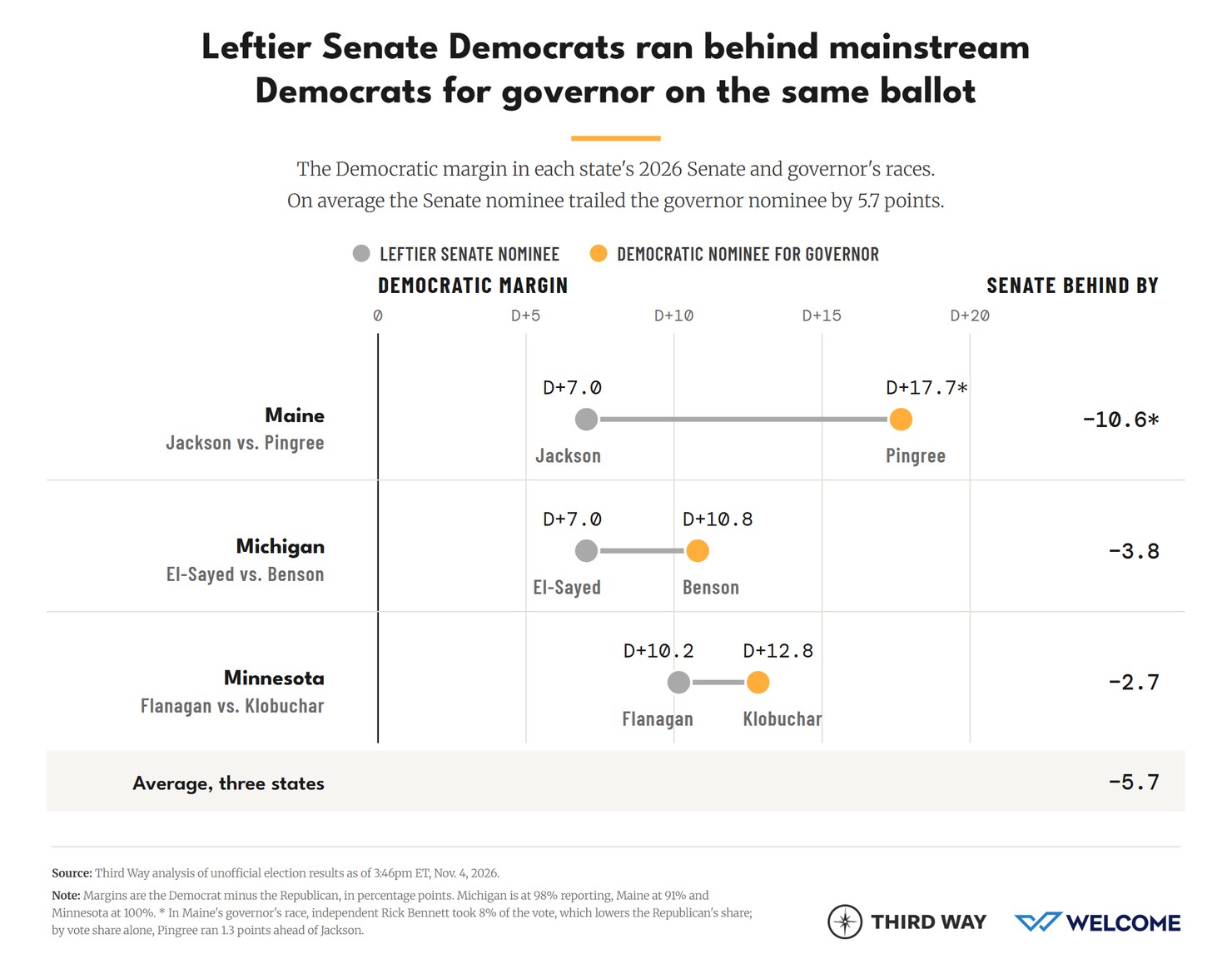
We should be clear that Democrats holding blue Senate seats in Michigan—a seat that Democrats have held for 47 years—and Minnesota—while running behind their party statewide—should not be looked at as the model for flipping red seats blue. In Maine, Jackson underperformed his center-left gubernatorial counterpart and U.S. House Democrats. All of these candidates eked out wins in spite of a massive blue wave environment. That is hardly the better formula when center-left, red-state Democrats overperformed and pushed Democrats into blue tsunami territory.
House: Moderates Flipped Red Places Blue and Delivered the Majority
Democrats needed to gain a net of four seats in the House of Representatives to retake the majority. As of Wednesday, center-left Democrats endorsed by Welcome, the New Democrat Coalition Action Fund, and Blue Dog PAC have flipped 31 Republican-held House seats from red to blue—of those called so far. Three candidates (Sam Forstag, Bob Brooks and Brian Poindexter) have been cross endorsed by moderates and Our Revolution. Democrats can now expect upwards of a 240-seat majority because of these candidates. On average, they ran 15 points ahead of Harris’s 2024 margin in these districts, and 25 of them won seats Trump carried in 2024. Since 2018, center-left candidates have now flipped 81 House seats from red to blue.
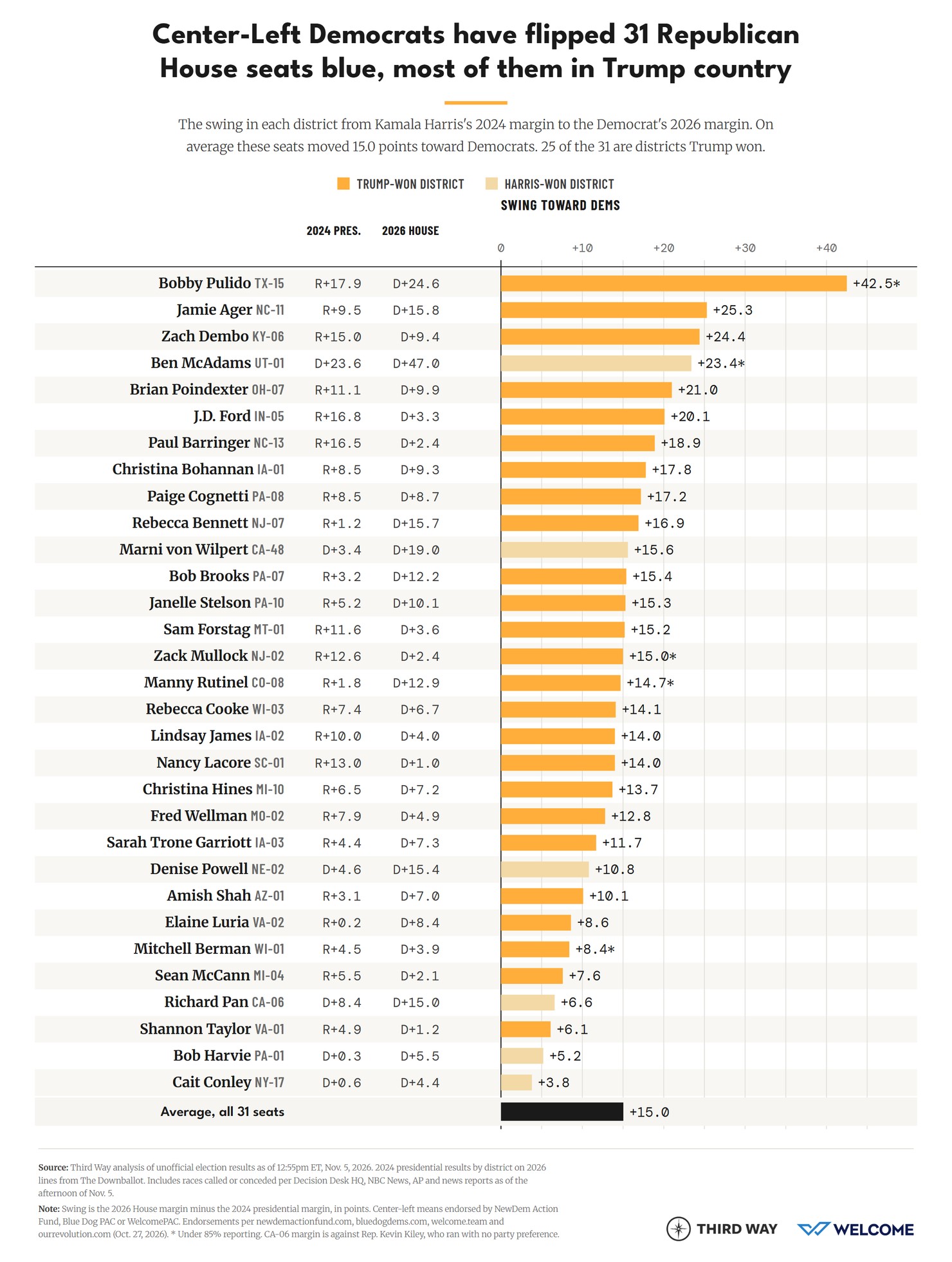
Many of these districts swung hard toward Trump in 2024 and have steadily moved away from Democrats over the last decade. Winning them required bringing back voters who supported Trump just two years ago. And center-left candidates did exactly that. Bobby Pulido won over working-class Latino voters and ran a whopping 43 points ahead of Harris to flip a Trump+18 district. Paige Cognetti won back working-class voters Democrats have been hemorrhaging in Northeast Pennsylvania, outrunning Harris by 17 points to flip a Trump+9 district. In western North Carolina, Jamie Ager was the only House candidate to outperform Roy Cooper, running 14 points ahead of Cooper and 25 points ahead of Harris to flip a Trump +9.5 district.
There is simply no majority without these 31 center-left Democrats. They ran on tackling the affordability crisis, supporting law enforcement, rooting out corruption, and securing the border while fixing the immigration system. They did not fall for the far left’s illusion that running further to the left was the path to victory, so when the GOP tried to brand them as card-carrying socialists, the attacks didn’t stick because voters simply didn’t believe them.
Only one Democratic-held seat untouched by redistricting looks set to buck the nationwide trend and flip red. With 94% of the vote counted, MAGA former Republican Governor Paul LePage leads Matt Dunlap by about 4,000 votes. The Trump+9 seat opened up when Blue Dog Rep. Jared Golden chose not to run again, and Dunlap, backed by Our Revolution, beat a NewDem moderate in the primary. National Republicans spent money to help Dunlap in that primary, betting he’d be the weaker opponent in November. If LePage holds on, the only blue to red, non-redistricting flip of the cycle may owe less to Republican strength than to progressives’ push to expel moderates in winnable races.
It’s a win for Democrats to flip any seat from red to blue. But barely eking out a few districts is not the same as building a durable majority. Candidates exclusively endorsed by Our Revolution flipped three seats (CA-22, MI-07, TX-23) so far. Of the 35+ seats flipped from red to blue that have been called, 31 were won by mainstream candidates. Meanwhile, it took a blue wave environment to carry these leftier candidates over the top. Whether they are capable of winning outside of a blue wave election, when a much more conservative electorate turns out in swing districts, remains to be seen.
Conclusion
As the Democratic Party looks to 2028, the lesson is unequivocal: Democrats running in the middle were the majority makers in 2026—and they are the model for 2028. Center-left candidates flipped places that Trump won by double digits and won over huge swaths of Trump voters. They ran on the issues that voters cared about—not litmus tests from the far left. And they ran as authentic candidates who would put a check on Trump and challenge the status quo of the Democratic Party. You don’t have to be a far-left Democrat to be a fighter or a change candidate.
As New York Times polling has found, 61% of voters want the Democratic Party to move to the center, nearly four times the share who said the party should move further left. And 52% of Democrats and Democratic-leaning independents want the next Democratic presidential nominee to move to the center in order to win in 2028, while only a quarter said the nominee should move to the left.
The results of 2026 put those numbers into practice. Center-left candidates weren’t just part of the winning coalition in 2026—they were the candidates who delivered the House and Senate majorities. The message for 2028 is unmistakable: Democrats win when they compete in the middle.
Endnotes
Troy Jackson ran against a moderate Republican Senator Susan Collins who has historically outperformed GOP presidential, governor, and House candidates she shares the ballot with.