Memo Published May 11, 2026 · 11 minute read
The Cost of Misplaced Priorities: Trump’s Coalition Frays


This April, Third Way worked with GBAO to conduct a survey of 2,000 registered voters nationwide. This is a continuation of our Signal project series in which we attempt to gauge issue salience to help separate the signal from the noise in the chaotic Trump presidency.
Overall, a clear trend is emerging that voters are losing faith in the Trump Administration’s ability to deliver on its promises and meet their needs.
- Voters are deeply concerned about rising costs and believe the Iran war is making that actively worse.
- Trump’s standing with Independents is weakening, and the share of Trump voters who are disappointed is rapidly increasing
- The Democratic brand is still damaged, but there is real opportunity, especially on the economy, and this should give Democrats a lift heading into the 2026 elections.
- If Democrats take back Congress, they will need to strike a balance between working with Trump and standing up to him—but voters see fixing the economy as the north star.
The Spring 2026 Political Moment
There’s little debate: voters are sour on the times in which they find themselves living.
When asked if the country is heading in the right direction or off on the wrong track, voters say by a 30-point margin (65% to 35%) and things are off on the wrong track. This is the fourth poll in our Signal tracker poll series, and that number has widened in every iteration. It is currently doubled from what it was a year ago (14-point margin in favor of wrong track). Democrats (-83) and Independents (-46) agree things are on the wrong track, while Republicans are still holding some faith. Conservative Republicans (+48) show more belief than moderate/liberal Republicans (+11), who are slowing approaching breakeven and have fallen more than any other group—having started at a 39-point margin saying right direction a year ago.
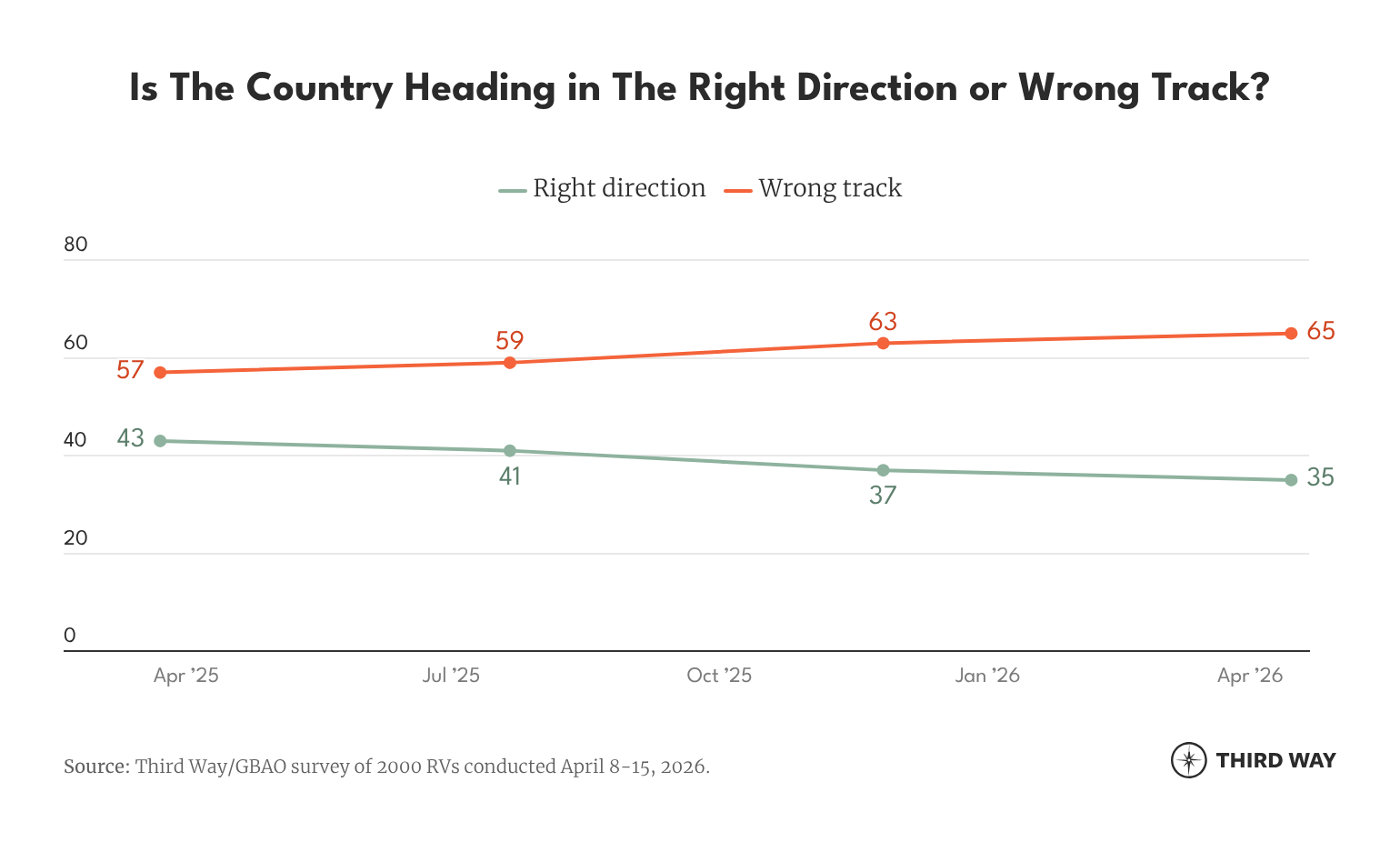
For the first time in this project, a majority of voters now (50%) say things are going worse in the Trump presidency than they expected. The share of voters who say things are going better is inversely at an all-time low of just 19%. Some of the biggest slides in that metric are among Latinos and young men, who have moved 18 and 26 points respectively towards “worse than expected” since last summer’s survey.
As one could imagine based on that data, Trump’s approval rating is sliding substantially. This survey finds him at 39%, down four points from the last one. His approval rating is even worse with Independents, currently standing at a measly 31%. While Trump has lost ground with all partisans, his worst slide is with moderate/liberal Republicans, with whom he has lost 40 points of net approval in the last year.
Voters continue to sour on the economy. They overwhelmingly agree that there is high inflation (86%), that the economy is not growing (64%), and that there is increasing unemployment (60%). Eighty-five percent of voters say there is corruption in the economy and government. And a majority of Democrats, Independents, and moderate/liberal Republicans agree with all four of those statements. This is also true of all income brackets.
By contrast, the notion that the United States is currently in a recession only garners 48%, driven by Democrats as well as those who earn under $50,000 a year. The belief the United States is in a recession is down by a substantial amount from the last survey from 2025, so despite widespread economic angst, that term is not the one that is connecting with voters in this moment.
Voters were also asked what they felt they were paying more for today than a year ago. Large majorities cited gasoline (89%), groceries (85%), going out to eat (72%), and utility bills (70%). Those making between $50,000 and $100,000 were the most price conscious about gasoline at 92%, while those making under $50,000 were the most price conscious about groceries at 87% and utility bills at 73%. The area with the biggest gap among incomes was housing, which was at 53%, but those under $50,000 were 23-points more likely to say so than those who made over $100,000, probably a sign that renters are struggling more than homeowners in this economy.
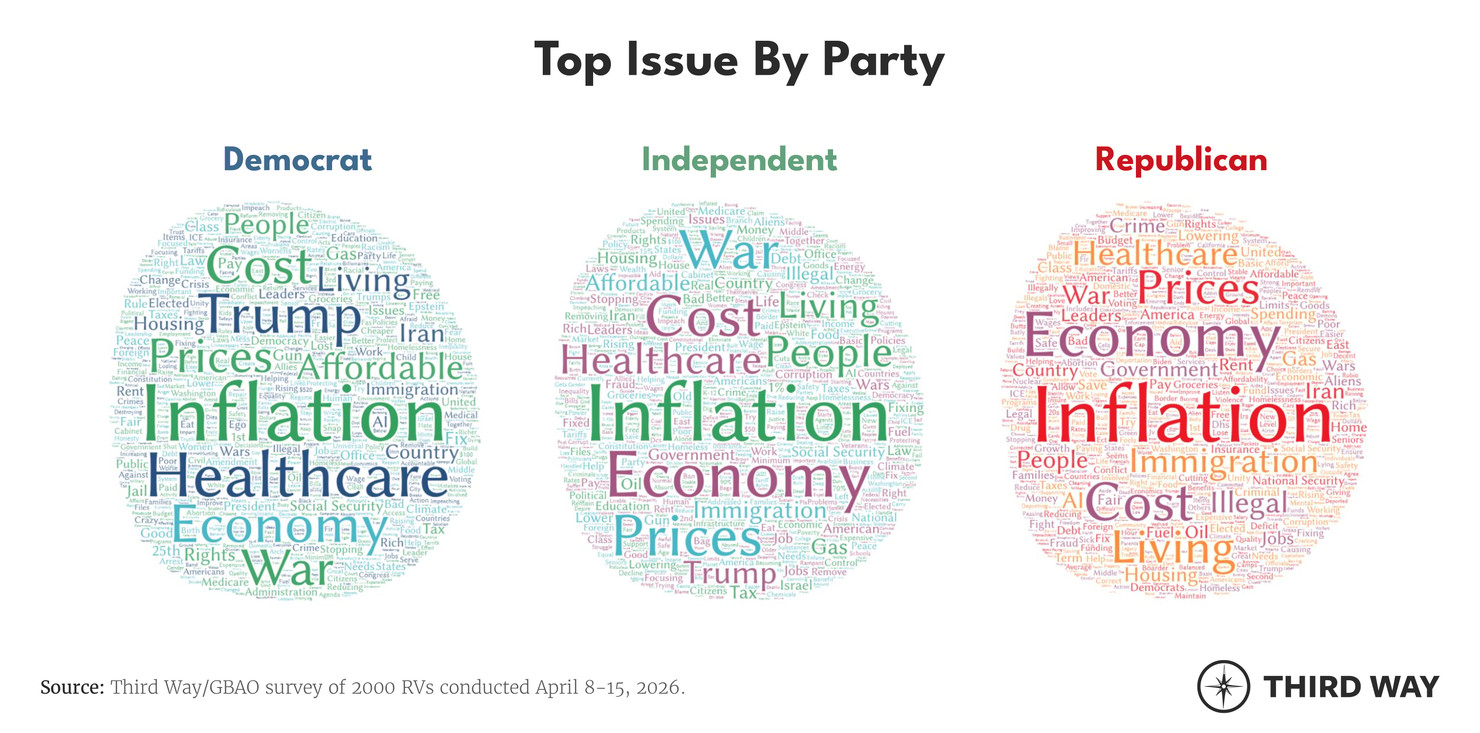
When asked about the most important issue, inflation rains supreme. Democrats, Independents, and Republicans used that word more than any other in an open-end exercise. Democrats and Independents were also likely to bring up health care and the war. Republicans were more likely to bring up illegal immigration than either of those two issues. While Democratic candidates will need to earn the trust of Independents on issues like inflation, health care, and war, it is an advantage that both Democratic and Independent voters are thinking about the same priorities.
The Democratic Party’s Opportunity
The Democratic brand is not in great shape, but there are real opportunities to make inroads and gain the trust of voters.
The favorability rating of the Democratic Party and Congressional Democrats is unmoved over the past year in our surveys. It currently stands at 39% favorable to 58% unfavorable, which is basically where it has been every instance this question has been asked in this project. If movement is to be observed, the Democratic brand image has improved by single digits with Democrats and Independents, while it has worsened with Republicans.
Meanwhile, the favorability of the Republican Party and Congressional Republicans is moving in a negative direction. Their rating of 38% favorable to 58% unfavorable now mirrors the Democratic brand, but that indicates real slippage over the past year. That movement is mainly due to two factors. The first is that Independents used to be a couple of points more sour on Democrats than they were on Republicans, but now that has flipped. The second trend is that there has been real erosion with Republicans, especially moderate/liberal Republicans, who have seen a 24-point slide in their favorability of their own party over the past year.
The generic ballot has moved slightly as well. Democrats now enjoy a 48% to 40% vote lead, up two points from the fall. The most movement has been seen among Latinos (up eight points) and young men (up 10 points).
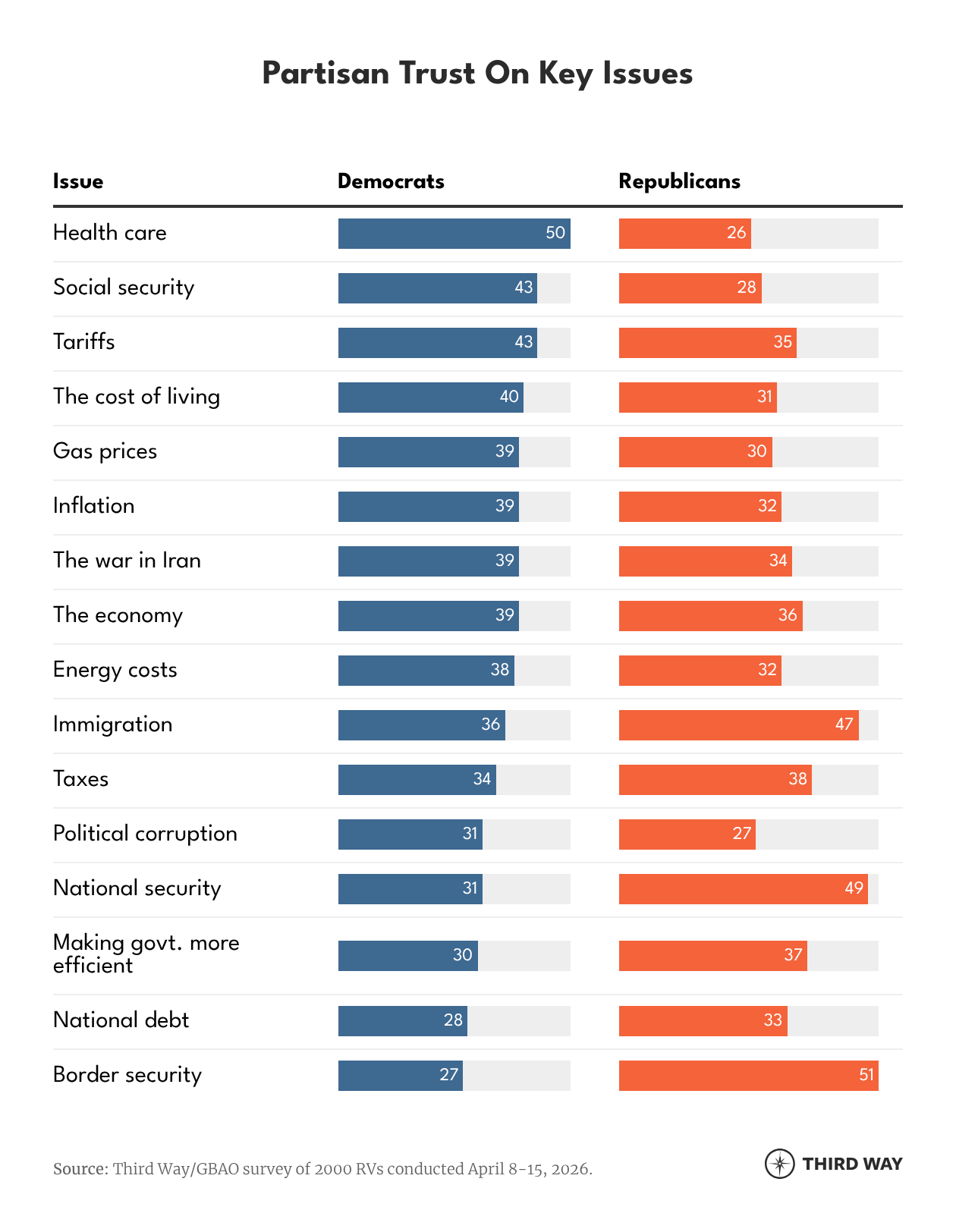
If Democrats want to cement and expand their ballot strength, they must look to strengthen some emerging patterns on issue trust. Unsurprisingly, they already have big advantages on issues like health care (50% to 26%) and Social Security (43% to 28%) over Republicans. But there has been some real movement for them on other economic issues as well.
Democrats are now more trusted than Republicans on the cost of living (40% to 31%), gas prices (39% to 30%), tariffs (43% to 35%), inflation (39% to 32%), energy costs (38% to 32%), and the economy (39% to 36%). Yet there’s work to do, as sometimes up to 1-in-5 people who say they plan to vote for Democrats in November do not currently trust them on these issues. Other small Democratic advantages include the war in Iran (39% to 34%) and political corruption (31% to 27%), but on those two issues (especially the latter) a lot of voters trust neither party at the moment.
Republicans enjoy an advantage over Democrats on issues relating to security, immigration, and certain fiscal issues. They have the edge on voter trust on border security (51% to 27%), national security (49% to 31%), immigration (47% to 36%), making government more efficient (37% to 30%), the national debt (33% to 28%), and taxes (38% to 34%).
And there is a warning for both parties in how Independents and other ideologically mainstream voters view their respective extremes. The MAGA movement on the right has a 31% favorable rating compared to 62% who view it unfavorably. Only 20% of Independents and 40% of moderate/liberal Republicans have a favorable view of MAGA. While less known than MAGA, the Democratic Socialists of America have a 22% favorable rating compared to 47% unfavorable, with only 16% of Independents and 25% of moderate/conservative Democrats having good things to say about them. Voters still aren’t sure who to trust, but they know it’s not the fringes on either side.
What Voters Want Right Now
Our survey also used a MaxDiff exercise to test issue salience. As expected, messages around economic pain and neglect rose to the top. Likewise, the War in Iran is breaking through due to its perceived economic impact and the disdain that voters have for leaders focusing on it instead of on lowering costs.
The four strongest messages were as follows in order:
- Republicans in Congress are championing a war in Iran that costs more than a billion dollars a day and has already resulted in gas prices rising by more than 30 percent in recent weeks with no end in sight. [Best among Republicans disillusioned with Trump]
- Republicans in Congress voted for a budget bill that bankrupts America with $5 trillion in new debt, and bankrupts Americans by raising health insurance premiums and electricity bills, all while giving tax cuts to billionaires. [Best among undecideds and Independents]
- Republicans in Congress have the wrong priorities, supporting hundreds of billions of dollars on an open-ended war with Iran while they are cutting programs like Medicaid and SNAP because they say we can't afford them. [Best among Democrats]
- Republicans in Congress voted to slash $1 trillion from Medicaid, threatening coverage for millions of children and hard-working people who can't otherwise afford health insurance, while increasing premiums for other Americans by 20 percent.
Throughout this project, there has been consistency on economic issues rising to the top, but the Iran war is a new wrinkle.
If Democrats were to take back some level of power in Congress in the midterms, voters are sending a clear message. They want them to focus on the economy above all other things, though that focus can heavily involve standing up to Trump and stopping his agenda.
In a forced choice on the path forward for Democrats, voters chose between two options.
- Democrats should stand up against President Trump's policies that have raised prices and are hurting regular people.
- Democrats should work with President Trump wherever possible to lower the cost of living for people struggling with high prices.
This question causes friction between Democratic voters and voters overall. The option to work with Trump won by a narrow 50% to 45% margin, thanks to its slim 47% to 45% margin with Independents. However, Democrats want Democratic leaders to stand up to Trump 80% to 18%.
But in another forced choice, voters were asked to choose between the following:
- Democrats should prioritize investigating the Trump administration for misconduct and impeach the President if he has broken the law.
- Democrats should prioritize bringing down costs for the American people, not investigations and impeachment.
The idea that Democrats should focus on the economy rather than investigations won handily in this matchup, 67% to 27%. Independents are begging Democrats to focus on bringing costs down by a 65% to 26% margin, while Democrats split with 49% saying investigate to 47% who say bring costs down.
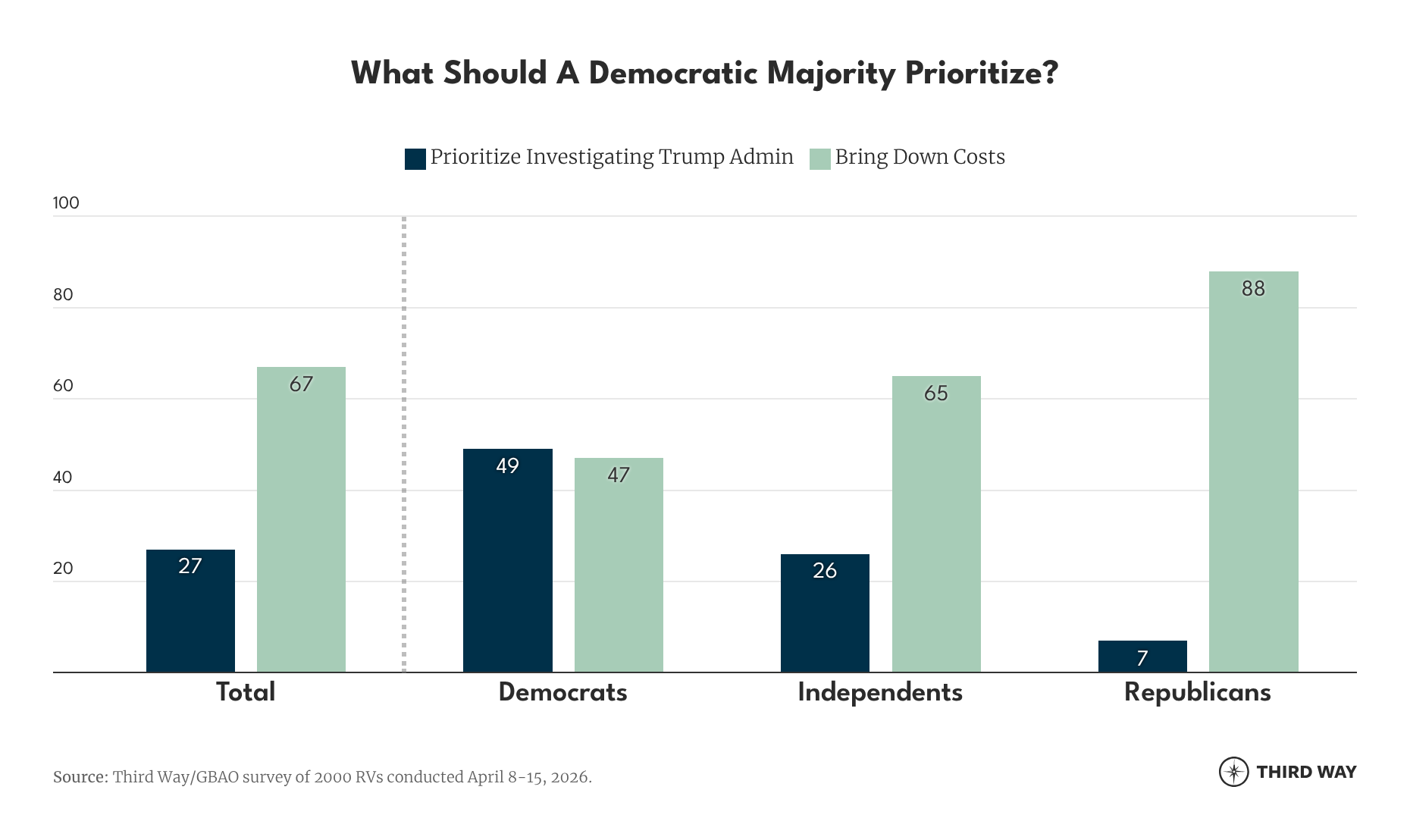
This is a clear indication that the Democratic base is looking for elected leaders to stand up to and fight Trump, but in service of helping bring prices down. If they claim a gavel this fall, voters will reward Democrats for using it to focus on ending tariffs and gasoline hikes from wars, not impeachment battles.
Conclusion
The Republican Party’s biggest weakness right now is that voters do not believe they are focused on the right issues, namely bringing down costs. In fact, voters believe that their misplaced priorities on things like Iran have even made things worse in terms of issues like gasoline prices. The Democratic brand is still struggling, but there is a clear path forward to hammer Republicans on their failures, misplaced priorities, and their support for tax cuts for the wealthy over help for working people. Democrats, for their part, should stay focused on lowering costs and restoring health care funding. There is a debate to be won and ground to be gained if they make a convincing case that they will focus on what voters truly care about, rather than being distracted like Congressional Republicans have been over the past year.