Memo Published December 25, 2025 · 12 minute read
Food & Medicine: Fuel for a Wave?

This November, Third Way worked with GBAO to conduct an online survey of 2,000 registered voters—the third poll in our effort to separate the signal from the noise in the chaotic news environment of Trump 2.0. This research set out to understand which of Trump’s actions have been most salient with voters and which specific arguments were most effective in moving persuadable Trump supporters and Independents away from the President and his party.
What is abundantly evident is the national mood continues to sour. There is a perception that because prices are high and rising, Donald Trump and congressional Republicans have failed to deliver on their economic promises. Voters are most concerned about core weekly and monthly budget items like health care and food costs. And they see a Trump Administration and congressional majority that is more concerned with giving money to the wealthy than helping normal families and workers.
This public opinion research is designed to find out what voters truly care about. It is about separating awareness from salience. Some things that rank high on awareness but low on salience now are the Epstein files, the East Wing renovations, and RFK Jr.’s job performance. Simply put, the stories of the day/week are not what voters are focused on and would not determine their vote if the congressional midterm elections were happening today.
However, Democratic congressional leaders should note that the negative views of their Republican counterparts has not yet created positive views of their performance overall. There are signs of hope in the improving congressional ballot for Democrats and the trust gap on economic issues due to Republicans losing trust. But whether Democrats hold even on the economic trust gap vs. building an advantage on the economy will probably be the difference between a blue trickle or a blue wave in 2026.
Weakening Trump
Voters became more pessimistic about the direction of the country as 2025 went on. In our March poll, 57% of voters thought the country was on the wrong track. By July, that percentage hit 59%. Now, in the November survey, 63% say the country is on the wrong track, which is a six-point increase from the beginning to the end of the year and a steady uptick as time passes.
Trump’s job performance continues to soften as well. In our March poll, his approval rating was 48%. By July, it fell to 45%, and in November, it was further eroded to 43%. From March to November, his approval rating with white, non-college voters has fallen from 62% to 52%, essentially now at a break-even point. Among Trump voters who think things are going worse than expected, his job approval rating is underwater, with only 41% approving.
His approval rating among those who were important new parts of his 2024 coalition continue to erode as well. Among those who consume news less than daily, his approval rating has fallen from 50% in March to 44% in November, which is slightly more than his erosion with those who consume news daily. His approval rating among Latinos stands at 33% and at 50% with young men. Both of these are down two points from July.
In a glass half-full situation, Trump’s approval rating with Independents has not soured since July. The problem for him is that it remained at just 37% in both surveys, a toxic number for a president’s party heading into a midterm election year.
The favorability rating of congressional Republicans and Democrats remains similar and constant from past surveys. Republicans currently have a 42% favorable rating, while Democrats sit at 40%. Democrats only have a 70% favorable rating from Harris voters, while Republicans enjoy a healthier 80% favorable rating from Trump voters. The good news is that Democrats are viewed 19 points better by those who claim they did not vote in 2024, 45% favorable towards Democrats to only 26% favorable towards Republicans. This, combined with Harris voters coming home when it comes to an actual vote, explains the congressional ballot now.
When asked about vote choice heading into 2026, 48% of voters would vote for a Democrat for Congress to only 42% who would vote for a Republican. While Harris voters are less approving of congressional Democrats than Trump voters are of congressional Republicans, the former is more likely to vote for their same party than the latter, with 91% of Harris voters planning to vote Democratic in 2026, compared to only 86% of Trump voters planning to vote Republican in 2026. Congressional Democrats enjoy a 46% to 21% lead among those who claim not to have voted in 2024.
Economic Sirens & Other Issues
Voters think we are headed toward, or already in, a recession. When asked if America is facing the problem of a recession, 57% of voters said yes. This includes 56% of Independents and 58% of non-college voters, and even 40% of Trump voters say so.
But while this economy would probably not be seen as the worst recession in the past half century by any means, the compounding conditions feel unusual. Voters say we are simultaneously experiencing high inflation (84% believe so), that the economy isn’t growing (60%), and that we have increasing unemployment (66%). Independents and non-college voters match those numbers throughout. Trump voters are less likely than everyone else to believe these things are happening, but a large majority (75%) say we are currently facing high inflation, while 46% say there is increasing unemployment, and 40% say the economy isn’t growing.
The most interesting finding is that there is real movement towards Democrats on economic issues. Democrats are tied on the economy now after being six points underwater in our summer survey. Democrats had a three-point lead in the July survey on cost of living and now enjoy an 11-point lead. Handling of inflation has moved slightly from being underwater by two points to now enjoying a one-point lead.
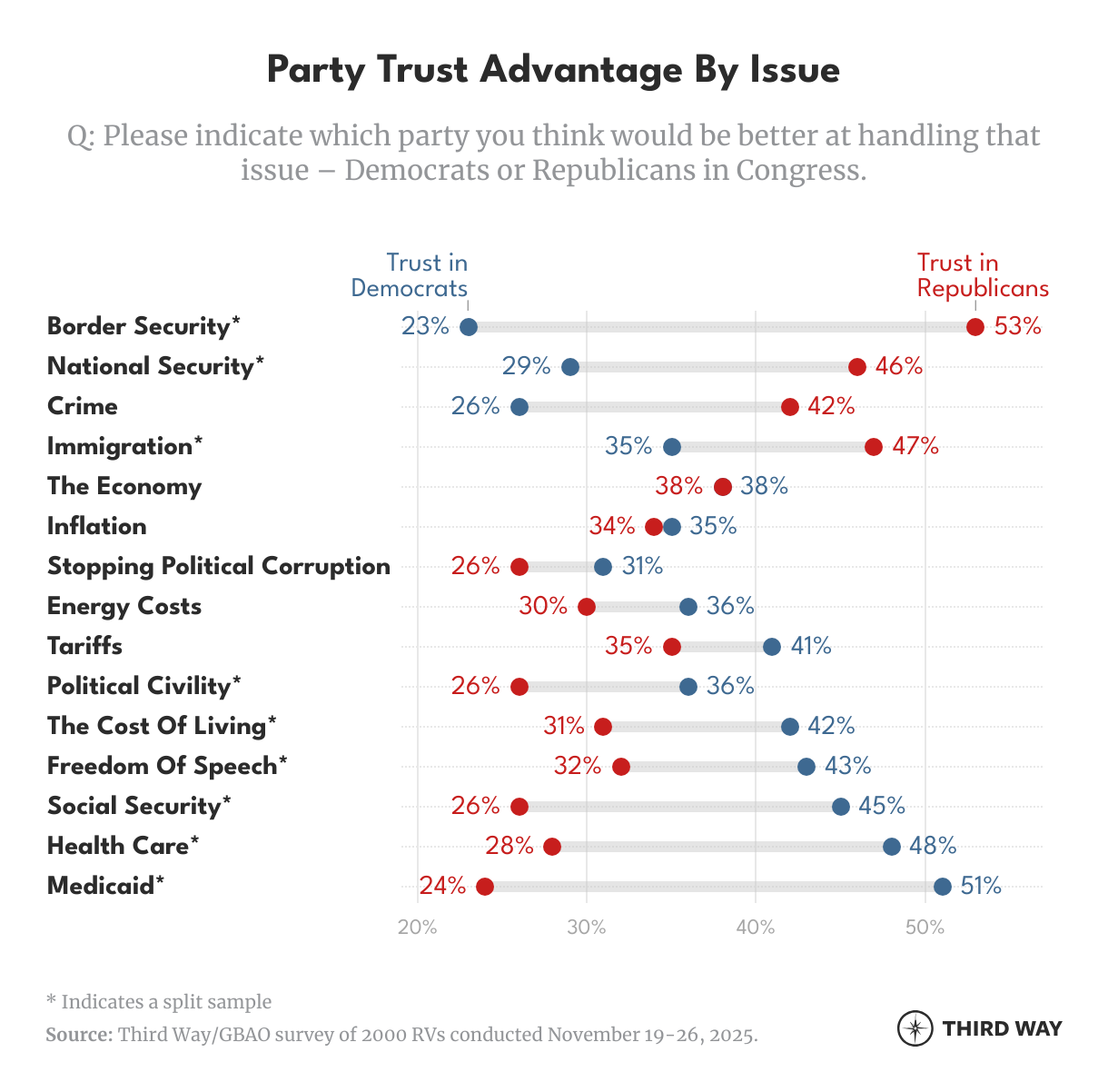
In terms of issue advantages, Democrats are showing signs of promise on economic issues, but now is not the time for a victory lap. When asked which party is better at handling a certain issue, Democrats and Republicans are tied on the economy at 38% apiece. On tariffs, Democrats hold a 41% to 35% advantage. On energy costs, Democrats have a 36% to 30% lead. On inflation, Democrats squeak out a 35% to 34% advantage, and on cost of living, an issue that Democrats struggled with mightily in 2024, Democrats now enjoy a 42% to 31% lead. Yet Democrats are unable to even match their 2026 congressional vote intention on any of these issues.
Democrats also lead on a host of other issues, some of which also hold economic implications. On health care, Democrats hold a large 48% to 28% lead, with an even larger 51% to 24% advantage on Medicaid. Democrats also lead 45% to 26% on Social Security.
Both parties have tried to make stopping political corruption part of their attacks on each other, and voters now narrowly side in favor of Democrats 31% to 26% on that issue. We also tested on issues that Republicans have tried to recently promote but do not appear to be landing. Democrats lead 43% to 32% on freedom of speech and 36% to 26% on political civility.
Where Republicans continue to see advantages is on law-and-order issues. Republicans enjoy a large 53% to 23% lead on border security and still maintain a 47% to 35% advantage on immigration itself. On crime, Republicans have a 42% to 26% advantage, and on national security, they have a 46% to 29% advantage. These were the only four issues where Republicans had voters’ trust, but all were robust leads.
Making voters feel more comfortable with Democrats on economic issues, and closing the margins on security issues, will be critical to move the needle on the congressional vote choice. Republicans losing trust on the economy will not be enough.
Awareness & Salience
It should come as no surprise, but voters say they have heard a lot about the Epstein files (69% a lot/some), ICE raids (86% a lot/some), RFK Jr. saying pregnant women taking Tylenol leads to autism in children (70% a lot/some), and tearing down the East Wing (77% a lot/some). But these issues and their equivalents failed to materialize in a MaxDiff exercise when testing salience and passion.
The top four performing messages in the MaxDiff exercise focused on congressional Republican actions that raised health insurance premiums, spiked electricity bills, cut Medicaid, and cut food assistance in the name of giving tax cuts to billionaires that saddle the country with more debt.1
One of the most shocking findings is that cuts to food assistance programs was the single most salient issue of the 14 tested messages. While there was no qualitative component, future research could explore the notion that middle-class Americans are seeing how hard it is for them to afford groceries nowadays and have deep sympathy for hard-working families and individuals, especially involving seniors and children, who need more help to get by.
Similarly, a message that combined Medicaid cuts with health care premium increases tested better than a message that just talked about Medicaid cuts and a message that just talked about premium spikes, which could indicate a solidarity to help all Americans struggling to provide for their families in today’s economy. People seem to understand that congressional Republicans have prioritized giving tax cuts to the wealthy over providing economic relief to the rest of the country. While Democrats can’t forget the value of hard work and the need to root out waste and abuse, there is a real opening to defend the social safety net for Americans in need.
On another economic note, all three polls this year have tested tariffs in the MaxDiff exercise. In March, the tariff message was a top four message and did well. By July, it had fallen off thanks to the One Big Beautiful Bill and the whiplash of tariffs being announced and being rescinded. Now, in November, tariffs are starting to rise to the top tier again coming in a strong fifth place as price concerns continue to reign supreme.
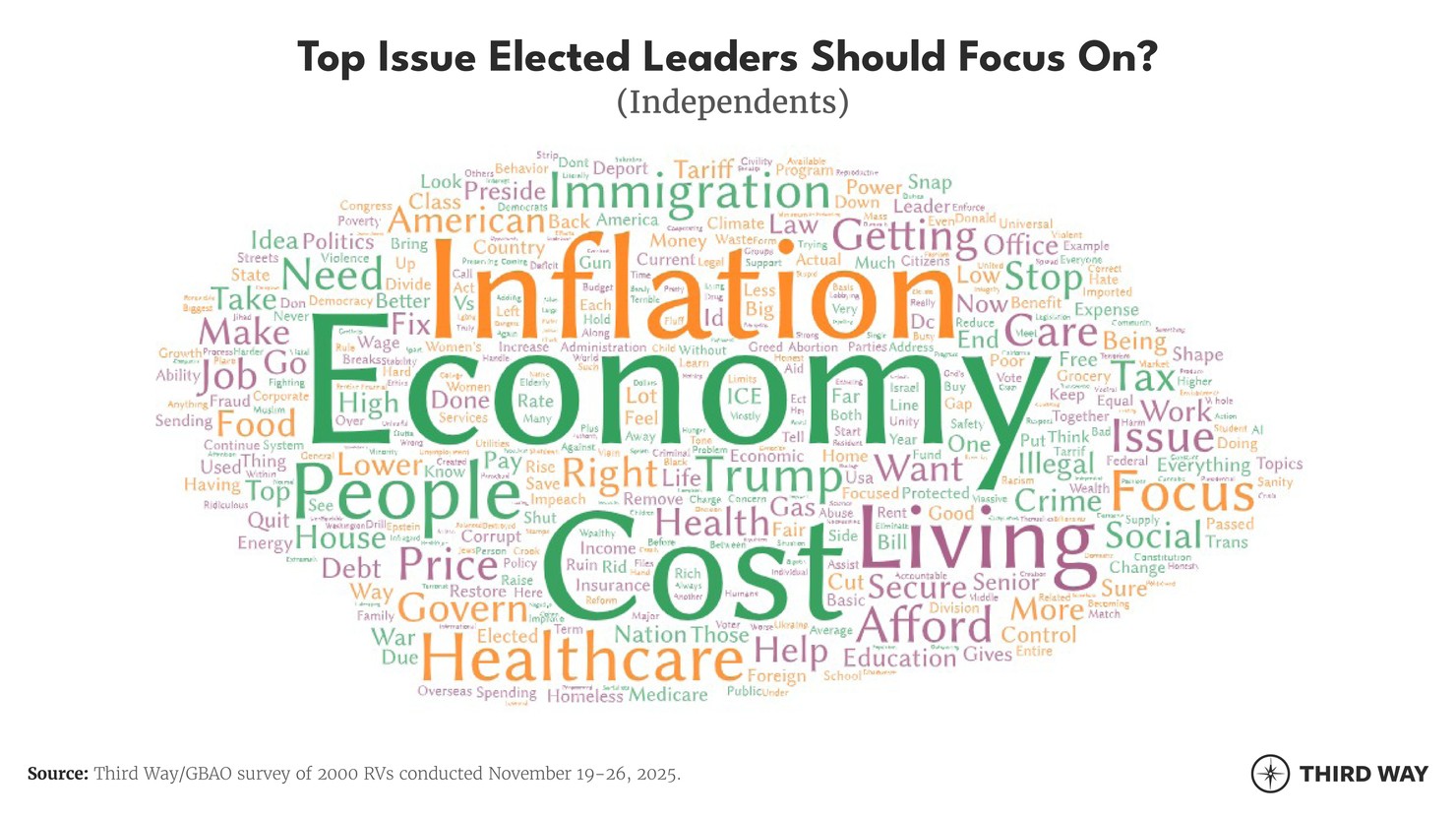
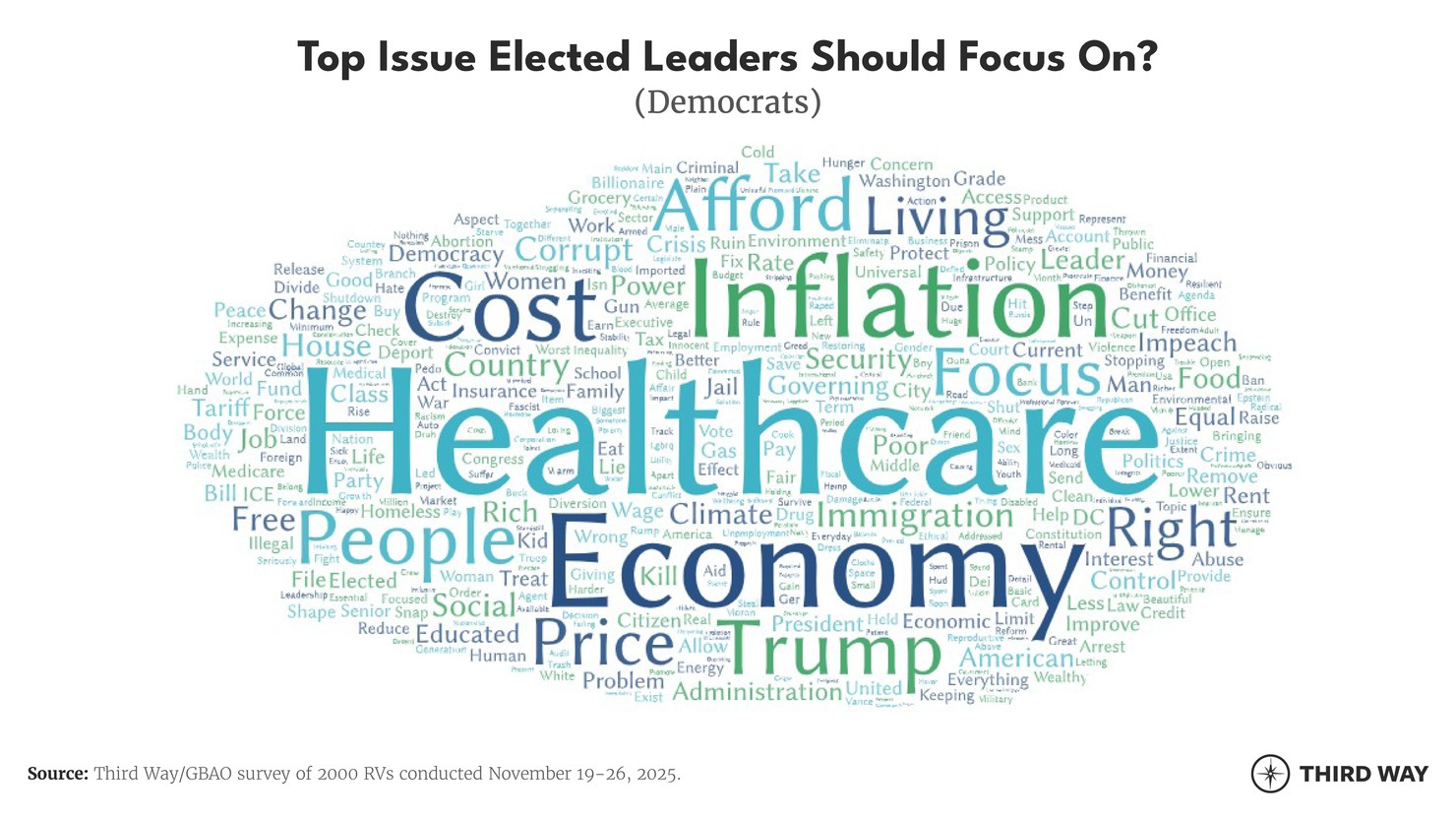
The daily chaos and issue of the week messages around RFK Jr., the East Wing, and even the Epstein files fell flat. Asked another way, we also inquired of voters to identify the top issue they wanted their elected leaders to focus on.
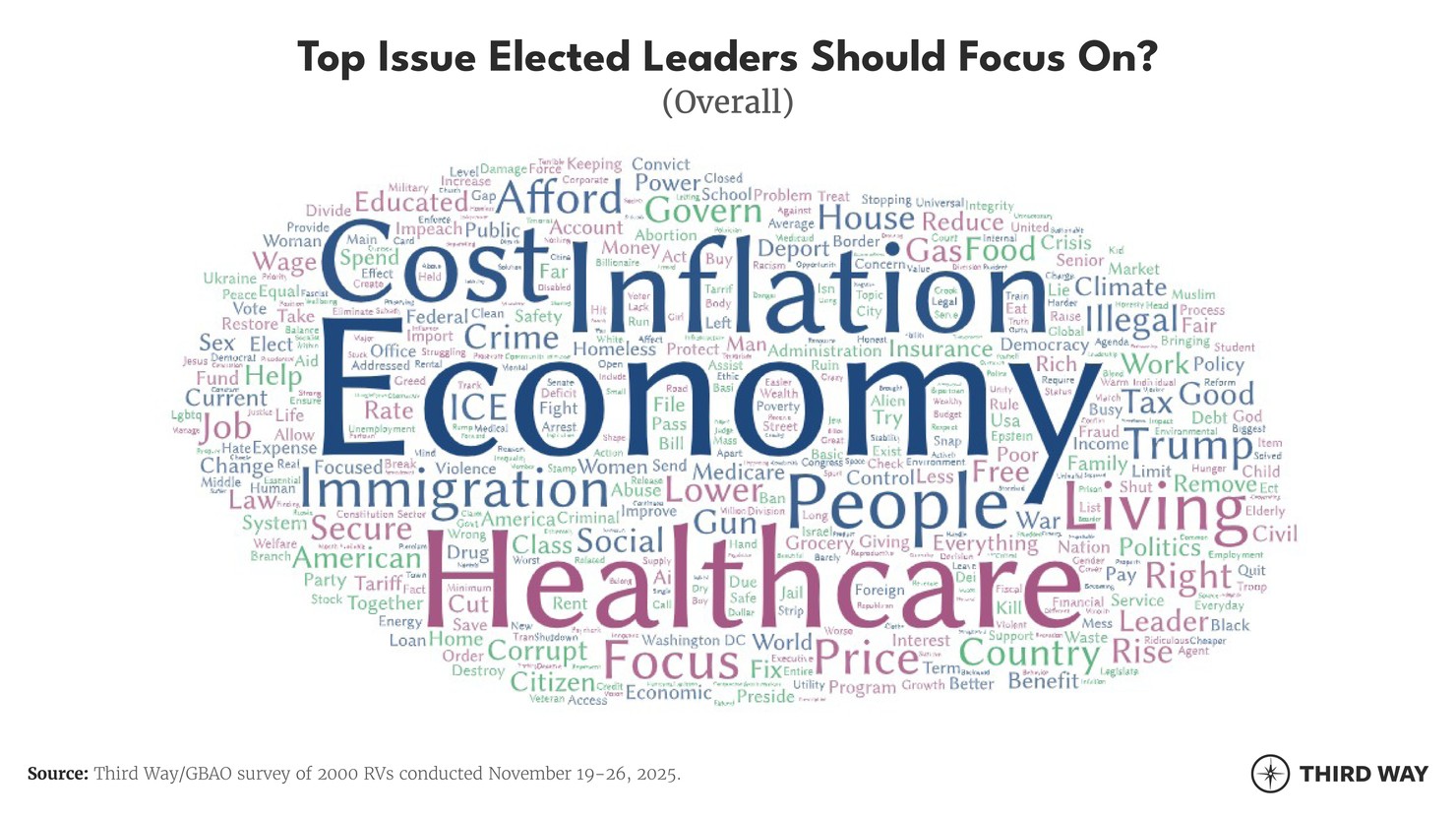
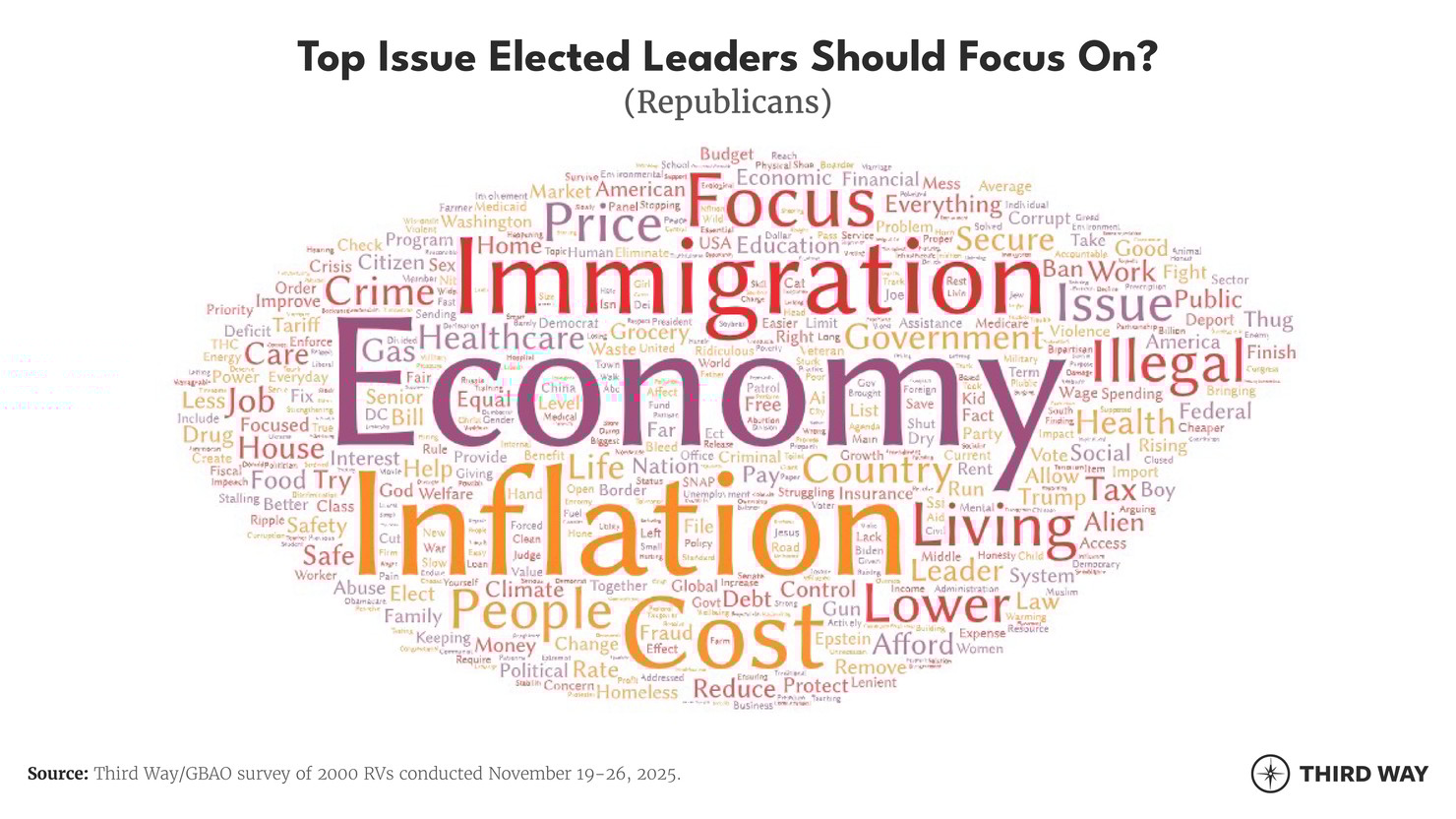
The word clouds below show the cost of living crises Americans face. Economy, Health Care, Inflation, and Cost stand out as the four words that rise to the top. Republicans differ, having Immigration as a top four response instead of Health Care, which shows misaligned priorities compared to the rest of the population.
Independents have the same core four as the general population, but People also stands out. Democrats have the same core four as Independents, with Health Care being more prevalent than the general population, but Trump also stands out. One important lesson for Democratic candidates is to listen to Independents on this and talk more about People than Trump, the latter of which just plays to the partisans they already have.
The Shutdown
Voters are relieved that the shutdown is over, but there are real mixed feelings, especially among non-Republicans. This survey happened completely after the shutdown ended, so it should be viewed in that context.
The shutdown itself broke through with 93% of voters saying they heard a lot or some about it. Voters were also more likely to blame Trump and Republicans in Congress for the shutdown than Democrats in Congress. Overall, 42% blamed Trump and Republicans, including 39% of Independents. Only 28% blamed Democrats, including 21% of Independents. That left 27% who blamed both parties equally, including 36% of Independents.
When asked about the eight Democratic senators who struck a deal with Senate Republicans to reopen the government, including to conduct a vote on extending Affordable Care Act subsidies, voters were mixed. By a two-point margin (44% to 41% with rounding), those who said they were planning to vote for Democrats or open to voting for Democrats in 2026 said it was a good compromise. It should be noted that this was asked before the Senate ultimately chose not to extend the ACA subsidies, since only a handful of Republicans supported that bill.
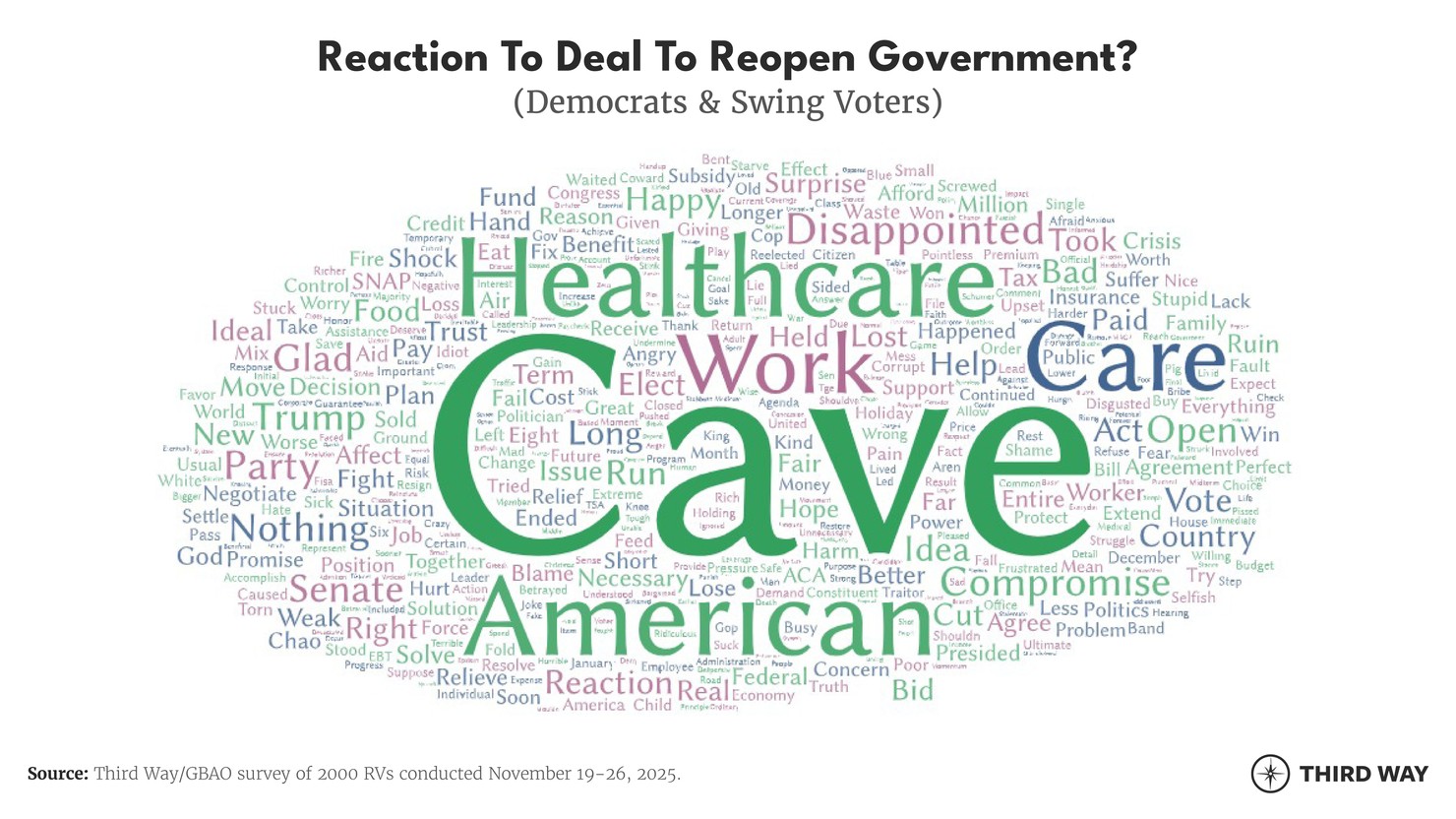
We also asked an open-ended question for non-Republicans to describe the end of the shutdown. One word stood out: Cave. Clearly, for a segment of voters who had strong feelings, the deal was seen as a political mistake.
Conclusion
Across three surveys that Third Way has conducted in 2025 on the topics of what is breaking through to average Americans, the economic conditions Americans face has been the north star of issue salience. President Trump and congressional Republicans have ceded the advantage on these issues they held just one year ago. The question is whether congressional Democrats can fully convince Americans that they will be focused on cost-of-living and not that scandal of the week.
The price of food appears to be a rising issue that can cut across socio-economic groups. Democrats would be smart to focus on food costs. They would also be smart to learn from the shutdown fight that compromise is still a popular sentiment, even among Democrats, but that it must be in service of real wins for people, rather than talking points.
As the calendar changes to 2026, we will continue to examine issue salience and try to find the signal through the noise.