Memo Published May 12, 2026 · 7 minute read
Strengthening EXIM, Strengthening America
Alan Ahn & Christel Hiltibran

Takeaways
- The Export-Import Bank of the United States (EXIM) advances American job creation, prosperity, and security primarily through financing and supporting US exports, particularly where the private sector cannot.
- Over time, EXIM has become overly risk-averse relative to its international counterparts, rendering it less competitive and less effective. It needs to be modernized.
- Emerging strategic sectors, such as critical minerals and high-capital energy projects like nuclear energy, will require greater risk appetite, higher loan authority, and an updated toolkit to compete with China.
- The Bank is up for reauthorization in 2026. This is a decisive window of opportunity to strengthen an agency that is crucial to American economic, strategic, and security goals.
Modernizing EXIM
The Export-Import Bank of the United States (EXIM), America’s official export credit agency (ECA), supports American jobs and companies by helping finance US exports and projects abroad. Through loans, insurance, and other mechanisms, EXIM can level the playing field for industry when facing unfair trade practices and geopolitically risky environments.
As far back as the Great Depression and World War II, EXIM has helped the US be competitive in overseas markets while creating high-quality domestic jobs in the process.
But compared to other ECAs, EXIM is constrained and uniquely ill-equipped to support emerging industries like critical minerals production and advanced energy infrastructure.
As international competitors, namely China, seek to dominate these markets, EXIM modernization is an economic and national security necessity.
Emerging sectors and cutting-edge energy technologies—such as advanced geothermal and nuclear—face special challenges. Financing first-of-a-kind projects to demonstrate proof of concept can be difficult, as can scaled deployment towards commercial maturity. A modernized EXIM will be essential in getting these innovative and strategic industries off the ground and globally competitive, as Third Way advocated last year.
Three key reforms as part of EXIM’s reauthorization in 2026 can substantially increase the agency’s lending ability, risk tolerance, and competitiveness with other ECAs:
- Address the restrictive default rate cap to increase the Bank’s risk tolerance and unlock support for emerging industries.
- Raise the total exposure cap to enable longer-term loans and higher capital projects.
- Bolster EXIM’s China and Transformational Export Program (CTEP) to reflect heightened geopolitical competition in strategic sectors.
The importance of strengthening and modernizing EXIM is clear. Without these reforms, EXIM cannot support America’s national interest in a modern, global, and highly competitive economy.
Central Priorities in EXIM’s Reauthorization
Thankfully, there is strong bipartisan alignment around the major priorities for reauthorization, as evidenced by the proceedings of recent House and Senate hearings, as well as bipartisan EXIM-related legislation introduced in this Congress.
This momentum and alignment are an opportunity to fix clear, central issues:
Unshackle The Agency
EXIM faces a congressionally-mandated default rate cap penalty, a limitation that no other ECA in the world has to deal with. Under current law, the bank would not be able to authorize new transactions if more than just 2% of its portfolio is in default. Because this metric is assessed on a quarterly basis, the Bank has limited time for borrowers to cure delinquencies before the cap can constrain new activity.
This policy forces an overly conservative approach—it can discourage the ambition, risk-taking, and transformative transactions needed to advance America’s current export priorities, and, if the cap is triggered, restricts the Bank from approving new financing and supporting strategic projects.
Ironically, the default rate cap restricts EXIM from helping the companies that need it most, and has been a key factor in the Bank using only 25% of its total loan authority. Practical, responsible reforms would include:
- Remove or amend the provisional terms mandating that the bank suspend operations if the agency hits the default rate cap
- Raise the default rate cap (e.g., 2% to 4%) to protect the agency without hampering its mission
- Exempt categories of transactions from default rate calculations, especially CTEP transactions and others of geostrategic significance
- Amend the calculation of the default rate to reflect only those transactions in default that result in actual losses for EXIM
- Empower the EXIM Board of Directors to exempt certain transactions from default rate calculations during financial crises, cases of importance to American geostrategic interests, and other extraordinary circumstances
Expand Its Capacity To Do More
EXIM’s $135B maximum exposure cap—or the total limit of loans, guarantees, and insurance that EXIM can hold at a given time—will become inadequate as the Bank’s risk appetite grows.
A significant part of EXIM’s portfolio is applied towards short-term projects, allowing the Bank’s financing to revolve in and out fairly frequently. But some sectors, like nuclear, generally face extended project life cycles and depend on loans with longer repayment periods. This means EXIM’s lending limit needs to grow to absorb these longer-term commitments, while still financing other strategic sectors.
In addition to nuclear technologies, the US is trying to secure critical minerals and liquified natural gas (LNG) projects, as well as sustain support in other important areas like renewable energy, aerospace, and manufacturing. To make room for new projects and maintain a diverse portfolio, we need to expand the balance sheet significantly.
In the FY26 NDAA, Congress more than tripled the US International Development Finance Corporation’s maximum contingent liability from $60B to $205B. That $205B figure could serve as a marker for increasing EXIM’s statutory lending cap in reauthorization, also helping to establish the interagency parity that would enhance coordination within the broader US financing toolkit.
As the volume of its activities increases, EXIM must also significantly increase its staffing resources. The agency is already seriously understaffed. If it’s going to take on a larger portfolio (and thus more risk), it needs a more robust, qualified workforce. One way to address this problem is through increasing the number of Administratively Determined (AD) staff.
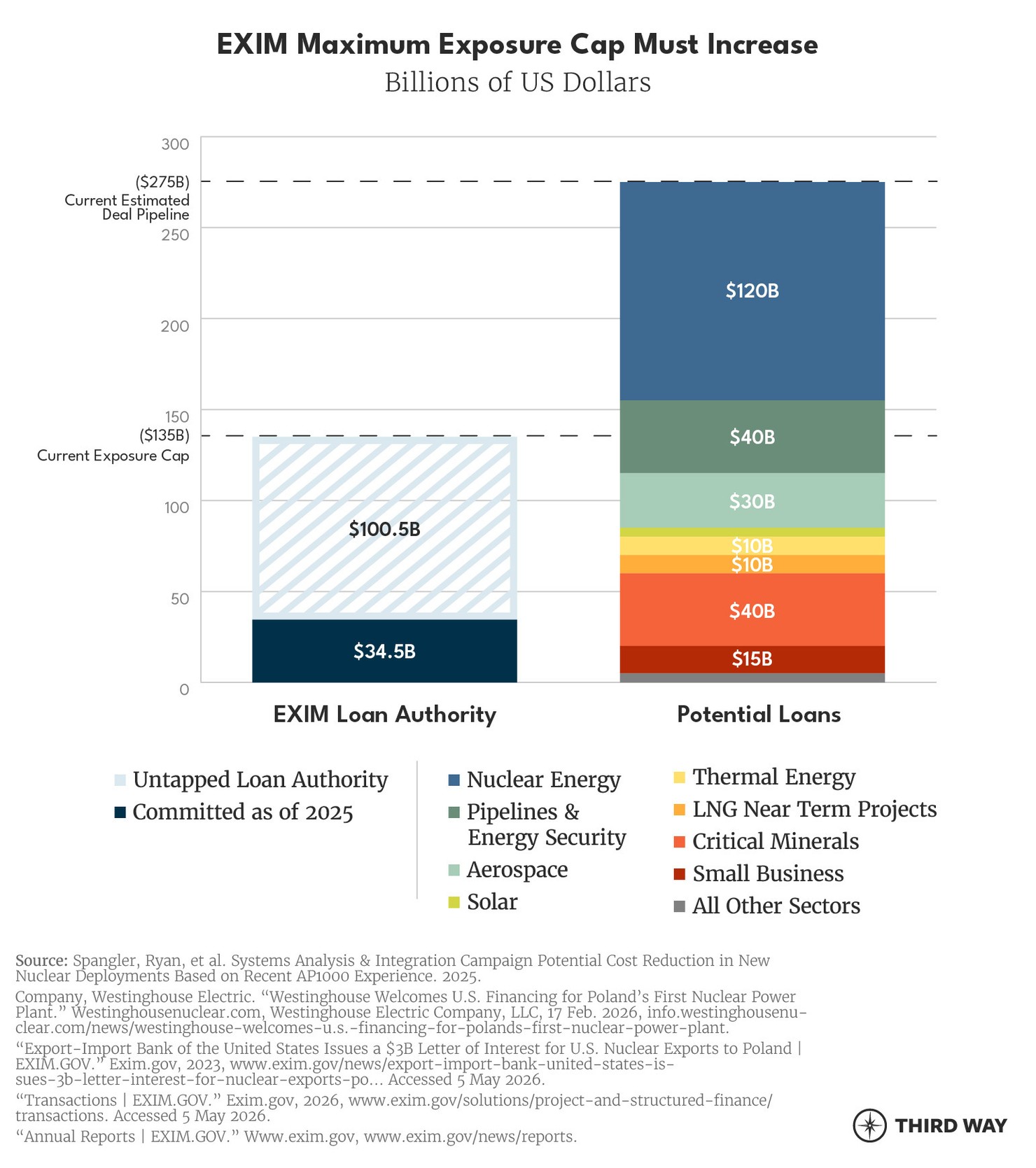
As shown in the chart above, if the default rate cap issue is addressed and the agency can finally take risk again, the loan portfolio will soon fill with strategic sectors like energy and advanced manufacturing. The sectors depicted reflect Administration announcements, historical levels, or projected expenditures by priority industries.1
Equip EXIM to Actually Compete Against China
The projects and transactions that EXIM should support often put it in direct competition with Chinese-backed state-owned enterprises. Recognizing the challenge, Congress created CTEP, a specific program implemented during EXIM’s last reauthorization that prioritizes ten transformational export areas and strengthens the Bank to compete with China.
CTEP is useful, but things have changed in the seven years since its inception. Today, both China and Russia heavily subsidize nuclear exports and are poised to dominate the global nuclear export market. Moreover, China has further tightened its grip over critical minerals, and EXIM’s involvement in overseas mining and processing projects is increasingly crucial to secure critical minerals supplies for American industry and strategic sectors.
Given the stakes, EXIM must be better equipped to win and close these deals moving forward. Congress should expand and bolster CTEP to enable broader eligibility for the program, particularly for sectors of national security and geostrategic importance, including nuclear energy. Other helpful provisions to strengthen CTEP may include:
- Including Russia in the list of covered countries
- Exempting all CTEP transactions from default rate calculations
- Increasing the percentage of EXIM’s total financing authority reserved for CTEP support in conjunction with raising the Bank’s overall lending authority
Conclusion
In the past year, many US international agencies have seen their resources and personnel slashed or eliminated entirely. But EXIM has remained a bipartisan priority, enabling the growth of quality US manufacturing jobs while competing in overseas markets.
The recommendations above—fixing the default rate cap, increasing EXIM’s total loan authority, and bolstering CTEP—are the minimum reforms to keep up with other ECAs. But they are also the most direct and efficient steps to make sure EXIM can succeed in strategic and transformative sectors. To protect our economic prosperity and national security, America needs to robustly finance advanced manufacturing, energy, and critical mineral projects worldwide.
The markets have evolved, as has the competition. EXIM needs to evolve too.