Memo Published July 23, 2026 · 5 minute read
Democrats Have Options to Meet Fiscal Goals
Democrats need a fiscal strategy that is grounded in both values and math. A growing number of progressive experts argue that the status quo is not sustainable.1 Currently, deficits are near 6% of GDP—a level historically seen only during major crises like wars or recessions—and are projected to approach 7% by the end of the decade. Republican tax cuts have made the long-term challenge even harder.
Improving the nation’s fiscal outlook will require real tradeoffs. But it does not require abandoning Democratic priorities. A responsible fiscal agenda can reduce deficits, protect popular programs, invest in the country’s future, and show voters that Democrats are prepared to govern seriously.
The first step is understanding the scale of the challenge. There are many possible deficit reduction targets, but here’s the bottom line: any meaningful improvement will require trillions of dollars in savings and revenue. That is daunting, but not impossible. Solving Social Security’s financing shortfall, repealing major parts of the One Big Beautiful Bill Act, and capturing stronger growth from AI-driven innovation could each make a substantial contribution. This memo walks through the size of the problem, the benchmarks policymakers should use, and suggestions on how to begin closing the gap.
Paths to Restoring Fiscal Stability
Deficits will be nearly 6% of GDP ($1.9 trillion) this year and are projected to reach 7% of GDP ($3.1 trillion) by the end of the decade.2 Republicans' One Big Beautiful Bill Act (OBBBA) worsened an already bleak fiscal picture. President Trump has attempted to use tariffs to paint a rosier fiscal picture, but that tactic has been limited by the Supreme Court.
To reduce the annual deficit to 3% of GDP by the end of the decade—a commonly used fiscal target with support across the political spectrum—policymakers would need to reduce deficits by around $10 trillion over 10 years.3 Getting deficits down to this level would likely stabilize the debt-to-GDP ratio at 100% by the end of the decade.4
Even if the politics of achieving these savings in the next few years remain challenging, doing nothing is not an option. Even modest reforms can lay the groundwork for a stronger fiscal outlook and create the political conditions for more ambitious action.
Policymakers achieved a budget surplus by the end of the 1990s by finding savings that totaled 2.9% of GDP over the decade.5 A similar-sized effort over the next 10 years would require finding savings of $11.6 trillion. However, this 1990s deficit reduction was enacted over three legislative packages, not a single grand bargain. A modest goal of finding savings equal to 1% of GDP—a figurative down payment that could be built upon by future Congresses—would require deficit reduction of roughly $4 trillion over 10 years.
A 1% of GDP deficit reduction over 10 years would reduce debt-to-GDP by 10 percentage points by the end of the decade (down from 124% to 114%), while matching the more ambitious scale of 1990s deficit reduction would reduce debt-to-GDP by 30 percentage points by the end of the decade (to 94%).6 Either path would be more favorable than the status quo.
If a Democrat-led budget bill slipped to 2029, deficit reduction might be more politically tenable, but the math more challenging. If policymakers waited an additional two years to take meaningful action on the budget, they would need an additional $3.5 trillion in additional savings—and this is before any policy promises like reversing Medicaid and SNAP cuts or extending tax cuts, let alone anything more transformative.7
Key Policies Can Do Much of the Heavy Lifting
Policymakers have hope, though. Here are three opportunities that can do much of the major lifting to improve the budget picture:
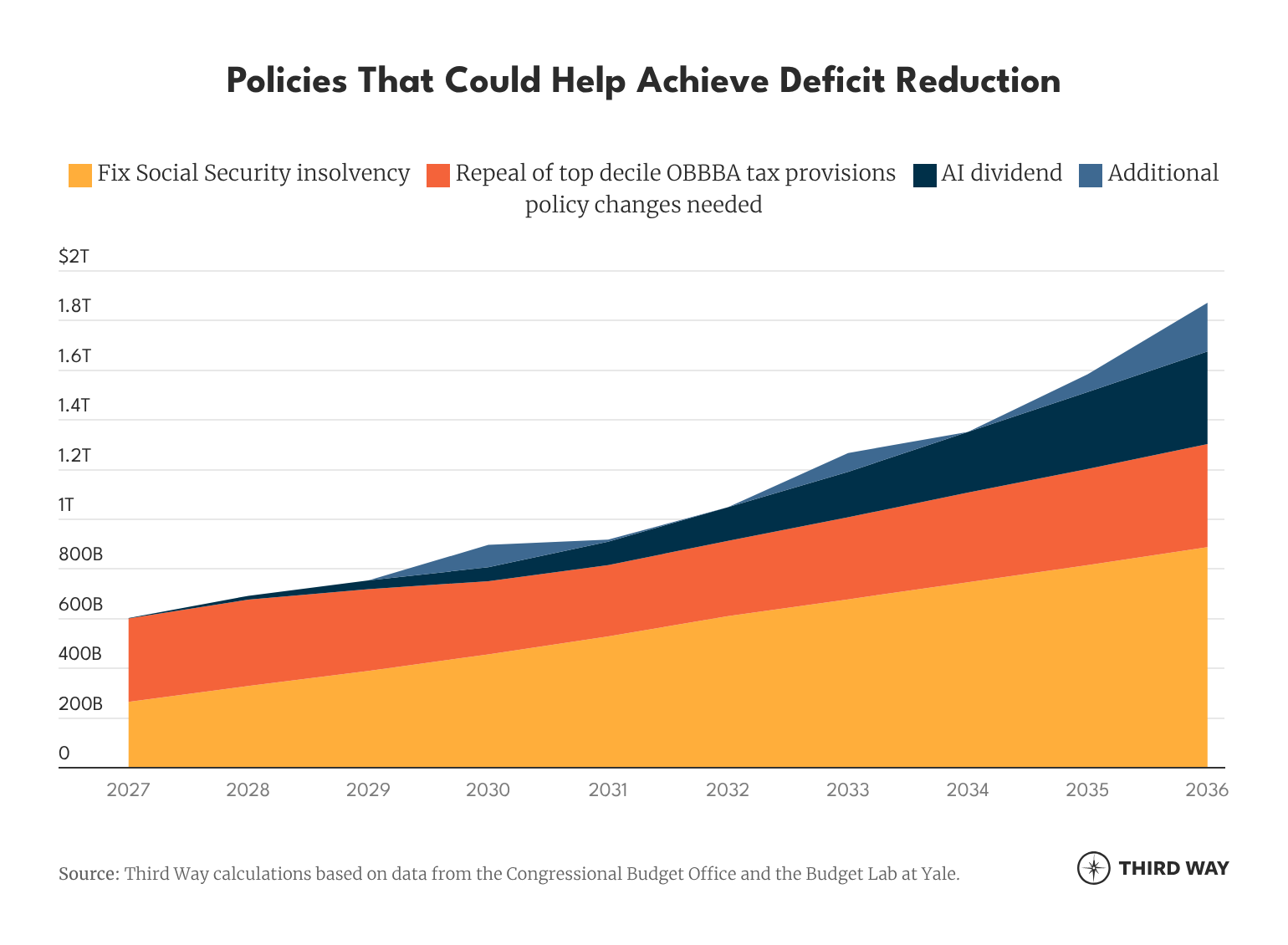
Repeal OBBBA: As we’ve covered previously, OBBBA accounts for 20% of the deficits over the next decade.8 Repealing OBBBA tax benefits that primarily benefit wealthy households would contribute roughly a third (34%, or $3.4 trillion with interest) to a 3% deficit target as discussed earlier.9 Full repeal of OBBBA tax provisions would reduce deficits by around $4.9 trillion over 10 years, and full repeal of all OBBBA that also restores the spending cuts to Medicaid and SNAP would reduce deficits by around $3.5 trillion over 10 years.10 Yet, for a variety of political reasons, complete repeal of OBBBA may not be on the table.
Save Social Security: Making the Social Security old age trust fund solvent would bridge roughly half (57%) of the gap to get the deficit to a 3% of GDP path by the end of the decade.11 There are many options for fixing the Social Security trust fund that require some combination of changes to the revenue and benefits of the program. Notably, although additional revenue will need to play a major role, it would be extremely difficult to save Social Security through revenue alone.
Use The Economic Dividend From AI: The fiscal success of the 1990s was partially due to policymakers’ decisions, but the federal budget also benefited from a post-Cold War peace dividend and economic boom.12 If artificial intelligence is going to be the boon to the economy that we and many others think it will be, economic growth should help bolster the fiscal health of the nation.13 A key economic analysis from the Budget Lab at Yale estimated a net 0.8% of GDP improvement to deficits stemming from AI, improved productivity, and adjustment costs to help workers by 2035.14 This would be 15% of the gap to meeting the 3% deficit target.15
Taken together, these three policies meet the deficit based on 10-year budget savings, but will have a slight shortfall in the last year.
To be sure, nothing in these fiscal scenarios addresses the costs of new problems or ongoing Democratic policy priorities. The incoming Democratic class in 2027 or 2029 may want to reverse the Medicaid and SNAP cuts from OBBBA, extend expiring tax provisions from OBBBA they see as benefitting the middle class, or further invest in the care economy, housing, among other priorities. A new fiscal commission is a positive step to potentially finding balance between priorities.16 It is possible to improve the fiscal outlook while protecting popular programs and building a stronger future, but it requires careful decision making.