Report Published November 18, 2025 · 8 minute read
What It Will Take to Fix the GOP’s Fiscal Mess
The US fiscal situation is like a horror movie—you find yourself shouting at the screen, “What are you doing?!? Don’t go in that direction!!” as some characters walk straight into danger.
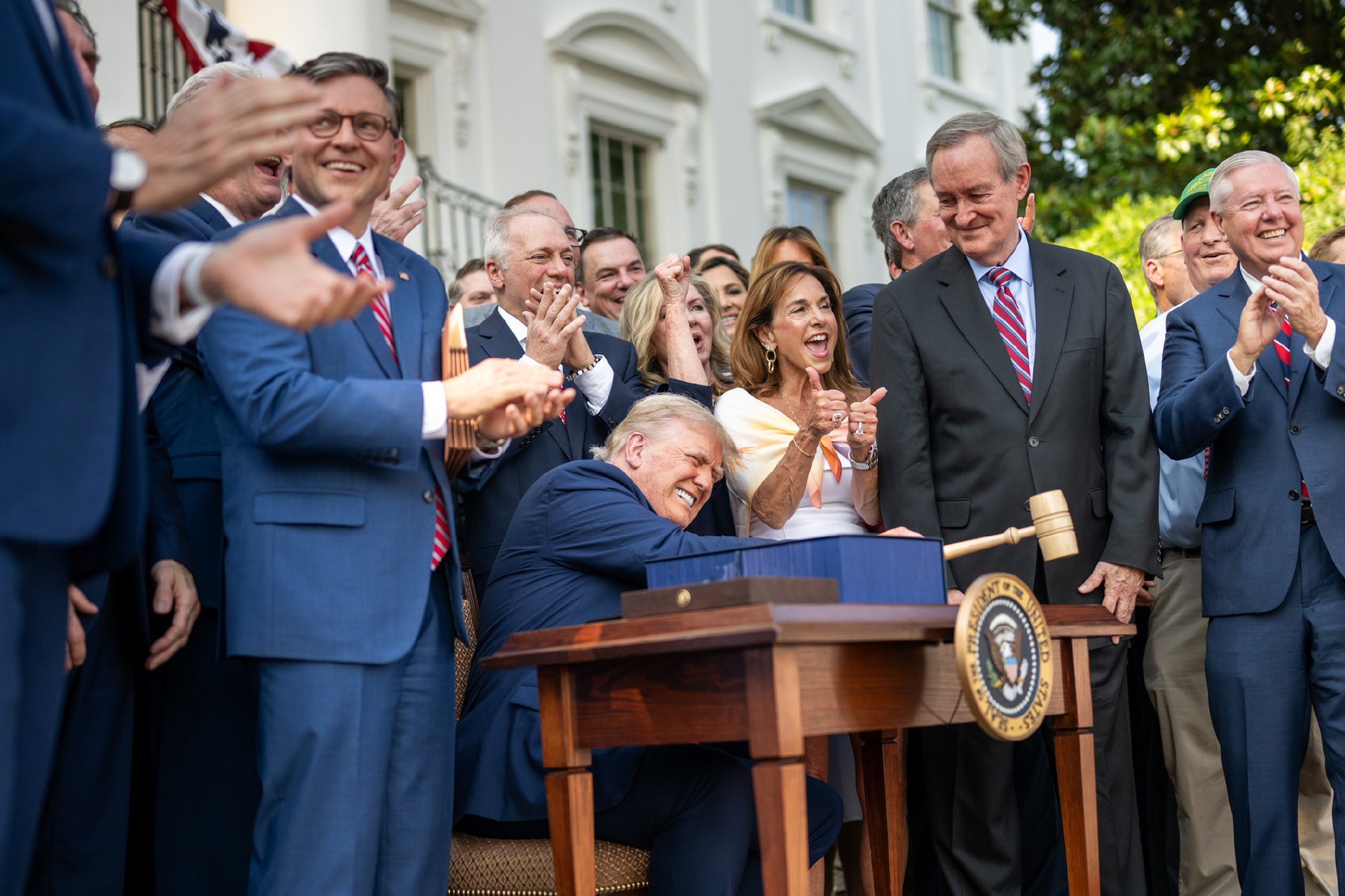
The One Big Beautiful Bill Act has made the script even more gruesome. Debt held by the public as a share of the economy is now projected to grow to between 120% and 134% of GDP over the next decade.1 This high and rising debt must be addressed. But like a character who doesn’t make it out of a horror movie, Republicans seem to think they’re safe cowering under the bed.
This story needs some heroes. Democrats have proven over the years that they know how to be fiscally responsible. In the past, they have found reasonable savings, slowed the growth of health care costs, and brought revenue back up to necessary levels. They can step up now as the voice of fiscal leadership. Unfortunately, it’s going to be harder this time around. In this report, we lay out the tough new numbers required to achieve various fiscal improvements, underscore why federal revenue must rise, and explain the value of spending more wisely.
Fiscal Goals are Now Harder to Achieve
At the start of the second Trump Administration, debt as a share of the economy was projected to grow to 118% of GDP by 2035.2 OBBBA alone added more than 10 percentage points to that figure. After accounting for other Trump policies, the Committee for a Responsible Federal Budget now estimates the federal debt will balloon to between 120% and 134% of GDP by 2035 (depending on whether Trump’s tariffs and other tax cuts/spending cuts materialize).3
As a result, many fiscal goals have become much harder to achieve. First, take stabilizing the debt-to-GDP ratio:
- One year ago, the federal government would have needed to find $7.9 trillion in deficit-reducing policies over the budget window to keep the debt-to-GDP ratio at 100%.4
- Following passage of OBBBA, we estimate that target has increased by $4.0 trillion—or more than 50%.5

A 100% debt-to-GDP ratio isn’t the only relevant fiscal goal, nor is it likely to be politically achievable with one bill. Still, meaningful progress is possible. And even pursuing more modest goals would allow us to strengthen the fiscal outlook while reducing debt-service costs.
History offers a useful guide for this goal. Together, the three major budget laws of the 1990s (BEA 1990, OBRA 1993, and BBA 1997) delivered deficit reductions amounting to just under 3% of GDP through a mix of spending cuts and revenue increases.6 That’s nearly all of the deficit reduction needed to stabilize the debt—$11.3 trillion, $13.3 trillion including interest.7
Another potential goal would be to match the savings from the last major bipartisan deficit reduction bill, the Budget Control Act of 2011. That bill managed to save about 1% of GDP over a 10-year period (equivalent to about $3.9 trillion from 2026-2037).8 Lawmakers could achieve similar deficit reduction across the same period by reversing the OBBBA tax cuts.
Finally, some prominent policymakers and experts have proposed a different benchmark: reducing annual deficits to 3% of GDP.9 This is a different fiscal goal than achieving 3% of GDP in savings over a decade. One credible analysis from the Committee for a Responsible Federal Budget says, assuming tariffs remain, a gradual path to cap annual deficits at 3% of GDP would require $7.5 trillion in deficit reduction over the decade.10

These numbers are huge, and frankly, feel challenging to hit. But we’ll have to start somewhere, and it must be balanced. Last year, the Peterson Foundation’s solutions initiative commissioned seven reports spanning the political spectrum that had many policy options to reduce the debt. But regardless of where the ideas come from, to improve the fiscal position of the United States and slow the growing path of national debt, two major levers are available to policymakers: increase revenue and cut spending.
Revenue MUST Be on the Table
After accounting for the One Big Beautiful Bill Act, we estimate that revenue as a share of the economy will dip below 17% of GDP.11 Once the new Trump tax cuts—such as the “no tax on tips” provision—expire, revenue rises to only slightly above 17%. That’s a full percentage point lower than CBO’s January projection, which was already extremely low given the level of government services Americans currently receive.12
To meaningfully address any fiscal goal, revenue must be on the table. Attempting to close the gap solely through spending cuts would be deeply unrealistic, terribly unpopular, and create damaging tradeoffs. Stabilizing the debt at 100% of GDP through cuts alone would require reducing all spending by 16%—including Social Security and Medicare. Spending would have to be reduced by 30% if Medicare and Social Security were exempted.13
If we want to keep our promises to the middle class and seniors—and avoid defaulting on the national debt—we need a tax code that generates more revenue while supporting economic growth.14 The tax principles released by the New Democrat Coalition in July emphasized both goals. In addition to supporting middle-class families and helping make essentials like housing and child care more affordable, the document underscores the importance of fiscal responsibility and long-term growth.
Still, there is always a barrier to raising revenue: sticker shock. Politically, someone is always cowering in fear of tax increases. But historically, we’ve been able to raise revenue. Here, for example, are some prior revenue increases, adjusted for a 2027-2036 budget window.
- In 1990, a bipartisan deal raised revenue by 0.42% of GDP. This would be equivalent to about $1.6 trillion over the decade ending in 2036.15
- In 1993, a Democrat-led bill increased revenue by 0.66% of GDP. This would be equivalent to about $2.6 trillion over the decade ending in 2036.16
- In 2010, the Affordable Care Act raised revenue by about 0.27% of GDP (on net). This would be equivalent to about $1.0 trillion over the decade ending in 2036.17
- And in 2022, the Inflation Reduction Act boosted revenue by about 0.1% of GDP on net. This would be equivalent to about $374 billion over the decade ending in 2036.18
We Need to Spend Smarter, Too
An all-revenue plan to meet major fiscal goals is politically unrealistic and, as we explained in a prior report, revenue won’t solve it all. That means we also need to spend smarter.19
There are strong fiscal and political reasons to do so. This summer, we commissioned a poll of Senate swing-state voters to dive into a wide variety of fiscal questions. We found that Democrats have a serious brand problem when it comes to spending. Voters gave Republicans a five-point edge on handling government spending decisions. When asked what concerns them about Democrats’ approach to the budget, 24% said they spend on the wrong priorities, another 24% said they don’t take waste, fraud, and abuse seriously, and 16% said they spend too much. In all, two-thirds of voters expressed concerns about Democratic spending.20
Voters also expect to hear about spending cuts in any conversation on fiscal responsibility. Nearly half (49%) said a fiscally responsible member of Congress would both raise some taxes and cut some spending. Another 39% said they would focus only on cutting spending, while just 10% said they would rely solely on raising taxes. In other words, 88% of voters believe spending cuts are a prerequisite for fiscal responsibility.21
So how can Democrats turn the corner and help tackle the debt? The first step is to target policies that reduce costs while improving services. In the Inflation Reduction Act, for example, Democrats authorized Medicare to negotiate drug prices—a reform that saved billions, made essential medicines more affordable, and is likely to improve health outcomes through increased uptake.22 More opportunities like this exist, such as:
- Hospital pricing reforms. Measures like site-neutral payments for Medicare can lower excessive hospital charges, increase competition, and reduce patient costs. Site neutrality alone would save the government an estimated $140 billion.23
- Cracking down on waste, fraud, and abuse. The federal government loses hundreds of billions annually to fraud. With better enforcement resources, much of this can be prevented or recouped. Past estimates suggest returns of $1.20–$3.00 for every dollar invested in enforcement, and five to ten times that when accounting for deterrence.24
- Modernizing Unemployment Insurance. Updating the system before the next recession will prevent overpayments and fraud while helping states process claims more smoothly. Simply returning to average improper payment rates, instead of the high error rates during COVID, would save $50 billion in the next downturn—or even more if Congress advances reforms like the bipartisan Unemployment Insurance Integrity and Accessibility Act from Senators Ron Wyden (D-OR) and Mike Crapo (R-ID).25
Finally, interest spending must come down. Unfortunately, this isn’t a line item we can simply cut. It falls only when other choices are made—through spending restraint or revenue increases that are under congressional control, or monetary and macroeconomic policy shaped by outside institutions. But the payoff is real: lowering interest spending helps bring down interest rates across the economy, reducing costs for families and businesses alike. Roughly speaking, every $6.00 to $6.50 in primary savings produces about $1.00 in lower interest costs. That, too, can be claimed as a spending win.26
The Bottom Line
Democrats must not follow Republicans into the haunted house—only to make the fiscal nightmare worse. Whether the fight is over funding levels, tax cuts, or affordability, Democrats must fight for fiscal responsibility. While the fiscal goals we’ve outlined above are daunting, even small improvements are helpful.