Memo Published June 9, 2026 · 13 minute read
Calm in Crisis, Clear in Purpose: Americans Want a New Foreign Policy Direction
Takeaways
- Foreign Policy is Up for Grabs: Voters reject Trump’s approach to foreign policy and national security, but that isn’t translating into trust in Democrats, who they view as indecisive and weak on defense. Americans prioritize alliances with friends above all else, a strong military, and ending the Trump tariffs.
- American Interests > Rigid Ideology: Traditional frameworks like hawk/dove, interventionist/isolationist, or nationalist/globalist are obsolete. After decades of wars, voters now evaluate whether American engagement feels practical, effective, and connected to clear US interests. Voters think that alliances make us stronger and safer, but our allies should pay their fair share. Leaders must know when to talk and when to draw the line.
- Open-Ended Wars Weaken America: Americans’ long-standing skepticism of open-ended conflicts is exacerbated by the Iran War. A majority of voters believe the Iran War is both unnecessary and makes America less safe.
- China is a Competitor, Not an Enemy: While Iran, Russia, and North Korea are viewed as enemies, voters are more likely to call China a competitor.
Americans are living through one of the densest stretches of foreign policy news in years. In his second term, President Trump has committed the US military to a widening set of international conflicts–from Iran to Venezuela–while pursuing a volatile tariff regime and unsettling America’s relationships with both allies and adversaries. Most Americans can’t name a coherent US strategy connecting any of it. But they are forming judgments about whether American leadership looks steady, competent, and capable in an increasingly unstable world.
To understand what voters are signaling about leadership, strength, and America’s role in the world, Third Way partnered with Impact Research to conduct a nationwide survey of 1,000 registered voters from May 1-7, 2026. Earlier this year, Third Way also partnered with Impact Research to conduct a series of focus groups on how Americans feel about foreign policy.
The results describe an electorate that is uneasy with both parties’ approach to foreign policy. Americans are wary of Republican brinkmanship and escalation, but remain unconvinced that Democrats project enough strength, clarity, or decisiveness on foreign policy issues. Instead, voters are searching for a foreign policy that feels steadier, more effective, and more connected to everyday American interests–one that prioritizes strong alliances, successful diplomacy, and tangible economic benefits at home. For Democrats, this creates both a warning and an opportunity. We explore those tensions in greater detail below.
Voters Want a Foreign Policy That Feels Practical, Not Ideological
The traditional frameworks that Washington often uses to describe Americans’ attitudes on foreign policy–interventionist versus isolationist, nationalist versus globalist–do not map cleanly onto how most Americans actually think about the country’s role in the world. Voters are not approaching foreign policy through rigid ideological categories so much as evaluating whether American engagement feels practical, effective, and connected to clear US interests.
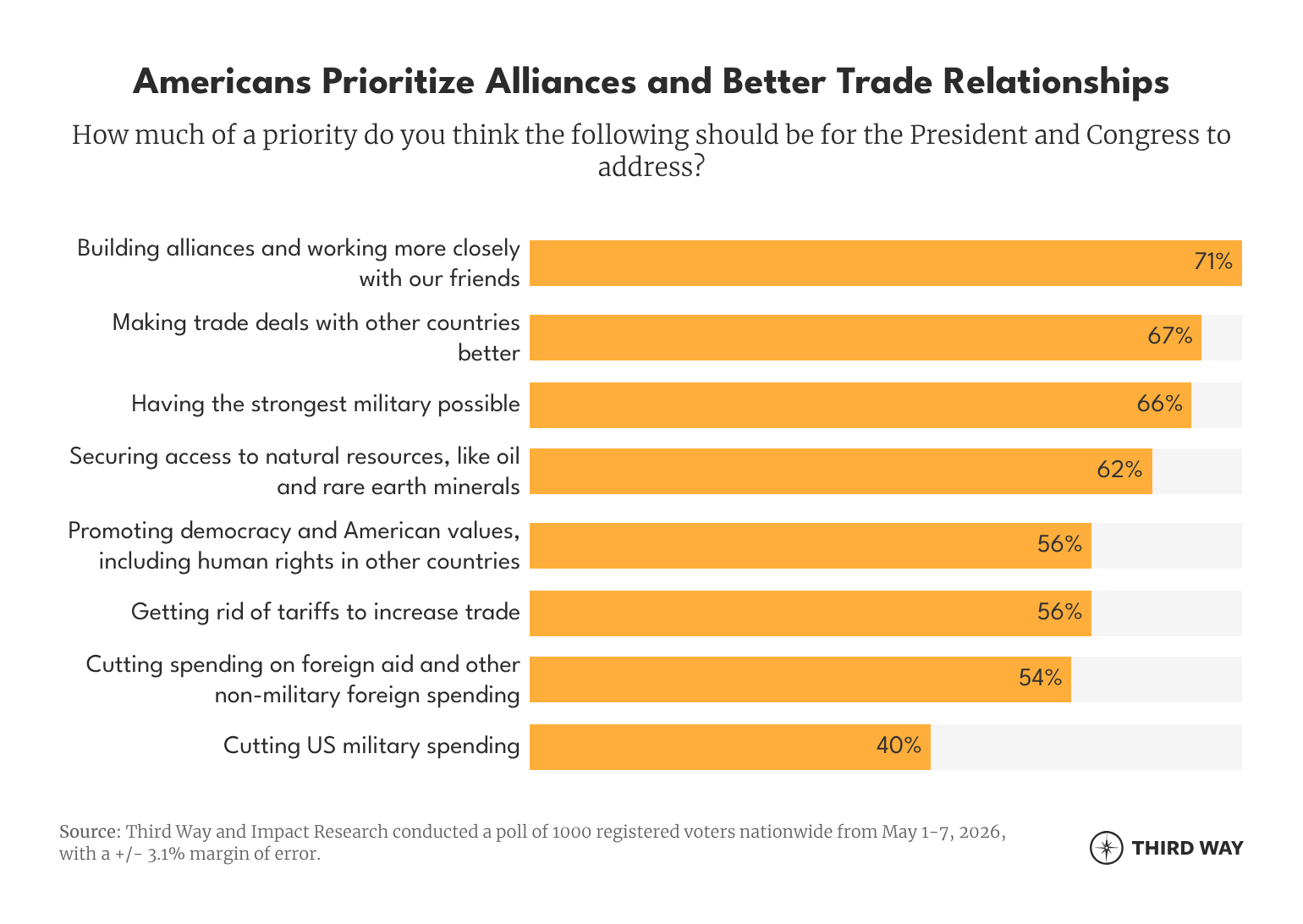
When it comes to foreign policy priorities, voters are far more interested in strengthening America’s relationships abroad than retreating from them. The majority of voters (71%), including the plurality of Independents, say that Washington should prioritize building alliances and working closely with our friends, and making trade deals better with other countries. That instinct carries through in how Americans are thinking about global engagement more broadly.
By a 25-point margin, Americans prefer maintaining strong alliances–even if alliances require compromise–over a more unilateral approach focused solely on US interests. Independents also follow a pro-alliance posture by a 28-point margin. The majority (55%) agree that it’s important for the US to have good relationships with as many countries as possible, even if it sometimes requires costs and commitments from the US, rejecting the framing that allies are not pulling their weight.
Cutting US military spending, however, ranked at the bottom. Only 40% of voters listed it as a priority, and over a third said it wasn’t a priority at all. That doesn’t mean voters give the Pentagon a pass. When asked what concerns them most about the US military budget, the plurality (33%) named corruption and wasteful spending well ahead of other concerns. Voters are asking for a more accountable defense budget, not a smaller one.
Americans are largely rejecting a purely isolationist or “America alone” worldview. But at the same time, support for alliances is tied to a belief that those relationships should strengthen the US economically and strategically. When asked what the US should prioritize in its relationship with allies, more than a quarter say the focus should be on ensuring that our allies are paying their fair share for their security and defense rather than relying too heavily on the US. The plurality, however, says the greater priority should be on strengthening alliances because they make the US stronger and safer.
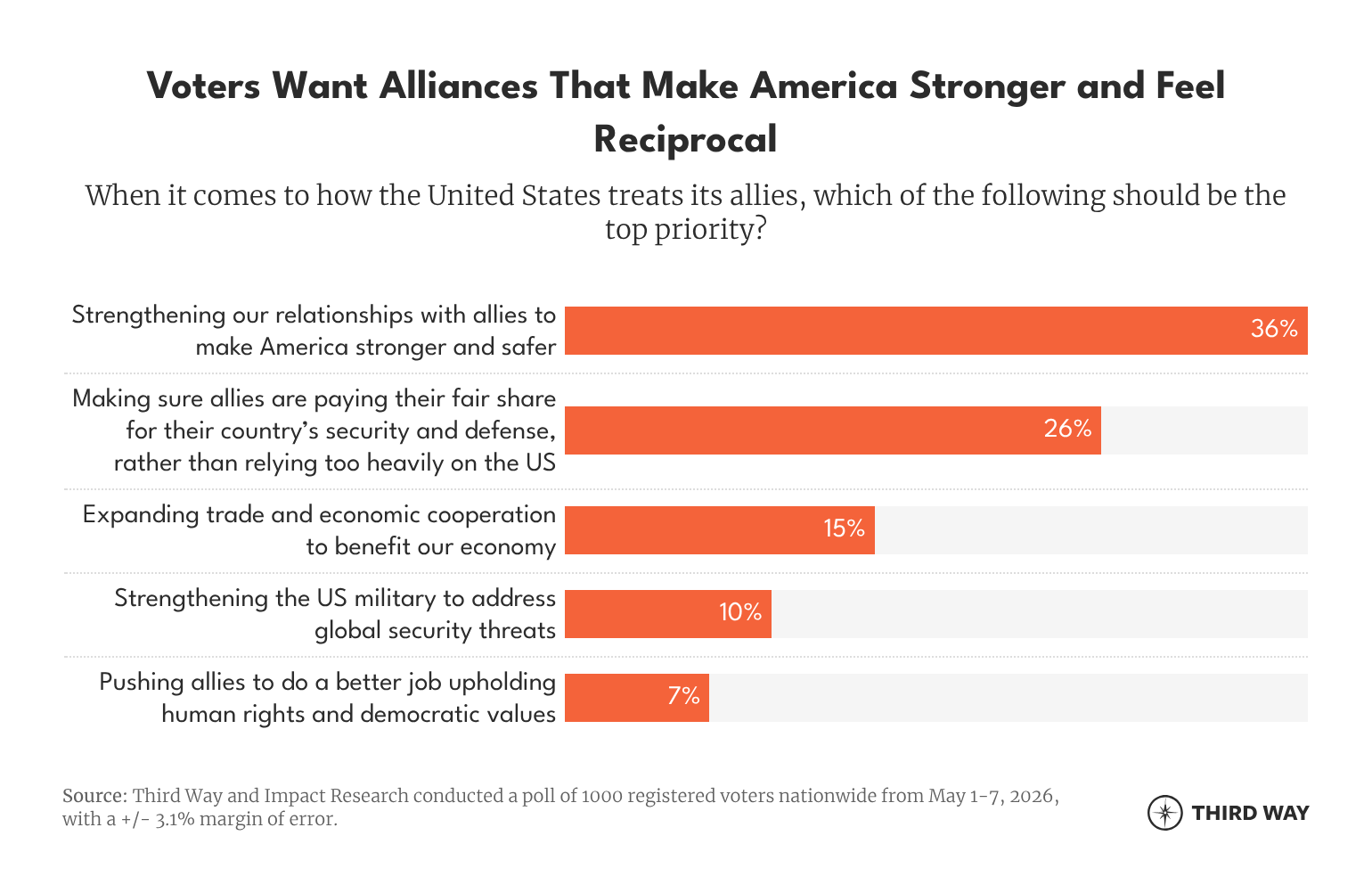
Taken together, the data point to a more heterodox view of global engagement. Voters are supportive of strong international relationships, but want those relationships to feel more reciprocal and more directly beneficial to the US. Alliances are tools of American power, and voters want their leaders to use them, not cast them aside.
Americans Draw Clear Limits Around Use of Force
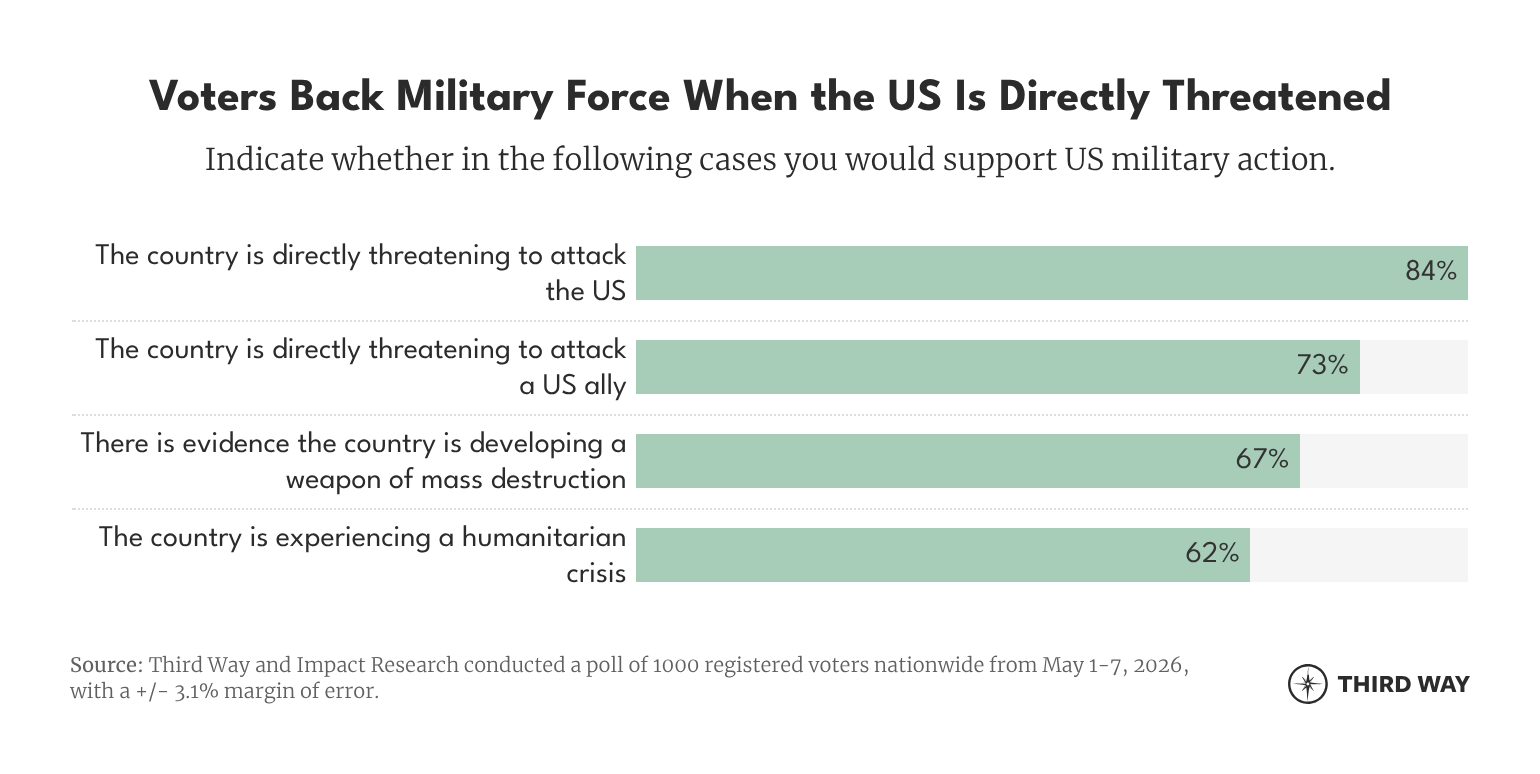
That same pragmatism shapes how voters think about the use of force. Americans do not reject military action altogether, but they are drawing clear distinctions about when they believe it is justified. An overwhelming majority (84%), including the majority of Independents (58%), support taking military action when the US is directly threatened. Support declines when the questions shift to defending allies, though a majority still remains supportive.
Humanitarian intervention, while still supported by a majority (62%) of voters, inspires far less conviction than military action that is tied directly to US security. Just 22% of voters strongly support military intervention in response to humanitarian crises, compared to 61% of voters who support military action when the US is directly threatened.
This tension becomes clearer when voters are asked directly what the US should do when other countries commit serious human rights abuses. Rather than favoring military intervention, a plurality prefers sanctions and diplomatic pressure over the use of force. That isn’t a rejection of humanitarian engagement. The majority of Americans (56%) say promoting democracy and American values, including human rights, is an extremely/very important priority. But Americans’ appetite for solving humanitarian problems through war has thinned. Voters are drawing a line between conflicts that feel necessary–direct threats to the US or its allies, credible weapons-of-mass-destruction cases–and conflicts that feel open-ended or disconnected from American interests.
Global Engagement that Benefits Americans
Americans apply this interest-driven lens to the specific countries and conflicts shaping today’s major foreign policy flashpoints.
When it comes to countries like China, the plurality of voters sees China as a competitor, not an enemy. By a 47-point margin, Americans want the US government to work with China on areas where our interests and concerns align, rather than going at it alone. Americans’ priorities for the US-China relationship are economic at their core–protecting jobs and supply chains and guarding American intellectual property. And when asked what worries them the most about the US’s current relationship with China, voters name things that touch American daily life–cyberattacks and economic dependence.
Issues that tend to lead more elite conversations on China–concerns around China’s violations of human rights or a potential invasion of Taiwan–ranked much lower among voters’ concerns. To Americans, China is not an enemy to vanquish, but a contest to be won on jobs, supply chains, and technology.
When it comes to Iran, voters take the threat more seriously. 67% of voters call Iran an enemy–6 points higher than Russia–and the majority across party lines are concerned about the threat Iran poses to US national security. The American electorate is far from soft on Iran, but recognizing the threat Iran poses does not translate into support for the current war. The majority (53%) of voters say that the war against Iran makes the US less safe. And voters' biggest concerns about the war include the loss of American lives (55%), the cost to taxpayers (44%), and gas prices increasing (43%). Concerns about Iranian lives lost ranked last. Americans are not opposing the conflict on humanitarian grounds. They’re opposing it because they don’t see a clear reason for America being involved and because they are absorbing it into a broader cost-of-living frame. Voters see a war that costs lives, costs money, and has not been explained. A Democratic argument that doesn’t run through that lens will not land.
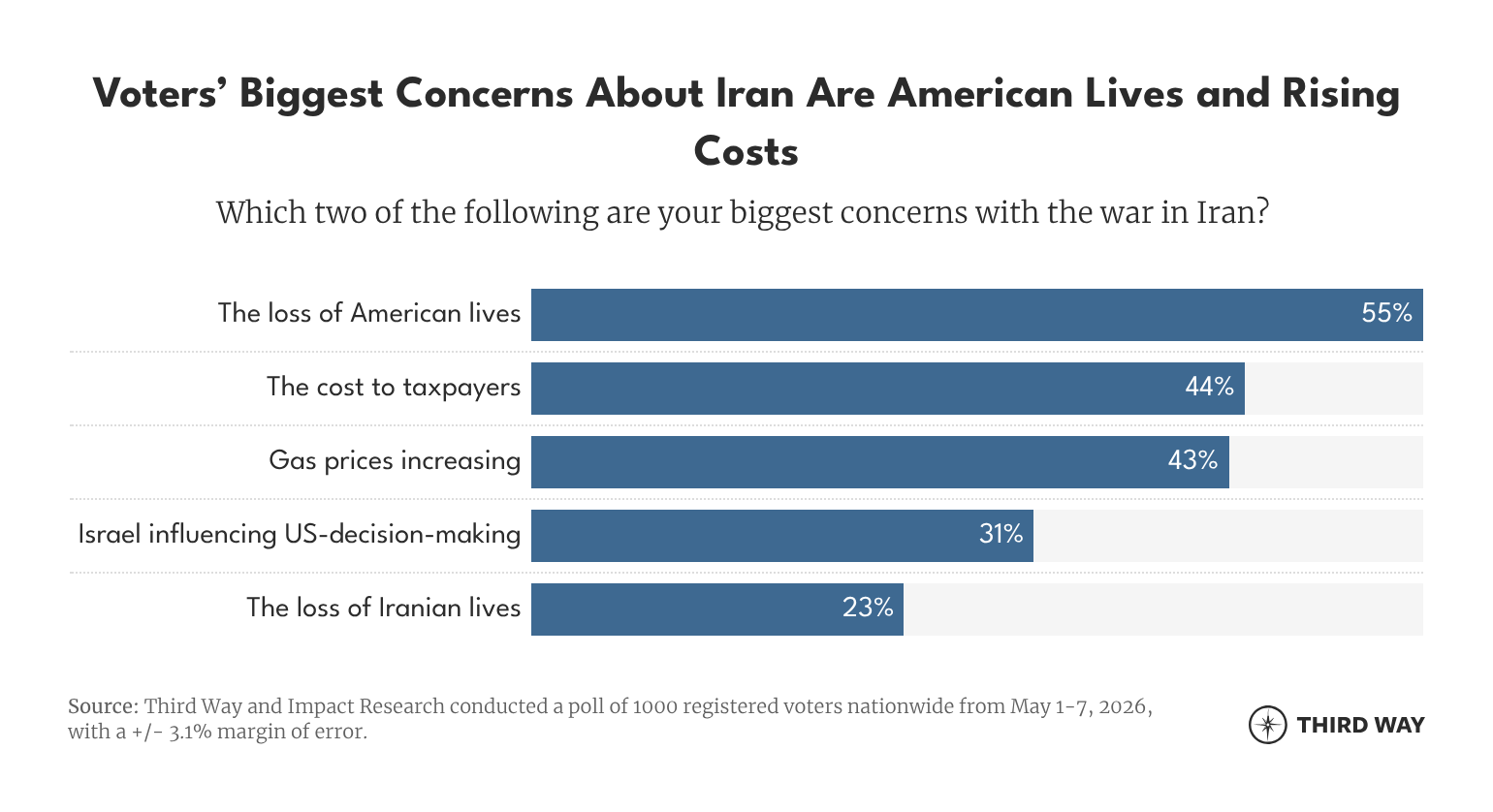
In their attitudes toward countries like China and Iran, voters are drawing the same line. They’re willing to engage, compete, and even fight where American interests are clear and the approach feels disciplined. They are not, however, willing to support open-ended conflicts whose costs fall at home and whose objectives continuously shift.
Foreign Policy as a Proxy for Leadership
That instinct is sharpened by the current economic moment Americans are living through. Affordability and the cost of living remain voters’ top concern by a wide margin, with only 6% naming foreign policy as the country’s most important issue, following healthcare, immigration, and government spending.
But issue-salience, taken on its own, is a misleading summary of what voters are actually paying attention to. While it’s true that voters do not weigh foreign policy the way they weigh the price of gas or eggs, they do, in some respects, weigh it more consequentially.
Right now, voters are watching a president who is generating crises and then asking to be credited for managing them. Everything from the war in Iran and the military operation in Venezuela to the tariff fights and the public confrontations with our allies–these are not inevitabilities; they are Trump’s choices. He is trying to sell them as proof of strength. Voters, however, are increasingly reading them as proof of the opposite.
In our focus groups, conducted in January, among swing voters nationwide, participants raised concerns about Trump’s actions and posturing on the world stage, describing it as a sign of weakness, not strength. As one non-college participant put it:
“The most dangerous aspect of him [Trump] is that everyone knows how to manipulate him now. You just flatter him. You stroke his ego, and you can get whatever you want. You can nominate him for some peace award, and he’ll be your best friend. He's basically a doorknob.”
Another non-college participant drew a sharp contrast with previous Republican administrations.
“After 9/11, Bush, a Republican, was able to rally the world to see the threat. He wasn't a bully about it. He was a diplomat. Everybody knew we were going into war. Everybody knew we were gonna take care of the problem, and he was able to rally around us. If that happened today, nobody's rallying around us. They'll feel bad for us, but they're not gonna rally around us.”
Foreign policy is where voters check how their leaders make America look on the world stage, and right now, the Republican Party is failing that test. The majority of voters say Donald Trump is doing a bad job on foreign policy (57%), and national security (55%), and Congressional Republicans are rated even worse. 62% say they’re doing a bad job on foreign policy, and 57% say the same on national security.
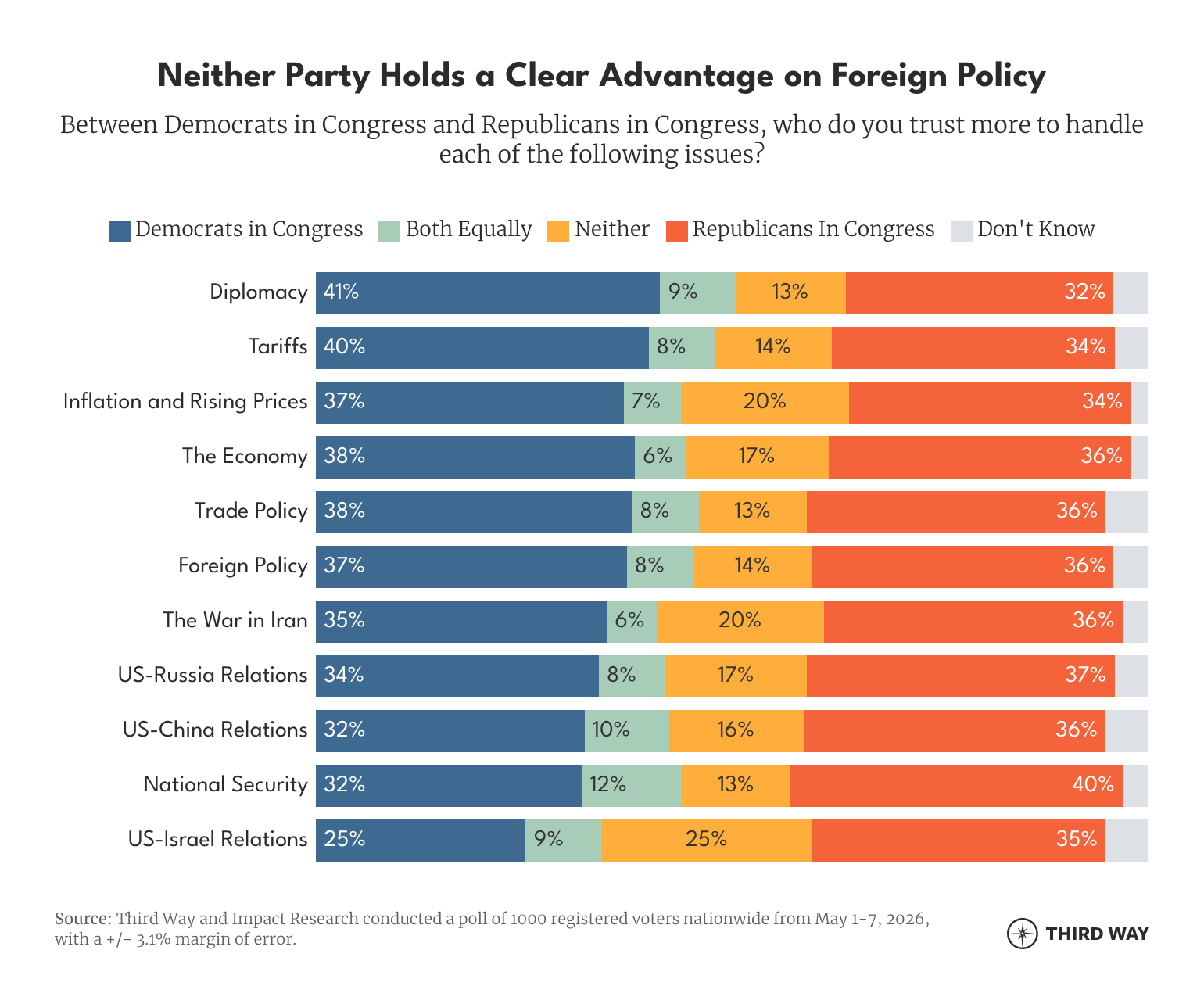
But Democrats aren’t seen as any better. When asked which party they trust more to handle these issues, voters are fairly split. While Democrats are gaining ground on economic and diplomatic issues, Republicans still retain an advantage on national security, US-Israel relations, US-China relations, US-Russia relations, and hold a 1-point edge on the war in Iran.
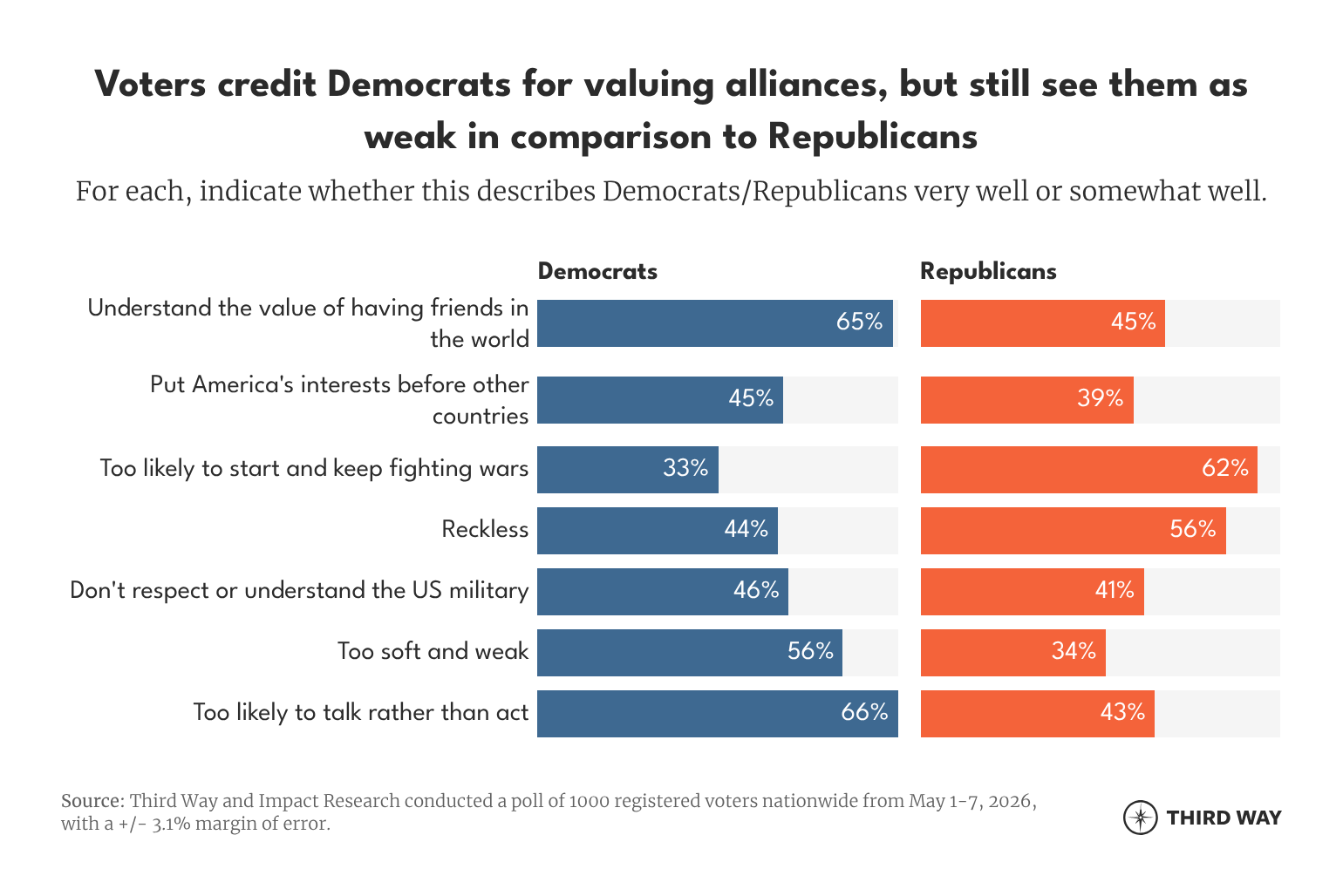
When asked to describe each party’s posture on foreign policy and national security, respondents produced near-mirror images of disqualifying vulnerabilities. Republicans are described as reckless and as too quick to start and continue wars. Meanwhile, Democrats are seen as too soft and too weak, and as too likely to talk rather than act.
For Democrats, this dynamic creates opportunity and risk in roughly equal measure. Right now, the Democratic Party is perceived to be hesitant, divided, and excessively procedural when it comes to foreign policy and other issues. But as voters watch the Trump Administration intentionally produce higher prices, weaker alliances, and diplomatic chaos, the issues that Republicans used to dominate are tilting toward the Democrats. Democrats are leading Republicans on the economy (by a 2-point margin), tariffs (by a 6-point margin), and diplomacy (by a 9-point margin), and hold a marginal advantage on foreign policy more broadly.
Given how closely voters are paying attention to foreign policy at this moment, Democrats have the opportunity to demonstrate their broader seriousness on the issue. Democrats have made gains on the economic issues that voters care most about–what’s missing is the posture that extends them into trust on harder national security questions that Republicans still lead on.
What Does This Mean For Democrats?
Voters are increasingly uncomfortable with Republicans’ chaos and escalation, but many remain unconvinced that Democrats project enough strength and decisiveness on foreign policy. Closing that gap will require Democrats to articulate a foreign policy that feels steady, practical, and firmly rooted in American interests. That includes the following:
- Showing resolve, not process: The majority (66%) of voters, including the plurality of Independents, think that the Democratic Party talks more than it acts. And that perception is partly correct. Too often, Democrats default to procedural language about norms and processes. Even if the underlying policy is sound, this reinforces perceptions of hesitation. That doesn’t mean that Democrats should abandon nuance or diplomacy, but they do need to lead more clearly and confidently with what they will defend, what they will deliver, and what adversaries will face if we’re pushed too far.
- Leading with what’s in it for Americans: Democrats should frame foreign policy around what voters actually care about–jobs, prices, wages, supply chains, and American safety and security. That doesn’t mean Democrats need to abandon values-based arguments about democracy or human rights. But those arguments have to sit inside the interest argument, not lead it.
- Pairing engagement with discipline: Voters are open to alliances and military strength, but they want both used selectively and in ways that clearly advance American interests. Democrats have an advantage here–the majority (65%) of voters say that Democrats understand the value of America’s relationships abroad. But that advantage only holds if Democrats talk about alliances as tools of American strength, security, and leverage–not just moral obligations. This same dynamic applies to the use of force. Voters support military action when the US or its allies are threatened, but drop sharply when conflicts feel open-ended or disconnected from US interests. Humanitarian intervention, while important, has softer support than self-defense. That doesn’t mean Democrats need to try to out-hawk Republicans to gain trust on foreign policy–they need to project a posture that feels grounded in Americans’ well-being and rejects costly open-ended wars.
Methodology
From May 1-7, 2026, Third Way and Impact Research conducted polling of 1,000 registered voters nationwide, via text-to-web and online panel, with a margin of error of +/- 3.1%. The margin of error for subgroups varies and is higher.