Memo Published May 13, 2026 · 7 minute read
Americans Want to Outperform China, Not Fight It
Takeaways
- To Americans, China is a competitor to be beaten, not an enemy to be vanquished.
- Voters aren’t looking for a new Cold War. They want the US to work with China where our interests align, not fight it on every front.
- Cooperation with China comes with conditions: the US has to prevail on its core interests. Voters want policymakers to extract concrete benefits–jobs, supply chains, fair competition–from any relationship with China.
The US and China are the world’s two largest economies, and the competition between them now touches nearly every consequential question in global affairs–trade, technology, security, and the race to dominate the industries of the future. That competition has never been fair. China has spent decades playing by a different set of rules–subsidizing strategic industries at a massive scale, deploying unfair trade practices, and leveraging state resources in ways no American company can match on its own. And Americans have noticed.
To understand how Americans want their leaders to respond, we partnered with Impact Research to poll 1,000 voters nationwide. Our research shows that Americans are clear-eyed about the challenge China poses, and they want policymakers to compete for them, not just against China. Concrete benefits for American workers and families–from good jobs to greater US influence around the world–must be at the center of any China strategy. We explore more below.
Americans Want to Compete Smarter
Americans are not naive about China, but how they characterize the US relationship with China has shifted meaningfully over the past few years. Our 2023 polling, conducted in the aftermath of the COVID-19 pandemic, captured a more combative public mood. More than a third called China an outright enemy, and few were interested in seeking any kind of alignment or cooperation with the country. Our 2025 polling found that sentiment was beginning to change. The share of voters calling China an enemy dropped by 7 points, while those who saw China as an ally or trade partner began to climb. Americans weren’t softening on China, but rather moving towards a more pragmatic recognition that you have to engage rivals in order to beat them.
Now, our 2026 survey shows that this reorientation has held, and in some ways, deepened. Fewer Americans call China an enemy than they did three years ago, while the share of Americans who see China as an ally or trade partner has grown by 3- and 4-points, respectively, since 2023. The plurality sees China as a competitor, and they’re clear-eyed about what competition actually demands. A competitor isn’t an enemy to be vanquished–it’s a rival to be beaten. You do that by being smarter, better prepared, and strategic enough to find alignment where it serves your interests. Americans have made that same calculation.
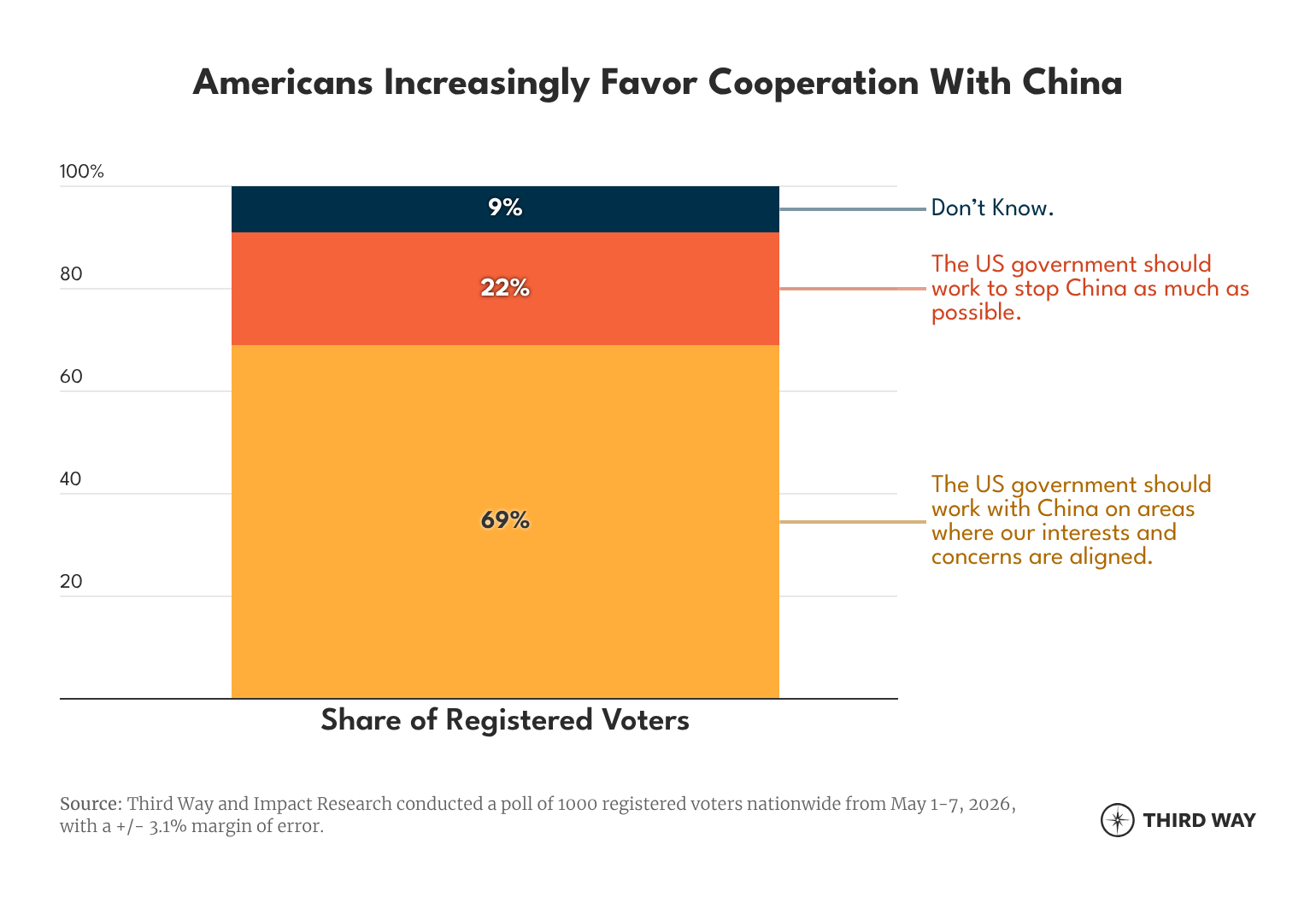
The majority (69%) of Americans across partisan lines agree that the US government should work with China on areas where our interests and concerns are aligned rather than trying to stop China at every turn–more than double the share who said something similar just three years ago.
The Top Priority? Protect American Interests
Knowing that Americans favor a more strategic approach to China is useful. But knowing what they want that strategy to prioritize is essential.
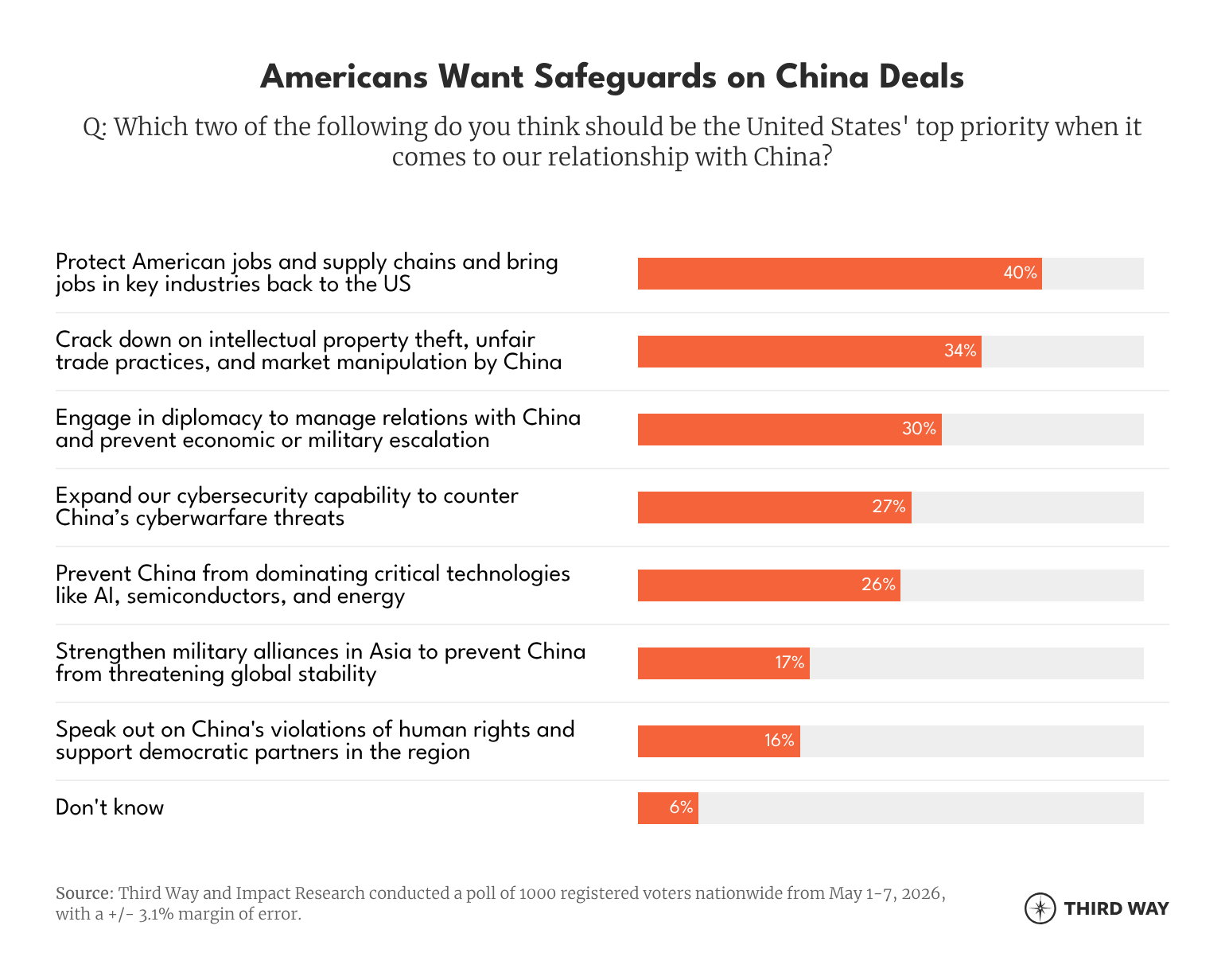
Voters lead with what they can feel. Our polling found that when it comes to America’s relationship with China, the most important issues to voters are economic: protecting jobs and supply chains, and cracking down on intellectual property theft and unfair trade practices. Issues like strengthening military alliances with the rest of Asia to stop China and speaking out on human rights abuses in China, while enormously important, ranked last. That’s not to say that voters are indifferent to those issues; rather, those issues just have not arrived at their doorstep in the same way that economic ones have.
Americans’ concerns tell a similar story. When asked what worries them the most about the US’s current relationship with China, voters lead with cyber-attacks and our economic dependence. In our focus groups conducted earlier this year, participants’ concerns about cybersecurity were striking. Voters are not thinking about cybersecurity in terms of espionage or classified systems; they’re thinking about the infrastructure that runs their daily lives–power grids, banks, and wireless networks. As one participant put it, “There is absolutely nothing you can't do without the Internet, without cybersecurity. There's nothing you can do without it. Nothing. Traffic lights are computerized. It would completely blow this country up."
Most participants in our focus group expected that any conflict with China would be fought digitally long before it was fought anywhere else–an assumption that is likely shaping their concerns about potential cyber-attacks from China.
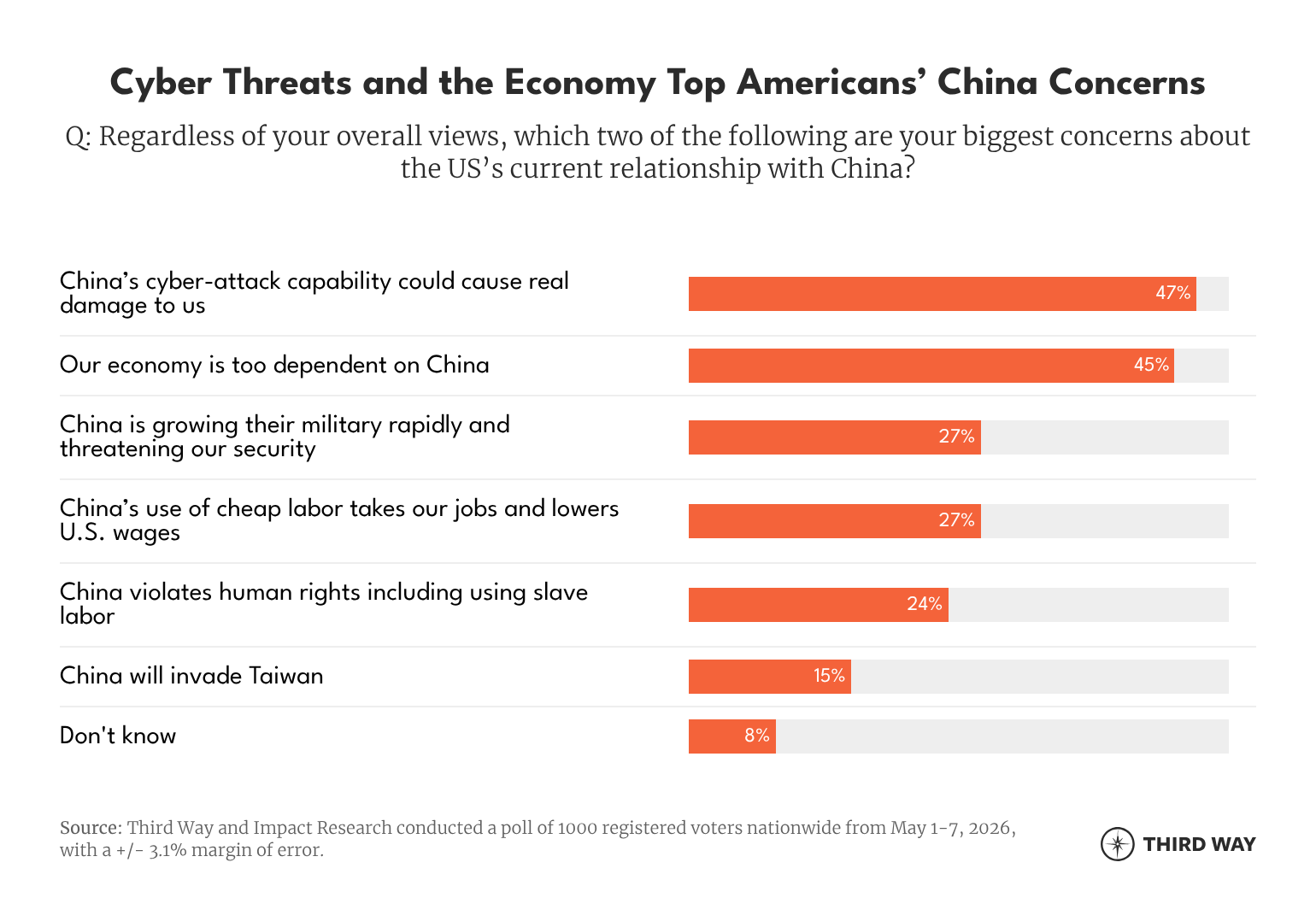
Concerns around China’s violations of human rights or a potential invasion of Taiwan ranked low among voters’ concerns. While undeniably serious issues with major geopolitical and ethical significance, they are relatively distant from Americans’ day-to-day lives. Issues tied to economic stability or security, however, are closer to home and therefore tend to command more attention.
Democrats Aren’t Trusted on China–but That’s a Problem They Can Fix
For years, Republicans owned the politics of economic competition. Now, that grip is loosening. As voters watch Trump’s approach produce higher prices, weaker alliances, and diplomatic chaos, that trust has shifted. Democrats are now more trusted on the economy (by a 2-point margin), tariffs (by a 6-point margin), diplomacy (by a 9-point margin), and foreign policy (by a 1-point margin). These are not minor cracks in Republican credibility.
But Americans still trust Republicans more to manage the US-China relationship overall (by a 4-point margin). 16% of voters, including 43% of Independents, trust neither party. This gap is a perception problem, but one with real roots that Democrats can’t ignore.
Trade deals like the North American Free Trade Agreement (NAFTA) and China’s entry into the World Trade Organization (WTO) were bipartisan efforts backed by both parties. Communities genuinely felt the fallout, with many places hit hard by factory closures and job losses. Over time, Republicans, and particularly President Trump, successfully laid much of the blame at Democrats’ feet, tying them directly to the broader decline of American manufacturing. Whatever the historical nuances and complexities of US deindustrialization, this narrative has proven politically resilient and painted Democrats as weak on China.
However, Democrats can still close that gap by being decisive, clear, and consistently tough on China on the issues voters actually care about the most: protecting US jobs and holding China accountable in ways that actually deliver for American families. In our focus groups, the most effective messaging on geopolitics directly tied strong foreign policy to economic security, US manufacturing, and technological leadership.
Americans know that China is a serious competitor, and they know serious competition requires a serious strategy, not just noise. Republicans have delivered the opposite– chaotic tariffs that have raised prices for American families, severe damage to our alliances, and several foreign policy crises that have made the US less competitive on the world stage. Democrats have a strong argument to make about what a more effective approach looks like, and they should be making it.
Methodology
From May 1-7, 2026, Third Way and Impact Research conducted polling of 1,000 registered voters nationwide, via text-to-web and online panel, with a margin of error of +/- 3.1%. The margin of error for subgroups varies and is higher.