Battleground State Climate and Energy Policies
Josh Freed, Jackie Toth
Empower States to Set Ambitious Goals to Make Their Electricity Clean
Purpose: Create new jobs and eliminate pollution quickly and cheaply by empowering every state to set a clear path to get 100% of electricity from the clean sources that work for them, including renewables, hydropower, nuclear, and carbon capture.1
Specifics:
- While these standards initially were limited to renewables, the overwhelming trend now among states is to make any and all technologies that can meet emissions requirements eligible.2
- A diverse combination of low-carbon electricity sources, including nuclear, can put us on the most efficient and affordable path to clean up the power sector.3
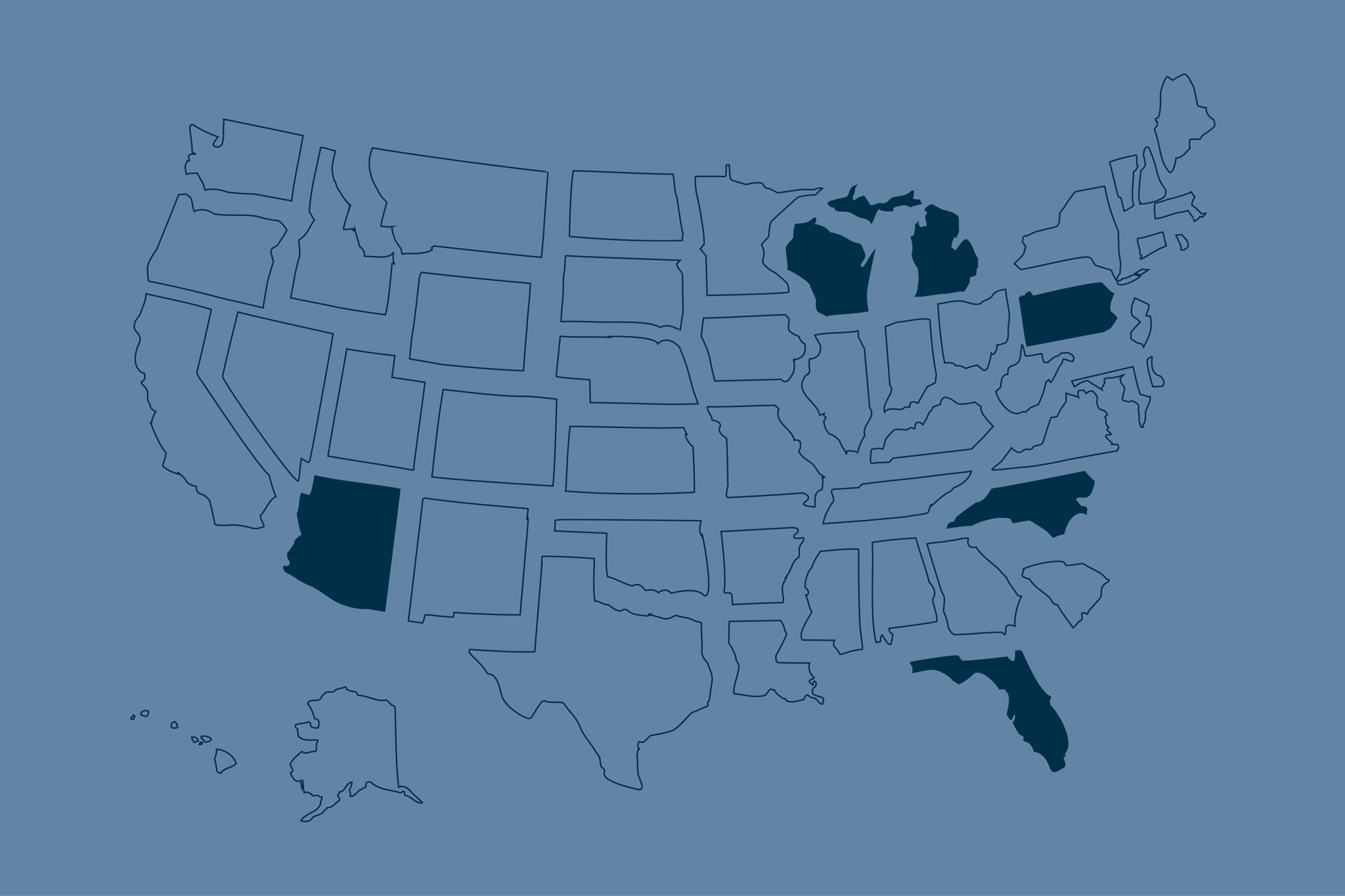
Importance for MI, WI, PA, NC, AZ, FL: PA, MI, WI, AZ, NC all have standards for the electricity sector.4FL does not. The standards in the target states are renewable-only, except for PA, which supports some non-renewable clean technologies.5
- Pennsylvania: Requires 18% of electricity to come from renewables as well as certain methane gas and coal mine methane, by 2021.
- North Carolina: Requires utilities to source 12.5% of electricity from renewables, and efficiency by 2021.
- Wisconsin: Required 10% of electricity used to come from renewables by 2015.
- Arizona: Requires 15% of electricity to come from renewables by 2025.
- Michigan: Requires 15% of electricity to come from renewables by 2021.
Political Supporters: Tina Smith (D-Minn.) and Rep. Ben Ray Luján (D-N.M.) have a bill to create a national Clean Energy Standard;6WI Gov. Tony Evers (D) signed an executive order in August 2019 announcing a goal for 100% carbon-free energy production by 2050.7
Key Stakeholders: Environmental groups, including non-renewable clean energy; technologies like nuclear and carbon capture in an energy standard will earn the support of unions like United Steelworkers and Utility Workers Union of America, as well as utilities.
Benefits: Joins an increasing number of states and cities already committing to 100% clean energy;8 provides flexibility to states to make a plan that fits them best; sets a clear goal that climate activists can rally behind; increases the number of clean energy providers, expanding the pool of advocates who will support more ambitious climate policies.9
Challenges: Some environmentalists want a 100% renewables-only standard; some climate advocates support a carbon price over a CES.
Invest in Our Future through Clean Energy Innovation in States
Purpose: A Clean Energy Innovation Fund would expand investment into the businesses and universities that employ Americans to develop clean energy technologies that we can sell to other countries. Investing in innovation is a down-payment on our long-term recovery from the current economic crisis and supports a strong domestic manufacturing industry.
Specifics:
- Groundbreaking clean energy R&D is already happening at universities, national labs, and companies across the country, and more funding means our best and brightest minds can continue creating tomorrow’s technologies. This funding would finance clean energy infrastructure in all states, not just those on the coast.
- Past R&D Investments we made in solar and wind helped us generate 5% of our power with renewables last year.10
Importance for MI, WI, PA, NC, AZ, FL: All six target states have universities and other research institutions that would play an increased role in clean energy RD&D if federal investment was increased. Each state runs critical clean energy initiatives, including:
- Pennsylvania’s Manufacturing PA Innovation Program provides grants to Carnegie Mellon University to ensure PA leads domestically and abroad on manufacturing and benefits from well-paying jobs in this sector.11
- Wisconsin: Several state universities collaborate with energy industry leaders through a research consortium called M-WERC – its Energy Innovation Center incubates clean energy technology.12
Political Supporters: There are bipartisan proposals in Congress to support or increase funding for every primary energy technology, including wind,13 solar,14manufacturing,15 nuclear,16and carbon capture.17
Key Stakeholders: Environmental groups; clean energy companies; U.S. manufacturers; academic institutions.
Benefits: Helps create jobs now and funds R&D into new technologies that will create more clean energy jobs in the future; 71% of adults think technological advances will be able to reduce most of the negative effects of climate change.18
Challenges: The American public is rightly concerned about their own finances right now, so the long-term benefits of innovative R&D need to be carefully conveyed.
Invest in Clean Manufacturing in America
Purpose: Reduce emissions from difficult-to-decarbonize manufacturing processes by investing in the state research institutions and companies that make American goods. Revitalize the U.S. manufacturing sector that’s critical to battleground states and help create union jobs by building carbon capture, utilization, and storage (CCUS) facilities.19
Specifics:
- Manufacturing employs more than 10% of the workforce of MI, WI, and NC and close to 10% of the workforce in PA.20
- Addressing climate change doesn’t mean we have to stop building things. The U.S. can remain a leading manufacturer, especially if it can bring down emissions from manufacturing activities.
- Even as we transition to clean energy, our economy is still going to rely on fossil fuels for decades to come. When possible, we should capture the carbon emitted from the production and use of these fuels and either put it to good use or store it underground so it doesn’t enter the atmosphere.
Importance for MI, WI, PA, NC, AZ, FL: The number of CCUS projects is continually growing in each of the target states – including in AZ, FL, NC, and WI, which have been run by Republican governors now or in the recent past.21
- Arizona: There are two CCUS projects in AZ including the Center for Negative Carbon Emissions at Arizona State University, which is working on technologies to capture carbon dioxide directly from the air outside.22
- Pennsylvania: PA is home to one of three National Energy Technology Laboratory locations, which lead DOE efforts on CCUS RD&D. PA universities, unions, and the Wolf Administration are also supportive of advancing CCUS technologies.23
- Florida: Florida has three projects that use captured carbon for other purposes: MicroBio Engineering in Orlando, Dioxide Materials in Boca Raton, and Algenol Biofuels in Fort Myers.
- Michigan: Core Energy in Gaylord, Mich., is using captured carbon to help access more oil and gas resources through enhanced oil recovery.24
- North Carolina: NC is home to twelve producers that use Carbon Cure technology to strengthen concrete with carbon dioxide. Meanwhile, the Research Triangle Institute in NC is working on a carbon capture process for coal-fired power plants using coal-derived flue gas.25
Political Supporters: The BlueGreen Alliance;26the AFL-CIO;27 Moms Clean Air Force is open to CCS;28Conor Lamb (D-PA) cosponsors one such CCS bill in Congress, Sen. Kyrsten Sinema (D-AZ) cosponsors another.2930
Key Stakeholders: Utilities; manufacturers; labor unions; the fossil fuel industry.
Benefits: Reduce emissions from difficult-to-decarbonize manufacturing and power generation facilities in battleground states; revitalize the manufacturing sector important to battleground states; create union jobs to build CCUS facilities.
Challenges: Skepticism among environmental groups that CCUS will prolong fossil fuel use; high up-front cost for demonstrations.
Finance Clean Energy Infrastructure
Purpose: Create a national financial institution so that critical clean energy projects can receive funding and create jobs. Such an institution could be critical to supporting the clean energy sector, as businesses may face difficulties accessing financial support from banks during the economic crisis and eventual recovery.
Specifics:
- After an initial appropriation, the bank could operate without additional funding.
- $25 billion in appropriations over six years could mobilize up to $1 trillion in private investment.31
Importance for MI, WI, PA, NC, AZ, FL: At least two of the six states have clean energy bank-like structures.
- Michigan: The Michigan Saves nonprofit green bank helps finance energy efficiency projects in Michigan.32Gretchen Whitmer (D)’s FY21 budget proposed $5 million in new funding for Michigan Saves.33
- Florida: The Florida Solar & Energy Fund helps finance home energy retrofit.34
Political Supporters: NRDC is co-secretariat of the global Green Bank Network;35Debbie Dingell (D-Mich.) has a bill to create a National Climate Bank, which is supported by Michigan Saves, NRDC, the Alliance to Save Energy, Environment America, and Union of Concerned Scientists.36
Key Stakeholders: Environmental groups; energy efficiency advocates; small businesses; manufacturers.
Benefits: Requires only initial appropriations to get started before becoming self-sufficient; creates jobs by funding clean energy infrastructure projects.
Challenges: Need for successful messaging that it’s not “just another bank.”
Create Jobs Now by Investing in Clean Energy Transportation Infrastructure
Purpose: Support jobs, save Americans gas money, and help us move off our gas-dependent transportation system by creating EV charging corridors and encouraging businesses to invest in public charging infrastructure.
Specifics:
- Our EV future is going to need a massive build-out in charging equipment to make it happen. This effort can put hundreds of Americans to work across the country.
- A permanent 30C tax credit for alternative fueling properties, including for EV chargers, would spur the development of charging infrastructure, while federal funds to match what states put into the creation of multi-state EV corridors could double deployment.
Importance for MI, WI, PA, NC, AZ, FL: Outside of WI, all of these states have either worked to increase EV charging infrastructure or have considered legislation to do so.
- Pennsylvania: Offers multiple EV and clean vehicle-related incentive programs and has designated 14 highway routes in the state as Alternative Fuels Corridors, so there is an EV charging station at least every 50 miles.37
- Michigan: State legislators introduced a bipartisan package of four bills to deploy more EV charging infrastructure and accelerate adoption of EVs.38
- Arizona: AZ and seven other Western states signed a Regional Electric Vehicle (REV) West Plan to create an Intermountain West Electric Vehicle Corridor that makes it possible to drive an EV across all eight states’ major corridors.39
- North Carolina: NC provides grants and funding opportunities for vehicle electrification.
- Florida: The state Senate passed a bill requiring Florida’s Public Service Commission to work with other state departments to develop a plan to build out EV charging station infrastructure along the state highway system (the House didn’t vote on it).40
Political supporters: Environmental groups.41
Key Stakeholders: Auto companies; dealerships; utilities; consumers.
Benefits: Improves air quality; secures competitiveness of U.S. auto manufacturers.
Challenges: Rural Americans have not seen the benefits of electrified transportation at the same scale as urban centers to date and must be included as key stakeholders.
Invest in Expanding Access across the Country to Clean Transportation for All Americans
Purpose: More Americans, including low-income families, should have access to the increasing number of innovative, clean, electric vehicles that will save them money in the long run and start reducing our air pollution and improving our health.
Specifics:
- An enhanced EV rebate or subsidy sends a signal to automakers that the U.S. is serious about a clean vehicle future.
- Tesla and GM have already met the sales cap on tax credits. This cap should be raised or removed so more consumers can still afford cleaner cars from our biggest EV players.
Importance for MI, WI, PA, NC, AZ, FL: NC stands out among the target states.
- North Carolina: Gov. Roy Cooper called for a plan to significantly increase the number of ZEVs on the road in North Carolina. NCDOT plans to get 80,000 ZEVs on the road by 2025.42
Political Supporters: Jackie Speier (D-CA) has a bill to provide significant point-of-sale tax credits for electric vehicles.43
Key Stakeholders: Auto companies; car dealerships; utilities; consumers.
Benefits: Improves air quality; secures competitiveness of U.S. auto manufacturers; enables faster transportation decarbonization; can be scaled for low-income buyers.
Challenges: Much of the oil and gas industry will try to undermine this effort with the public, calling it a subsidy for the wealthy; in shifting to EVs, U.S. will need to provide job training and supply a greater share of global auto market to make sure autoworkers aren’t displaced.
Keep Our Autoworkers Employed and the Industry Competitive
Purpose: America has so many talented, skilled autoworkers, many of whom are union members. They should be the ones to help build the transportation options of the future, and that only happens if we help companies retool their facilities to develop new kinds of vehicles. Plus, we’ve got to go big on EVs to reduce pollution, retain and create auto jobs and stay competitive in the global auto market.
Specifics:
- Redeveloping existing auto manufacturing facilities to produce EVs keeps the jobs local and requires less capital than standing up new plants.
- Providing loans and tax credits to suppliers will help companies currently struggling in the economic downturn to stay afloat, while also providing for cleaner vehicle manufacturing for decades to come.
Importance for MI, WI, PA, NC, AZ, FL: Detroit has become a hub for EV and AV manufacturing, with big EV investments planned from GM and Ford.44In 2019, workers were employed across each of motor vehicle manufacturing, bodies and trailers, and parts work in the following numbers:45
- Michigan: 181,000
- Pennsylvania: 18,000
- North Carolina: 27,000
- Wisconsin: 17,000
- Florida: 8,000
- Arizona: 2,000
Political Supporters: Senate Minority Leader Chuck Schumer (D-NY) has a proposal to re-tool existing auto factories to develop zero-emission vehicles or charging equipment;46 Dingell has proposed legislation to reauthorize the Advanced Technology Vehicle Manufacturing (ATVM) loan program that was instrumental in standing up Tesla and Nissan’s EV manufacturing facilities.47
Key Stakeholders: United Auto Workers; International Brotherhood of Electrical Workers; Ford; GM.48
Benefits: Establishes cutting-edge auto manufacturing at facilities in regions where talent pool already exists; ensures the U.S. is part of an electrified transportation future and stays competitive.
Challenges: Direct job creation is localized, so convey that indirect and induced jobs are also supported.
Help States Be Better Prepared to Manage Natural Disasters
Purpose: Climate change is increasing the frequency and intensity of natural disasters. We need to prepare for these emergencies ahead of time and protect vulnerable communities – from coastal residents experiencing hurricanes, to farmers facing floods in the plains, to Western populations witnessing longer and more destructive wildfire seasons.
Specifics:
- Already exhausting its funding and staff due to COVID-19, FEMA at its current capacity will struggle to respond to hurricanes and other natural disasters this year.49
- Americans’ opinion on climate change is often impacted by the extreme weather they are experiencing in increasing frequency.50
Importance for MI, WI, PA, NC, AZ, FL: AZ, NC, and FL, in particular, are witnessing the need for resilience every year, especially in the summer. All target states have some kind of disaster preparedness and response agency.
- Florida: A compact of counties in Southeast Florida, including Miami-Dade County, helped shape legislationFlorida passed to require sea-level rise to be considered in local comprehensive plans.51
- North Carolina: 56% of North Carolina voters told the North Carolina League of Conservation Voters in March that they think a mobilization, such as the current one against COVID-19, is required to avoid the worst health and economic effects of climate change.52
Political Supporters: Numerous Democrats leading bills in Congress to improve resilience against natural disasters;53incorporate climate change into disaster planning;54and ensure older adults and people with disabilities are prepared for disasters.55
Key Stakeholders: All Americans; state and local emergency response departments and personnel.
Benefits: A political win-win, particularly as we face increasingly numerous and strong hurricanes, wildfires, and floods; reduces costs in life and property.
Challenges: High up-front preparatory costs to realize benefits following disasters.
Endnotes
Sepulveda, Nestor A., et al. “The Role of Firm Low-Carbon Electricity Resources in Deep Decarbonization of Power Generation.” Joule, vol. 2, no. 11, 2018, pp. 2403-2420.
Benahmed, Farah, and Lindsey Walter. “Clean Energy Targets are Trending.” Third Way, 11 Dec. 2019, https://www.thirdway.org/graphic/clean-energy-targets-are-trending. Accessed 23 April 2020.
Fitzpatrick, Ryan, et al. “Clean Energy Standards: How More States Can Become Climate Leaders.” Third Way, 27 June 2018, https://www.thirdway.org/report/clean-energy-standards-how-more-states-can-become-climate-leaders. Accessed 23 April 2020.
“U.S. State Electricity Portfolio Standards.” Center for Climate and Energy Solutions, https://www.c2es.org/document/renewable-and-alternate-energy-portfolio-standards/. Accessed 23 April 2020.
Clean Energy Standards: State and Federal Policy Options and Considerations.” Center for Climate and Energy Solutions, November 2019. https://www.c2es.org/site/assets/uploads/2019/11/clean-energy-standards-state-and-federal-policy-options-and-considerations.pdf. Accessed 23 April 2020.
Picciano, Paul, et al. “Projected Effects of the Clean Energy Standard Act of 2019.” Resources for the Future, 8 May 2019, https://www.rff.org/publications/issue-briefs/projected-effects-clean-energy-standard-act-2019/. Accessed 23 April 2020.
The State of Wisconsin, Office of the Governor. “Executive Order #38: Relating to Clean Energy in Wisconsin.” Office of the Governor, 16 Aug. 2019, https://evers.wi.gov/Documents/EO%20038%20Clean%20Energy.pdf. Accessed 23 April 2020.
Benahmed, Farah, and Lindsey Walter. “Clean Energy Targets are Trending.” Third Way, 11 Dec. 2019, https://www.thirdway.org/graphic/clean-energy-targets-are-trending. Accessed 23 April 2020.
Prieto, Andres, and Lindsey Walter. “Carbon Pricing: One Piece of the Climate Puzzle.” Third Way, 4 Feb. 2020, https://www.thirdway.org/memo/carbon-pricing-one-piece-of-the-climate-puzzle. Accessed 23 April 2020.
“What is U.S. electricity generation by energy source? U.S. Energy Information Administration, 27 Feb. 2020, https://www.eia.gov/tools/faqs/faq.php?id=427&t=3. Accessed 23 April 2020.
“Manufacturing PA Innovation Program.” Pennsylvania Department of Community and Economic Development. Accessed 23 April 2020.
Walter, Lindsey. “Wisconsin.” Third Way, 23 April, 2019. https://www.thirdway.org/report/wisconsin. Accessed 23 April 2020.
United States, Congress, House of Representatives. Wind Energy Research and Development Act of 2019. Congress.gov,https://www.congress.gov/bill/116th-congress/house-bill/3609. 116th Congress, 1st Session, H.R. 3609.
United States, Congress, House of Representatives. Solar Energy Research and Development Act of 2019. Congress.gov,https://www.congress.gov/bill/116th-congress/house-bill/3597. 116th Congress, 1st Session, H.R. 3597.
United States, Congress, Senate. Clean Industrial Technology Act of 2019. Congress.gov, https://www.congress.gov/bill/116th-congress/senate-bill/2300. 116th Congress, 1st Session, S. 2300.
United States, Congress, Senate. Nuclear Energy Leadership Act. Congress.gov, https://www.congress.gov/bill/116th-congress/senate-bill/903. 116th Congress, 1st Session, S. 903.
United States, Congress, House of Representatives. Nuclear Energy Leadership Act. Congress.gov,https://www.congress.gov/bill/116th-congress/house-bill/3607. 116th Congress, 1st Session, H.R. 3607.
The Washington Post and Kaiser Family Foundation. 9 July-5 Aug. 2019. https://games-cdn.washingtonpost.com/notes/prod/default/documents/fd042513-7ab8-40e0-9551-5f844587dbdd/note/4b15d814-7840-4c50-8e78-cf8ad6d5aeb0.pdf. Accessed 23 April 2020.
Bright, Matt. “Appealing to Battleground States with Policies for Clean Manufacturing and Industry.” Third Way, 20 April 2020, https://www.thirdway.org/memo/appealing-to-battleground-states-with-policies-for-clean-manufacturing-and-industry. Accessed 23 April 2020.
“State Manufacturing Data.” National Association of Manufacturers, https://www.nam.org/state-manufacturing-data/. Accessed 23 April 2020.
Burns, Erin. “Carbon Capture Projects Map.” Third Way, 18 July, 2018, https://www.thirdway.org/graphic/carbon-capture-projects-map. Accessed 23 April 2020.
“Center for Negative Carbon Emissions.” Arizona State University, https://cnce.engineering.asu.edu/. Accessed 23 April 2020.
Sisk, Amy. “At Penn State, researchers push for answers on carbon capture: Will it stay where we put it?” StateImpact Pennsylvania, 14 Dec. 2018, https://stateimpact.npr.org/pennsylvania/2018/12/14/at-penn-state-researchers-push-for-answers-on-carbon-capture-will-it-stay-where-we-put-it/. Accessed 23 April 2020.
“Core Energy, LLC.” http://www.coreenergyllc.com/, Accessed 23 April 2020.
“Large Bench Scale Development of Non-Aqueous Solvent Carbon Dioxide Capture Process for Coal Fired Power Plants Utilizing Real Coal Derived Flue Gas.” National Energy Technology Laboratory, https://www.netl.doe.gov/project-information?k=FE0026466. Accessed 23 April 2020.
“Solidarity for Climate Action.” BlueGreen Alliance, 24 June 2019, http://www.bluegreenalliance.org/wp-content/uploads/2019/07/Solidarity-for-Climate-Action-vFINAL.pdf. Accessed 23 April 2020.
Cohen, Rachel M. “The Environmental Left Is Softening on Carbon Capture Technology. Maybe That’s OK.” The Intercept, 20 Sept. 2019, https://theintercept.com/2019/09/20/carbon-capture-technology-unions-labor/. Accessed 23 April 2020.
Atkin, Emily. “Some of the Biggest Green Groups Have Cold Feet Over the ‘Green New Deal.’” The New Republic, 15 Jan. 2019, https://newrepublic.com/article/152885/biggest-green-groups-cold-feet-green-new-deal. Accessed 23 April 2020.
United States, Congress, House of Representatives. Fossil Energy Research and Development Act of 2019. Congress.gov,https://www.congress.gov/bill/116th-congress/house-bill/3607. 116th Congress, 1st Session, H.R. 3607.
United States, Congress, Senate. Launching Energy Advancement and Development through Innovations for Natural Gas Act of 2019.Congress.gov, https://www.congress.gov/bill/116th-congress/senate-bill/1685. 116th Congress, 1st Session, S.1685.
“Dingell Leads House Bill to Establish a National Climate Bank to Finance the Clean Economy Transition.” Press Release, Office of Rep. Debbie Dingell (D-Mich.), 12 Dec. 2019, https://debbiedingell.house.gov/news/documentsingle.aspx?DocumentID=2024. Accessed 23 April 2020.
Michigan Saves. “About,” https://michigansaves.org/about/. Accessed 23 April 2020.
Balaskovitz, Andy. “Whitmer proposes $10 million for green bank, clean energy revolving fund.” MiBiz, 9 Feb. 2020, https://mibiz.com/sections/energy/whitmer-proposes-10-million-for-green-bank-clean-energy-revolving-fund. Accessed 23 April 2020.
“Our Story.” Solar Energy Loan Fund, https://solarenergyloanfund.org/about/. Accessed 23 April 2020.
Sims, Douglass, et al. “Green Finance Center.” Natural Resources Defense Council, 3 Dec. 2019, https://www.nrdc.org/resources/green-finance-center. Accessed 23 April 2020.
“Dingell Leads House Bill to Establish a National Climate Bank to Finance the Clean Economy Transition.” Press Release, Office of Rep. Debbie Dingell (D-Mich.), 12 Dec. 2019, https://debbiedingell.house.gov/news/documentsingle.aspx?DocumentID=2024. Accessed 23 April 2020.
Lillian, Betsy. “Pennsylvania Expands Alternative Fuel Corridors.” Next-Gen Transportation, 17 May 2019, https://ngtnews.com/pennsylvania-expands-alternative-fuel-corridors. Accessed 23 April 2020.
“Electric Vehicle Champions.” Michigan League of Conservation Voters, https://michiganlcv.org/narrative/electric-vechicle-champions/. Accessed 23 April 2020.
“REV West.” National Association of State Energy Officials, https://www.naseo.org/issues/transportation/rev-west. Accessed 23 April 2020.
United States, Florida, Senate. Essential State Infrastructure https://www.flsenate.gov/Session/Bill/2020/07018. 2020 Session, SB 7018.
Cattaneo, Lia. “Investing in Charging Infrastructure for Plug-In Electric Vehicles.” Center for American Progress, 30 July 2018, https://www.americanprogress.org/issues/green/reports/2018/07/30/454084/investing-charging-infrastructure-plug-electric-vehicles/. Accessed 23 April 2020.
“Road Map to More Electric Vehicles in N.C.” North Carolina Department of Transportation, https://www.ncdot.gov/initiatives-policies/environmental/climate-change/Pages/electric-vehicles.aspx. Accessed 23 April 2020.
“Rep. Speier Introduces Bill to Increase US Auto Industry’s Share of Global Electric Vehicle Market, Boosting Jobs and Taking Action on Climate Change.” Press Release, Office of rep. Jackie Speier (D-Calif.), 11 Dec. 2019, https://speier.house.gov/2019/12/rep-speier-introduces-bill-to-increase-us-auto-industry-s-share-of-global-electric-vehicle-market-boosting-jobs-and-taking-action-on-climate-change. Accessed 23 April 2020.
“Legislators, Auto Industry Leaders Discuss Supporting Electric Vehicle Growth In Michigan.” Press Release, Detroit Regional Chamber, 10 Feb 2020, https://www.detroitchamber.com/legislators-auto-industry-leaders-discuss-supporting-electric-vehicle-growth-in-michigan/. Accessed 23 April 2020.
“State and Metro Area Employment, Hours, & Earnings.” Current Employment Statistics, United States Bureau of Labor Statistics. https://www.bls.gov/sae/. Accessed 23 April 2020.
Senator Chuck Schumer. “Chuck Schumer: A Bold Plan for Clean Cars.” New York Times, 24 Oct 2020, https://www.nytimes.com/2019/10/24/opinion/chuck-schumer-electric-car.html. Accessed 23 April 2020.
United States, Congress, House of Representatives. USA Electrify Forward Act. Congress.gov, https://www.congress.gov/bill/116th-congress/house-bill/5558/. 116th Congress, H.R.5558.
Senator Chuck Schumer. “Chuck Schumer: A Bold Plan for Clean Cars.” New York Times, 24 Oct 2020, https://www.nytimes.com/2019/10/24/opinion/chuck-schumer-electric-car.html. Accessed 23 April 2020.
Christopher Flavelle and Zolan Kanno-Youngs. “FEMA, Racing to Provide Virus Relief, Is Running Short on Front-Line Staff.” New York Times, 3 April 2020, https://www.nytimes.com/2020/04/03/climate/fema-staff-shortage-coronavirus.html. Accessed 23 April 2020.
Associated Press. “Poll: Increase in natural disasters changing minds on climate change.” Market Watch, 28 Jan 2019, https://www.marketwatch.com/story/poll-increase-in-natural-disasters-changing-minds-on-climate-change-2019-01-28. Accessed 23 April 2020.
Sydney Menees and Jessica Grannis. “Lessons in Regional Resilience: The Southeast Florida Regional Climate Change Compact.” Georgetown Climate Center, 17 Jan 2017, https://www.georgetownclimate.org/files/report/GCC-Lessons-in-Regional-Resilience-SE_FL_Compact-Jan_2017-v2.pdf. Accessed 23 April 2020.
Tom Jenson. “North Carolina Voters Support Climate Action Like COVID-19 Response.” Public Policy Polling, North Carolina League of Conservation Voters. 19 March 2020, https://www.eenews.net/assets/2020/03/20/document_cw_01.pdf. Accessed 23 April 2020.
United States, Congress, House of Representatives. Coastal Communities Adaptation Act. Congress.gov, https://www.congress.gov/bill/116th-congress/house-bill/1317/. 116th Congress, H.R.1317.
United States, Congress, House of Representatives. PREPARE Act of 2019. Congress.gov, https://www.congress.gov/bill/116th-congress/house-bill/4347/. 116th Congress, H.R.4347.
United States, Congress, Senate. FEMA Climate Change Preparedness Act. Congress.gov,https://www.congress.gov/bill/116th-congress/senate-bill/3204. 116th Congress, S.3204.
United States, Congress, Senate. Real Emergency Access for Aging and Disability Inclusion for Disasters Act. Congress.gov, https://www.congress.gov/bill/116th-congress/senate-bill/1755. 116th Congress, S.1755.


Latest Publications
On Permitting Reform: How To Talk About BAAJA
Past the Pump: How Americans are Footing the Costs of Trump’s War of Choice
EIA is Under Attack. That’s Dangerous for the Entire Energy Sector.
On the Grid: PERMIT Me to Celebrate
Never Miss an Update
Sign up for updates on the pragmatic, center-left ideas shaping the future of American policy.