Blog Published October 21, 2026 · 9 minute read
Past the Pump: How Americans are Footing the Costs of Trump’s War of Choice
Takeaways
- Since Trump declared war on Iran, all kinds of petroleum product prices have spiked, increasing the cost of daily life for Americans
- Transportation is getting more expensive—our analysis shows that American households have spent $765 more on gas this year and are paying $81 more per flight
- If the Trump Administration fails to take the affordability crisis seriously and high costs persist for the next year, we’ve calculated that:
- The average farmer will be left spending an additional $3,000 on fuel
- Americans heating their homes with heating oil may spend up to $1,664 more
In June, we reported how Trump’s war in Iran has come with a growing price tag for Americans. Today, eight months into the conflict, it’s even worse. The average two-car American household is shouldering an extra $765 from higher gas prices since the war’s outbreak.
Gas price spikes are a twist of the knife for households already bearing the burden of Trump’s volatile tariffs.
As Americans are getting poorer, oil companies and President Trump are getting richer. In the first full economic quarter since the war began, the eight largest oil producers—including BP, Shell, Chevron, and ExxonMobil—have nearly doubled their combined profits since mid-2025. In an astounding conflict of interest, President Trump has gained $15.5 million in oil and gas stocks since the war started.
Unfortunately, the US appears far from resolving the conflict. Passage through the Strait of Hormuz remains dangerous, and President Trump himself has cast doubt that the administration is even negotiating with the right people.
Below, we explain how President Trump’s war in Iran affects everything from farming to flying to driving. Until this conflict ends, Americans will continue to pay the price.
Why Prices Have Increased
The war in Iran has triggered a perfect storm of factors to drive an energy crisis. The Strait of Hormuz closure constrained the global supply and transport of crude oil, while missile strikes have damaged key oil refineries and pipelines. Houthi attacks are jeopardizing exports via the Red Sea, and the energy sector was already contending with fallout from Russia’s war against Ukraine.
Even though the US produces more crude oil than any other country, it primarily produces the wrong kind of oil to lower domestic prices. Most US oil is “light, sweet crude,” but the largest refineries are built for “heavy, sour crude,” mostly from Canada and the Gulf of Mexico. The United States is thus deeply dependent on global oil markets and a steady balance of imports and exports. This is true for affordable refined products—like gasoline and diesel—which the West Coast and Northeastern US import from Canada and Asia.
Put simply, when the global supply of crude oil, gasoline, and diesel goes down, prices in the US go up.
Unprecedented Disruptions to Oil Prices
Since the war broke out in February 2026, prices across common fuel sources are way up. These price increases echo, and in some cases surpass, the historic price levels after Russia’s illegal invasion of Ukraine. In both cases, the global market has had to scramble to adjust as long-standing fuel sources become unreliable.
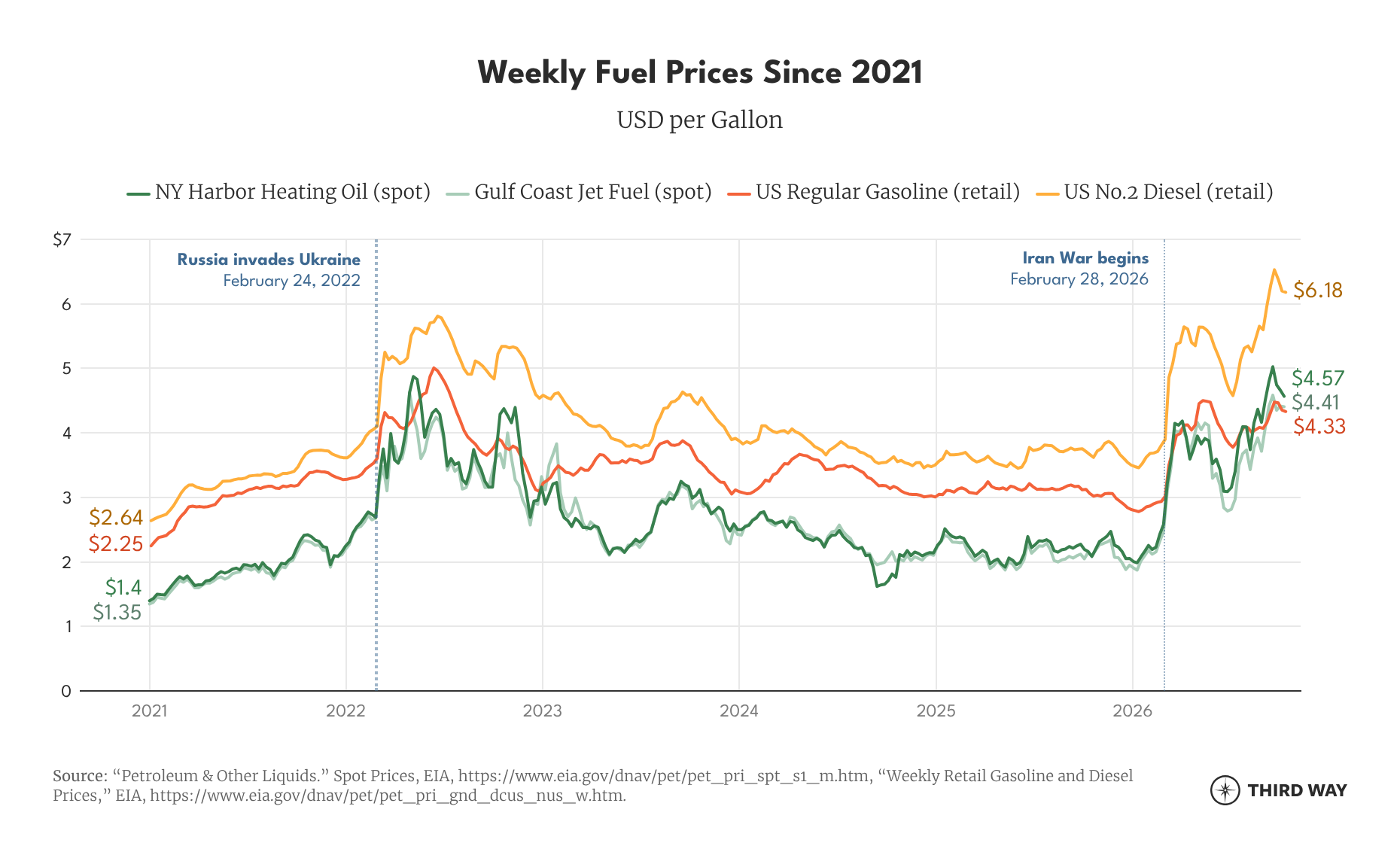
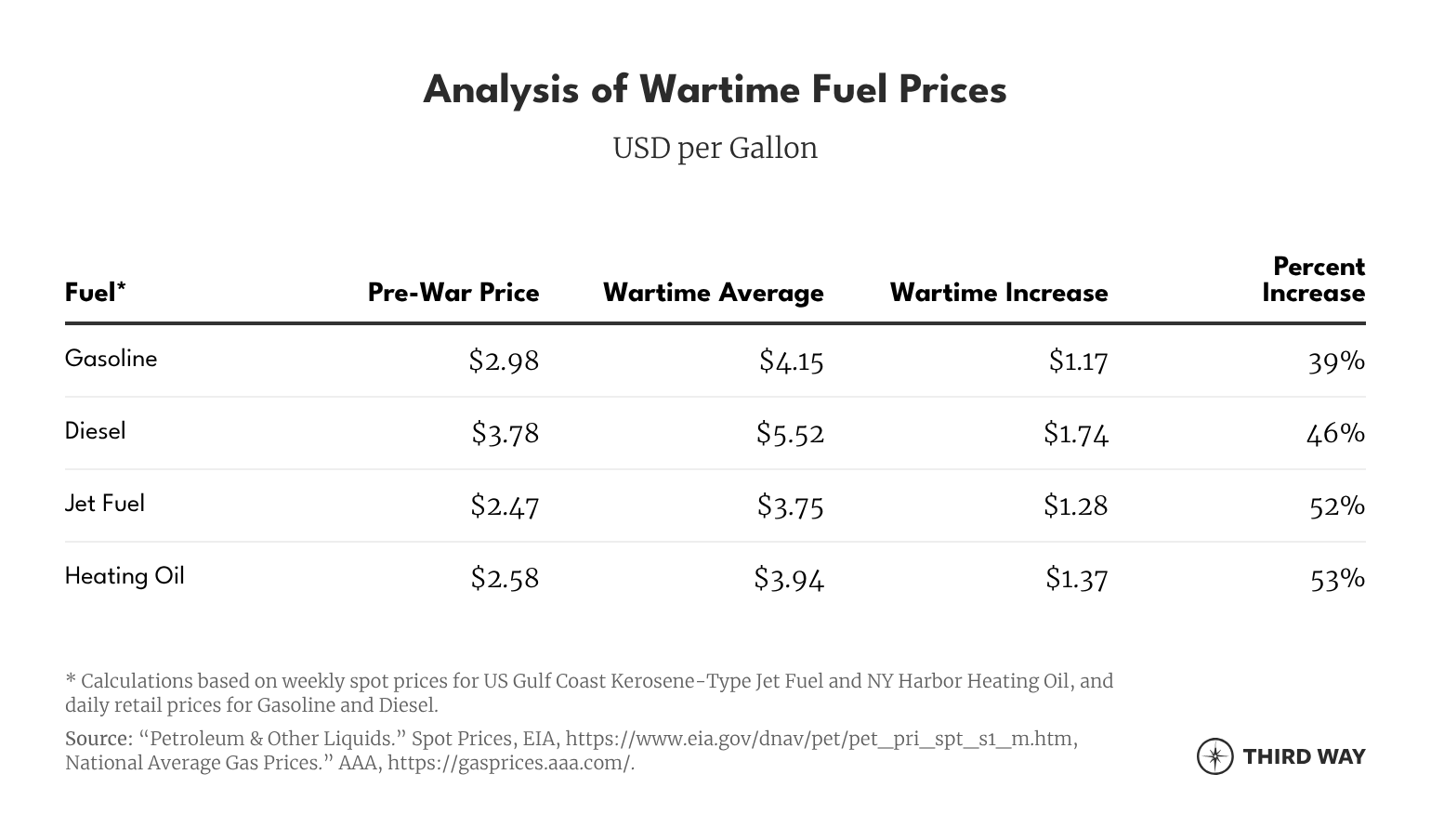
Our analysis highlights that oil-based fuels are up across the board since the start of the war. With the “meant-to-be-four-week” war crawling into its ninth month, consumers aren’t just feeling the pressure at the pump, but also when they fly, buy food, and heat their homes.
Analysis of Wartime Fuel Prices (in US Dollars per Gallon)
Higher Fuel Prices Make Life More Expensive For Everyone
Gasoline
As of October 19, 2026, American car owners have spent an extra $324 on gas per vehicle, compared to what they would have spent if prices stayed at pre-war levels. That number is $481 for truck and SUV owners. At today’s elevated gas prices, drivers can expect to pay an additional $587 and $871, respectively, over the next 12 months compared to pre-war prices.
Some regions are more exposed to these shocks than others. In the Mountain West, Idaho has seen gas prices rise 61%, while Utah’s have risen 70%, up from 45% at the time of our last reporting in June 2026.
Diesel
While diesel prices have dropped a few cents, they recently reached an all-time high of $6.53 per gallon. That’s more than their peak following Russia’s invasion of Ukraine. Diesel is the fuel for the tractors, trucks, and trains that keep our economy running, meaning that any price increase ripples through the supply chain.
Farming
We’ve calculated, using USDA data, that the average farm will spend about $3,000 more on fuel this year if wartime prices persist for 12 months—not accounting for all the other rising prices they’re facing. In the spring planting season alone, a Joint Economic Committee’s Minority Staff report estimated that farmers collectively paid about $1.4 billion more than they did last year. The USDA has also forecast that, cumulatively, fuel and oil costs will total $21.62 billion for American farmers in 2026, the highest burden on record. That’s approximately 17% higher than 2022’s cost. Farmers were already struggling with higher fertilizer prices, high tariffs, and rising production costs, and higher diesel prices are exacerbating the financial pain. In a survey of farm managers, bankers, and USDA Farm Service Agency personnel operating in Mississippi, Arkansas, Louisiana, Tennessee, and neighboring states, 73% of respondents reported worsening liquidity and solvency among crop producers in 2026 compared to the previous year. In short, the war has left farmers vulnerable to bankruptcy and dampened the entire US agricultural economy.
Groceries
High diesel prices are passed on to consumers as well. Once food leaves a farm, it still needs to be transported to the grocery store—typically in a diesel-fueled truck or train. Fuel-related costs account for 15–30% of the total cost of certain food products. In the US, wholesale food prices jumped 1.2% from August to September, the largest monthly increase since February. Goods requiring refrigerated transportation are particularly exposed to fuel price shocks, and fresh produce prices are indeed forecast to increase 5.7% in 2026.
Jet Fuel
Air travelers have spent an average of $81 more on a single domestic itinerary since the war began than they did the year prior, according to our analysis of Bureau of Transportation Statistics data. That’s an increase of over 20% from the 2025 average cost of $388. As travelers gear up for the holidays, they’re facing the highest holiday fares in the past ten years. To make matters worse, airline executives are scaling back the number of routes due to rising fuel costs. First on the chopping block are lower-priced budget-friendly flights and flights to less popular destinations. Thanks to President Trump’s war of choice, Americans traveling to visit family this holiday season will see higher costs and fewer direct flights to get where they need to go.
Heating Oil
In the Northeast, about 3.9 million American households rely on heating oil to stay warm during the fall and winter. Our analysis of Energy Information Administration (EIA) daily spot price data shows that this year, a household using heating oil will pay between $555 and $1,664 more because of the war. Even though the EIA optimistically forecasts that the worst of the war’s supply disruptions are behind us, they still expect retail heating oil prices to rise by 34% this winter as compared to last. In a state like Maine, where nearly 11% of the population lives below the national poverty line and more than 50% relies on heating oil, these costs are alarming.
The Trump Administration’s “Solutions” Will Not Help
President Trump has largely ignored that his war is making life more expensive for all Americans. The few actions that have come out of the White House are temporary or half-baked.
In one instance, President Trump signed an executive order to temporarily allow red dye diesel—a fuel that’s exempt from federal diesel tax and reserved for off-road purposes like farming or construction—to be used for highway transportation. This does little to help farmers, as many farmers already had access to the fuel. The order may also spur an increase in overall demand for red-dyed diesel, crowding out the farmers who still need it.
President Trump also threatened a 90-day diesel export ban, which we’ve previously noted would aggravate the price problem. While an export ban may initially divert more diesel into domestic markets, the US can only store so much. As soon as storage is filled, refiners will slow processing—reducing diesel production and the refining of gasoline and jet fuel, which take place in the same plants.
Using the diesel export ban as leverage, President Trump pressured American allies to tap into stored diesel. At the beginning of October, the G7 agreed to release 100 million barrels of diesel and crude oil from strategic reserves. While this infusion has the potential to decrease prices by 25 cents per gallon, it will not increase refining capacity. When the reserve runs out, there is still no long-term solution, and the reserve will need to be replenished. A similar scenario has played out before. In March, members of the International Energy Agency released 400 million barrels of oil, only temporarily alleviating the energy squeeze before prices started climbing again. Relying on temporary fixes has long-lasting consequences: Aramco’s chief executive announced that the world oil supply is now “scarily thin,” which increases geopolitical and economic instability.
Most recently, the White House lifted sanctions on Russian diesel exports, drawing condemnation from both Republicans and Democrats as well as our allies. President Trump has indicated the US may buy Russian diesel, a move that would effectively bankroll Russia’s war in Ukraine and line Putin’s pockets with American dollars. Addressing war-caused price pain should not jeopardize US national security.
While President Trump Profits, Americans Feel the Pressure
As the Trump administration delays, distracts, and downplays, Americans will feel the price increases more and more. Americans will be forced to cut back on any discretionary spending and to make difficult choices to stay afloat. Those constraints will ripple out across the economy, as they have since the war began.
The supply of oil affects too many aspects of daily life for Americans for any quick fix to solve. A real solution involves addressing the root cause by stabilizing the Strait of Hormuz and ending this war. Until then, while President Trump profits from high oil and gas stocks, Americans will continue to pay the price of his policies.