Memo Published June 25, 2026 · 6 minute read
Prices at the Pump: How Every State is Paying for Trump’s Iran Gamble
Takeaways
- The war in Iran and the closure of the Strait of Hormuz has become, in effect, a tax on the entire American economy. The administration has no real solutions, and Americans in every state are feeling that pain at the pump.
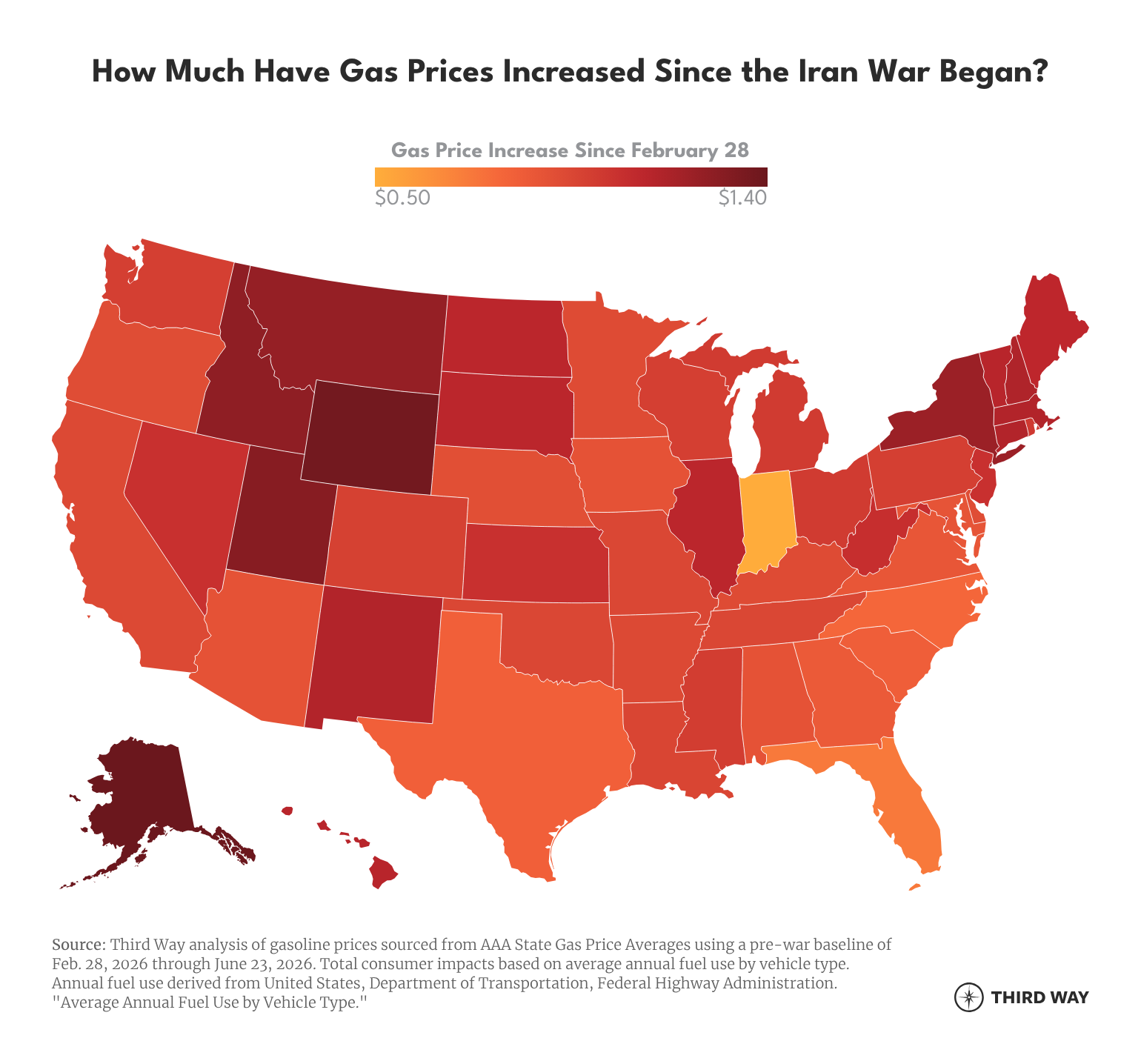
- Third Way has mapped out the increased cost of gasoline in every single state, as well as the total consumer impacts resulting from these higher gas prices.
- Based on Third Way’s analysis, the war in Iran has cost the average American car owner an extra $156 and the average truck or SUV owner an extra $232 in gasoline costs. If gas prices stay high for a full year, the war could cost American car owners $446 more and truck drivers $662 more—or roughly $1,100 for the standard two-vehicle household.
- High gas prices have prompted some policymakers to float a gas tax suspension as one way of blunting the impact of these increases on consumers. This would be an expensive band-aid solution that wouldn’t meaningfully lower costs for consumers.
As the Trump Administration’s fragile ceasefire with Iran hangs on—with traffic through the Strait of Hormuz still running at just a fraction of pre-war levels—the cost of the global energy crisis gets higher every day.
On top of President Trump’s failure to justify the war in the first place, he has also failed to put forward any serious policies to provide relief to Americans. At times, he has fully disregarded the financial pain they’re experiencing.
The global picture is concerning. But for policymakers looking for a reason to push back on the president, the increasing costs in their states should be enough reason to demand action.
Gas Prices are Up in Every State
Gasoline prices are still up more than 30 percent—an increase of roughly $1 per gallon—since the war with Iran began in late February 2026. Prices are now at the highest levels seen since the Russian invasion of Ukraine in 2022.
Price increases have been sharpest in states further away from major coastal refineries, which typically have higher transportation and distribution costs. States in the Rocky Mountains like Wyoming, Montana, and Utah have seen prices increase by more than 45 percent, or at least $1.25 per gallon.
Consumer Cost Impact
The war in Iran has cost the average American car owner an extra $156 and the average truck or SUV owner an extra $232 in gasoline costs.1 If the war persists for a full year and gas prices stay high, the war could cost American car owners $446 more and truck drivers $662 more.2
These costs add up, especially for lower and middle-income households. For a two-vehicle household making the median income of $83,730 a year, the added cost of these gas price increases—sustained for a full year—would amount to a 1.3% reduction in their annual pre-tax income.3 That roughly equates to more than a month’s rent for the median American household.4
These costs are even more acute in states like Michigan, where the median household income is $11,000 lower and cost of a gallon of gas is higher than the national average.5 There, the war could cost the average two-vehicle household over $1,160 more than they would have otherwise spent on gas by the end of February 2027.6 In Illinois, it’s more than $1,320.7
The sudden and prolonged increase in fuel prices are driving inflation across other sectors too, extending the pain for Americans beyond the gas station. Higher diesel prices are increasing freight and shipping costs, jet fuel is increasing the cost of airfare, and higher costs of petroleum byproducts are increasing the costs of manufacturing.
The war in Iran has become, in effect, a tax on the entire American economy.
Grasping at Straws to Fix the Problem
The Trump Administration entered this war without a plan to address the predictable consequences for global energy markets. The flatfooted response to the predictable closure of the Strait of Hormuz is the clearest example. The administration has been scrambling ever since, unsuccessfully, to come up with a solution.
Americans can see the cracks in the excuses. 77 percent of registered voters believe President Trump bears responsibility for the extra money they’re forced to spend.
Is a Federal Gas Tax Holiday the Answer to High Gas Prices?
Some policymakers on both sides of the aisle—as well as the President—have warmed up to the idea of a suspension of the federal 18-cent-per-gallon gas tax as a way of offering short-term relief for drivers. But in practice, it’s barely any relief at all.
There are two reasons for that:
First, drivers wouldn’t receive all the savings. The University of Pennsylvania estimates that gas prices would only fall by about 13 cents, or about 70% of the total gas tax suspension. Upstream suppliers and wholesalers would pocket the rest.
Second, the small savings won’t change the fact that gasoline prices would remain dramatically higher than pre-war levels. For the average car driver, a suspension would translate into savings of around $2 per fill-up, with drivers still paying an extra $9-$13 more than they were before the war.8
Put another way, a gas tax suspension is a 13-cent solution to a $1.00+ problem.
The Tradeoff: Less Funding for Roads, Bridges, and Transit
The minor savings from a gas tax suspension would come with costly tradeoffs. Federal gasoline taxes provide the largest revenue stream for the Highway Trust Fund (HTF), the federal government’s only dedicated funding source for roads, bridges, and public transit.
The HTF is already significantly underfunded and facing insolvency, so suspending the gas tax to provide underwhelming savings at the pump would starve an already-strained HTF of much-needed revenues and undermine long-term infrastructure investments.
It would also put taxpayers on the hook for any transfers from the general treasury fund to offset that lost revenue. For policymakers who have championed basic government competence, as Governor Whitmer famously did with her “Fix the Damn Roads” agenda, a gas tax suspension represents a poor trade-off.
Conclusion
Half-measures and band-aid solutions will not address the scale of this energy shock.
The only real path to meaningfully lower gasoline prices is to resolve the Iran conflict and reopen the Strait of Hormuz—and even then, it will take months for prices to normalize. Until that happens, Americans will continue paying the price at the pump—and beyond—for President Trump’s war of choice.