Memo Published May 22, 2026 · 7 minute read
A Whole New World: Meet Nevada’s Democratic Primary Voters

No one yet knows which states will lead off in the Democratic presidential primary contests in 2028. But there’s a very good chance that Nevada will be one of the earliest deciders in the nomination fight. And it’s a whole new world in the Silver State—now that they’ve shelved their outdated caucus system, 2028 will be the first time the state will host a real, contested presidential primary.
So who are the voters that will decide this race in Nevada, and what do they want? This spring, Third Way worked with Global Strategy Group to conduct a survey of 1,000 registered voters who are likely to vote in the Democratic presidential primary, with an oversample of 250 Latino likely primary voters. The sample included registered Democrats as well as registered voters who aren’t Democrats but say they are likely to switch their party to participate in the Democratic primary (though there are 13 times as many of the former than the latter in the poll’s universe). The results reveal an electorate that is solidly mainstream, focused on pragmatism over progressivism, and motivated most centrally by simply wanting to win.
Who Are Nevada Democratic Primary Voters?
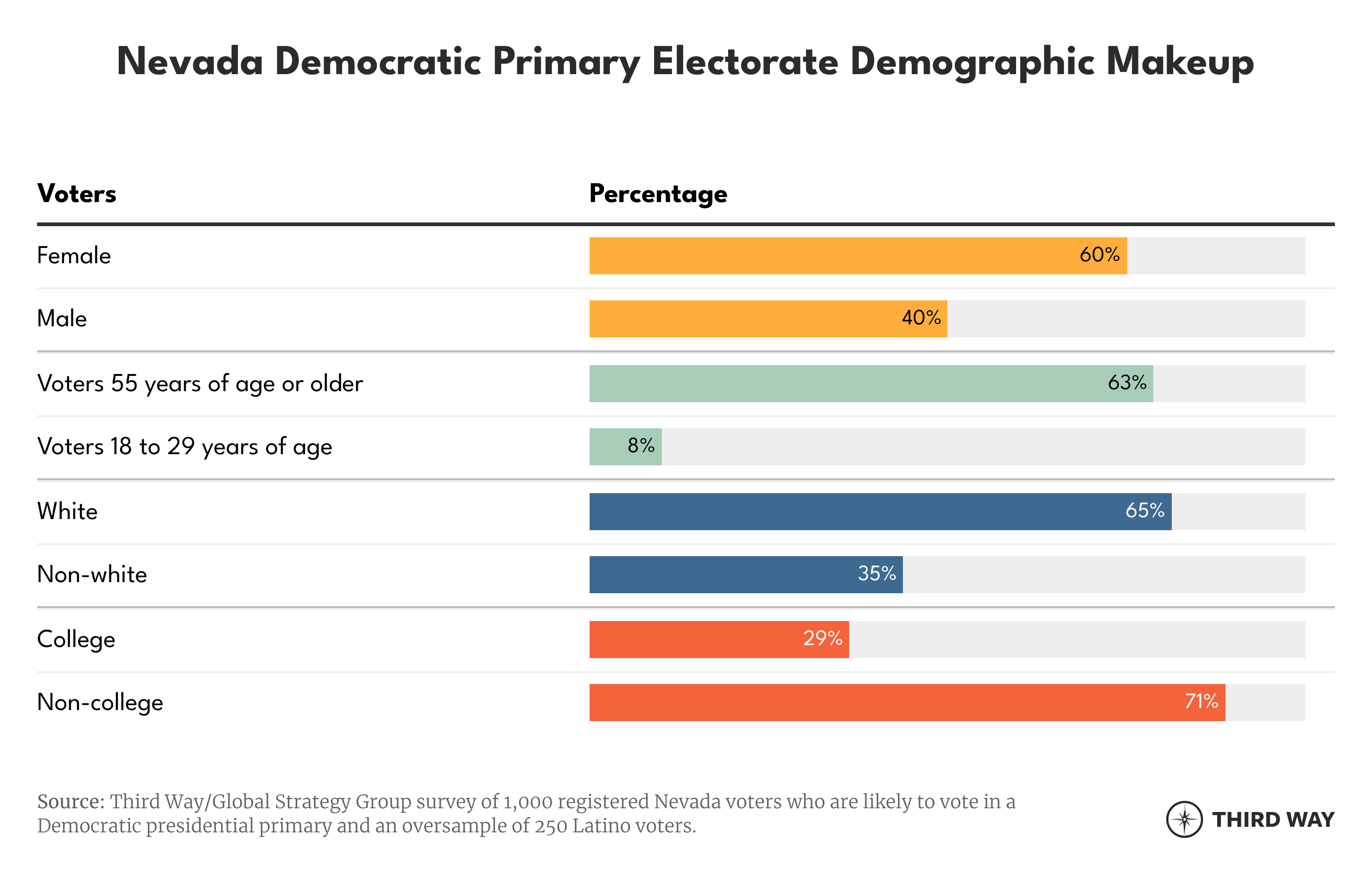
The vast majority of Nevada Democratic primary voters are people who stay out of politics on social media and pay much more attention to the real world. If you were trying to describe the demographics of the average primary voter in the state as a single person, she would be a white woman without a college degree who is nearing retirement age.
Women comprise a supermajority of likely primary voters at 60%. The primary electorate is racially diverse, with sizable portions of Black voters (14%), Latino voters (14%), and Asian voters (8%), but white voters make up the majority at 65%. Voters over 55 years of age comprise a whopping 63% of the primary electorate, while those under 30 years of age are only 8% of the vote. The four-year college degree attainment rate is 29%, which means more than 7 in 10 Democratic primary voters in Nevada do not have a four-year college degree.
This primary electorate frequently consumes social media, but most do not post on it on a regular basis. They are generally on YouTube and Facebook at least weekly: YouTube weekly use clocks in at 64%, with Facebook at 58%. But X/Twitter and Bluesky users are rare among this group, with only 11% of Democratic primary voters using the former weekly and 9% using the latter. Posting is even rarer: across all platforms, only 21% post anything about politics weekly, with daily posters representing just 8%. In fact, a majority of Nevada primary voters (53%) say they never post on social media about politics.
In terms of how people get their news, broadcast (50%) and local TV (49%) dominate these voters’ news consumption, although a fair number also watch cable news, with 42% citing MS NOW/MSNBC and 41% citing CNN. Less than a quarter read the New York Times on a regular basis.
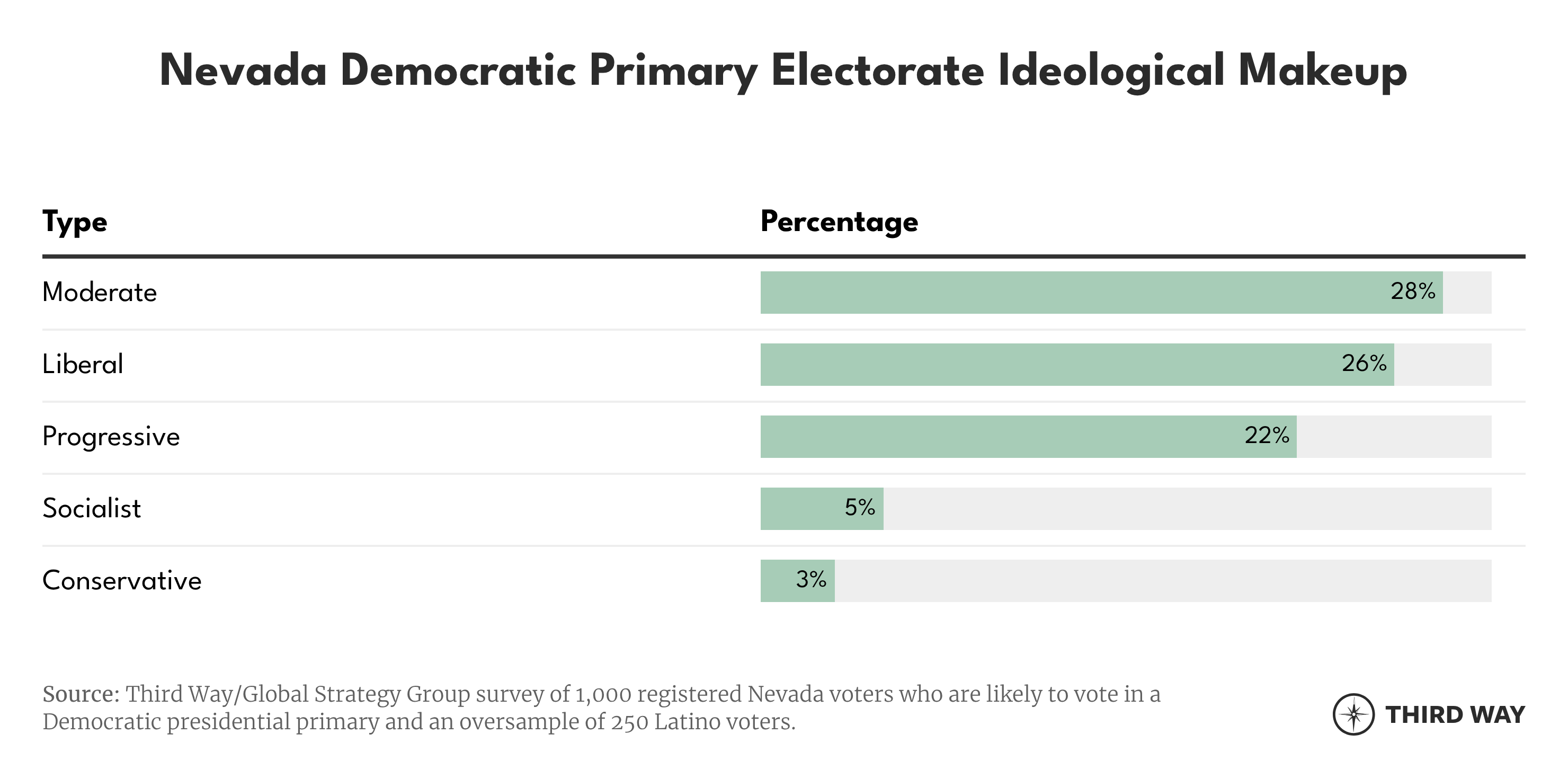
When it comes to ideology, the primary electorate is left of center but falls well within the mainstream. When asked to describe themselves ideologically, the two largest groups were moderates at 28% and liberals at 26%—and these two groups tracked together throughout the rest of the survey in terms of attitudes and policy preferences. Another 22% called themselves progressive, while only 5% labeled themselves socialist—just shy of the 3% of idiosyncratic Democratic primary voters who called themselves conservative. Similar to the pairing of moderates and liberals, the progressives and socialists tracked attitudinally throughout the poll, illustrating that there are at least two lanes in the Democratic primary. Contrary to common wisdom, however, the center left lane appears to be the larger one, with a combined 54% of the primary electorate tracking in that direction. The further left lane of self-described progressives plus socialists made up only 27% of the sample.
Why does it seem from the political conversation that these numbers should be inverted? One major driving factor is that the far-left cohort is significantly more online than their more mainstream brethren. Among all ideological groups, the 5% who describe themselves as socialists are the most likely to post online at least weekly. In fact, socialists post online so frequently that basically the same number of socialists post online daily (18%) as moderates who post online at least monthly (17%).
Similarly, socialists and progressives are much more likely to have attended a protest or political rally in the past year. A whopping 63% of socialists have done so, while progressives are split more evenly with 46% in that camp. Seven in 10 of both liberals and moderates haven’t attended a protest during Trump 2.0.
What Do Nevada Primary Voters Want in a Leader?
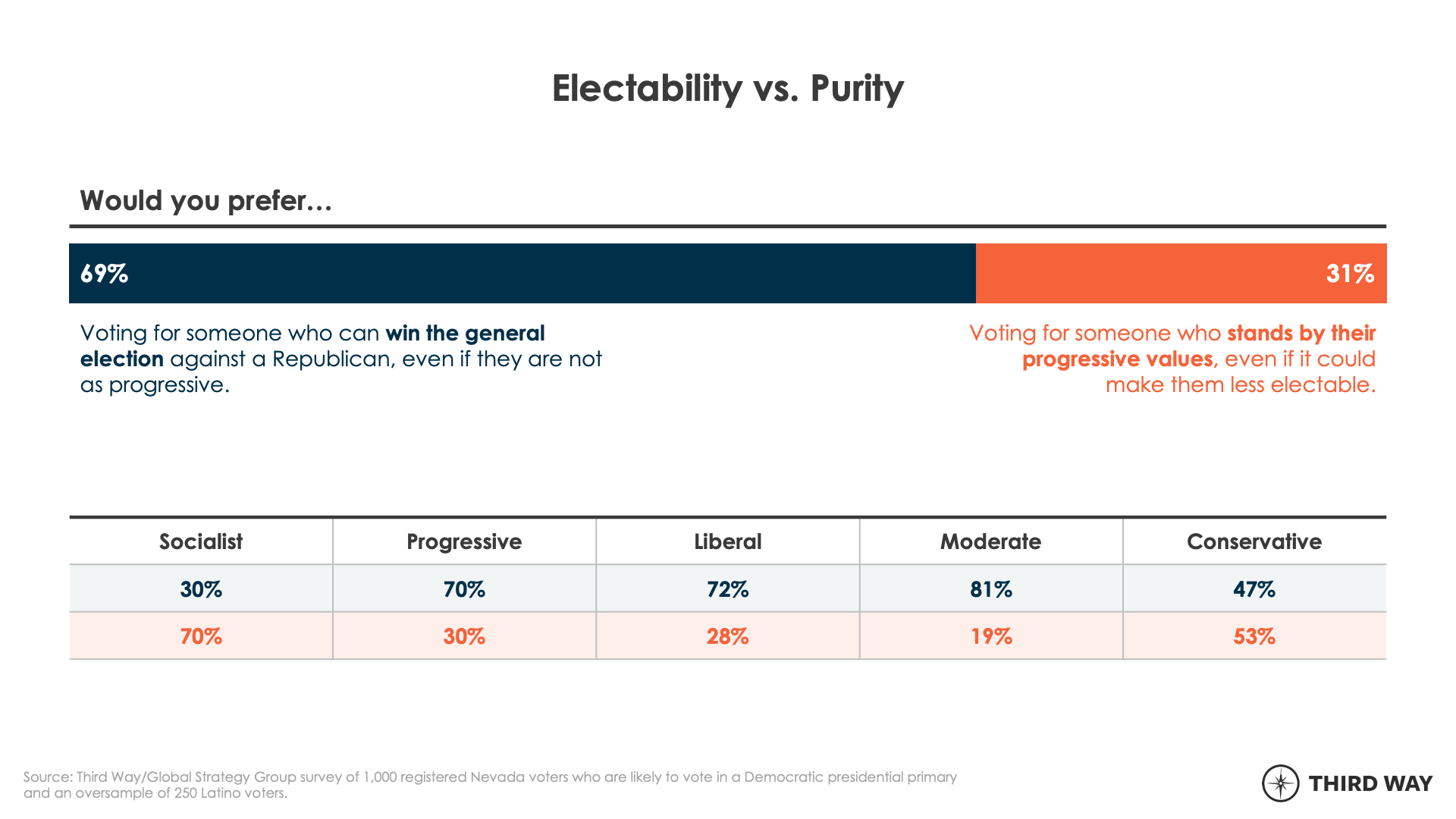
Nevada Democratic primary voters prioritize electability over ideological purity.
By a large margin, they say it’s more important to vote for someone who can win the general election (69%) than to vote for someone who stands by their progressive values (31%). Big majorities of moderates (81%), liberals (72%), and progressives (70%) prefer the former, though 70% of those loud online socialists prefer the latter choice.
They also vastly prefer someone who compromises to get things done (76%) over someone who sticks to their progressive beliefs (24%). Again, huge majorities of moderates (90%) and liberals (85%) prefer compromising. Progressives are more split (53% want to compromise). Socialists are the only group who pick standing by their progressive beliefs in this head-to-head at 54%.
Two-thirds of Nevada primary voters believe that nominating a candidate who is too far left risks losing the general election because they will turn off swing voters. And 85% say that “just because a candidate is moderate does not mean they are boring.”
Where Are Nevada Primary Voters on the Issues?
Despite what you might surmise from the dialogue on X or Bluesky, Democratic primary voters in Nevada are a mainstream bunch that tracks fairly close to the general electorate on key issues.
- On the economy, investing in apprenticeships and vocational training (86%) interests many more primary voters than a Universal Jobs Program (14%).
- When it comes to dealing with costs, 80% said they support expanding tax credits for working people compared to only 19% who support providing direct cash payments.
- On college costs, 65% say they prefer making college more affordable and ensuring students get a return on their investment compared to 35% who want to cancel all student loan debt and make college free.
- On policing, Neveda primary voters want to increase the number of police while holding them accountable over defunding the police by an 87% to 13% margin.
- And on immigration, these primary voters choose deporting convicted criminals while protecting law-abiding immigrants including with a path to citizenship over decriminalizing border crossing and abolishing ICE by a 75% to 25% margin.
Admittedly, on energy policy primary voters were more split: 50% want an all-of-the-above strategy focused on bringing costs down and 49% would prefer to pass the Green New Deal to address climate change. Moderates (63%) prefer all-of-the-above, and liberals are split evenly. Progressives (66%) and socialists (65%) prefer the Green New Deal on this match up. But across the board on the issues that are driving American politics today, it is clear that there are two lanes in the Democratic primary, and on net, the center-left lane is wider than the one on the far left.
Conclusion
To win a swing state like Nevada in 2028, a Democratic nominee must appeal to swing voters and moderates. Thankfully, this survey of Democratic primary voters shows there is a wide-open lane for a center-left candidate in the primary to make a pitch that can do just that. The question now is only who is going to eschew the siren song of the online bubble to make a play for the hearts of primary voters in Nevada and pave a path to general election victory.