Memo Published March 2, 2026 · 10 minute read
The Truth About Democratic Primary Voters
This February, Third Way worked with Global Strategy Group to conduct an online survey of 1,400 registered voters who said they are likely to vote in a Democratic Presidential primary. The purpose was to understand who the people are that will likely determine the next Democratic nominee for president, what they value, and what they want to see at the top of the ticket. This is the second such poll in a project that started in fall 2025, the first iteration of which can be found here.
Here's what we gleaned:
- Democratic primary voters live lives that are similar to the average American—and quite likely different than most political operatives and commentators (including the authors of this memo). They also aren’t regularly contributing to the political narrative on social media.
- They characterize themselves primarily as liberal and moderate, with only a tiny slice calling themselves socialist, and the latter have a very different profile than the rest of the primary electorate.
- They want their candidate to be a fighter for working people who is not afraid to stand up to Trump, and they care more about winning than ideological purity.
1. Who Are Democratic Primary Voters?
If you spend time on X or Bluesky, you might assume most folks who will choose the Democratic nominee for president in 2028 will be activist college students, self-described Democratic socialists, or far-left ideologues who will want candidates to embrace revolutionary ideas that "move the Overton window."
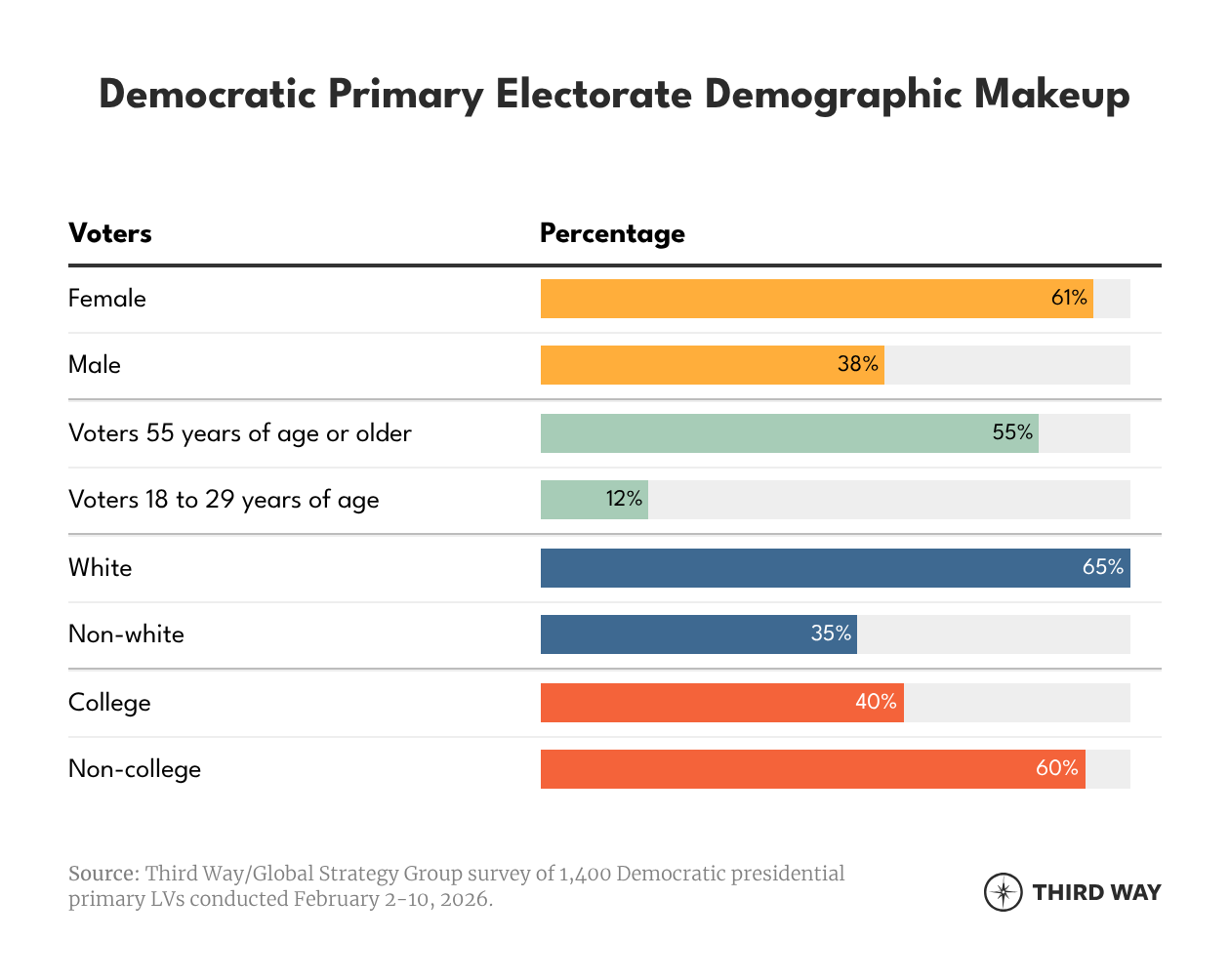
But the truth is that the typical Democratic primary voter is a white woman over the age of 55 without a college degree. These primary voters are:
- 61% female and 38% male;
- 65% white and 35% non-white;
- 60% non-college and 40% college educated; and
- 55% 55 years of age or older, with only 12% under 30.
Fifty-eight percent of primary voters call themselves Christian, with only 9% saying they are atheist. In fact, three times as many Democratic primary voters self-identify as born again or Evangelical than the number who identify as atheist.
Primary voters are also less online than one might expect. Only 13% of them say they post about politics online daily. Triple that amount said they never post about politics online. Clearly, the social media cacophony is being created by a tiny slice of the primary electorate, and the majority live in the real world.
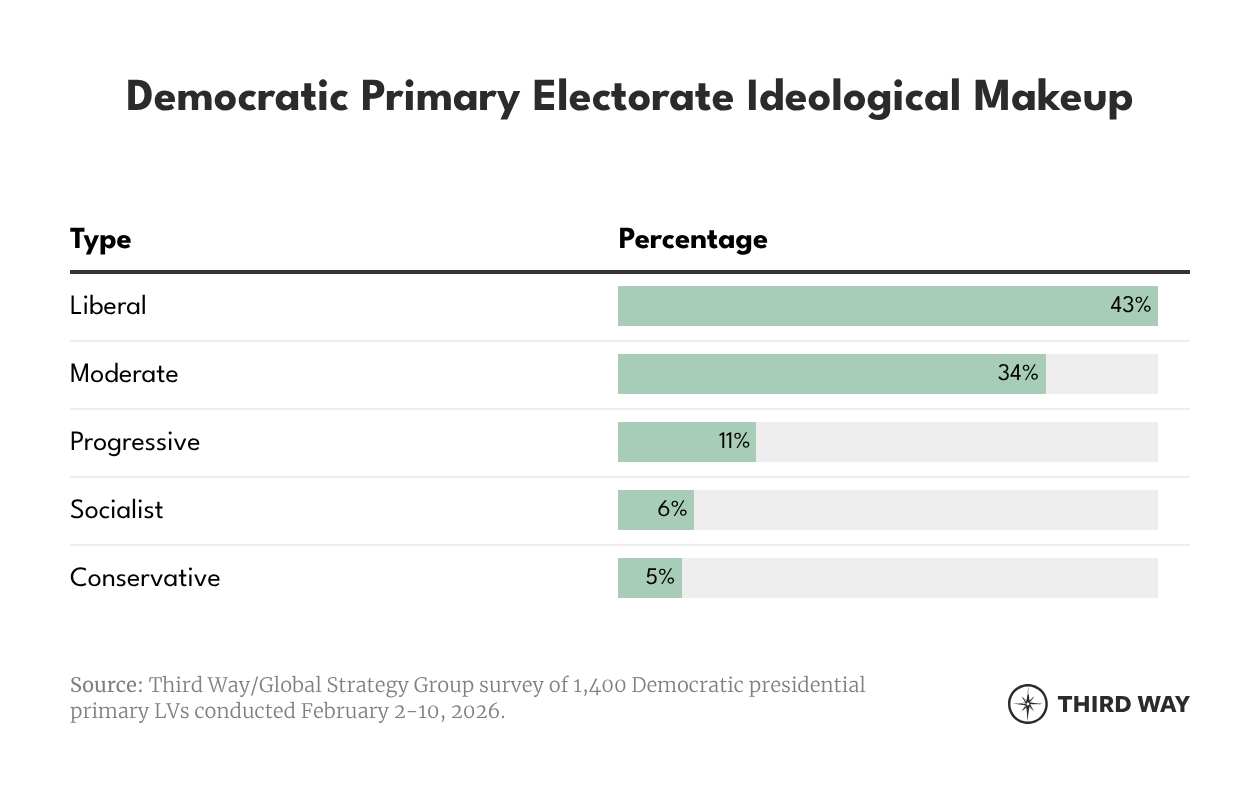
We asked these primary voters how they would label themselves ideologically. The most popular response was liberal at 43% followed close behind by moderate at 34%. Another 11% called themselves progressive, while a tiny sliver of 6% described themselves as socialist. Nearly as many labeled themselves conservative (5%)—a fact that will likely surprise many who live in a Twitter bubble. Throughout the survey, the 17% combined progressives and socialists often tracked together, while the 77% combined liberals and moderates were aligned.
2. What Are Primary Voters’ Lives Like?
Since most Democratic primary voters aren’t spending their days obsessively posting about politics on social media, we asked a series of questions about what they do in their day-to-day lives to gain a fuller picture of this group that will choose the party’s next presidential nominee.
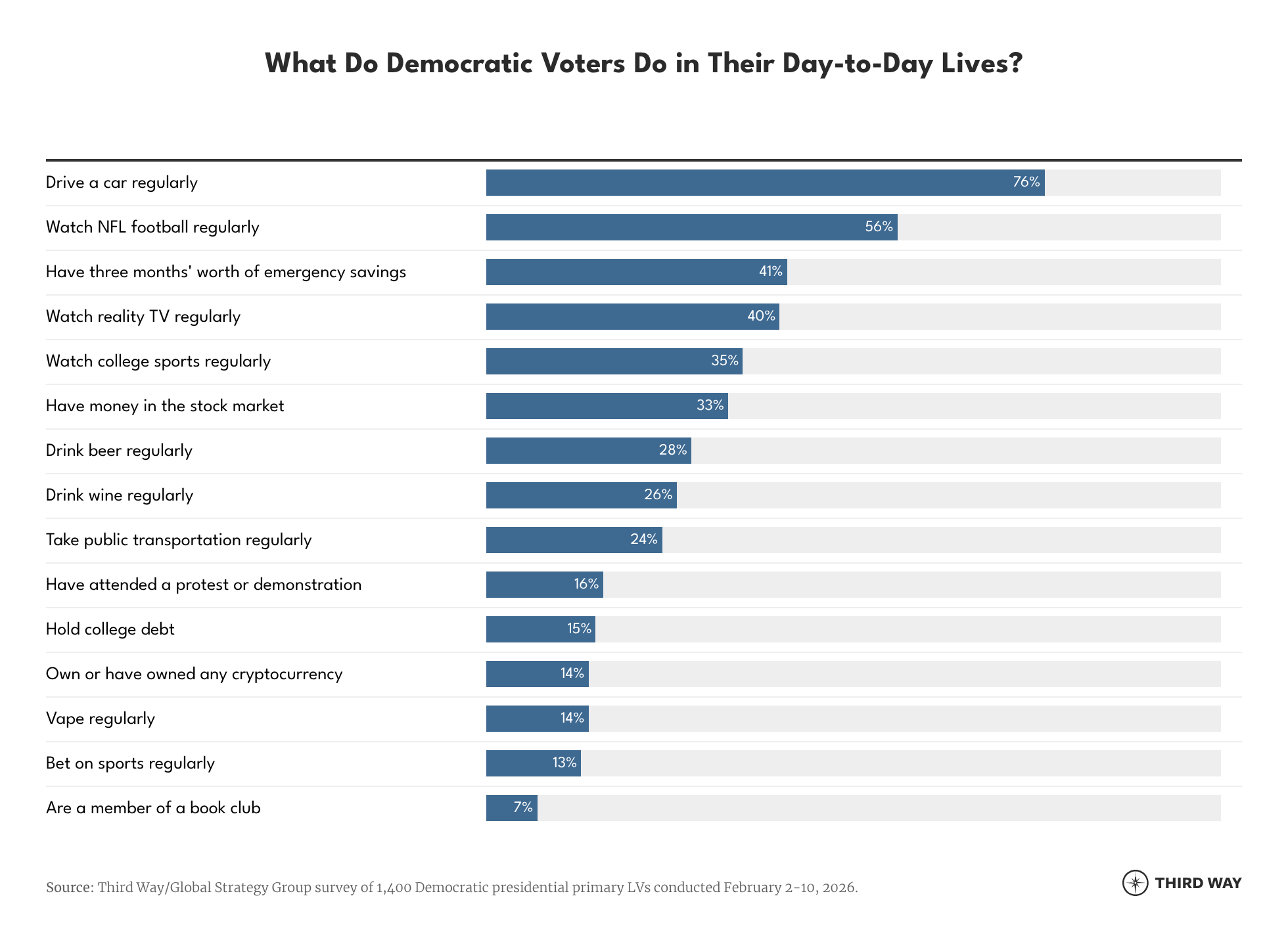
- 76% say they drive a car regularly, compared to 24% who take public transportation regularly (these were not forced choice questions; you could answer yes to all).
- 56% say they watch the NFL regularly, compared to 7% who are members of a book club.
- Only 41% have three months of emergency savings, and only 33% have money in the stock market.
- Only 15% hold college debt.
- Only 16% have attended a protest or demonstration in the past year.
As far as daily habits go, the socialists stand out compared to other groups (though admittedly, the sample size is small). Only 14% of Democrats own or have owned any cryptocurrency, but that number is more than ten percentage points higher at 26% for socialists. Likewise, 14% of Democrats vape regularly, but socialists are at 26% (and conservatives are at 24%). No other group is close.
Socialists are also not a sports-loving bunch. As mentioned above, 56% of Democrats watch the NFL and 35% watch college sports. Socialists are 30 percentage points lower than any other group on these measures, with only 17% of socialists saying they watch the NFL and 4% saying they watch college sports.
As referenced above, a surprisingly low number of respondents say they hold college debt. No group is above 20%, except for socialists who are at 48%. Similarly, socialists are an outlier on holding emergency savings. No group is below 38%, except for socialists at 10%.
Socialists were also a mixed bunch on how they get around, with 48% each saying they drive cars and take public transportation. And as much of an outlier as this small group was in lifestyle, the same was true when it came to political preferences and approach.
3. What Do Primary Voters Want in a Leader?
As countless Democrats prepare to throw their hats in the ring and explore presidential runs, we wanted to understand what kind of leader would appeal to these primary voters in this moment. The answers might surprise those who typically do this kind of pulse check on social media.
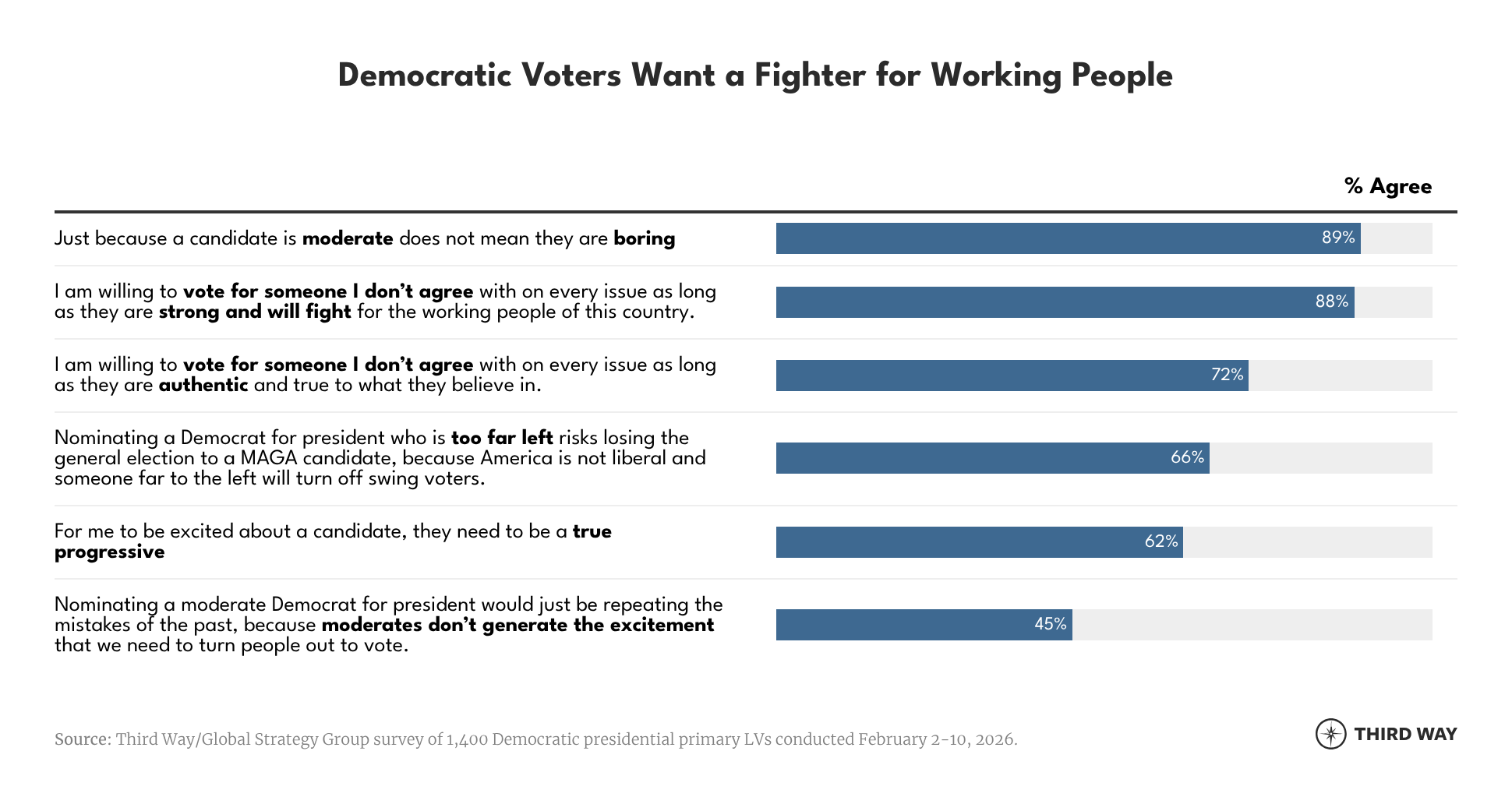
When asked about a series of statements on candidate attributes, primary voters responded overwhelmingly that they want a candidate who fights for working people, and they value authenticity over ideology.
- 89% said that moderate candidates were not inherently boring.
- 88% would vote for someone they don’t agree with on every issue as long as they fight for working people.
- 72% said they would support someone they don’t agree with on everything as long as they are seen as authentic and true to what they believe.
- 66% are worried that nominating someone who is too far left risks losing the general election because they could turn off swing voters, while only 45% said they worried that nominating a moderate wouldn’t generate the excitement that we need to turn people out to vote.
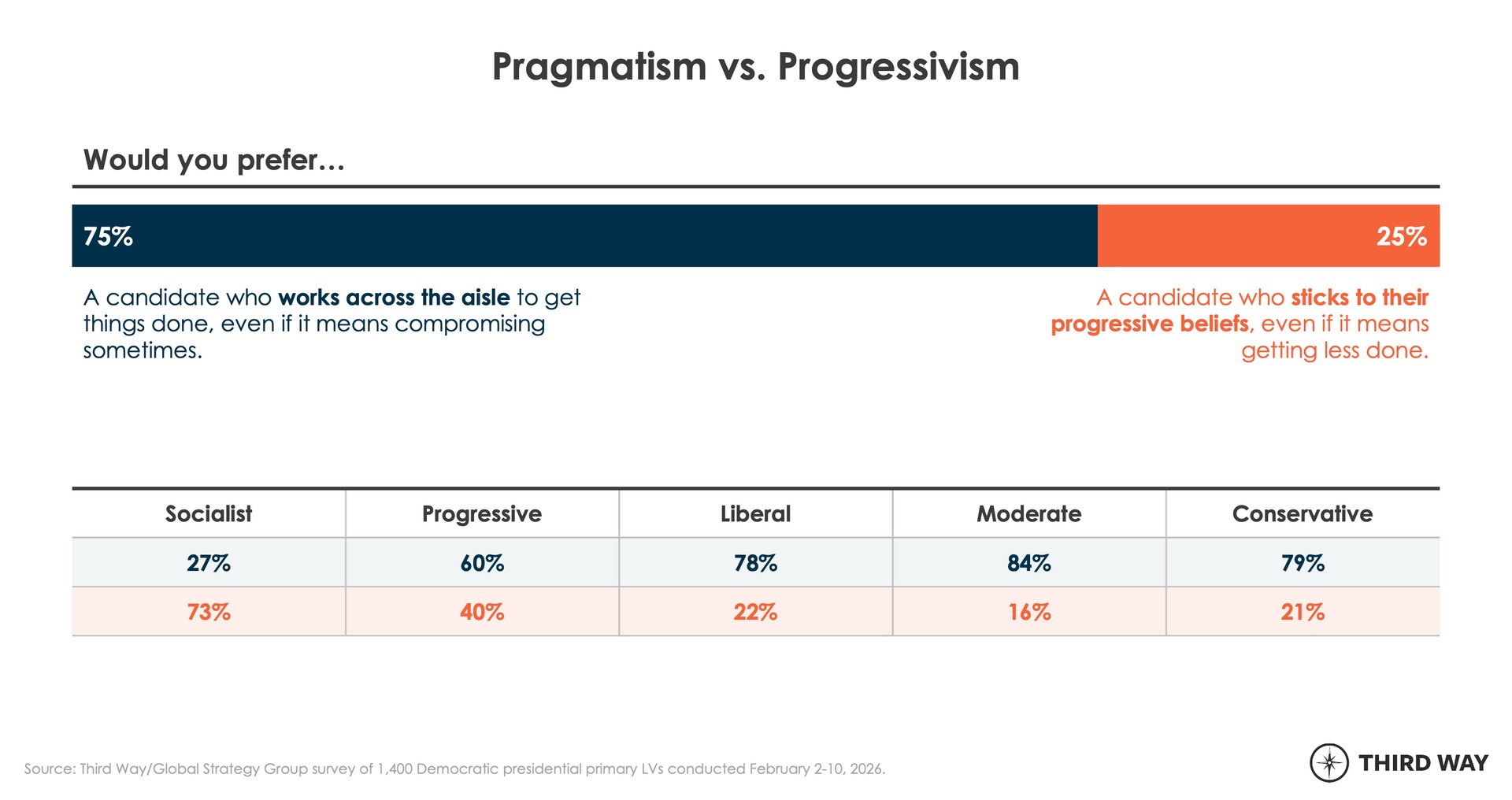
Overwhelmingly, primary voters in our poll preferred a candidate who works across the aisle to get things done over a candidate who sticks to their progressive beliefs, even if it means getting less done: the former won 75% to 25%. Working across the aisle was more popular with all ideological groups except socialists, who preferred sticking to their beliefs 73% to 27%.
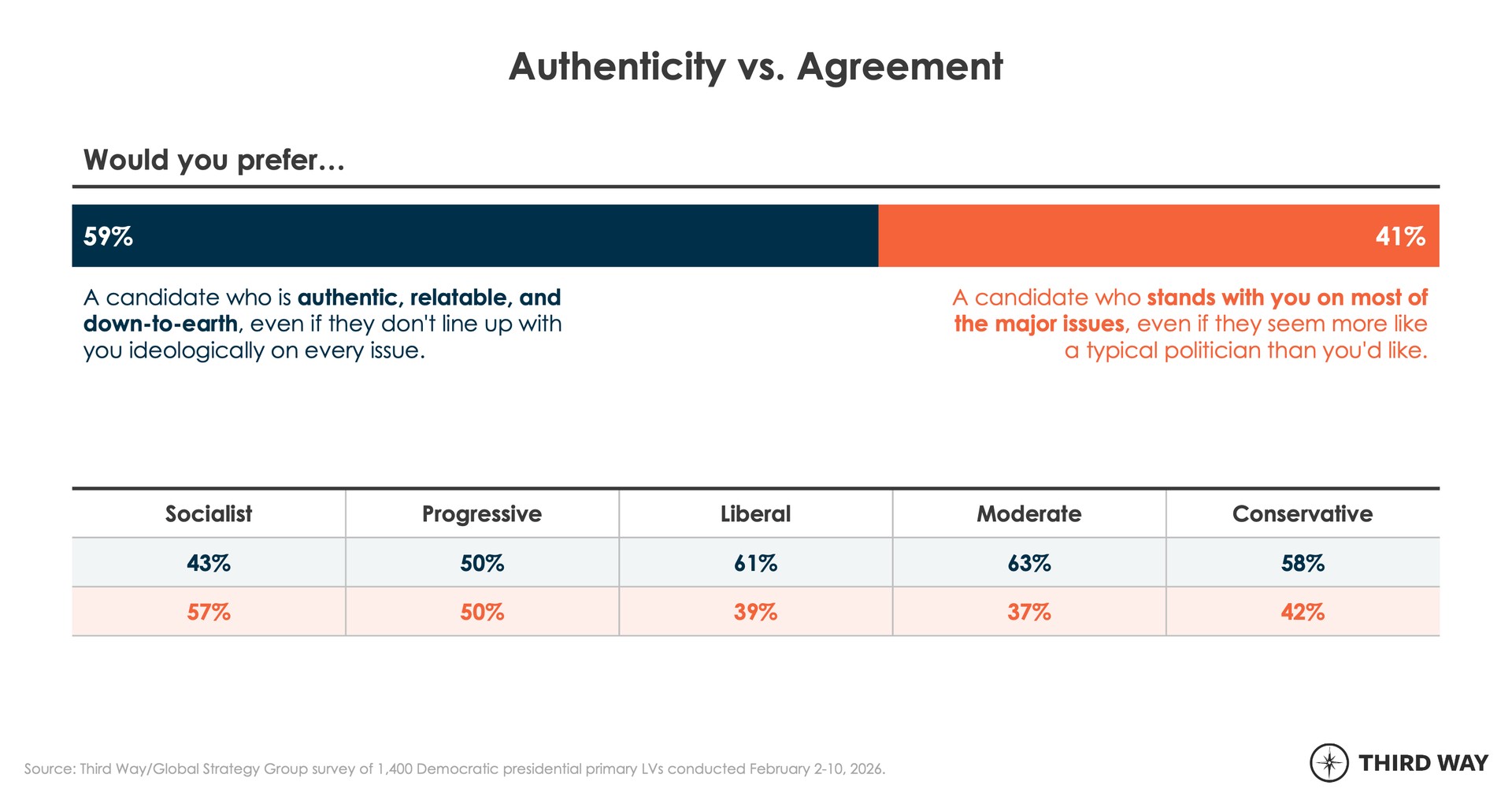
Similarly, when asked to pick between a candidate who is authentic, relatable, and down-to-earth, even if they don’t line up with you ideologically on every issue, or a candidate who stands with you on most of the major issues, even if they seem more like a typical politician than you’d like, the former wins 59% to 41%. Over 60% of liberals and moderates pick the former, progressives are split 50% apiece, and socialists pick the latter by a 57% to 43% margin.
We also asked a forced choice question designed to test two theories of the case for how to be a fighter:
- 53% preferred a candidate will fight every day for the working people of this country, delivering a safer, stronger, and more affordable future.
- 47% picked a candidate who believes that billionaires and corporate interests have too much power in this country and will fight the oligarchy and go after corporations that have rigged the system.
Moderates and conservatives each pick the "fighter for" message with 61%, and liberals back it with 57%. Progressives choose the "fighter against" with 69%, while socialists pick it with 90%. Clearly, there’s an appetite in the Democratic primary electorate for an angry, anti-oligarchy message, but it turns out the lane for a fighter for working people is at least as big, and it wins by double digits with the ideological groups who make up the biggest chunks of this cohort.
Finally, in this existential moment, these voters just want to win. Electability reigns, with 62% preferring someone who can win the general election against a Republican and only 38% saying they’d want someone who stands by their progressive values, even if it would make them less electable. Liberals and moderates overwhelmingly choose the former. Progressives are split evenly, and socialists say by 63% to 37% they prefer the latter.
4. What Do Primary Voters Want on Policy?
In the fall poll in this series, we tested center-left and left-wing policy ideas in forced choice exercises, finding that the center-left ideas tied the far-left ones on some issues and massively outperformed them on the rest. This time we tested various proactive policies separately to see if primary voters would find them appealing if offered the chance to choose them all.
What we found is that there is near unanimous support uniting the entire primary coalition for a range of center-left ideas:
- 96% support for building on the Affordable Care Act;
- 95% support for investing in a range of energy sources to bring down bills;
- 95% support for providing more low-cost vocational training and apprenticeship opportunities; and,
- 93% support for overhauling ICE to focus only on dangerous criminals.
There was also support among Democratic primary voters for a series of ideas that are further to the left, though none of those ideas were as popular as their center-left comparisons.
- 83% of these primary voters said they would vote for a candidate who supported Medicare for All (13 points lower than building on the ACA);
- 74% said the same about the Green New Deal (21 points below the energy option above);
- 72% would vote for a candidate who wants to cancel all student debt and make college free (eroding 23 points from apprenticeships); and,
- 59% would consider supporting someone who said Abolish ICE (34 points below overhauling the agency).
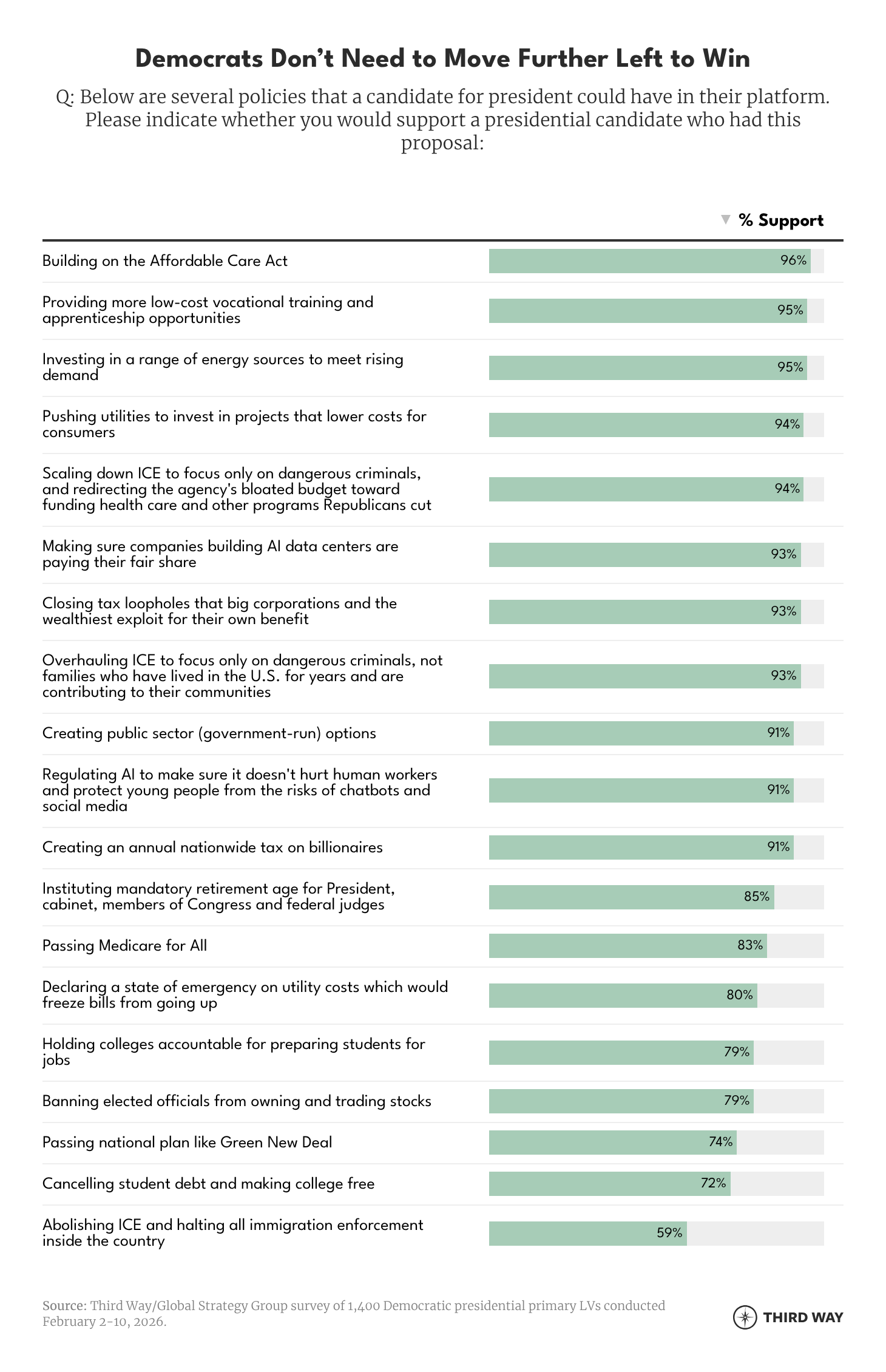
The lesson here should be that Democratic candidates need not embrace a litany of far-left ideas to woo primary voters. No doubt, there will be a far-left lane that some candidates occupy, and a decent proportion of voters in the primary may find those takes appealing. But there’s an even broader appetite for ideas that unite the coalition—and enable a candidate to win in a general election.
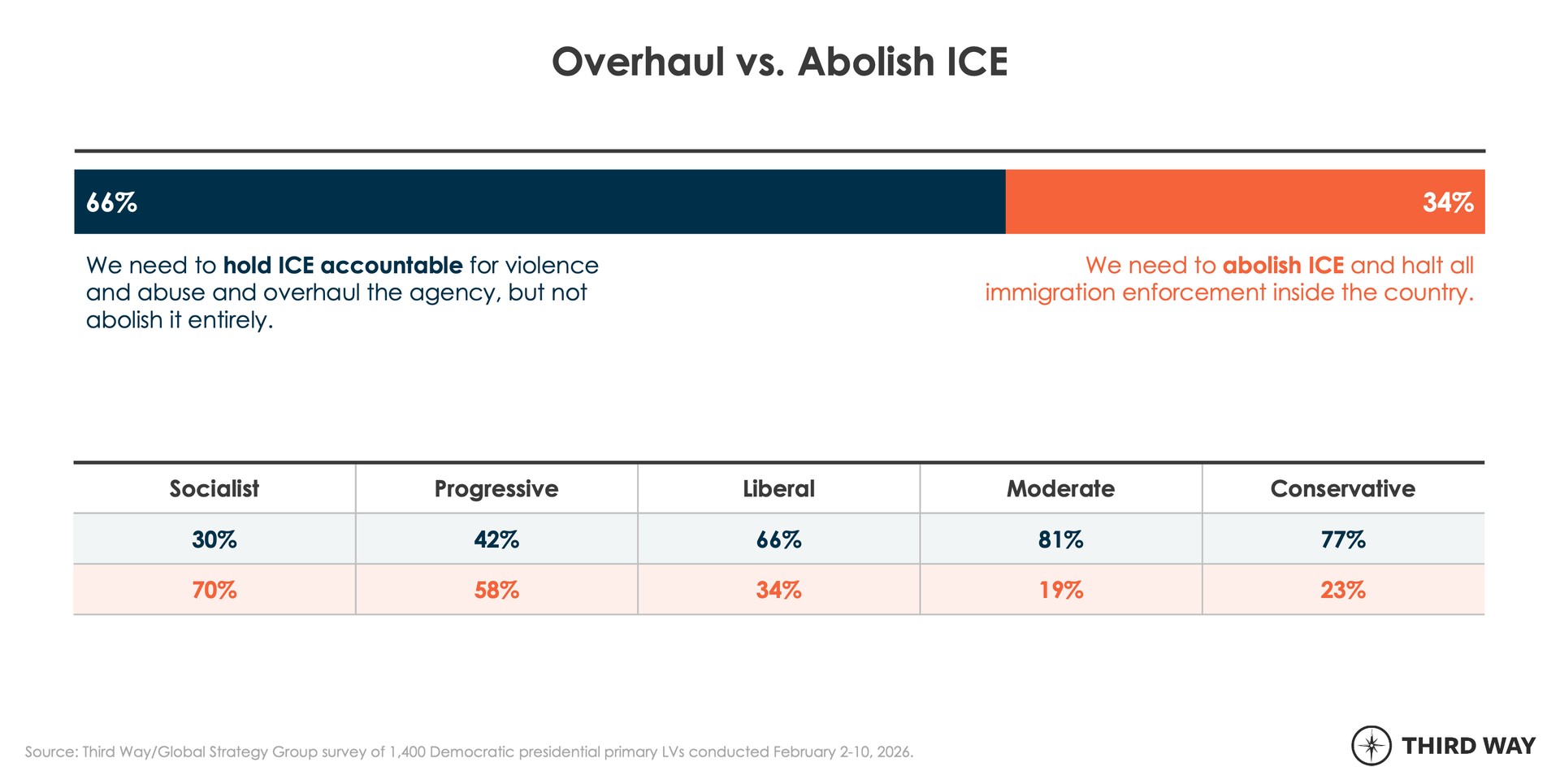
This preference is evident when we asked primary voters to choose between two options, rather than saying yes to everything. Overhauling ICE wins over abolishing the agency by a 2-1 margin: 66% to 34%. Liberals, moderates, and conservatives all prefer the former, while progressives and socialists prefer the latter with socialists at 70% support for the second option.
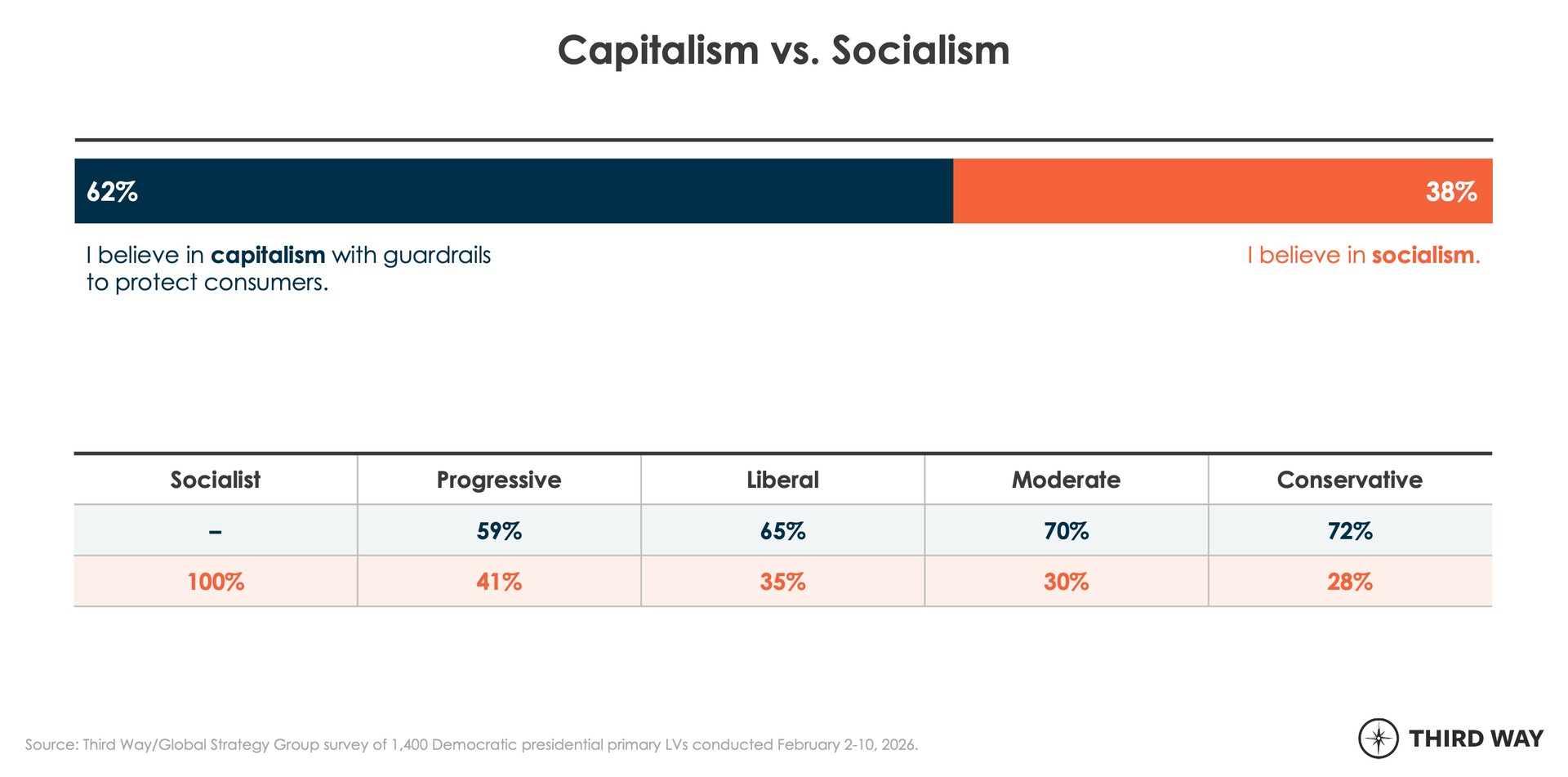
And capitalism with guardrails beats socialism 62% to 38%, with majority support from all ideological groups except (unsurprisingly) socialists, 100% of whom preferred socialism.
One place where primary voters took a different approach was on redistricting. A whopping 62% want Democrats to "fight fire with fire" against Republican mid-decade gerrymandering by partaking in it themselves in blue states, compared to 38% who say we should stick to democratic norms on fair districts. Every ideological group was united on this approach, except conservative Democrats.
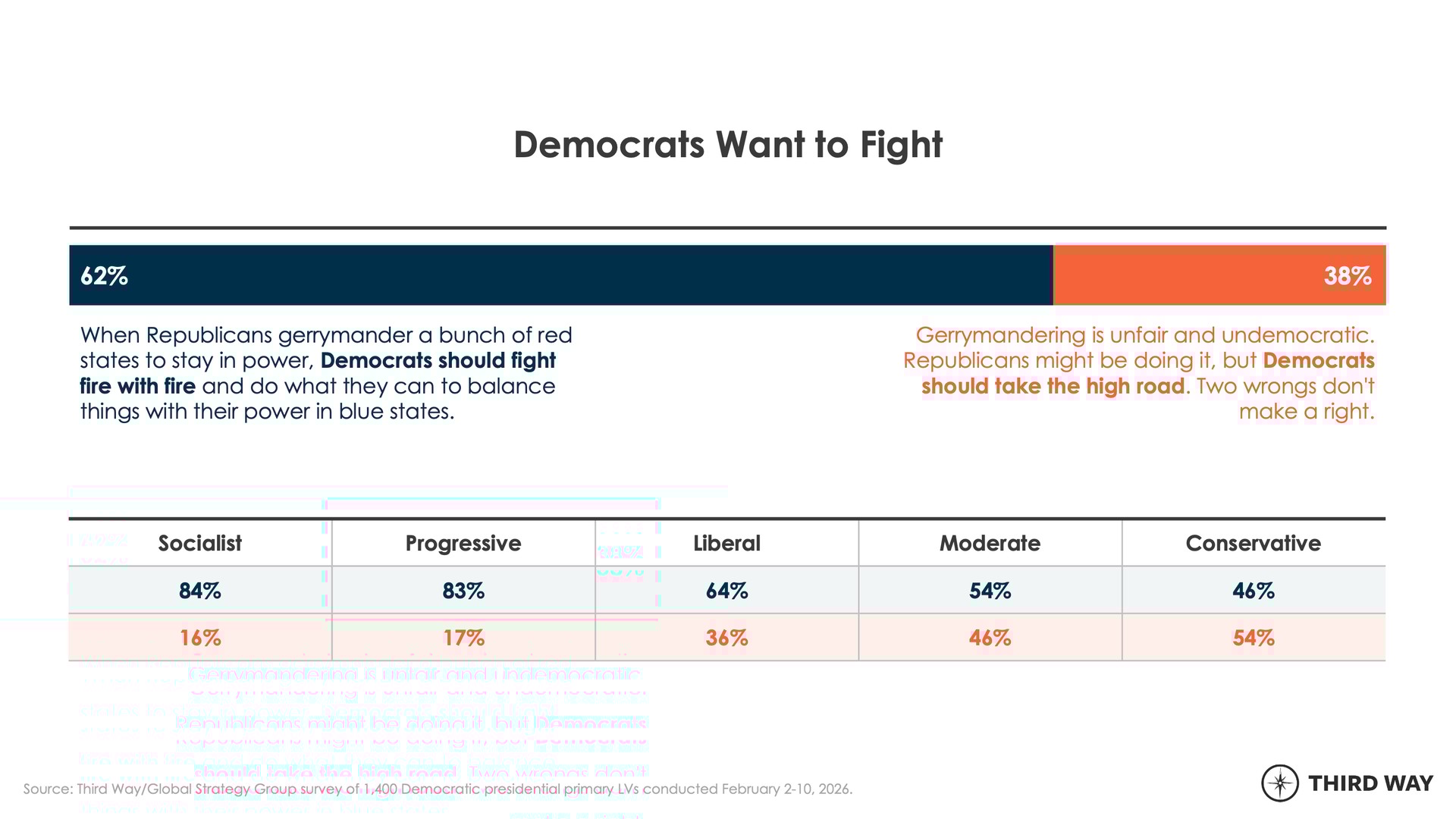
Compared to public polling from before 2025, this is a huge shift in public opinion among Democrats and underscores that fighting must be a key attribute of any Democratic approach moving forward.
Conclusion
The key takeaway from this research is that Democratic primary voters want an authentic and down-to-earth leader who is more focused on results than a checklist of progressive ideological policies. They want someone who will fight against Trump and for working people, and most importantly, they want to win. As the narrative around 2028 continues to take shape, we will continue to conduct research with this group to remind commentators and candidates alike that Twitter is not real life, primary voters are pragmatic, and they don’t want their nominee to go so far left in a primary that they can’t win against MAGA in the general.