Blog Published March 17, 2026 · 7 minute read
Why Are Electricity Bills High in Pennsylvania?
Francesca Hsie, Maya Gibbs, Dr. Florian A. Schneider, & Carson Ohlen

Pennsylvania is one of the nation’s top energy producers. It’s a major exporter of electricity, a leader in nuclear energy, and home to substantial natural gas reserves. But even with this wealth of energy resources, Pennsylvanians’ electricity bills are rising, and a growing number of households are unable to keep up with high costs. There’s no indication that prices are going down any time soon.
Before recent price increases, Pennsylvanians were already struggling to make ends meet:
- 24% of Pennsylvanians report being unable to pay an energy bill at least once in the past year.
- 30% report cutting back on food or medicine to pay their energy bills.
But in Pennsylvania, as in the rest of the country, ideological narratives dominate the conversation on energy and rising prices, making it harder to understand which policies will actually keep costs down for working people.
The fact of the matter is that forcing old coal plants to stay open, stalling the buildout of renewable energy, and over-indexing on natural gas is bad policy for working families. To protect Pennsylvanians from rising energy costs, the state needs pragmatic policy solutions. That starts with getting a clearer picture of what Pennsylvanians are actually paying and why.
Price Snapshot: What Are Pennsylvanians Paying for Electricity?
Statewide, Pennsylvanians are paying about $164 for their monthly electricity bill on average as of December 2025, almost 10% higher than the national median of $150. But that relatively small difference between Pennsylvania and the US writ large obscures large rate fluctuations in some parts of the state.
Last June, Citizens Electric customers in Union County and Wellsboro Electric customers in Tioga County saw rate increases of 31% and 40%, respectively. In January 2026, customers were hit with an additional 6.8% increase in Union County and a further 18% for Wellsboro Electric customers in Tioga County. That kind of price fluctuation isn’t sustainable, even if bills are comparatively low to begin with.
In Union County, that huge rate hike brought bills in this rural community closer to the national median, around $150. But in Tioga County, June 2025 rate hikes sent bills soaring far beyond what typical Pennsylvanians pay, with the median monthly bill coming in around $187/month.
Power Sources: What Keeps the Lights On in Pennsylvania?
Pennsylvania is the third largest producer of electricity in the nation, generating over 240,000,000 MWh annually—enough to power 1 in 6 homes in the country. Pennsylvania exports about a quarter of the energy it produces–mostly natural gas (59%) and nuclear power (32%)–to other states, serving as an important part of the country’s largest regional grid and competitive wholesale power market, PJM Interconnection (PJM).
Through PJM, 13 mid-Atlantic states and the District of Columbia share power resources and regional grid investments. But being part of this wholesale market also means Pennsylvania’s power prices are influenced by policies and investment choices made throughout the region, not just in Harrisburg. And the retail costs Pennsylvanians pay for power supply are set by PJM wholesale prices, not in-state decision-makers.
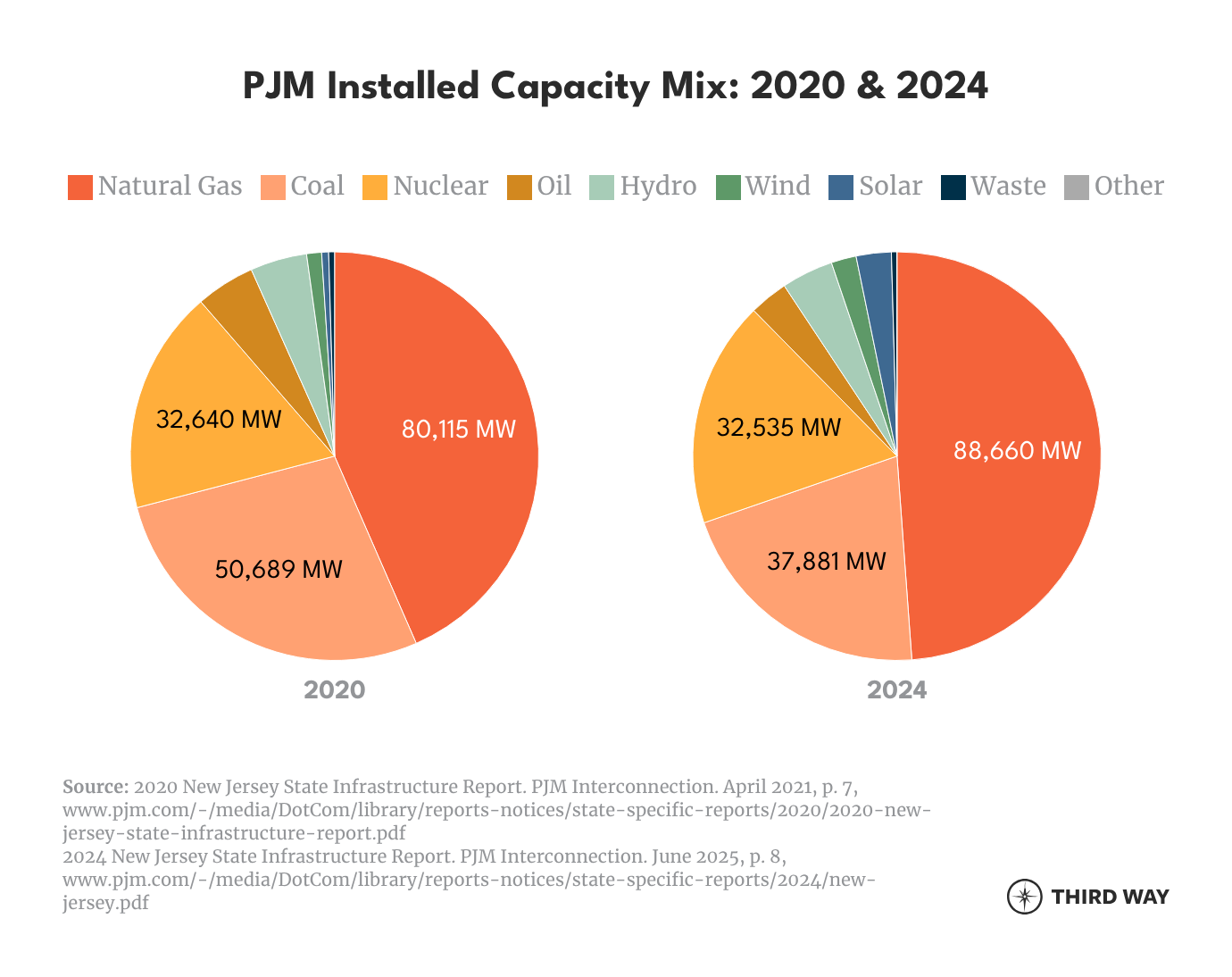
While Pennsylvania has displaced most of its historic coal generation with natural gas, coal is still the second largest share of installed generation capacity in the PJM region. And while the rest of the country has added diverse supply to the grid, most of PJM’s new generation between 2013 and 2023 came from fossil generation. 66% of new generation additions in PJM were fossil-fueled.
Compare PJM’s reliance on fossil fuels with other states’ additional generation: 0% of new generation in CAISO (California) came from fossil fuels during the same time period, 0% in SPP, and just 0.5% in MISO (Central US). 10% came from fossils in ERCOT (Texas), 29% in SERC (Southeast US), 29% in NYISO (New York), and 40% in ISO-NE (New England).
PJM lags behind other wholesale markets, with natural gas, coal, and nuclear making up the majority of power sources. Solar and wind have increased steadily, but still make up less than 5% of the PJM electricity mix. Pennsylvanians foot the bill for PJM’s outdated and unstrategic overreliance on fossil fuels.
What’s Really Driving Up Prices?
PJM Capacity Market – PJM operates a forward capacity market that pays generators to commit to being available in the future to meet peak demand projections. When new supply additions can’t keep up with increasing demand, customers see it in power supply rates listed on their bills, and they feel it in their wallets. Even with the savings and efficiencies that come with a regional, wholesale electricity market, PJM’s most recent capacity auction for the 2025–2026 delivery year resulted in dramatically higher prices. That spike comes from rapid load growth projections–largely data centers, electrification of buildings, and manufacturing–and the slow addition of new generation sources. Average hourly peak demand is forecasted to grow by more than 20GW by 2030 and another 30 GW by 2035. While PJM saw about 40GW of new generation come online between 2013 and 2023, that new supply almost entirely served to replace retiring power plants. The costs of this higher capacity is getting passed onto Pennsylvania customers.
Slow Interconnection Process – PJM’s challenge with rising demand is a bottleneck in connecting new power generation projects to the grid. Developers want to more than double PJM’s estimated 180 GW of existing installed capacity, but these projects are stuck in PJM’s interconnection backlog. Years of delays and a cumbersome interconnection process have slowed the pace at which new resources can actually come online to a crawl. That constraint tightens supply and puts upward pressure on capacity prices. There’s a willingness to build, but if projects cannot connect fast enough, consumer prices will continue to rise.
The Role of Natural Gas in Setting Prices – Pennsylvania is home to the Marcellus Shale formation and is a major domestic producer of natural gas. But the price of gas is highly volatile and subject to forces outside the State’s control. Natural gas generation sets wholesale power prices, so when natural gas prices rise, wholesale electricity prices follow suit. Over the last few years, compounding events have led to significant price shocks–Russia’s invasion of Ukraine, increasing European and global demand for liquified natural gas, post-COVID demand increase, gas infrastructure limitations, and extreme weather events. These spikes in natural gas prices have led to high wholesale electricity prices that have been passed on to retail customers.
Can Clean Energy Help Reduce Costs?
Despite recent federal policies aimed at curbing its growth, clean energy deployment is central to affordability and reliability in Pennsylvania. Expanding and accelerating renewable generation adds much-needed capacity to the grid, protecting Pennsylvanian households and businesses from the dramatic price swings associated with natural gas.
By increasing the share of clean energy on the grid, Pennsylvania can ultimately reduce the dominant influence of fossil fuels on wholesale electricity prices and keep them stable moving forward.
Adding clean energy to the grid would also help with supply constraints in PJM’s capacity markets and ease upward pressure on prices by increasing competition as new generation comes online. At the same time, investments in energy efficiency and grid flexibility can reduce overall peak demand. These are the short periods of time throughout the day with the highest levels of electricity use. By lowering or shifting demand during these periods, the combination of clean energy and efficiency upgrades can help keep electricity affordable by reducing the need to build additional infrastructure to keep the lights on when the grid is most constrained.
The Trump administration has slowed or reversed investments in low-cost clean energy and related infrastructure while simultaneously propping up aging and expensive fossil fuel plants well past their anticipated retirement. According to a recent Grid Strategies report, DOE’s decision to extend the lifetime of Eddystone Generating Station, located in Delaware County, will cost ratepayers an additional $70 million annually. Federal actions to delay or undermine clean energy projects have the potential to halt nearly 70 planned clean energy facilities throughout the commonwealth.
Analysis from Energy Innovation shows that President Trump's "One Big Beautiful Bill Act" would significantly increase the state's reliance on natural gas. This would drive wholesale electricity prices in Pennsylvania up by 18% by 2035 and increase annual household energy bills by $165.
These decisions constrain new clean energy supply, worsen capacity shortages, and push the state deeper into volatile fossil fuel markets. All these factors will make electricity more and more expensive for Pennsylvanians.