How Marriage Won in Washington State
Lanae Erickson, Sarah Trumble
Election night of 2012 brought a sea change for advocates of marriage for gay couples. Thirty-two past ballot initiative losses were relegated to history as voters sided with marriage in all four states with questions on the ballot. Together with researchers at Grove Insight, Third Way conducted a poll immediately after the election in Washington State, where voters had approved, 53.7% to 46.3%, a law passed by the state legislature allowing gay couples to marry.* When compared to the results of our 2009 post-election poll in the same state, these new results illustrate the rapid evolution that has taken place in just the last handful of years. The data also points to two major shifts in advocates’ messages that were instrumental in making this the first year marriage was victorious at the ballot:
- Focusing on commitment, rather than rights;
- Effectively responding to marriage opponents’ most potent attacks by using strong values language, including reinforcing that parents are responsible for teaching core values to their children.
Grove Insight conducted a poll for Third Way of 800 voters in Washington State November 8-12, 2012. The margin of error for the overall results is +/-3.5% and higher among subgroups.
Who Voted for Marriage?
Demographics of Marriage Supporters
The victory for marriage in Washington State was delivered by voters well outside the usual liberal base. Centrist voters supported the marriage referendum by large margins, with 66% of moderates voting yes, as well as 59% of Independents. And while voters in Seattle contributed a significant chunk of the yes vote in the state, support was also high in the suburbs and exurbs, where both the Portland media market and the Snohomish and Pierce county regions voted for marriage by 13 and 7-point margins, respectively.
Women statewide supported the marriage referendum by 15 points, while men tilted slightly against by a slim, 2-point margin. This gender gap persisted throughout other demographic groups as well. There was a 20-point gap between support among Democratic men and women (although both supported marriage by huge margins of +60 and +80, respectively) and a 26-point gap among men and women over 50 (-29 and -3, respectively). However, the gender distinction was much less pronounced among younger men and women, who both supported marriage by wide margins: 65% of men under 50 favored it, compared to 68% of women in the same age group. Younger voters solidly supported the marriage referendum in general, with 74% of 18-29 year-olds voting in favor as well as nearly two-thirds (63%) of voters in their thirties and forties. Those in their 50s and 60s broke slightly against the marriage referendum (53% no), while those who were 70 and older opposed it by a substantial margin.
As we consistently find, religiosity correlated to marriage opposition in Washington. While marriage lost among regular churchgoers (those who attend once a week or more), the referendum garnered 53% support among those who attend church once or twice a month. And it passed by an overwhelming margin among those who were less religious. Married voters favored marriage 51% to 49%, along with 60% of parents with children under the age of 18. Unlike past elections—including Proposition 8 in California, where Democrats had trouble consolidating their own base in favor of marriage—this time 80% of Obama voters pulled the lever for marriage, as well as 86% of Democrats. Even 79% of moderate and conservative Democrats voted in favor of marriage for gay couples, as well as 38% of liberal and moderate Republicans;
The biggest takeaway of the marriage vote in Washington is that the center is now squarely on the side of marriage advocates. The striking margins of support for the referendum among moderates (+33) and Independents (+21) are indisputable, and they mark both a significant shift and a tipping point for the country on this issue.
Groups Voting for Marriage | Groups Voting Against Marriage |
Women (+15) Voters under 50 (+33) Democrats (+72) & Independents (+21) Liberals (+78) & Moderates (+33) City (+21) & Suburban/Exurban Dwellers (+7) Moderate & Conservative Democrats (+58) Married Voters (+2) Parents with Kids under 18 (+21) Voters who Attend Church Monthly (+8) | Men (-2) Voters over 50 (-15) Republicans (-70) Conservatives (-75) Rural Voters (-1) Regular Churchgoers (-41) |
Change Since 2009
In just the three years since our last survey in Washington State (November 2009), there has been a 12-point swing in favor of marriage among voters in the state. Then, support for allowing gay couples to marry stood at 43%, while 49% of the state’s voters said they opposed it. Today, 53% say they favor marriage for gay couples, the same number who voted yes on the marriage referendum. This means that nearly 1 in 5 have changed their minds on the issue in the past 3 years. The number of Washingtonians who strongly favor marriage has also jumped significantly, from 31% in 2009 to 43% today. When asked directly whether their views on marriage for gay couples had changed over the last several years, 40% said their views had shifted, with 31% reporting they have become more supportive of marriage over that timeframe. Among that group, 9 out of 10 voted in favor of marriage this year, meaning they have not only grown more accepting but have now moved fully into the yes column on the issue.
This striking movement occurred even more rapidly among swing voters. Support for marriage among Independents grew 27 points since 2009, and the swing was an equally astounding 23 points among moderate and conservative Democrats. Liberal and moderate Republicans still oppose marriage overall, but they’ve gained 23 points in support as well, with nearly 4 in 10 now voicing support. Moderate voters moved 22 points over the past three years and now boast a solid two-thirds in favor of marriage. When asked about their own change of heart, these swing voters reported significant movement as well, with 4 in 10 Independents and the same number of moderates saying they had grown more supportive of marriage for gay couples in the last several years.
President Obama and Marriage
Some pundits had predicted that President Obama’s historic announcement of support for marriage would hurt him at the ballot box. Our data shows that if anything, there may have been a slightly positive effect—at least in the state of Washington.
When asked whether President Obama’s support for allowing gay and lesbian couples to marry made them more or less likely to vote for him, the plurality of voters (44%) said the issue made no difference in their presidential vote. Equal numbers (28% apiece) said it would make them less likely to vote to re-elect the President as said it would make them more likely to do so. The passion was tilted slightly in favor of marriage opponents, with 20% saying they were much less likely to vote for President Obama because of the issue, compared to 13% who said they were much more likely to give him their vote. But those who voiced strong opinions were base voters on both sides: conservatives, Republicans, weekly churchgoers, and Evangelicals, who were not likely to be in the President’s camp regardless of the marriage issue, versus liberals, Democrats, younger voters, and Seattle residents, who were likely already in the President’s camp.
Putting the bases aside, swing voters were actually more likely to say the President’s marriage support influenced their vote in a positive direction. Thirty percent of moderates said it made them more likely to cast their vote for him, with 14% saying it made them much more likely to vote for the President. By contrast, only 12% of moderates said they were less likely to vote for President Obama based on his marriage support, with only 6% saying they were much less likely to do so. It seems that with swing voters, the President’s marriage support helped more than it hurt.

When asked about the issue’s influence on their vote for state legislature, the trend was similar. Four in 10 said that a state legislator’s support for marriage made no difference in their vote, and a mirror-image 30% said it affected them in one direction or the other. Moderates again tilted in the pro-marriage direction, with numbers almost identical to those for the President: 30% of moderates said they were more likely to vote for a state legislator who supported marriage (11% much more), compared to 14% who said it made them less likely to vote for that legislator (6% much less likely).
Why Did They Vote for Marriage?
Commitment, not Rights
One major reason for the massive shift since 2009, and the historic wins in Washington and the three other states with marriage votes on the ballot in 2012, was an intentional shift in the way marriage advocates framed the issue and the language they used to describe it. In the past, marriage advocates had focused almost exclusively on making a rights-based argument—saying that gay and lesbian couples have a right to marry and receive the government benefits and protections marriage brings. Over the past three years, the conversation has shifted to focus on lifetime commitment instead of rights—a shift we strongly recommended based on our previous research—and our data reveals that this shift was a major factor in the 2012 successes at the ballot.
Our past research had shown that Americans in the middle see marriage as primarily about making a lifetime commitment to love and care for another person through better or worse and pledging your fidelity to them in front of family and friends. But we found that many of those folks in the middle didn’t believe that this intention was shared by gay couples who desire to marry—rather, they said gay couples wanted rights and benefits like hospital visitation, tax advantages, and sharing a spouse’s pension. Rights-based messages reinforced that disconnect and made it harder to persuade those who were on the fence on marriage, because believing gay couples want to marry for the same reasons as any other couple was directly linked to supporting their ability to do so. In our June 2011 national survey, 60% of those who said gay couples marry for commitment favored marriage for those couples, and most did so strongly, while 60% of those who said gay couples marry for rights and benefits opposed it, most in the strong category.
Marriage advocates in Washington knew that they needed to convince voters that gay couples want to marry to make a lifetime commitment, and they focused their message on that task, in line with our previous advice. An early public education ad illustrated this message, saying:
I know a number of gay and lesbian couples that have been together for forty years. I saw in these couples love, commitment, a sharing of a life together—everything that makes for a good marriage. Everybody wants to say, ‘This is the person that I love,’ and stand up and have a ceremony with their family and friends.1
This message broke through and contributed to the historic win. By an 8-point margin, voters in Washington now believe gay couples marry for commitment, rather than rights. Compared to our national poll just last summer, the number of people who said gay couples marry for commitment in the post-election survey in Washington State was 5 points higher—the exact margin of victory on the ballot referendum. And, of those who said gay couples marry for commitment, 85% voted yes to support allowing them to do so. Of those who still said gay couples marry for rights, three-fourths opposed marriage at the ballot.*
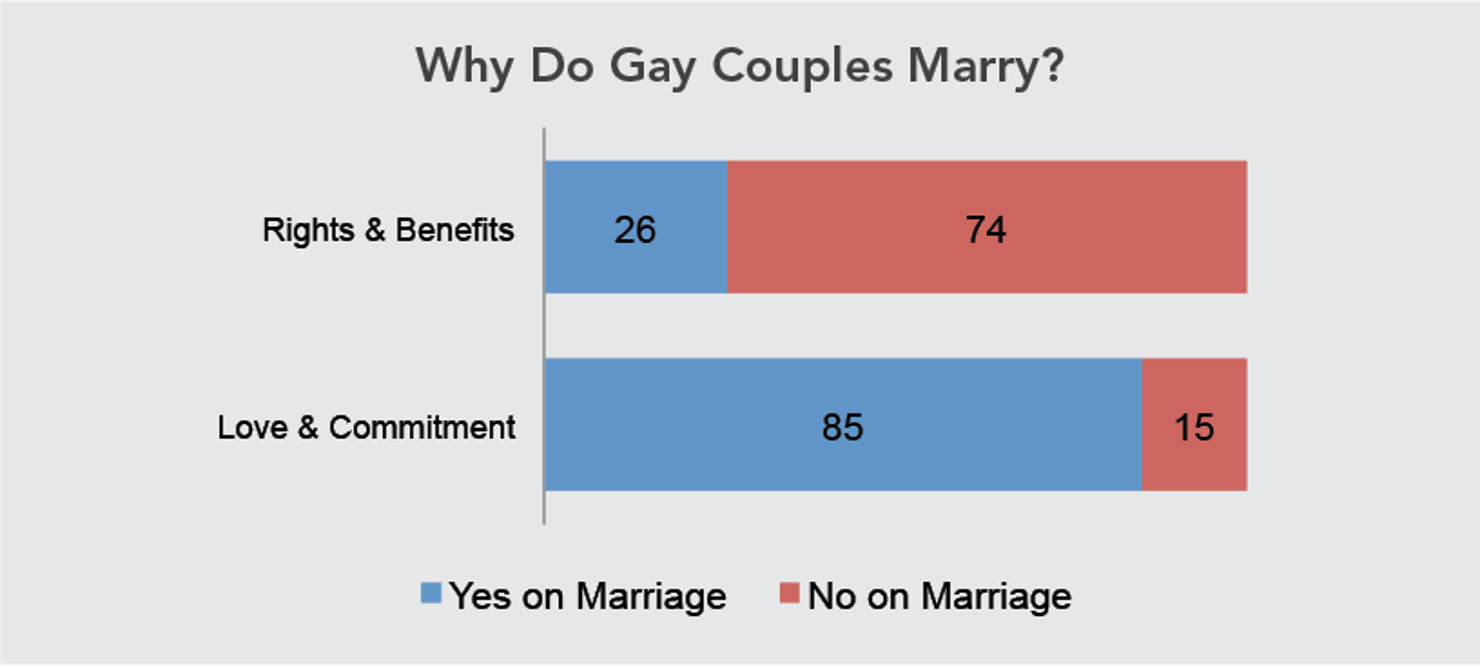
A similar split was evident on the related question of whether gay couples were trying to join or change the institution of marriage. Half of Washingtonians chose join, compared to 38% who picked change, and 92% of the former group voted yes on marriage, while 93% of those who chose change voted no.
When asked directly what the best reason was to vote in favor of marriage, Washingtonians chose commitment. Given five options, they picked this statement: “Gay couples want to marry for similar reasons as anyone—to make a public promise of love, responsibility, and lifetime commitment.” It was the most popular first choice as well as ranking the highest overall when folks were given a second choice: 36% said it was one of the two most important reasons for voting yes on marriage, and it tested 9 points above any other reason. Among moderates, the numbers were even higher, with 43% saying commitment was one of the top two reasons to allow gay couples to marry. Strikingly, only 5% of Washingtonians chose “marriage is a human right that should not be denied to gay people” as their first choice, placing rights 17 points below commitment, and only 16% thought the rights argument was either the first or second best—20 points lower than the commitment statement.
We also asked what influenced their vote on marriage in another way, by offering Washingtonians a series of statements without making them choose between them. Even without us forcing them to prioritize one reason over all the others, they overwhelmingly chose statements that conveyed deep values and reflected the commitment framework. Forty-eight percent said this statement was very important to their vote: “Gay and lesbian couples want to marry for similar reasons as anyone—to make a lifetime promise of love, commitment, and responsibility to each other.” That included 61% of moderates and 85% of those who voted yes on marriage.
Other values-based messages were persuasive as well. The following three statements, all of which track the messages used by marriage advocates in Washington, drove support for marriage in the poll, according to statistical analysis of the data:
- “If a couple is willing to stand up in front of family and friends and make a lifetime promise of fidelity to each other, it’s not for us to judge, or to deny them that opportunity.” Forty-eight percent said this was very important to their vote, including 59% of moderates and 85% of those who voted yes.
- “Allowing gay couples to marry follows the core principle of the Golden Rule—treating others as we would want to be treated ourselves.” Forty-eight percent said this was very important, including 58% of moderates and 83% of yes voters.
- “The freedom to marry is a basic freedom that should not be denied to anyone.” Forty-nine percent said this was a very important reason, including 59% of moderates and 83% of those who voted yes.
Compared to the opposition messages, these pro-marriage arguments laced with values and commitment garnered significantly more support. The highest-testing message for marriage opponents in the poll was “Marriage has always been between a man and a woman, and we need to protect traditional marriage.” Only 45% said that was a very important reason for their vote, and among moderates agreement with the opposition messages never rose higher than the 30s. One of marriage opponents’ arguments that had previously tested well against the pro-marriage rights framework was rendered significantly less effective now that marriage advocates have moved toward talking about commitment: only 35% said “Gay couples in Washington already have all the rights and benefits of marriage” was a very important reason for their vote. If marriage is about commitment, not rights, that argument is significantly less potent.
Similarly, messages focusing on rights or the fine print were not the strongest affirmative arguments, nor were they particularly persuasive rebuttal messages. Only 23% said that the fact that the referendum preserved domestic partnerships for seniors was a very important factor influencing their vote. And when pitted against an opposition attack, responses about values and commitment prevailed, while rights-based messages withered. When asked which statement comes closer to their view, “Marriage for gay couples is unnecessary because they already have equal rights in our state under domestic partnership laws” garnered 46% to 40% when paired against “Domestic partners have been denied access to their loved ones in the hospital. Only marriage provides the protections families need in a crisis.” However, when the same first statement was paired with a commitment response, the numbers flipped. Forty-six percent chose “In addition to offering important protections, marriage is a unique promise of commitment and fidelity, and no other relationship can substitute for it,” and only 39% picked the opposition argument that domestic partnerships are sufficient. In particular, the commitment message helped to solidify important groups of voters, gaining bumps of 21 points with Independent women, 17 points with weekly churchgoers, 11 points with those in their 40s and 50s, and the same number with rural voters.
Responses on Kids
Our past research has shown that, for voters in the middle, marriage opponents’ attacks around children and schools have been consistently persuasive. They have peeled off soft marriage supporters in the final days of other ballot initiative and referendum campaigns, and the responses of marriage advocates haven’t been sufficient to quell the fears they have raised. But this year, when marriage opponents rolled out this attack, those who support marriage for gay couples were ready with a response that went directly to the core fears of those in the middle and reassured those folks that they could safely vote to allow gay couples to marry in their states. Based on extensive research we conducted, marriage advocates reminded Washingtonians, and those in the other states with 2012 marriage votes, that parents are responsible for teaching core values to their children, and allowing gay couples to marry isn’t going to change that.
Traditionally, advocates of marriage have tried to turn the tables on the opposition’s kid-related attacks by refocusing on the welfare of the children of gay couples and emphasizing the rights and protections marriage would bring to them. But that tactic hasn’t successfully convinced voters in the middle. When asked which statement comes closer to their view, “Marriage exists for the benefit of children, who do best with a mom and dad” garnered 46% support in our poll, compared to 41% for “Children who have gay or lesbian parents deserve the same protections as any children—protections that only marriage provides.” Although hearing from the grown children of gay couples can play an important role in persuading those in the middle to support marriage, those spokespeople still need to convey values of commitment and responsibility, not just focus on rights. And they must also pair that message with one that goes to the heart of middle voters’ concerns: their own children.
Our past qualitative research revealed that reinforcing the fact that parents are responsible for teaching core values to their children does just that, and the post-election data shows it was used effectively in Washington State. In response to opponents’ ad threatening that schools will “teach gay marriage” to young children, the Washington marriage campaign released an ad featuring a mother (who is also a teacher) and a father reminding viewers that values are taught at home.2 Tracking our recommended message, it said:
Mother/teacher: “I’ve been teaching for 28 years.”
Father: “Kids learn a lot of important things at school.”
Mother/teacher: “But they learn their most important values at home, from their parents.”
Father: “And that’s where our family values come in. The key is constant communication.”
Mother/teacher: “When it comes to same-sex marriage, we want our kids to know that all loving, committed couples should be able to get married. What we teach at school is no substitute for what happens at home.”
Father: “And that’s the way it should be.”
When we tested that “parents teach core values” message in the poll, respondents said it was the second highest reason overall in influencing their vote. Fifty-one percent said that it was a very important reason for their vote, including 60% of moderates and 82% of those who voted yes on marriage. That means it tested 7 and 9 points higher than the two opposition attacks around children which drove marriage opposition. And the trend was similar in other questions: the argument that kids do better with a mom and a dad was the most popular reason for a no vote on marriage when pitted against other possible arguments to vote no, but it still tested 9 points lower than the commitment framework (27% versus 36%).
In order to directly test the perennial opposition attack around kids and schools against the new “parents are responsible for teaching core values” framework, we asked folks which statement better reflected their views:
- “If gay couples can legally marry, teachers could be forced to teach young children about gay marriage and address the issue in the classroom, and parents will have no right to object” OR
- “Parents are responsible for teaching their children’s most important values, and allowing committed gay couples to marry isn’t going to change that.”
Washingtonians chose the latter statement 48% to 41%, marking the first time a response to this attack has not only fought it to a draw but prevailed against it. The strength was on the side of the “parents teach core values” response as well, with 38% saying the second statement reflected their views much more, compared to 26% for the former.

Religious Liberty
Opponents also attempted to deploy another line of attack to stop marriage advocates: threatening that allowing gay couples to marry would infringe on religious liberty, forcing churches and religious organizations to act in ways that go against their religious beliefs, or face punishment. Although religion was a component in driving opposition to marriage—with “gay marriage goes against my religious beliefs” being one of the statements that drove people to vote no—the specifics around religious liberty concerns didn’t rise to the top of the opposition messages. For example, only 37% said this message was very important in influencing their vote: “Under gay marriage laws in other states, clergy, small businesses, and charities that disagree have faced lawsuits, fines and punishment—just for standing up for what they believe.”
To the extent that this concern did drive opposition to marriage, however, marriage advocates were able to deploy some very effective responses. We asked respondents which statement came closer to their views:
- “Christians and churches will be punished under the law if they refuse to support gay marriage” OR
- “The First Amendment guarantees that no pastor or priest could ever be required to perform a marriage that goes against their beliefs.”
Only 35% chose the first statement, and 45% picked the latter. Again, the strength was on the side of marriage proponents: only 23% said they agreed much more with the first statement, compared to 37% who said they agreed with the second statement much more. That means the First Amendment argument garnered a 14-point lead with those who felt strongly on the issue.

Conclusion
Our country’s views towards marriage for gay couples are changing rapidly, and although the road ahead will not be smooth, the 2012 election was a historic turning point that ushered in an era when marriage can win. In order to replicate the incredible victories in Washington, Maine, Maryland, and Minnesota, marriage advocates must carry forward the lessons learned in those states. Our post-election poll in Washington clearly lays out two of those lessons: marriage must be about commitment, not rights, and parents are responsible for teaching their children core values. If future advocates take those lessons to heart and put them into practice, they will be able to speed our country’s journey to a time when all committed couples can make the unique and lifelong promise of marriage.
Endnotes
“Why Marriage Matters: Freedom,” Television Advertisement, The Pride Foundation, uploaded July 26, 2012. Accessed November 26, 2012. Available at: http://www.youtube.com/watch?feature=player_embedded&v=mVqlXACfHVw.
“Behrendts,” Television Advertisement, Washington United for Marriage, uploaded October 29, 2012. Accessed November 26, 2012. Available at: http://www.youtube.com/watch?v=56wCkj6UKl8&feature=youtu.be.


More in Politics
View all Politics
2012 Marriage Poll: Washington State
The Big Shift: Why Marriage Won at the Ballot Box
The Big Shift: Changing Views on Marriage for Gay Couples
Latest Publications
The Immigration Enforcement Revolution: How a Historic Funding Surge Is Reshaping American Criminal Justice
Testing the Limits of Economic Populism
What Are Men Under 50 Prioritizing Heading Into the Midterms and 2027?
Five Questions Boards Should Be Asking Before Election Day
Never Miss an Update
Sign up for updates on the pragmatic, center-left ideas shaping the future of American policy.