Memo Published April 29, 2026 · 4 minute read
Winning Voter Trust on the Economy

Takeaways
- In all but one election over the last 20 years, the party with an advantage on voters’ top issue has won the House of Representatives.
- Since the Obama era, Republicans have held the advantage on economic trust—leading in every cycle where the economy was the top issue (2014, 2016, 2022, and 2024) and winning the House each time.
- Democrats currently hold a 7-point average lead on what is functionally the same issue, inflation and the cost of living, for the first time since 2012.
- 2018 and 2022 offer two examples portending what can happen when the party out of power stays disciplined in messaging on the top issue (Democrats in 2018) and when they do not (Republicans in 2022).
- Democrats may own trust on economic issues right now, but the long-term question is whether they can remain disciplined enough to build a durable party identity to hold this ground after the midterms.
Twenty years of issue trust data reveals a clear directional relationship: the party voters trust most on their top concern wins the national House vote. As of April 2026, Democrats hold a 7-point advantage on inflation and cost of living, the top issue of the midterms.
Why does this matter? Because in all but one election over the last 20 years, the party with an advantage on voters’ top issue has won the House of Representatives. The lone exception, 2012, Republicans held onto the House due to aggressive gerrymandering, despite Democrats winning the national generic ballot.
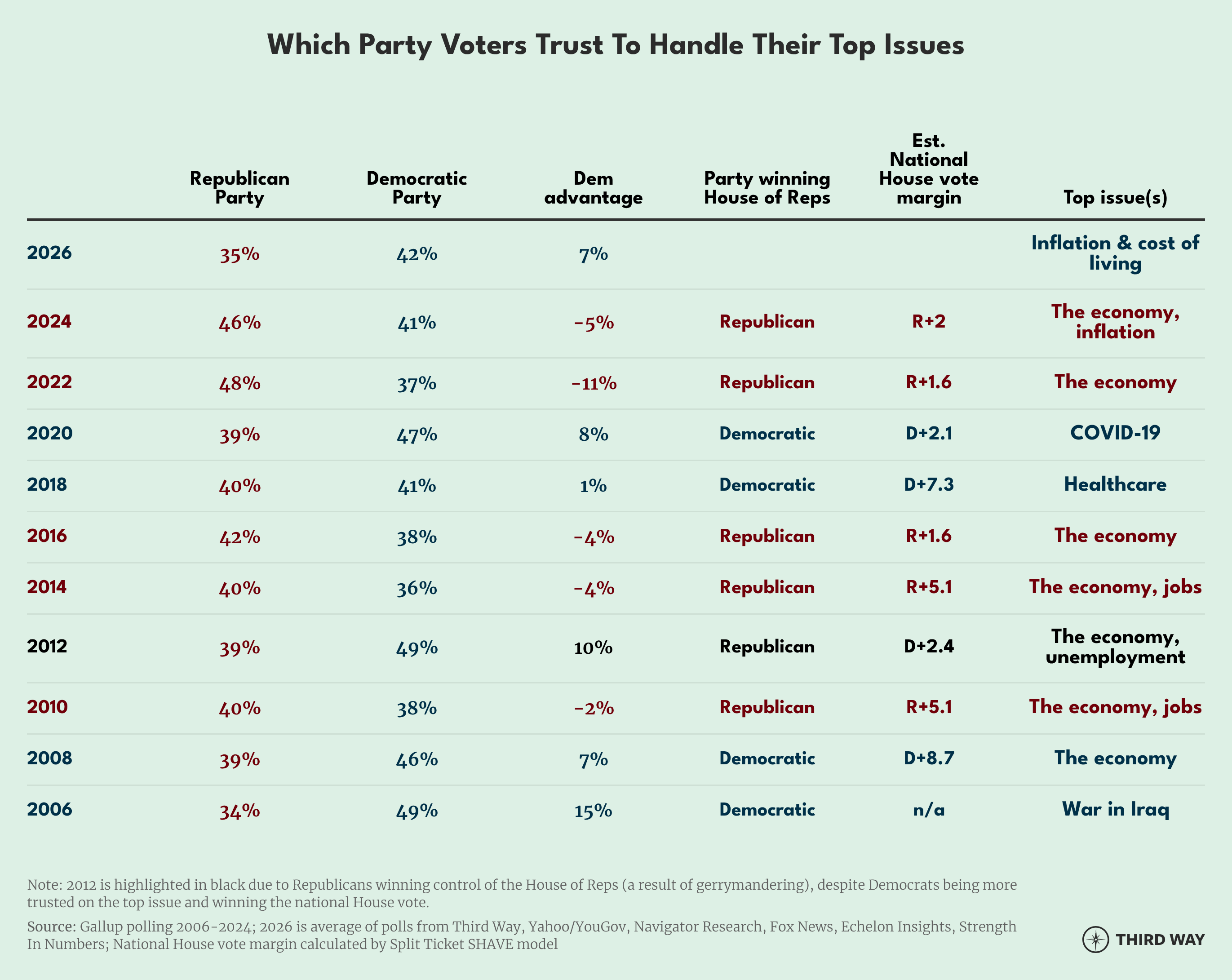
But this is a story beyond just winning on the top issue. Democrats have been given a golden opportunity to build a sustained trust advantage on the economy for the first time in a decade. Since the Obama era, Republicans have held the advantage on economic trust—leading in every cycle where the economy was the top issue (2014, 2016, 2022, and 2024) and winning the House each time. Democrats are now leading what is functionally the same issue, inflation and the cost of living, for the first time since 2012.
Two recent midterm cycles portend what can happen when the party out of power stays disciplined in messaging and when they do not. In 2018, Democrats nominated strong, moderate candidates in competitive House races across the country, and they were laser focused campaigning on health care costs and protecting the Affordable Care Act—voters’ top issue of the cycle. Democrats ended up winning the national House vote by over 7 points and flipping 40 seats. (By the time votes were cast, exit polls showed that Democrats led Republicans on trust to handle health care by eight points, 52-44%, nearly hitting the exact national margin that Democrats won by.)
Meanwhile, Republicans failed to take advantage of a similarly ripe midterm environment in 2022. Republicans were more trusted to handle the economy by 11 points a month before the election amid high inflation and rising prices. However, nominations of poor candidates and tacking to the extreme right on issues that were not central to voters’ top issues, like adhering to Trump’s 2020 election denial, led to a dismal “red trickle” election where the GOP only won the national House vote by 1.6 points and barely flipped enough seats to take the lower chamber.
Republicans netted just 9 seats in 2022 versus Democrats’ 40 in 2018. For all midterm elections since 1946, the average midterm loss for the president's party is 25 U.S. House seats. The question for 2026 is whether Democrats hold their economic trust lead and hit historical gains in the House, or if they lose issue focus in the closing months as the GOP ramps up their campaigns.
The Economic Opportunity Beyond 2026
There is also a long-term opportunity for Democrats to capitalize on. Republican trust on the economy has been exceptionally durable over the last 12 years—peaking in 2024 with Trump’s re-election. What was once Republicans’ structural edge to winning election after election has eroded. Democrats may own trust on economic issues right now, but the long-term question is whether they can remain disciplined enough to hold this ground after the midterms.
The reality is that real-world events are most determinative of the economy and the top issue of an election cycle than either party’s messaging strategy. Regardless of those components, the lesson from this data is that when Democrats did not own trust on the economy, they lost.
Democrats cannot misread the 2026 election results as a full embrace of the party and move sharply to the left or put the affordability crisis aside to prioritize other issues. If Democrats hope to win in 2028, they must build a durable party identity and vision that promises an affordable life for every family today and a stable economic future for tomorrow.