Memo Published April 3, 2026 · 7 minute read
Winning a Durable Majority Through the Center

Takeaways
- If Democrats have the same generic ballot margin of victory as they did in 2018 (D+7.3), we would expect them to flip 25 seats and net 19 seats overall, leading to a House majority of 234.
- To regain the 257 House seats Democrats held at the start of President Obama’s term, they would need to hold all 215 of their current seats and flip 42 more—22 of which are in districts that Trump won by double digits.
- The 44 districts on the DCCC’s 2026 target list average out to Trump+8—many of which are in traditionally red places. By contrast, the average squad member’s district is Harris+40.
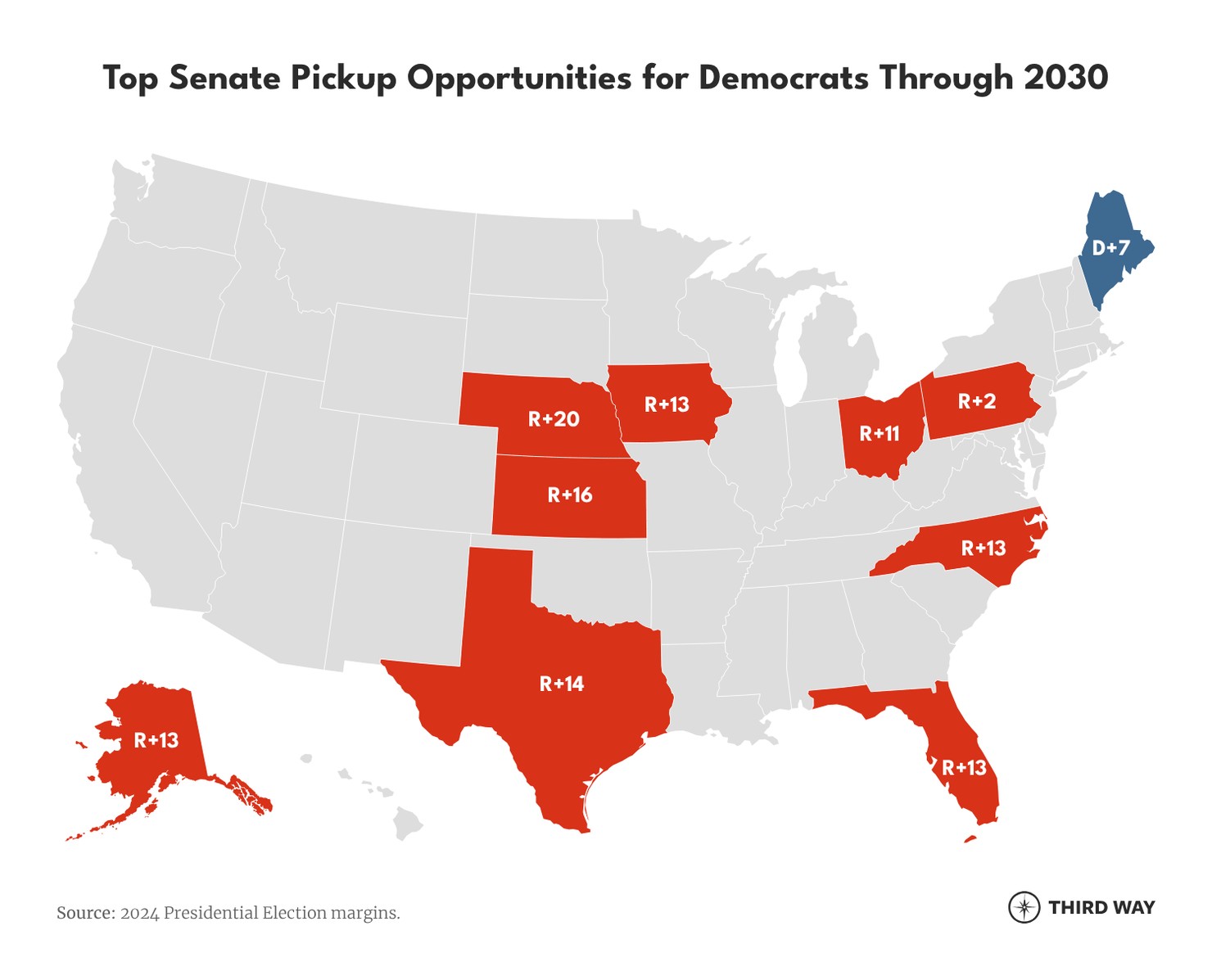
- To get to 55 Senate seats by 2030, Democrats will need to hold all 47 of their current seats and flip an additional 8 of 10 states. Outside of Maine, those states range from Trump+2 to Trump+20—five of which are currently governed by Republican trifectas.
The 2026 midterm elections are still months away, but early indications portend a very encouraging election night for Democrats—if they run the right candidates and stick to the right playbook. Democrats are currently in the minority in both the House and Senate. To flip both chambers, they cannot simply appeal to voters in blue America. Democrats already hold 37 of 38 Senate seats in the 19 states that Harris won, and there are a mere 8 congressional districts that Harris won with a Republican House member—if Democrats flipped all of these districts, they would retake the House, but it wouldn’t be a durable majority. To flip both chambers in Congress and win a durable majority, Democrats must win seats in purple and red places by nominating candidates who can win competitive general elections. We took a closer look at the path to flipping those seats, and it turns out the road is steeper than it might seem.
House Outlook
We applied four different scenarios for what the 2026 midterms might look like, factoring in the new Republican and Democratic House districts that have been implemented through redistricting (as of March 2026).1
Under one of the most optimistic scenarios, if Democrats have the same generic ballot margin of victory as they did in 2018 (D+7.3), we would expect Democrats to flip 25 seats and net 19 seats in total. While this is a far cry from the 40 seats that Democrats netted in the 2018 cycle, it is a similarly strong performance, as Democrats are starting with a much higher floor of 215 seats this cycle, compared to 194 seats in 2018. And for context, this is roughly in line with the historical average of 25 U.S. House seats lost by the president’s party in midterms since 1946.
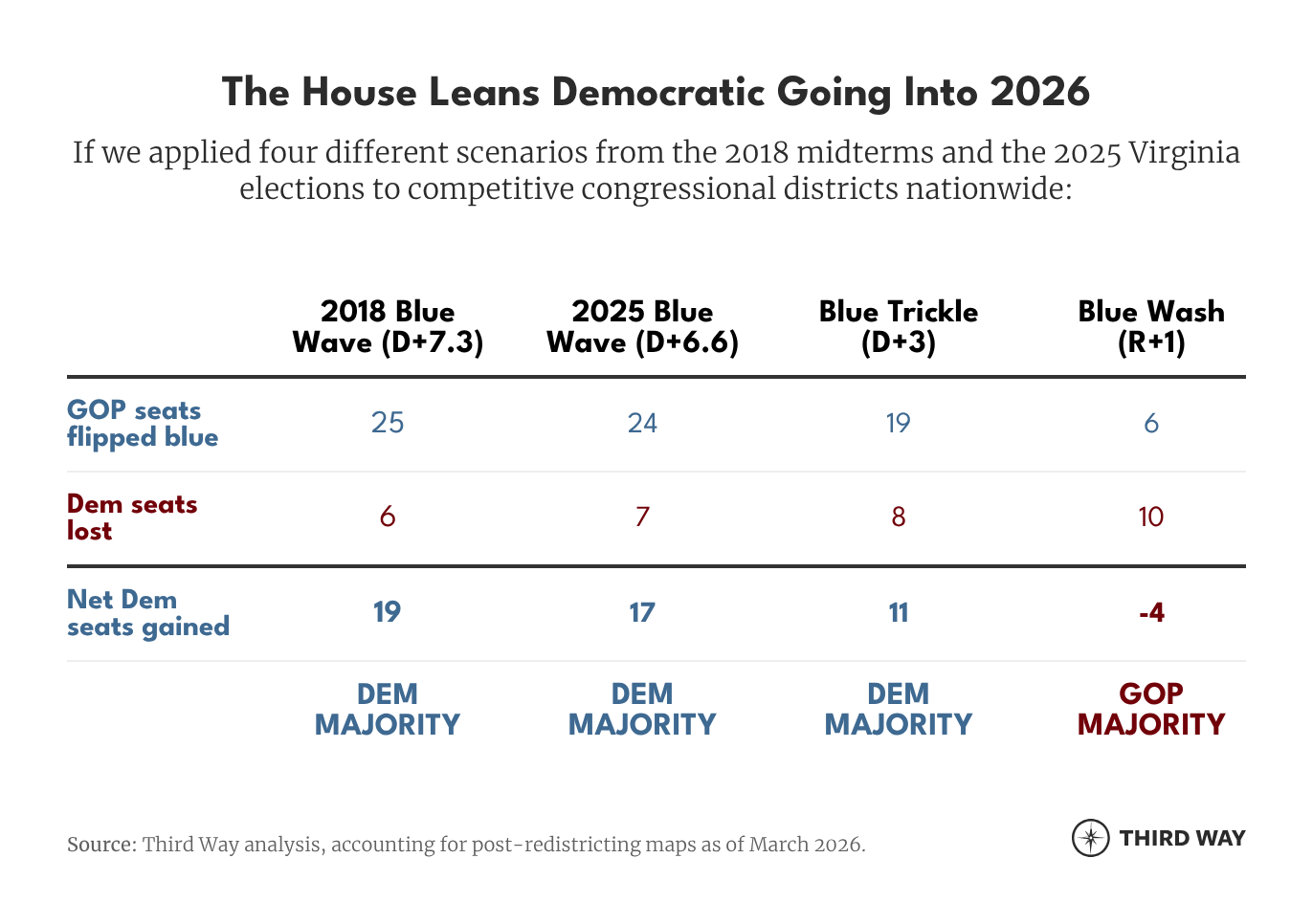
The other three scenarios paint a marginally less rosy picture for Democrats. If Democrats have a strong night, but it’s something more akin to what a competitive district looked like in Virginia in 2025—in this case, Spanberger’s performance in VA-02 where she won by 6.6 points—then we can expect Democrats to net 17 seats nationwide. If Democrats have a less stellar D+3 night, we might expect a slimmer victory, with Democrats netting just 11 seats. And if Democrats have a disastrous blue wash of a night (R+1), then they’ll have a net loss of four seats, and Republicans would maintain their House majority.
Democrats could win a razor-thin House majority simply by picking up the eight Harris-Republican districts, but this would be anything but a durable majority or a mandate to put a significant check on the Trump Administration. To regain the level of 257 House seats that Democrats had at the start of President Obama’s term, they need to hold all 215 seats they have and flip 42 seats—22 of which are in districts that Trump won by double digits. Notably, the 44 districts on the DCCC’s 2026 target list average out to Trump+8—many of which are in traditionally red places. By contrast, the average squad member’s district is Harris+40.
If Democrats hope to beat Republican incumbents in red and purple districts, then they cannot run candidates who are far outside the mainstream of their district. The margin that House Democrats enter 2027 with is highly dependent on running the right candidates who are representative of their district, who are laser focused on implementing an aspirational economic agenda, and who follow the moderate playbook. It has been key to flipping as many seats as Democrats have since 2018.
Senate Outlook
On the Senate side, Lakshya Jain at The Argument did a great analysis that showed what conditions Democrats would need to flip the Senate—in short, they’re going to need more than just a blue wave. As Lakshya puts it, “They’re going to need credible candidates who can win over a lot of swing voters — and the evidence we have suggests that those voters are relatively moderate.”
Under the assumption that Democrats flip North Carolina, oust Susan Collins in Maine, and hold all their current seats up for election, it gets them to 49 seats in the Senate. To get to 51 seats, Democrats will need enormous overperformances in two of the remaining Republican-held seats that are currently all rated lean, likely, or solidly Republican.
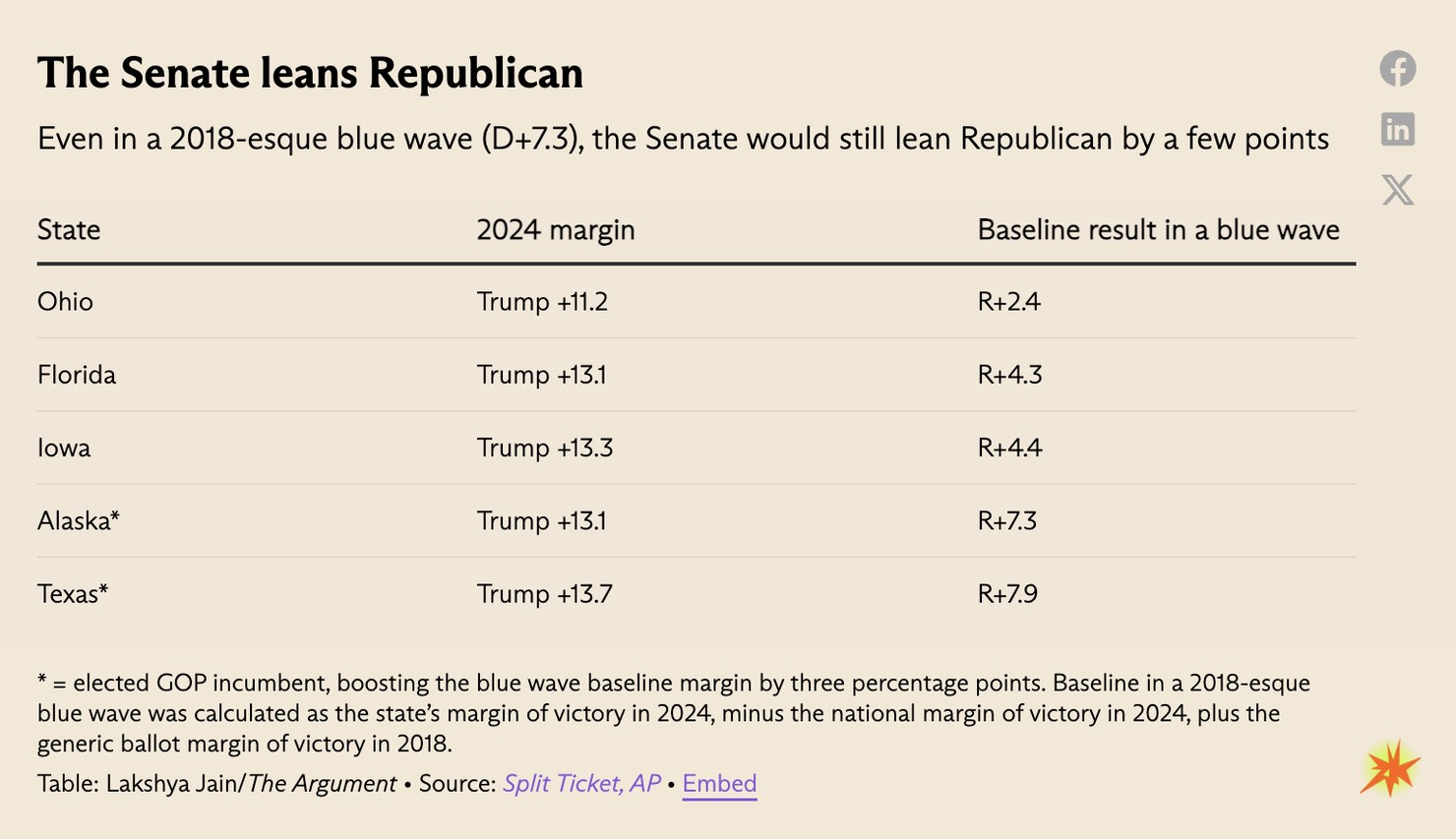
This is where candidate quality matters most. Even in the blue-wave year of 2018, four moderate incumbent Democrats in red states (Florida, Indiana, Missouri, and North Dakota) lost their re-election bids by margins of 0.1 points up to 11 points. To flip the Senate in 2026, moderate candidates who run on a moderate playbook and espouse a “fighter” demeanor are much more likely to get the overperformance that pushes them over the finish line. As Lakshya put it, this is “an important part of how the party has managed to hold on in states like Nevada, Arizona, and Georgia.”
But even if Democrats do exceptionally well in 2026, the road to a durable majority in the Senate is very steep. 2008 was the last election that either party won over 55 seats in the Senate and had a durable majority. To get to 55 Senate seats by 2030, Democrats will need to hold all 47 of their current seats and flip an additional 8 of 10 states. Outside of Maine, those states range from Trump+2 to Trump+20—five of which are currently governed by Republican trifectas.
Conclusion
The critical task going forward is to ensure that Democrats do not fall victim to the electoral illusion that the far left is selling. We now have a decade of proof that the far left’s approach not only cannot advance the project of flipping red places blue, but it can make that task significantly harder. From 2017 when Trump was first elected president through the 2025 off-year elections, far-left organizations and candidates have not flipped a single seat in Congress from red to blue—literally not one seat despite having tried dozens of times. According to our records, they’re 0 for 30 in failed red-to-blue attempts. In stark contrast, moderate Democrats have flipped 50 House seats from red to blue in this time period.
As Charlie Cook recently put it, “One easy way to seize defeat from the jaws of victory would be [for Democrats] to follow the instincts of their base, nominating candidates in swing states and districts who may be extremely popular among the party faithful, but completely incompatible with swing voters.” To have any chance of building majorities in the midterms and beyond, we must assiduously avoid that mistake.
Methodology
Calculations for the four different House scenarios: House district margin in 2024, minus the national margin of victory in 2024, plus hypothetical 2026 wave scenario; House districts that were redistricted were calculated using 2024 presidential results along newly drawn lines, plus/minus SplitTicket's 2024 WAR for each incumbent, plus hypothetical 2026 wave scenario. These calculations assume a uniform national swing, meaning every district shifts by the same amount relative to 2024.