Tough, Fair and Practical: Winning the Immigration Reform Debate
It is unclear whether there will be Hill action on immigration reform in 2010. Regardless, immigration reform is certain to be a political topic around the country. In the past, progressives feared that immigration reform would hurt them politically. But in 2006 and 2008, immigration was the dog that didn’t bite. In fact, we could not find a single prominent Congressional Democrat or Republican who lost a local race because of their support for reform. In part this was because other issues dominated, but in part this was because supporters used effective messaging—calling for tough, fair, and practical reform.
In this memo we again recommend the same three magic words: tough, fair, and practical. This message is based on our initial polling in 2006 and a subsequent poll by America’s Voice1 in 2009 (both by Benenson Strategy Group).
Support for immigration reform was solid in both polls; however on all culture issues we caution against over-confidence about top-line results. Support doesn’t necessarily mean popularity. In addition, today’s environment provides unique challenges. There is a crushing economy, and it helped immensely to have former President George W. Bush on board in the previous debate. Culture issues always benefit from deep bipartisanship.
Whether comprehensive immigration reform comes to a vote this year or not, this memo describes how to support reform efforts most effectively.
Three Words
There is a tested message on immigration that works with the vast majority of Americans, including a strong majority of Hispanics. That message is tough, fair, and practical.
- Tough means being tough on border security and workplace enforcement.
- Fair means FAIR TO TAXPAYERS.
- Practical means finding a realistic and lasting way to restore the rule of law.
Opponents of reform should be cast as those who created the problem in the first place. For eight years they turned their back on the border, turned a blind eye to businesses hiring illegal immigrants, and put a welcome mat out at our borders.
- Their plan perpetuates a tax-dodging, shadow economy instead of putting the taxpayer first.
- Their plan does nothing to deal with the 11 million illegal immigrants already in the country except say to cash-strapped governors—it’s your problem.
Six Public Opinion Insights
- Fairness to taxpayers trumps justice and compassion: Most voters believe that illegal immigrants are largely good, hardworking people who seek to build a better life in America. But their warm feelings toward illegal immigrants end where their taxpayer interests begin. In our poll voters ranked “don’t pay their fair share in taxes” as their second highest complaint about illegal immigration (behind only national security concerns and far above concerns about breaking the law or taking jobs away). Voters ranked “fairness to taxpayers” as their top goal for immigration reform with “fair to the illegal immigrants who currently live in the U.S.” far below.
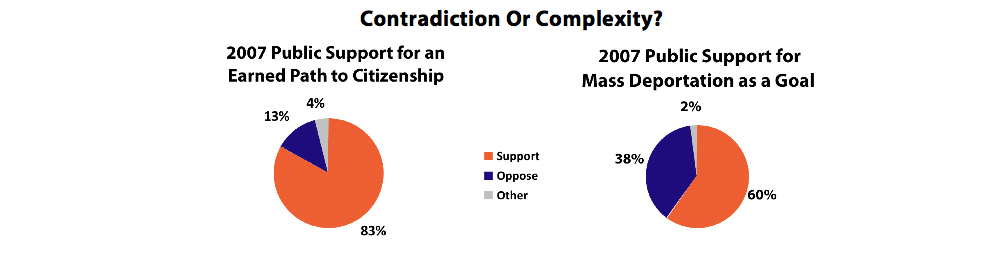
- Don’t confuse support for legalization with popularity: By 83-15%, voters supported the 2007 bipartisan Senate compromise, which included an earned path to citizenship. At the same time, 60% of voters (including 51% of Hispanics) believed it would be a good goal to deport all 12 million illegal immigrants back to their home countries. This is not a contradiction. Voters are torn. They are willing to support comprehensive immigration reform because they know the current system is broken, but they aren’t clamoring for it and must be convinced that any proposed solution would really work.
- The economy is the hurdle: It may be hard to positively link immigration reform to the economy. One approach is to emphasize putting taxpayers first: requiring legalization, shutting down the shadow economy, and making illegal immigrants and the businesses that hire them pay their fair share in taxes. Opponents of reform must be defined as undercutting the legal employment system and perpetuating a broken system.
- Both parties need each other: To the extent that immigration reform is seen as a “special interest” or partisan cause, support may vanish. In our polling, we found that people saw Democrats as compassionate towards illegal immigrants to a fault. On the other hand, they saw Republicans as mean-spirited and inflexible. Many voters are both compassionate toward illegal immigrants and resentful that they are here using taxpayer resources. More than most issues, Democrats and Republicans need each other on immigration reform if they are to get approval from voters in the middle. The public doesn’t trust either party on implementing reform.
- Tout enforcement successes: One year into the Obama administration, conservatives will try to shift blame for the current illegal immigration population onto Democrats. In fact, of the 10.8 million illegal immigrants most recently estimated to be in the country, most came during the Republicans’ watch and thus they must be made to own the problem.2 Obama and DHS Secretary Napolitano have been tougher on border enforcement than Bush ever was—by cracking down on businesses hiring illegal immigrants and also focusing enforcement efforts on immigrants with a criminal record. These tougher measures, combined with the bad economy, have reduced the flow of illegal immigrants into the country by more than half from peak years.
- Citizenship is precious: Would you take $1 million if it cost you your citizenship? American citizenship is the greatest privilege on earth. Progressives, in particular, cannot be seen as just giving it away because it’s the easy solution. Citizenship must be earned.
Conclusion
With the economy only now pulling out of a historic downturn, this is not an easy environment to pass comprehensive immigration reform. But that doesn’t mean that progress cannot be made. The combination of stricter enforcement and the loss of jobs have led to a dramatic decline in the number of new, illegal entrants. Some previously hostile voices against reform have begun to take a different tune.3 Whether the bill is moved this year or next, these three magic words—tough, fair, and practical—are not only the right message, but the right guide for legislative reform.
Endnotes
Hoefer, Rytina, and Baker, Estimates of the Unauthorized Immigrant Population Residing in the United States: January 2009, U.S. Department of Homeland Security (January 2010) available online at: http://www.dhs.gov/xlibrary/assets/statistics/publications/ois_ill_pe_2008.pdf.
See, e.g., Peter Wallsten, Dobbs Reaches Out to Latinos, With Politics in Mind, Wall Street Journal (November 25, 2009) available online at: http://online.wsj.com/article/SB125910998942663259.htm.

Latest Publications
The Immigration Enforcement Revolution: How a Historic Funding Surge Is Reshaping American Criminal Justice
Battleground Democrats Aren’t Ducking the Immigration Fight
On Immigration, Battleground Voters Want Both Order and Opportunity
Restoring Confidence in the Supreme Court
Never Miss an Update
Sign up for updates on the pragmatic, center-left ideas shaping the future of American policy.