Memo Published August 28, 2026 · 13 minute read
The Case to Improve Clearance Rates
Marla L. Guerra & Sarah Pierce
Takeaways
- Most violent crimes in the United States go unsolved. In 2024, law enforcement agencies cleared fewer than 44% of reported violent crimes, leaving more than 650,000 cases without an arrest or other resolution.
- Multiple factors are making serious crimes hard to solve, including overloaded investigators, forensic delays, fragmented casework, and limited witness cooperation.
- To address this critical threat to public safety, policymakers should advance a federal initiative that helps local agencies hire specialized personnel, process evidence faster, improve coordination, and strengthen engagement with victims and witnesses.
Crime has fallen dramatically from its pandemic-era peak, and preliminary 2026 data suggest that homicides have declined even further. But falling crime doesn’t tell the whole public safety story. Hundreds of thousands of violent crimes go unsolved each year, denying justice to victims and their families and weakening confidence that the law will hold offenders accountable.
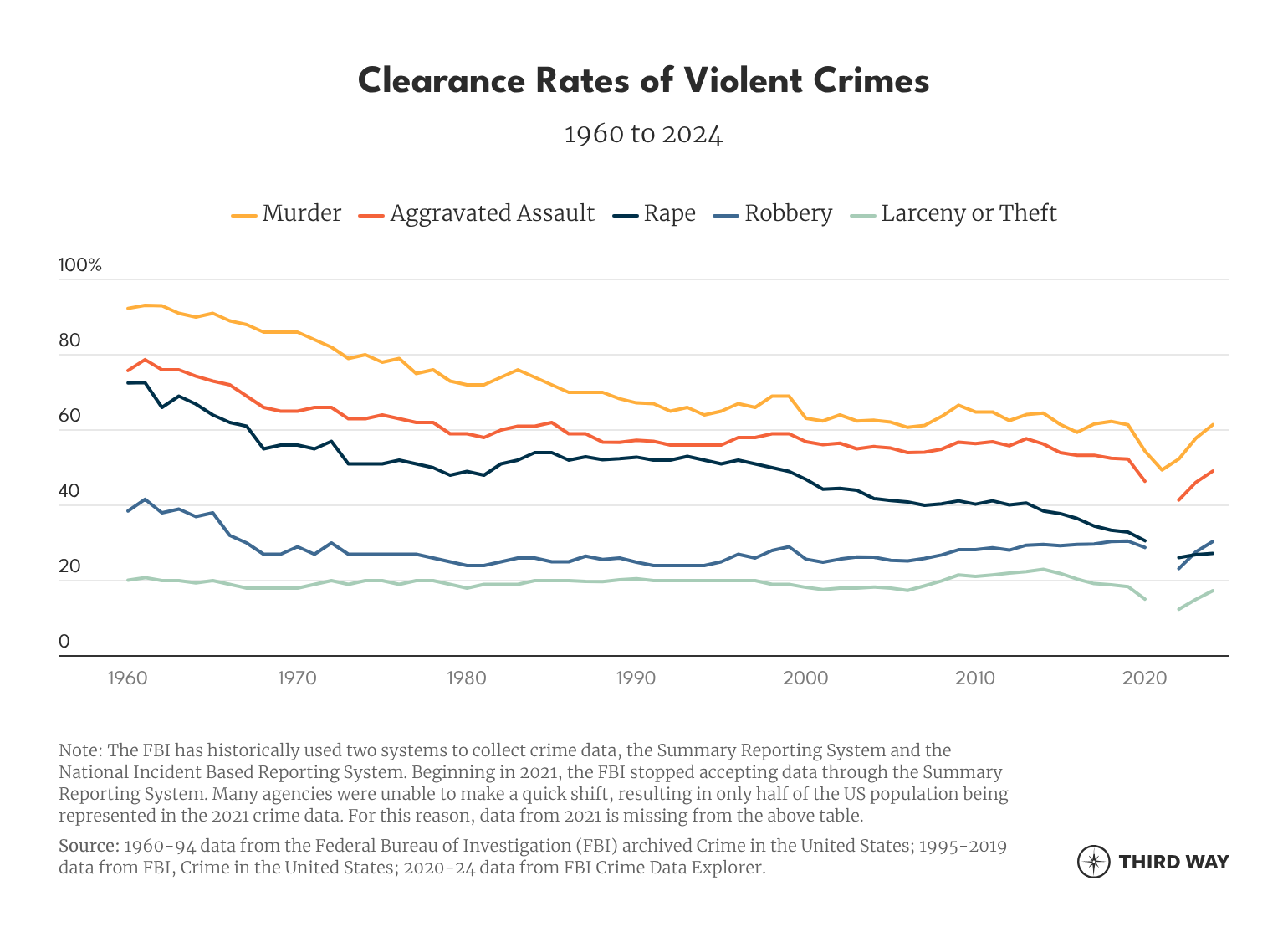
In 2024, the national violent crime clearance rate remained below 44%, meaning more than 650,000 violent crimes did not end with an arrest or other official resolution. Homicide clearance rates have recently ticked upward, reaching 61% in 2024, and preliminary indications suggest that the rate could be even higher in 2025. But far too many murders still go unsolved—especially those involving Black victims, whose cases are significantly less likely to result in an arrest than those involving white victims.
Policymakers should make solving more serious crimes a central public safety priority. In Congress, they could advance that goal by creating a dedicated federal Violent Crime Clearance Initiative that helps local law enforcement agencies hire and train investigators, move forensic evidence more quickly, deploy proven crime-solving technology, and improve cooperation among detectives, prosecutors, crime labs, victims, and witnesses.
Safer communities require not only fewer crimes, but also more solved crimes.
The Problem
Clearance Rates Are Alarmingly Low
Clearance rates measure the share of reported crimes that law enforcement agencies close through an arrest or other qualifying circumstances. While clearance rates have risen since their COVID-era low, they remain far from their historical highs. In the mid-1960s, the national homicide clearance rate exceeded 90%. By 2022, only about half of murders nationwide were solved.
Clearance rates for non-fatal shootings are often even worse. Some cities have recently solved fewer than 20% of such cases, and in other places the rate has fallen as low as 10%. In many locations, that means most survivors of gun violence go on to watch the investigation stall without an arrest.
The changing nature of serious crime has made some cases more difficult to solve. More homicides now involve firearms, which generally leave less physical evidence than weapons requiring close physical contact between victim and assailant. Stronger policing practices and higher prosecutorial standards have also raised the bar for making arrests, meaning that fewer arrests are being made on weak evidence.
But difficult cases do not fully explain today’s low clearance rates. Too many law enforcement agencies simply lack the investigators, forensic capacity, coordination, and public cooperation needed to solve serious crimes.
Too Many Cases, Too Few Investigators
Police departments across the United States are struggling to recruit and retain qualified officers. In a recent national survey, more than 70% of responding law enforcement agencies reported greater difficulty hiring officers than five years earlier. Although some large departments saw modest growth in 2024, they still employed about 6% fewer officers than in 2020.
These shortages leave officers stretched thin and investigators overloaded. Best practice recommendations from the Case Closed Project suggest that each detective should handle about six homicide cases per year and no more than 10 or 12 non-fatal shooting cases. However, few jurisdictions can meet those standards.
In Oakland, for example, detectives were managing more than two dozen homicide cases each in 2022 and, as a result, the clearance rate was just 36%.
Low staffing levels have been linked to slower response times, higher crime rates, and greater officer burnout—all of which make it harder to solve cases. Without enough trained investigators, agencies must make difficult decisions about which cases to prioritize. As a result, delays mount, backlogs grow, and too many cases go cold.
Evidence and Information Move Too Slowly
Modern forensic tools can help identify suspects, connect crimes, and generate leads that would have been impossible a generation ago. But those tools cannot help investigators when evidence sits untested for months—or years.
Crime labs across the country lack the staffing and resources needed to keep pace with demand, creating major backlogs in DNA, ballistics, and digital evidence. A study of firearms investigations in nine American cities found that ballistics analyses took an average of six months to complete. Because of that delay, ballistics evidence rarely helped investigators make arrests.
Analyses of other types of evidence face similar bottlenecks. In Virginia, where the state crime lab recorded over 3,800 backlogged DNA cases in 2025, the average turnaround time for DNA tests exceeded seven months. Digital and multimedia evidence took around 10 months. In St. Louis, the police crime lab reported 552 backlogged DNA cases related to homicides in 2023 and an average turnaround time of 15 months.
The backlog of untested sexual assault kits is particularly staggering. As of July 2026, in just the states that kept tally of the backlogs, there were more than 52,780 untested sexual assault kits.
By the time test results arrive, witnesses may no longer be reachable, suspects may have disappeared, and critical leads may have gone cold.
Investigations can also stall because information is fragmented across police units, crime labs, prosecutors, federal partners, and neighboring jurisdictions. Detectives may not learn quickly enough that a firearm, suspect, vehicle, or pattern is connected to another case. Prosecutors may identify problems with evidence only after valuable investigative time has been lost.
Solving more crimes requires more than hiring detectives. It requires a coordinated system that can move evidence and information quickly from the crime scene through prosecution.
Solving Crimes Requires Public Cooperation
Investigations often hinge on victims and witnesses who are willing to provide information, identify suspects, and remain engaged throughout a case. In communities where relationships with the police are strained, residents may be reluctant to participate. Without their cooperation, serious cases can stall.
That creates a destructive cycle. Distrust makes crimes harder to solve. When police then fail to deliver justice, public distrust deepens further, making future cooperation even less likely.
Police violence, unequal treatment, and a lack of accountability have lasting consequences for public confidence, especially in Black communities. Immigration enforcement can produce similar fears in immigrant communities. Immigration status may already deter victims and witnesses from contacting police, and police leaders have warned that aggressive federal immigration enforcement can further reduce reporting and cooperation.
Local police cannot solve serious crimes without public participation. Building trust is not separate from effective law enforcement; it is one of the tools investigators need to identify offenders and hold them accountable.
Trump is Making the Problem Worse
At a moment when police departments are struggling with staffing shortages, forensic backlogs, and fragile community trust, federal policy should reinforce local crime-solving capacity.
Instead, the Trump Administration has diverted federal personnel from core public safety missions into immigration enforcement and proposed reductions to agencies that support state and local investigations. President Trump proposed cutting $468 million from the Bureau of Alcohol, Tobacco, Firearms and Explosives (ATF)—a 29% reduction in the agency’s overall funding, although Congress ultimately enacted a substantially smaller reduction. The Administration’s nominee for ATF Director nevertheless warned that the funding reductions were “eroding core enforcement operations” and limiting the agency’s ability to support local partners.
The Administration has shifted personnel from federal investigations involving firearms trafficking, organized crime, drugs, child exploitation, and other serious offenses. The Trump Administration is also defunding violence prevention programs, delaying or imposing ideological conditions on public safety grants, and weakening gun regulations. These choices weaken the support available to state and local agencies at the same time that too many violent crimes already go unsolved.
Congress should move in the opposite direction by making a sustained investment in the people, partnerships, and technology that help law enforcement solve serious crimes.
The Idea: A Federal Crime Clearance Initiative
Law enforcement agencies solve more crimes when investigators have manageable workloads, evidence moves quickly, agencies work together, and the public is willing to participate. Federal policymakers should advance smart, effective strategies to boost clearance rates and deter crime over the long term, including a multiyear grant initiative dedicated to improving violent-crime clearance rates.
Administered through the Department of Justice, a federal Violent Crime Clearance Initiative could support state, local, and tribal agencies that adopt evidence-based investigative practices and demonstrate a clear plan for improving case outcomes. Grants should be flexible enough to meet local needs but focused on four essential components of effective investigations.
Build Dedicated Investigative Teams
Grant funding should help agencies hire and train homicide and shooting investigators, civilian investigators, crime analysts, forensic intelligence specialists, victim-support personnel, and other staff who contribute directly to solving cases.
With greater resources and more manageable caseloads, detectives can dedicate more time to interviewing witnesses, pursuing leads, communicating with victims, and building cases for prosecution. This strategy worked to great effect in Denver, where the police department created a specialized team to investigate non-fatal shootings in 2020. Within seven months, the city’s clearance rate increased from 39% to 65%. Agencies should also be empowered to train existing officers and establish specialized units devoted to homicides, shootings, or other serious crimes.
Specialized personnel can make investigations considerably more efficient. Crime analysts and forensic intelligence specialists can identify patterns, connect related incidents, organize large amounts of evidence, and help agencies allocate investigative resources more effectively. Civilian staff can handle reports, witness follow-up, evidence processing, and public communication, allowing sworn officers to concentrate on work that requires their training and authority.
The Phoenix Police Department, for example, began hiring civilian investigators in 2022 to assist with writing incident reports, following up with witnesses, processing crime scenes, communicating with the public, and submitting cases for prosecution. Other civilian personnel handle parking violations and minor traffic accidents, freeing up officers to focus on serious crime.
Move Evidence Faster and Expand Proven Technology
To increase the number of crimes solved, the federal government should increase support for state and local crime labs to hire and train personnel, modernize equipment, and reduce turnaround times for DNA, firearms, digital, and multimedia evidence. Grant funding for this purpose should require recipients to establish clear benchmarks for processing evidence in homicide and shooting cases and report their progress publicly.
Congress should also expand access to crime-gun intelligence technology.
Crime Gun Intelligence Centers (CGICs) bring together local law enforcement, ATF, crime labs, prosecutors, and other justice system partners to process ballistic evidence, identify connections among shootings, trace crime guns, and develop cases against repeat offenders. Their work relies in part on the National Integrated Ballistic Information Network (NIBIN), which compares images of cartridge casings and firearms recovered from crime scenes.
These tools have shown promising results when agencies have the personnel and protocols needed to act on the information quickly. After Detroit received federal funding to establish a CGIC and adopted a strategy centered on NIBIN-related cases, fatal and non-fatal shootings associated with those leads were 4.84 times more likely to result in clearance. Similarly, after Tulsa more heavily leveraged NIBIN data, the city reported a 150% increase in firearm-related arrests. In Milwaukee, the clearance rates for non-fatal shootings with a ballistic database connection rose from 23% to 36% between 2014 and 2017, whereas the rate for shootings without such a connection remained unchanged.
Technology alone will not solve cases. The quality of evidence collection, the speed of processing, and the availability of investigators to pursue leads are all essential. Democrats should therefore support technology as part of an integrated investigative strategy, not as a substitute for trained personnel.
Connect Police, Prosecutors, Labs, and Federal Partners
Federal policy should encourage and support early and continuous coordination among detectives, prosecutors, crime labs, analysts, victim-service providers, federal agencies, and neighboring jurisdictions.
Prosecutors should be involved early enough to identify evidentiary problems before an investigation stalls. Crime labs should have systems for prioritizing evidence from serious and time-sensitive cases. Local departments should be able to share intelligence and connect cases that cross jurisdictional boundaries. Investigators should use shared case-management tools so that critical information does not remain siloed within one unit or agency.
Congress can support this work by permitting funds to be used for prosecutor recruitment and retention, regional investigative partnerships, shared analytical personnel, and interoperable case-management systems.
Agencies should also be encouraged to adopt clear investigative protocols and provide specialized training. Research, including recent efforts in cities like Baltimore, has linked structured investigative practices, supervisory review, analytical support, and stronger coordination to better case outcomes.
Strengthen Engagement with Victims and Witnesses
Federal initiatives should support practices that make it easier and safer for victims and witnesses to participate in investigations—particularly as this Administration pursues policies that discourage such cooperation.
That could include dedicated victim advocates, witness-support personnel, language access, regular communication with victims’ families, relocation or safety assistance in appropriate cases, and partnerships with trusted community organizations. Agencies should also be able to fund de-escalation, procedural justice, and community-policing training that strengthens public confidence and reduces unnecessary uses of force.
Such integrated strategies, rooted in community trust, can improve clearance rates. In Omaha, law enforcement leaders credit the city’s 100% homicide clearance rates in 2023 and 2024, in part to sustained community engagement and a strong focus on public trust. Investments in community engagement, transparency, and sustained partnership enhance law enforcement capacity and reinforce a shared goal of preventing and solving crime, and Congress can advance these efforts through sustained federal funding for similar initiatives.
Build on Promising Ideas Already Before Congress
Some efforts to improve clearance rates are already before Congress.
The bipartisan VICTIM Act would provide annual grants to local, tribal, and state law enforcement to support additional hiring, training, investigative technologies, and victim support services—each aimed at improving clearance rates for homicides and gun violence. The Retired Law Enforcement Officers Continuing Service Act would help agencies hire civilian personnel. And the Public Safety Act would expand Community Oriented Policing Services funding by reallocating funds funneled to immigration enforcement through reconciliation.
Federal policymakers can build on these and similar efforts to bring together a focused initiative organized around a measurable goal: helping law enforcement solve more serious crimes.
Funding should be multiyear so agencies can hire and retain qualified personnel rather than building short-lived programs around one-year grants. The Department of Justice should also fund technical assistance for smaller and rural agencies that may lack dedicated grant-writing or data-analysis staff.
In return, participating agencies should report consistent information about caseloads, staffing, forensic turnaround times, victim communication, investigative practices, and clearance outcomes. Congress should provide dedicated funding to the Justice Department’s National Institute of Justice for independent evaluations to identify which combinations of staffing, technology, coordination, and community engagement produce the strongest results.
The objective should not be to reward agencies for making more arrests regardless of quality. It should be to help them conduct stronger investigations that identify the correct offender, withstand prosecutorial scrutiny, and produce fair and reliable case outcomes.
Conclusion
As violent crime falls, policymakers should be clear that public safety also requires solving the serious crimes that still occur. A dedicated federal Violent Crime Clearance Initiative would offer a practical agenda for delivering justice to victims, holding offenders accountable, and strengthening confidence in the law. Rather than arguing over who sounds toughest, Congress should invest in the proven people, tools, and partnerships that help law enforcement improve accountability.