Memo Published May 4, 2026 · 7 minute read
DOJ’s Ideological Hijacking of Public Safety Grants
Marla L. Guerra & Sarah Pierce
Donald Trump’s Department of Justice is turning public safety grants into political weapons.
In fiscal year (FY) 2025, the US Department of Justice (DOJ) imposed sweeping new conditions on grants that states and localities rely on to hire officers, support victims, prevent violence, and strengthen public safety. But these conditions are not tailored to crime reduction or justice system performance. Instead, they drag public safety funding into the White House’s ideological battles over immigration, gender, vaccines, diversity initiatives, and other unrelated political priorities.
This is not only ideological overreach. It also weakens programs communities rely on to stay safe.
What These Grants Are Supposed to Do
The Administration’s new conditions reach across three major DOJ grantmaking streams.
The Office of Community Oriented Policing Services, or COPS, awards grants that support law enforcement hiring, officer training, community policing, and other local public safety strategies. These grants help agencies build capacity, strengthen trust, and respond more effectively to crime.
The Office of Justice Programs, or OJP, supports public safety and the administration of justice through a wide range of competitive and formula grants. These grants fund everything from crime prevention, victim assistance, policing and prosecution, corrections and reentry, research, and other facets of safety and justice operations. Grants move through several offices within OJP, including the Bureau of Justice Assistance, the Office for Victims of Crime, the National Institute of Justice, and the Office of Juvenile Justice and Delinquency Prevention. OJP is one of the federal government’s central vehicles for helping state, local, and tribal partners improve safety and justice system performance.
The Office on Violence Against Women, or OVW, provides grants to help prevent and respond to domestic violence, sexual assault, dating violence, and stalking. These grants support victim advocacy, legal services, law enforcement training, and cross-system partnerships between justice systems and community organizations.
Each of these grant offices supports some of the most important public safety work happening in communities across the country.
DOJ’s New, Ideological Conditions
The new restrictions vary across programs, but they fall into a few clear categories.
Some are explicitly tied to immigration enforcement. For example, state and local grantees may now have to avoid policies seen as limiting cooperation with DHS, refrain from using funds in ways DOJ characterizes as impeding federal immigration enforcement, and certify compliance with 8 USC 1373—a statute that prohibits state and local governments from restricting communication with federal immigration authorities. In addition, many grant programs now include priority consideration for applications that include immigration-related activities.
Other conditions target diversity, equity, and inclusion initiatives. Some DOJ programs now require grantees to certify that funds will not support DEI-related components that the Administration describes as violating civil rights or nondiscrimination laws. OVW grant materials go further by specifically barring support for DEI or related programming that the Administration says conflicts with its own priorities—a vague requirement that local agencies and organizations are struggling to grapple with.
The Administration has also imposed restrictions tied to gender-related programming, including bans on using funds to promote what it calls “gender ideology.”
Other grant conditions relate to vaccine policies, the protection of public monuments, and more. Below, we lay out new conditions placed on DOJ grants.
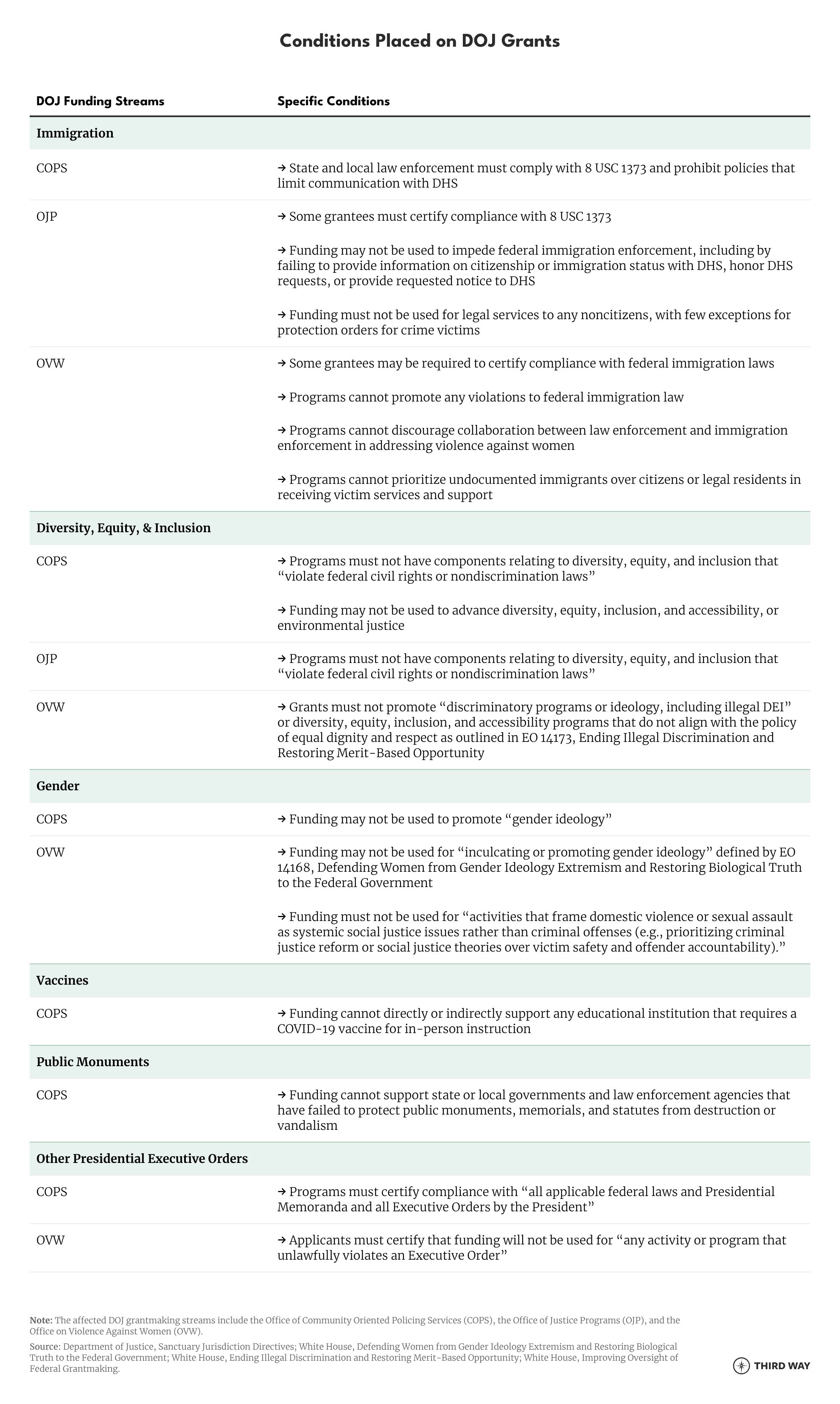
Taken together, these conditions represent a major shift in how the federal government supports public safety in American communities. Instead of directing DOJ grants toward proven public safety needs, the Administration is using them to reward political alignment and punish independence.
Why This Threatens Public Safety
The most immediate danger is that these conditions will deter qualified applicants from even seeking federal support. Some states, cities, agencies, and nonprofit partners may decide the legal uncertainty, confusion around the conditions, ideological strings, and compliance burden are simply too great. Even jurisdictions that cooperate with federal immigration authorities may be hesitant to certify compliance with some of the more subjective and ill-defined grant conditions, such as the ban on “promoting gender ideology” or the requirement to comply with executive orders that have not yet been issued. Others may conclude that accepting the money is not worth the risk of later losing it or being dragged into litigation.
Jurisdictions that do apply may feel pressure to tailor their work toward the Administration’s preferred ideological priorities rather than their communities’ actual safety needs. That means grant dollars are less likely to flow to the best violence-prevention strategy, the most effective victim-service provider, or the strongest community-policing proposal. Instead, they are more likely to reward political conformity.
The instability is even more dangerous for multi-year grants—which include most of DOJ’s awards. If the administration attempts to withhold or condition future funding awards, recipients may have to navigate situations where funding is available one moment and uncertain the next. Programs may not know whether they can hire staff, continue services, or move forward with long-term planning. In practice, this means more disruption for communities that depend on consistent public safety investments.
And DOJ is not alone. The Trump Administration has pursued similar strategies across the federal government. The Federal Emergency Management Agency (FEMA) sought to withhold more than $300 million in funding unless states adopted administration-backed population-counting changes tied to deportations. Similarly, the Department of Housing and Urban Development (HUD) attempted to condition homelessness-related grant funding on whether recipients supported sanctuary policies or maintained inclusive policies for transgender individuals.
These examples illustrate only a fraction of the larger pattern. This Administration is trying to reshape federal funding by attaching political conditions to programs that were supposed to serve practical governing purposes.
Courts Say DOJ Has Gone Too Far
The DOJ’s restrictions have faced a wave of legal challenges.
Cities, including Chicago and St. Paul, Minnesota, have sued to block the DOJ from enforcing restrictive conditions on COPS grants, arguing that withholding these funds undermines their public safety work. In San Diego, local officials warned that new OJP conditions could jeopardize funding for a task force that combats child exploitation, with their city attorney stating that “these conditions have nothing to do with protecting children from online predators.” In Rhode Island, a court recently blocked the Administration’s conditions on OVW grant funding, which supports survivors of domestic violence and sexual assault.
While the legal challenges are far from addressing all of the problematic grant conditions, courts are increasingly recognizing that these grants cannot be an end-run around Congress’s power of the purse nor be turned into vehicles for partisan or ideological coercion.
Conclusion
DOJ’s grants help communities hire police officers, support victims, prevent violence, and strengthen local justice systems. But when access to that funding is tied to immigration demands, culture-war conditions, or a shifting set of White House priorities, the grants stop being about public safety. The result is fewer resources for proven programs, more uncertainty for local agencies and service providers, and a greater risk that federal dollars will be awarded based on political conformity rather than community need.
It’s important to make clear that public safety funding cannot be used as a political weapon. Proposals like Senator Cory Booker’s Federal Grant Neutrality Act would help prevent administrations from punishing jurisdictions over partisan demands and refocus federal grantmaking where it belongs: on whether communities can use the funding to reduce crime, protect victims, and increase accountability.
Public safety grants should not be used to wage ideological fights, strong-arm local governments, or jeopardize programs communities depend on to stay safe. They should serve one purpose: helping communities protect the people who live there.