Memo Published May 11, 2026 · 14 minute read
How the Trump Administration is Making Policing More Difficult
President Trump and his Administration have gone out of their way to project a pro-police image. They have promised to empower state and local law enforcement, called for higher police pay, and made shows of force central to their political brand. But the reality on the ground tells a very different story.
Across the country, the Administration’s reckless approach to immigration enforcement—combined with billions of dollars in delayed and ideologically-conditioned public safety funding—has made policing harder, not easier. ICE operations have heightened tensions in local communities, failed to coordinate with local law enforcement, and left local agencies to deal with the fallout. In some cases, local officers have been forced to respond to abandoned vehicles, frightened children, and chaotic scenes created by federal enforcement actions. These operations have also fueled imitation crimes, damaged community trust, and increased demands on police departments that are already stretched thin.
At the same time, the Administration has failed to deliver resources that police departments and crime prevention programs were counting on. Billions of dollars appropriated in fiscal year 2025 remain undistributed, with no clear plan to get the funding out the door. Billions more have been weighed down by ideological conditions unrelated to the grants’ primary public safety purpose. The result is predictable: stalled investigations, strained departments, and fewer tools for the agencies responsible for keeping communities safe.
The Administration’s 30-day federal surge in Washington, DC, offered a clear example: a costly and unnecessary federal show of force imposed on a city where crime was already falling. Rather than support local progress, it disrupted it—and turned public safety into political theater.
This memo examines how the Trump Administration’s approach has made communities less safe and policing more difficult.
Mass Deportation Over Law-and-Order
The Administration sold its mass deportation agenda as a public safety campaign aimed at removing the “worst of the worst.” In practice, its enforcement has been poorly targeted, deeply disruptive, and damaging to public safety. Rather than support local policing, it has created chaos that makes officers’ jobs harder and communities less safe.
ICE’s Sloppy Policing Creates Real Public Safety Risks
Police leaders have increasingly called out ICE’s tactics as unprofessional, reckless, and “sloppy policing.” When the Department of Homeland Security (DHS) surged resources to Maine, Cumberland County Sheriff Kevin Joyce condemned ICE’s “bush-league policing,” after agents arrested a “squeaky-clean” recruit for the Cumberland County Jail and left his car running, unlocked, and exposed in the street. Minneapolis Police Chief Brian O’Hara described similar scenes during the federal immigration surge there: cars left unattended in roadways, traffic blocked, and, in one case, a vehicle left rolling down the street because it had not been put in park.
These instances are part of a broader pattern captured on videos across the country. Footage has shown ICE and other federal officers pulling US citizens from their vehicles, pointing guns at crowds and bystanders, impersonating utility workers, and using force far outside accepted policing norms, including chokeholds, kneeling on a target’s head, aggressive vehicle maneuvers, pepper balls against peaceful protesters and reporters, and tear gas at close range and in residential neighborhoods.
This same sloppy policing has had deadly consequences. Three US citizens have been killed: Alex Pretti, Renee Good, and Ruben Ray Martinez. Former police chiefs, trainers, and policing scholars have described these incidents as textbook failures: officer-created jeopardy, poor de-escalation, bad communication, unsafe crowd tactics, and shooting at or around moving vehicles in ways professional policing has spent decades trying to eliminate. Those concerns are only heightened by the Administration’s push to expand ICE rapidly while reducing training and accelerating hiring. Former police trainers, a retired police chief, a former ICE official, and a longtime policing scholar have all warned that rushed hiring and shortened training increase the risks of bad hires, poor judgment, unlawful force, and operational mistakes that endanger both the public and officers.
Another warning sign is the repeated refusal of federal immigration officers to identify themselves. Federal regulations require immigration officers to identify themselves when making arrests. Yet DHS agents have repeatedly refused to display badges or credentials and, in many cases, have concealed their faces altogether. That behavior is not a minor procedural failure. It violates basic policing norms, undermines public trust, and makes it harder for communities to distinguish lawful enforcement from intimidation or vigilantism.
Local Police Are Left Managing the Fallout
Those tactics are creating real operational problems for local police. Because federal immigration officers are in plainclothes and masks, drive unmarked or minimally marked vehicles, and fail to clearly identify themselves, police departments across the country are fielding more 911 calls from residents who believe they are witnessing kidnappings, assaults, or police impersonations. In Los Angeles, Seattle, and elsewhere, local officers have rushed to respond to potential violent-crime calls only to discover masked federal agents carrying out immigration enforcement.
“They were unmarked cars, men with guns in the yard, we got the call. Of course, if a deputy rolls up on something like that, it could be catastrophic. That’s why the partnership is important. We have to know what [ICE is] doing, they have to know what they’re doing… It’s very frustrating… Respecting small towns and those elected to serve, that’s one of the most important things you can have in a partnership,” said Franklin County, Florida Sheriff A.J. Smith.
By operating without clear identification or coordination, federal agents create dangerous conditions for other law enforcement officers. That danger is compounded by ICE’s repeated failure to coordinate with local law enforcement, even when local departments ask directly for the information. In Brooklyn Park, Minnesota, an off-duty officer was assaulted by ICE agents after they illegally stopped her vehicle and demanded proof of citizenship. When Brooklyn Park Police Chief Mark Bruley sought answers from DHS, he got none. As Bruley later said, “When you call ICE leadership or you call Border Patrol leadership or you call Homeland Security leadership, they’re unable to tell you what their people were doing that day.”
Even departments that have attempted to cooperate with ICE have often been met with dysfunction rather than partnership. In Chicago, more than two dozen Chicago Police Department (CPD) officers responding to the scene of an ICE-involved shooting were affected by chemical agents deployed by federal officers into crowds of protesters. ICE has reportedly used tear gas, smoke, and other riot-control agents repeatedly in Chicago, despite warnings from local law enforcement that CPD officers do not have the equipment needed to operate safely in those conditions. Yet even as local officers were left to manage the fallout, CPD leadership was criticized by the Trump Administration for not doing more to assist federal agents at the scene.
Federal agents’ use of masks and failure to identify themselves have also created an opening for criminals to impersonate ICE officers, adding yet another burden for local law enforcement. Reported incidents include:
- In Delaware, two men wearing vests labeled “ICE” pulled over a man, removed him from his vehicle, and stole his wallet, while armed with a knife and a firearm.
- In Colorado, a masked man entered into a grocery store with a semi-automatic gun and flashed a fake ICE badge when challenged.
- In Florida, a woman wearing an ICE shirt and a mask kidnapped a hotel clerk, who later escaped.
- In Pennsylvania, a masked man entered an auto repair shop, shouted “Immigration!,” tied up a woman, and stole $1,000 in cash before fleeing.
- In New York, a man claimed to be an ICE agent and ordered a woman into a basement stairwell. He assaulted and robbed her.
- Also in New York, three men in black vests entered a restaurant claiming to be ICE agents. Inside, they tied up two workers, kicking one to the ground and pulling a garbage bag over the other’s head.
- In North Carolina, a man allegedly posed as an ICE officer, showed a badge, and threatened to deport a woman unless she had sex with him at a motel.
- In South Carolina, a man presented himself as an ICE agent to pull over and detain a group of Latino men.
There is no official count of alleged ICE impersonation cases. But a CNN review found two dozen such incidents in 2025, a sharp increase over prior years. By October 2025, the FBI had issued a law enforcement bulletin warning that criminals posing as US immigration officers were carrying out robberies, kidnappings, and sexual assaults. The Administration’s approach has not just strained local policing, it has also made it easier for criminals to exploit the confusion.
Law enforcement is thus increasingly being forced to manage the fallout from federal immigration enforcement while still trying to carry out its core public safety mission. Cities that saw surges of immigration enforcement have had to pay local police tens of millions in unexpected overtime pay because police were pulled off active criminal investigations to instead respond to protests and keep the peace. In Portland, Oregon, emergency call times increased as police were pulled to respond to incidents involving immigration enforcement. That burden strains police resources, complicates local operations, and damages the trust departments have spent years trying to build in their communities.
“The one issue, honestly, that's keeping police chiefs up at night is dealing with immigration…Dealing with their communities, dealing with federal law enforcement, they really find themselves caught in the middle and trying to navigate that ground as best they can." - Chuck Wexler
As Chuck Wexler, executive director of the Police Executive Research Forum, put it, “The one issue, honestly, that's keeping police chiefs up at night is dealing with immigration…Dealing with their communities, dealing with federal law enforcement, they really find themselves caught in the middle and trying to navigate that ground as best they can."
The strain is not just operational. It is reputational. “It’s impacting our brand as police officers, our brand of how hard we work to build trust,” said Chief Mark Bruley of Brooklyn Park, Minnesota.
In response, some local law enforcement leaders have been forced into an unusual position: reassuring residents that they are not immigration officers and that people should still feel safe calling 911 or cooperating with police. Departments have held town halls, released videos, and issued public statements to try to repair the damage federal immigration tactics have done to community trust. In some jurisdictions, local leaders and police departments have gone further, encouraging residents to call police if they see unidentified individuals conducting law enforcement activity or feel threatened by federal immigration operations.
Persistent Funding Failures
Even as the Administration demands more from local law enforcement, its Department of Justice (DOJ) has failed to release billions of dollars Congress appropriated for law enforcement and public safety resources, and placed ideological conditions on billions more.
Public Safety Funds Are Stuck in Washington
Each year, Congress appropriates funding for DOJ's largest grantmaking office, the Office of Justice Programs (OJP), to invest in state and local public safety across the country. Over the past decade, OJP has delivered an average of $3.9 billion per year in public safety grants, the majority of which go directly to state, local, territorial, and tribal governments. Those dollars provide a critical infusion of resources for police and prosecutors, jails and prisons, and victim service providers in all 50 states, reaching nearly every congressional district in the nation.
But since the Trump Administration took office, the consistent flow of federal public safety support to which these jurisdictions are entitled has slowed to a trickle.
In fiscal year (FY) 2025, Congress provided OJP with more than $4 billion in grant funding to support policing and justice system agencies, combat violence, and serve victims of crime. Typically, OJP awards the vast majority of its grants by the end of a given fiscal year on September 30. But nearly six months after the end of FY 2025, OJP had awarded only $1.99 billion—less than half the total funding intended for police, prosecutors, and victims of crime.
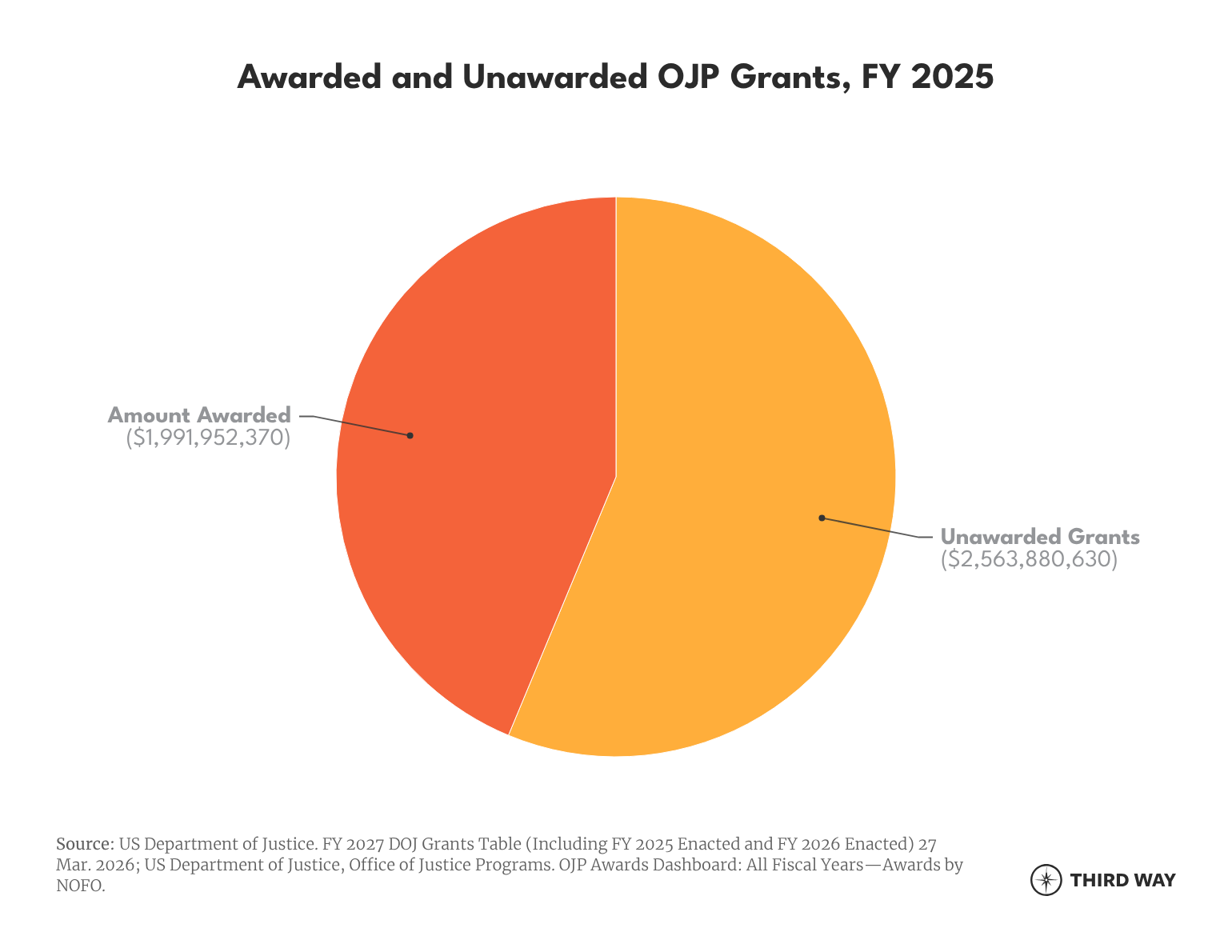
Under a normal grantmaking timeline, OJP should be posting grant applications for FY 2026 right now. Instead, law enforcement and public safety officials across the country are still awaiting funding for FY 2025.
The impact of these delays is particularly severe in rural communities, whose police departments often lack the staffing and financial capacity of their urban and suburban counterparts. Recognizing those challenges, in FY 2025 Congress appropriated $7 million specifically to help rural law enforcement combat violent crime. Yet DOJ abruptly canceled grants under this program in April 2025, and then waited a full year to post the application for new funding.
In addition to the drastic slowdown of grants, DOJ has terminated funds already awarded to local law enforcement. In 2025, DOJ terminated hundreds of grants, including grants focused on “combatting violent crime, protecting American Children, and supporting American victims of trafficking and sexual assault, and better coordinating law enforcement efforts at all levels of government.” The canceled grants included funding tied to police training and officer wellness.
The effects have been catastrophic. In rural Oregon, for example, investigators were close to arresting a violent offender who had evaded justice for 40 years. But then DOJ clawed back its funding, and the county was forced to halt the investigation and let a violent criminal walk free.
Turning Public Safety Grants Into Political Weapons
The Trump Administration has also attached sweeping ideological conditions to DOJ grants, shifting them away from their core purpose. These new conditions reach well beyond public safety performance and instead tie funding to the Administration’s political priorities on immigration, DEI, gender, vaccines, public monuments, and compliance with current and future executive orders. For example, in order to receive funding from DOJ’s Office of Community Oriented Policing Services, grantees must ensure the funding will not directly or indirectly support any educational institution that requires a COVID-19 vaccine for in-person instruction.
Taken together, these conditions endanger public safety rather than increase it. The conditions will deter qualified applicants from seeking federal support and influence others to tailor their work toward the Administration’s preferred ideological priorities rather than their communities’ actual safety needs.
The Administration’s funding failures have reached beyond police departments themselves to also hit the broader infrastructure that helps law enforcement function well, including technical assistance for rural agencies and programs that reduce demands on patrol officers.
This has also included cuts to community violence intervention funding that many police leaders view as a force multiplier. For example, DOJ has cut more than half of all federal gun violence prevention funding. In response, 18 law enforcement groups and police chiefs urged Attorney General Bondi to restore the grants, calling them “lifesaving, law-enforcement-enhancing strategies that work.” Columbia, South Carolina Deputy Police Chief Melron Kelly similarly said the programs improved collaboration between police and community organizations and helped drive shootings to a 10-year low. Cutting those resources removes tools that prevent violence before officers have to respond to it.
Conclusion
A genuinely pro-police agenda would make officers safer, strengthen trust in law enforcement, support local public safety priorities, and deliver the resources departments need to do their jobs well. This Administration has too often done the opposite.
Its immigration enforcement tactics have created chaos that local police must absorb. Its refusal to coordinate with local agencies has made dangerous situations even more dangerous. Its tolerance for masked, poorly executed federal operations has undermined public trust and opened the door to impersonation crimes. And its failure to disburse congressionally appropriated public safety funding has left departments and communities without resources they were counting on.
Public safety isn’t about staging crackdowns and glorifying force. It means supporting strategies that reduce crime, respecting local public safety judgment, and delivering resources communities need to stay safe. By that measure, this Administration has turned its back on public safety.
- Includes annual appropriations for OJP and mandatory funding made available under the Crime Victims Fund, which is administered by OJP’s Office for Victims of Crime.
- The Full-Year Continuing Appropriations and Extensions Act, 2025 maintained prior year funding levels for most DOJ programs, including the rural violent crime initiative, which was funded at $7 million in FY2024.