Memo Published November 27, 2023 · 22 minute read
The Affordable Care Act: Finishing the Job
David Kendall, Darbin Wofford, & Kylie Murdock

Democrats agree that health care should be a right, but the question is how: build upon the Affordable Care Act (ACA) or start from scratch with a single-payer system? In the last Democratic presidential primary, candidates were divided. Then-candidate Joe Biden ran on a platform that used the ACA as the foundation, as did candidates Sen. Amy Klobuchar and former Mayor Pete Buttigieg. Sens. Bernie Sanders, Elizabeth Warren, and others chose some variation on a “Medicare for All,” single-payer route. During the campaign, significant policy and political problems emerged with single payer and, ultimately, Biden swept to the nomination and won the presidency.
Once Biden took office, and regardless of where Democrats previously stood on single payer, we united and mobilized around a generational commitment to protect and expand the ACA. President Biden expanded the ACA through additional cost caps on premiums and prescription drugs in Medicare. Meanwhile, single payer’s biggest champion, Sen. Sanders, said of his proposal, “we ain’t gonna get it” upon taking the helm of the Senate HELP Committee.1 He cited the lack of votes in Congress, including many in his own caucus.
After a decade of successes with the ACA (through Democratic expansions, GOP assaults, and nail-biting court fights), let’s acknowledge the path forward. Tearing down Obamacare and starting over with single payer is neither necessary nor desirable to achieve the shared Democratic dream of universal and affordable coverage. Pursuing single payer—with its high costs and tremendous obstacles, which even its most passionate champions acknowledge—would delay the dream. It would leave tens of millions of Americans—perhaps for decades more—without the affordable care they need and deserve. If it were ever implemented, it would put women’s health care at greater risk once Republicans controlled the government and prevent access to services like abortion for the whole country.
The next great Democratic health care project must be to finish the job on the ACA. The United States needs and deserves quality and affordable coverage for all built on our own political traditions and culture. While quicker and less costly than single payer, it won’t be easy. It means challenging the status quo and committing to big and bold ideas that take on a lot of special interests and politicians aligned against us. But it is achievable. Below, we describe what “finishing the job” does and does not look like and offer seven ideas to guarantee that everyone in America has affordable and accessible care.
The ACA: Made in America
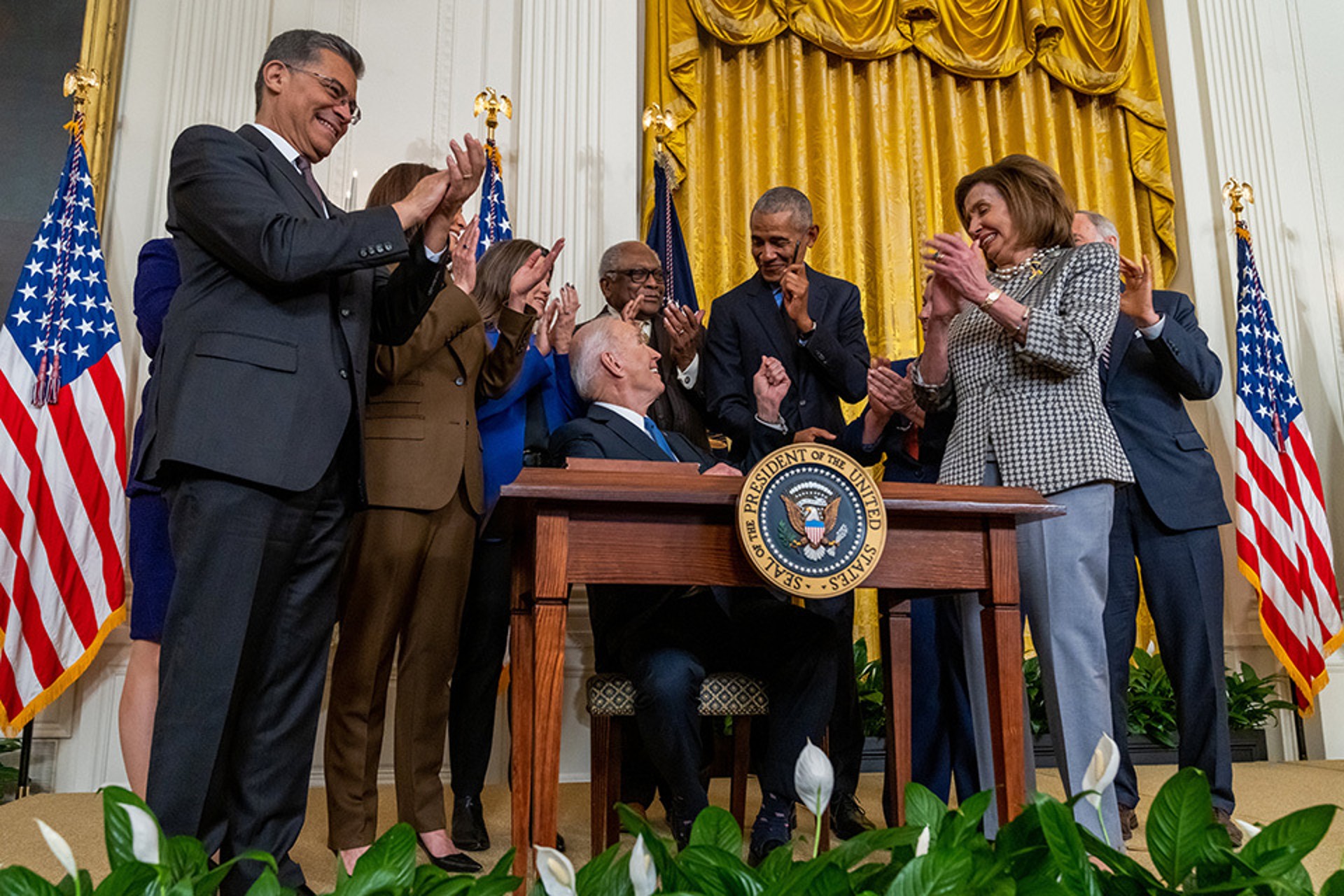
At the White House signing ceremony for the Affordable Care Act, then-Vice President Joe Biden infamously whispered six words to then-President Barack Obama: “This is a big f*cking deal!” Today, it’s clear that Biden was more prescient than he ever could have imagined.
Just like Medicare and Medicaid, the ACA is made in America. It shares a fundamental attribute with the other two pillars of the US health system: a blend of public and private coverage. When President Lyndon Johnson traveled to Independence, Missouri in 1965 to sign Medicare and Medicaid into law, employers were widely providing private health care coverage, but retirees and the poor were being left behind. Without coverage, they were missing out on the rapid expansion of lifesaving, but expensive, treatments, like pacemakers and organ transplants.
With the stroke of a pen, LBJ filled those gaping holes. Medicare covered the nation’s retirees and working-age disabled, and Medicaid covered health care for the poor and long-term care for disabled children and poor seniors. They complemented the private sector coverage through employers. Medicare was specifically designed to rely on private supplemental coverage to cover high hospital costs and other out-of-pocket costs that Medicare doesn’t cover. As the programs have evolved, the role of private health plans has expanded. They cover 72% of Medicaid’s beneficiaries and 51% of Medicare’s, with the same or better quality of care as measured by patients’ results.2 Medicare’s prescription drug benefit is delivered exclusively through private plans, which use privately- and publicly-negotiated prices.
While most countries use public and private coverage, each country has its own unique blend. The United States is no different. The ACA followed LBJ’s legacy by closing another big hole in coverage: working adults without health benefits at work. Most people have coverage through a job, but nearly half of employers do not offer health benefits, especially small businesses.3 Prior to the ACA, people without coverage at work faced a daunting process to get insured. They had to fill out long applications listing their medical history, which could lead to rejection or exclusion of coverage due to pre-existing conditions. The ACA regulated and expanded private coverage for individuals through exchanges—and included cost caps to help them afford it. Under President Biden, the exchanges have risen to a record enrollment of 16 million.4
As the ACA expanded private coverage, it enshrined a series of protections to ensure stability and security for those with insurance, such as protecting those with pre-existing conditions. It also expanded Medicaid, which had previously covered children and pregnant women living in poverty and all other adults with incomes far under the poverty level. The ACA initially required states to expand the Medicaid program for working adults whose incomes are at or just above the poverty level until the Supreme Court struck down that requirement. Still, Medicaid expansion has been successful with most states voluntarily expanding Medicaid for a gain of 21 million more people with coverage.5
The decades of work erecting the health care system has produced a unique blend of private and public insurance. It is a system that has been continually improved and is built upon a foundation that can be further enhanced in decades to come.
The Temptation of Single Payer
The complexity of US health care makes it a tempting target for anyone who has imagined starting a new system from scratch. Our current system still has gaps and can be frustrating to use. Indeed, the American public sees enough wrong that the majority are open to major change.
A perennial alternative to fixing the current system is replacing it with single payer. Under this approach, a single government health plan would replace all other forms of coverage including workplace coverage, the ACA exchanges, and Medicaid. Even Medicare would be significantly different despite single payer often being called “Medicare for All”. It would end the blend of public and private coverage currently in Medicare and throughout our health care system by banning all private insurance options.
The claims about single payer can be alluring given the problems with our current system. But when one digs deeper, it’s clear the claims all have serious flaws:
Claim: “Single payer would save money.”6 On its face, single payer would cost less overall simply because the legislation says it would. The bill dictates a 40% cut in providers’ pay from what they currently receive from private health plans. That generates about two-thirds of its overall savings. But let’s be real: Congress is unlikely to make such a large cut and sustain it under intense lobbying pressure from hospitals, physicians, and all other providers and facilities. Instead, single payer would create new cost pressures by making every health care dollar a matter of public debate. Providers would argue that funding their care above all else is critical for patients’ health. Congress and the Administration are simply not well positioned to say no.
Claim: “A single-payer national health program is not only affordable, it’s the only affordable option.”7 Single-payer is often portrayed as a better value, but that ignores the problem of higher taxes. Single payer would require new revenue equal to double the current level of federal income and corporate taxes to offset a massive shift of spending from private bank accounts to the US Treasury.8
The quality of coverage under single payer would depend primarily on the amount of taxes the government could raise. The $17.5 trillion in revenue (over ten years) to pay for Sen. Bernie Sanders’s single payer bill would include an 11.5% tax on the income of workers (4% paid by employees on income above $29,000 and 7.5% paid by employers, which most economists believe would come out of the employee’s paycheck).9 Getting Congress to raise taxes to adequately fund coverage without higher deficits is anything but simple or guaranteed.
Another major problem with higher taxes is squeezing other public priorities. The public’s willingness to pay more taxes to fund education, day care, long-term care, paid family leave, retirement, and other social needs would be greatly diminished under single payer.
Claim: “Single payer—simple solution.”10 Many argue that a single health plan is a simple way to avoid the transitions and gaps in coverage currently affecting Americans. But single payer would also require everyone to switch to a new plan that does not even exist today—even for people in Medicare. Half the people in Medicare would lose the coverage they currently have through private Medicare Advantage plans. Most of the rest would lose their supplemental coverage, which can come from a private plan or Medicaid.
Further, individuals would no longer have a role in determining the value of health care services through their choices—leaving the government with the sole responsibility of determining the value of services. That loss of control would mean less value for patients if the government allocated health care in ways that people did not like. For example, most countries with single-payer systems have explicit waiting lines for services. On the whole, people in other countries do not wait longer for health care than people in the United States, but public queues would likely frustrate Americans who currently do not have to deal with them.11
Claim: “Majority still support single payer.”12 Past polling has shown support for single payer ranging from 30% to 70%.13 But the range of support reflects how the question is posed and what people know about it. Polling has shown that support for Medicare for All drops from 51% to 29% when the cost is mentioned.14 Hearing about paying more in taxes also causes support for single payer to drop precipitously (support drops to 37%).
Claim: “Most European countries have single payer.”15 Such broad statements about public systems overseas oversimplify what is often a more nuanced relationship between public and private coverage, even in countries often cited as single payer like France.16 Nearly everyone in France has private supplemental coverage much like Medigap coverage for people in Medicare, which Sen. Sanders’ proposal would eliminate. The French have supplemental coverage in part to cover some services like dental and optical, which do not receive enough government funding.17 Other European countries like the Netherlands and Switzerland offer a choice of regulated, private plans much like the ACA exchanges. Canadians often have prescription drug coverage through their employer.18
Claim: “States now hold the key to making Medicare for All a reality.”19 While organizing for single payer at the state level has been a perennial effort, it has never been successful. Legislation has been introduced in more than half of states, but it has rarely made it to the governor’s desk.20 Vermont came closer than any other state, but after three years of trying to implement single payer, the governor gave up because of the costs. The financing would have made some lower-income families worse off as employers shifted the cost of new taxes on to employees, which soured supporters on the challenges of implementation.21 All state ballot efforts throughout the country have failed to enact single payer, even in blue states like California and Colorado. Massachusetts recently passed non-binding ballot initiatives for single payer, but the commonwealth has a long history of debating and ultimately rejecting single payer.
Claim: “Doctors favor single payer, despite likely income hit.”22 Many doctors and other health professionals have become so frustrated with health care in the United States that they support single payer despite the potential income cut. Indeed, US doctors made an average of $316,000 annually compared to $183,000 in Germany and $138,000 in the UK.23 Registered nurses in the United States earn 65% more than in other high-income countries.24 But single payer isn’t the cure-all for provider frustration. Doctors in single-payer countries sometimes see their health care systems as bad as doctors see the US system.25The budgets and rules for health care set under a public health plan can be as challenging as under private health plans.
Claim: Single payer would “fix our broken health care system that puts corporate profits ahead of patients.”26 It is true that private health plans would no longer have a role in determining the medical care that insurance would cover. Instead, those decisions would be up to the government, which may be even more problematic.27 For example, private health plans are more likely to cover abortion than public plans.28
Private health plans are more likely to cover abortion than public plans.
But before Republicans would shape coverage regulations based on conservative ideology, they would level unrelenting charges of socialism against single payer. The GOP failed to make that stick against the ACA as Washington Post columnist Jennifer Rubin recently wrote, partly because “red-state Americans have been using it at higher rates than blue-state residents.”29 But charges of socialism could stick against single payer because it would give the government ownership and control of all health insurance.
Claim: "A single-payer system has more incentive to direct healthcare spending toward public health measures.”30 If public decision-making were perfectly rational, that would be true. But Medicare shows how public decision-making can go awry. For decades, it has limited payments to primary care, which is key to public measures like vaccines and preventing more costly specialty care. Instead, payments for specialty care have increased due to the power of specialty medical societies in setting Medicare payment rates to physicians.31 As a result, Medicare faces high costs from untreated and preventable disease.32 That problem can and should be fixed, but single payer does not provide any more guarantee of rational decision-making than our current system.
Altogether, the American public is right that US health care needs substantial reforms to ensure health care is more affordable and accessible. But single payer has too many substantive and political issues to be the answer.
Seven Steps to Finish the Job of Guaranteed Affordable Care for All
While single payer is deeply flawed, the goals of universal coverage and lower costs are shared by advocates across the Democratic Party spectrum. Fortunately, the ACA provides a strong foundation for Congress and the Administration to build upon. Here are seven steps that would finish the job that the ACA started and make health care affordable and accessible to all:
1. Cap Out-of-Pocket Costs Under Private Coverage
The ACA capped the cost of premiums and out-of-pocket cost as a percentage of income for people who purchase their own coverage through the exchanges. It put similar but higher caps in place for people with workplace coverage. But premiums and out-of-pocket costs (deductibles, copays, and co-insurance) remain too high for many people.
How to finish the job: Three steps would ensure health care would be fully affordable for everyone with private coverage. First, Congress should make permanent the Inflation Reduction Act’s expanded cost cap on premiums for people buying insurance in the exchanges as President Biden has proposed.33 Second, it should lower the caps for out-of-pocket costs for coverage in the exchanges with expanded financial assistance.34 As part of that change, people with chronic conditions and other costly health problems should have specific cost caps when they have high out-of-pocket costs over multiple years.35 Third, people with workplace coverage should have the same cost caps as people with exchange coverage.36 Ultimately, there should be a limit on what anyone has to pay out of pocket each month for health care no matter where they receive coverage.
2. Finish Covering the Working Poor and Elderly
The ACA expanded Medicaid for the working poor and improved Medicare coverage of preventive services. Yet, ten Republican-led states have blocked expanded Medicaid coverage after the Supreme Court struck down the requirement for states to provide it. Medicare beneficiaries still lack coverage for basic health care like dental services and full coverage of out-of-pocket costs if they are low-income.
How to finish the job: It is a great moral failing that the poorest workers in the nation lack access to affordable coverage. The federal government should offer coverage to adults in states without expanded Medicaid coverage as Democrats proposed in 2021, which would cover 2.1 million (8% of the uninsured).37 Alternatively, Congress could allow local governments to bypass state legislatures and expand Medicaid in their area.38 For the half of America’s poor seniors who do not receive the protection they are entitled to under the Medicare Savings Program, they should have automatic enrollment into the program.39 And dental, vision, and hearing benefits starting with the highest value care like treating a cavity should be added to Medicare to complete the financial protection seniors need and give them access to critical care.
3. Make Coverage Automatic for the Remaining Uninsured
The ACA expanded ways for states to automatically enroll people in coverage based on participation in other assistance programs like SNAP, which provides food security.40 A program called express lane eligibility was originally enacted as part of the Children's Health Insurance Program and helped bring the health coverage rates for children up to 98%. While the coverage rate for the whole country is 91%—a record high—26 million still don’t have coverage.
How to finish the job: Two-thirds of the remaining people without coverage, 17.4 million, qualify for partially or fully subsidized coverage but are not enrolled.41 That is where automatic coverage comes in—if people without coverage have an easy way to get affordable coverage, then they are much more likely to take it, which is particularly helpful for people of color.42 The state of Maryland has pioneered this idea by allowing people to check a box on their tax return to get coverage automatically. Congress should build on Maryland’s success by using federal tax forms to allow people to enroll in coverage as proposed by Sen. Chris Van Hollen (D-MD) and Rep. Ami Bera (D-CA).43
4. Abolish Medical Debt
The ACA’s expansion of coverage has reduced medical debt because more people have the means to pay for their care. It also barred health plans from setting a dollar limit on annual or lifetime health care costs so that patients are truly protected from catastrophic costs. For non-profit hospitals, it required an explicit financial assistance policy for patients without the means to pay their bills and prohibited hospitals from reporting unpaid bills to credit card companies unless they checked to see if a patient qualified for their assistance program.44 Despite progress in fighting it, medical debt still affects more than 100 million adult Americans.45 More than half of all bankruptcies in the United States are tied to medical issues.46
How to finish the job: Congress should abolish medical debt for people who maintain adequate coverage.47 Congress can buy medical debt for pennies on the dollar as a leading charity, RIP Medical Debt, has shown, while ending it for good by ensuring that adequate coverage is affordable.48 In addition, the Biden Administration should continue expanding its efforts to crack down on aggressive debt collection while Congress expands lower income patients’ financial protection through hospitals’ financial assistance programs and the 340B Prescription Drug Pricing Program.49 It is also critical to prevent medical debt and people gaming it by requiring applicants for debt relief to either have or purchase health care coverage so they are protected from future debt. And Congress needs to make good coverage more affordable by raising the standard for affordable coverage in the exchanges and through employers as proposed in the first proposal above. That would give everyone a way to pay their medical bills without needing debt relief in the future.
5. Stop Runaway Costs from Fee-For-Service Health Care and High Prices
The ACA launched a movement away from fee-for-service payments, which reward providers for the quantity of care and does not hold them accountable for the overall price and quality of care.50 The ACA made permanent a new kind of payment system called accountable care organizations and launched a wave of innovative payment reform experiments, like a bundled payment. The lessons learned point toward increasing the use of these new payments.51 The ACA also extended the life of the Medicare trust fund for hospital care by 11 years through 2029, but the trust fund is again facing insolvency in eight years.52
How to finish the job: Congress should limit fee-for-service Medicare payments so they do not exceed payments to accountable care organizations and other new payment models that incentivize value.53 This would eliminate the wide variation in costs seen throughout the country that have nothing to do with providing better quality care. The waste occurs because providers can bill for services without being accountable for the cost and quality of care. The savings over ten years from cutting this wasteful variation would be $2.8 trillion. These savings, in combination with President Biden’s proposal for additional revenue for Medicare, would extend the life of the Medicare Part A trust for the next generation.54 It would also give providers responsibility for the cost and quality of care so they would no longer have to get approval from health plans for the care they provide.
Another area for savings is lowering pharmaceutical prices by ending patent abuse that delays the development of less expensive generic drugs.55 Lastly, Congress should lower hospital prices by preventing hospitals from padding bills for routine care with facility fees, prohibiting anti-competitive business practices, and letting employers, unions, and health plans negotiate lower prices collectively.56 The savings from these cost-saving measures would pay for all the additional spending outlined above and reduce the deficit.
6. Expand the Use of Low-Cost Care
The ACA has provided new ways to expand low-cost care, which can avoid the use of high-cost care in hospitals and nursing homes. One example is the Independence at Home Demonstration, which brought comprehensive care to patients unable to leave their home. It reduced trips to the emergency room and hospitalizations while providing better patient care and more support to caregivers.57 The ACA also enabled several states to pursue greater care coordination for people who are dually eligible for Medicare and Medicaid because they are elderly and unable to care for themselves. The state of Washington succeeded in saving Medicare $300 million over six years.58
How to finish the job: For decades, the default care in the United States has been high-cost care in hospitals and nursing homes. It is time to push in the opposite direction with low-cost primary care, home health care, and care coordination. This can be accomplished by improving payments for primary care in Medicare.59 That includes shifting payments from specialty care to primary care and providing a new ACO-like payment model for primary care.60 In addition, Congress should encourage states to replicate Washington State’s success with home health care and care coordination for people who are dually eligible for Medicare and Medicaid and integrate care through managed care plans.
7. Make Health Care Equitable
The ACA reduced racial and ethnic disparities by dramatically expanding rates of coverage. Between 2013 and 2018, coverage rates for Hispanic working-age adults jumped from 64% to 81% and for Black adults from 78% to 89% in states that had expanded Medicaid.61 Coverage rates for adults in rural areas jumped by eight points from 76% to 84% between 2010 and 2019.62 The ACA’s coverage increases also helped reduce the portion of people avoiding care due to costs across racial, ethnic, and geographic lines.63
How to finish the job: The ACA’s efforts have been a good start, but deep, cultural obstacles to health care equity will require a broader view of what influences health. Often called the social determinants of health, factors like food and nutrition, housing, transportation, social services, the environment, and economic mobility have a bigger impact on health than health care.64 As health care delivery gets organized into accountable groups of providers, they should have responsibility and payment for connecting patients with social services that are critical to health. In addition, organized care delivery organizations should have the responsibility for reducing inequitable outcomes and experiences specifically related to health care. This accountability would start with simply measuring the quality of care by the race and ethnicity of an organization’s patients and ladder up to payments for equitable care and penalties for inequitable care.
Other measures are necessary as well, such as expanding the diversity of the health care workforce.65 The lack of diverse physicians breeds mistrust of health care, with more than half of Black individuals saying they don’t trust our health care system.66 Diversity is achievable by awarding grants to medical schools and other health care professional schools that produce diverse graduates, and colleges that feed diverse groups into medical schools and other health care professions. Our other recommendations in this memo, from capping out-of-pocket costs to ending medical debt will also inject more equity into the system.
Conclusion
In building on the ACA, we must be bold and practical. Problems with health care are rampant, and the public wants to see lower costs above all else. This situation presents an extraordinary opportunity for Democratic forces to unite behind an agenda that is not chock full of high costs like single payer. Expanding the ACA is the best way to fulfill the promise of better care at lower costs for all.