Memo Published August 18, 2025 · 8 minute read
Neighbors and the Rebels: Joe Rogan, Local Electricians, and Selling Non-College Men on Clean Energy
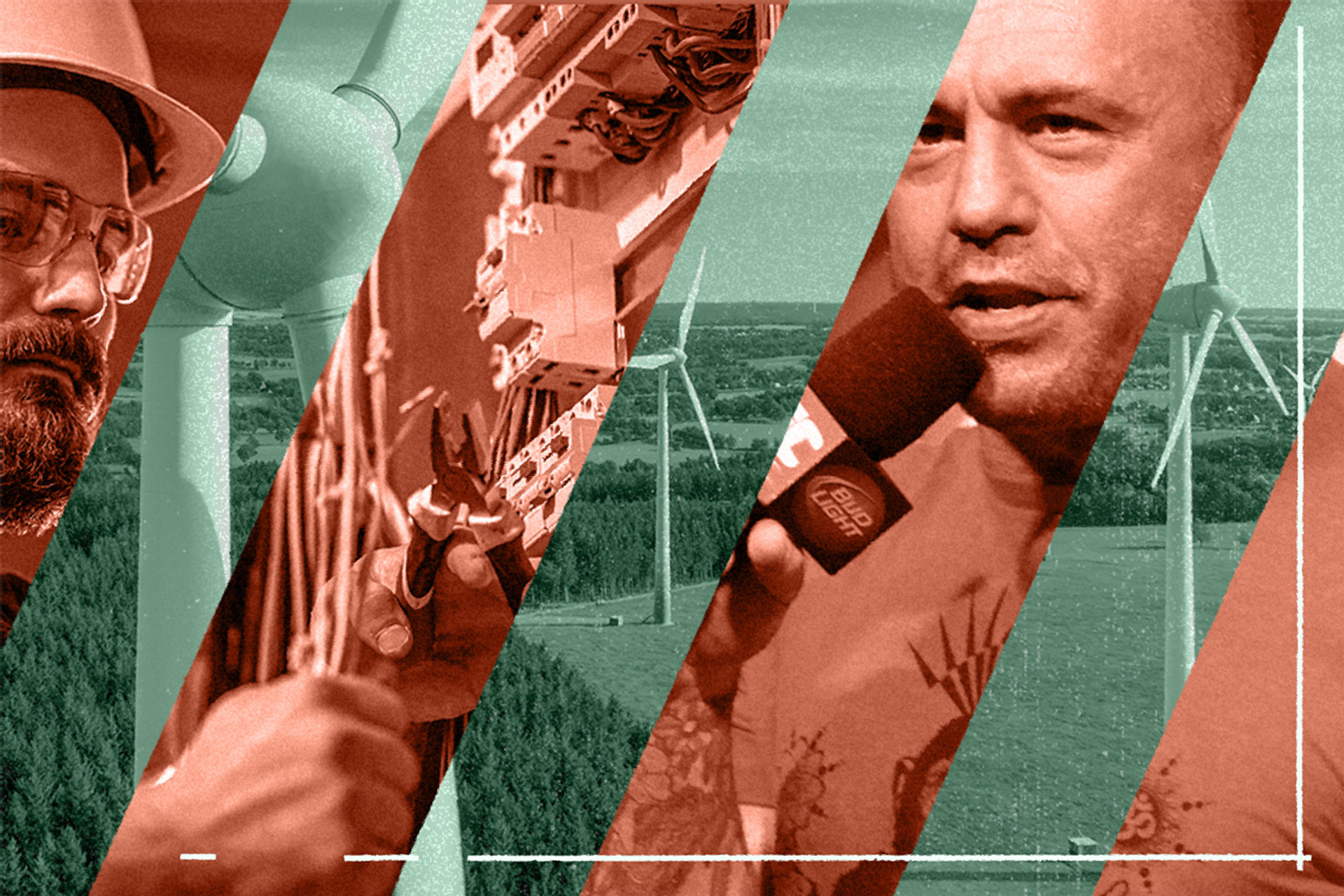
The 2024 election was the latest high-water mark in a decades-long rightward shift in non-college men’s beliefs and voting patterns. It prompted a reckoning for many, including Beltway insiders, industry, and media leaders, on how to reach this sizable, diverse constituency.
Much of the debate has focused on the media that non-college men consume. A consensus has formed that advocates must pay greater attention to digital spaces if they hope to reach young men. From podcasts to Twitch streams, suddenly ‘New Media’ is crowded with voices hoping to make their case to young men and win their support for a brand, candidate, or cause. But it isn’t enough to have the right venue—we also must have the right message and, crucially, the right messenger.
For clean energy advocates, clear strategies to reach non-college men are badly needed. Previous research from Third Way revealed that this group is more likely to hold troubling misconceptions about clean energy.
Around 40% of non-college men say fossil fuels are as good or better for the environment than clean energy. In focus groups, many men cited conspiracy theories about clean energy technologies or overemphasized facts that don’t reflect the reality of clean energy’s benefits.
To grow support for the energy transition, these misconceptions must be addressed head-on, with effective messaging and compelling messengers.
Third Way partnered with Impact Research to determine how best to win support from non-college men under 50 for the energy transition. We conducted polling via online panels from May 27 to June 2, 2025, among 800 non-college-educated men aged 18-49.
Below, we explore who non-college-educated men trust on energy issues and what kinds of messaging they find the most compelling.
Effective Messengers
When it comes to low-information issues, like climate change and clean energy, public opinion is easily swayed by little pieces of information, especially when voiced by trusted figures. Trusted, however, doesn’t always mean accurate. That gap creates an opening for bad-faith actors to spread misinformation, as evidenced by the rise of vaccine skepticism following the COVID-19 pandemic. The same pattern is playing out around clean energy technologies today. To get non-college men on board, advocates need to understand who they trust.
We asked survey respondents to consider who was most likely to share accurate information on the cost of clean energy. Across the board, older non-college men were consistently less trusting than their younger counterparts.
Neighbors and Rebels
Messengers who provoked the strongest reactions fell into two categories: the ‘neighbor’ and the ‘rebel’.
‘Neighbors’ included local professionals who are more likely to have ‘skin in the game’ for the energy transition. Local electricians, linemen, and business owners all came out on top, as did utility companies. Respondents were more willing to take advice from those close to home than from those in Washington. That’s doubly true for those who share similar backgrounds with respondents: Union leaders, for example, were 19 points more trustworthy to those in unions or union households than they were to non-union participants.
‘Rebels’ were anti-establishment voices like Elon Musk, Joe Rogan, and Theo Von. All three of these men are rich, famous, and professionally successful. But none are conventional. They say what they’re thinking and like to publicly go against the grain. The majority of Rogan’s and Von’s listeners are under the age of 35 and male. These shows come with built-in communities, from the comments section on YouTube to Reddit and Twitch. This dialogue reinforces the shows’ content, whether it’s accurate or patently false. The same is true of Musk’s online platform X, whose algorithm has been tailored to boost the reach of its controversial leader and other Right-leaning accounts. The result is that all three men—and other prominent online voices like them—have remarkable reach with legions of ‘validators’ at the ready to amplify their opinions.
It is important to note that, while Musk, Rogan, and Von instill trust in many respondents, especially those under 35, they also provoke hostile reactions from many others. Responses to Musk are particularly polarizing: while 24% of respondents trust Musk a lot and 54% trust him at all, 40% distrust him entirely. Online influencers like Mr. Beast and Theo Von have similar numbers, with 37% distrusting online influencers entirely.
Rogan, perhaps unsurprisingly, is more protected from skepticism: 22% trust him a lot, 57% trust him at least somewhat, and 28% don’t trust him, significantly lower than the level of distrust for Musk and Von.
Establishment voices like Warren Buffett and national publications like the Wall Street Journal and Bloomberg News were among the least trusted voices across all age groups. This may be a function of access or reach: both WSJ and Bloomberg are paywalled, while Rogan and his peers are largely free to listen.
Unsurprisingly, young men’s anti-establishment streak extends to most elected officials. Just 17% of non-college men noted that they trusted their member of Congress or local elected officials to talk honestly about clean energy. This is a sharp rebuke to many in the energy space who continue to rely on lawmakers almost exclusively to spread effective clean energy messaging. For this group, politicians simply aren’t credible.
What Messages Work?
The right messenger matters, but that’s only one part of the equation. The message itself has to land, and getting it wrong has real consequences.
Positive messaging can reinforce support for clean energy, but our research shows that, for this cohort, it does not grow popular support for these technologies. Our strongest message focused on the lifecycle of clean technologies compared to fossil fuels.
“Clean energy is better for the environment than fossil fuels, because over their lifetime, technologies like wind, solar, and nuclear emit no carbon emissions. Even when you account for emissions from mining, manufacturing, and transport for these technologies, studies show that clean energy still has much lower emissions than fossil fuels.”
By contrast, negative messaging can seriously erode support for clean energy among non-college men. In our message testing, exposure to critiques of clean energy increased the share of non-college men who said that fossil fuels were just as good or better for the environment by 6 points.
When it comes to negative messaging against the benefits of clean energy, non-college men found messages on waste in the clean energy supply chain particularly impactful. These messages, though true, run counter to the orthodoxy that clean energy can save the environment and has no negative impacts. What respondents may be reacting to when they hear forthright talk about clean energy’s tradeoffs is the same thing they see in figures like Joe Rogan and Elon Musk: authenticity and a willingness to “tell it like it is.”
“Clean energy projects are often abandoned before completion due to budget issues, creating tons of waste. Clean energy equipment also doesn't last forever and ends up discarded at the end of its life cycle. The whole process involves substantial amounts of wasted materials that are unmentioned by companies that want us to invest in clean technology.”
To maintain and grow support for clean energy, advocates must thread the needle between touting clean energy’s benefits and being straightforward about its drawbacks. Yes, focus on the upsides—especially those that matter most to non-college men—but also be clear that no technology is perfect, and it takes an all-of-the-above approach to power our economy. A few tips:
- Build an Economic Narrative: For non-college-educated men, the strongest messages focused on tangible economic benefits like well-paying jobs, lower costs, and reduced reliance on foreign energy, not the environmental benefits (like fighting climate change) that may strike them as abstract.
- Highlight Trusted Messengers: Advocates must learn to identify and deploy more resonant voices in support of clean energy, even when those messengers might not fit the mold of the polished Washington insider. It will take time, research, and dedication to cultivate strong messengers in unusual places, but doing so will pay dividends later on. Do not try to force trust or forge it elsewhere. Go where your audience already places their trust.
To counter misinformation about clean technologies and build durable support for the energy transition among non-college men, advocates should identify and recruit local tradespeople, business owners, and influencer personalities who are already shaping their perspectives.
Methodology
From May 27 to June 2, 2025, Third Way and Impact Research conducted polling via an online panel of 800 non-college-educated men aged 18-49, with a +/- 3.5 credibility interval. We also conducted four virtual focus groups from January 29-30, 2025, among men without college degrees nationwide. Groups consisted of white men ages 18-27, white men ages 28-40, Black men ages 18-40, and Hispanic men ages 18-40. All participants were swing voters, not firmly committed to either party.