Skip to content

Memo Published January 28, 2026 · 4 minute read

Medical Debt is Worse for Republican Voters

David Kendall

Jump to section...
HG shutterstock 114288868 1 25x

Medical debt affects millions of Americans across the political spectrum, but it hits Republican voters the hardest. We estimate that Republican voters have roughly $70 billion in medical debt while Democratic voters have $65 billion in medical debt. On average, Republicans carry $1,800 more in medical debt than Democratic voters. This burden stems from problems in our health care system—from gaps in coverage to high costs—even for those who are insured. Yet, Republican officials have largely ignored these problems and, in many cases, have made them worse with cuts to health care coverage and opposition to Affordable Care Act tax credits.

This memo presents the first analysis of partisan differences in medical debt showing that, among people behind on medical bills, medical debt is greater for Republican voters. In this analysis, we define Republican and Democratic voters based on their presidential preference in 2024. Our analysis also reviews polling that demonstrates strong bipartisan support for reducing medical debt and shows how Republican leaders have been making the problem worse.

Medical Debt is Bigger for Republicans

On average, Republican voters with past-due medical bills have an estimated $11,300 in medical debt compared to $9,500 for Democratic voters.1 Notably, President Trump won several demographic groups with higher levels of medical debt: men, people 45 years and older, people with no college degree, rural residents, and families with incomes under $100,000.2 All of those demographic groups have higher medical debt than their corresponding cohort.

For example, men have an average of $6,566 more in medical debt than women.3 According to exit polls in 2024, President Trump won 55% of male voters compared to 43% for former Vice President Kamala Harris.4 A person with medical debt and no college degree has nearly twice the average debt level as a person with a college degree. Those are among the many reasons that Republican voters are likely to have a higher amount of medical debt. Here are more:
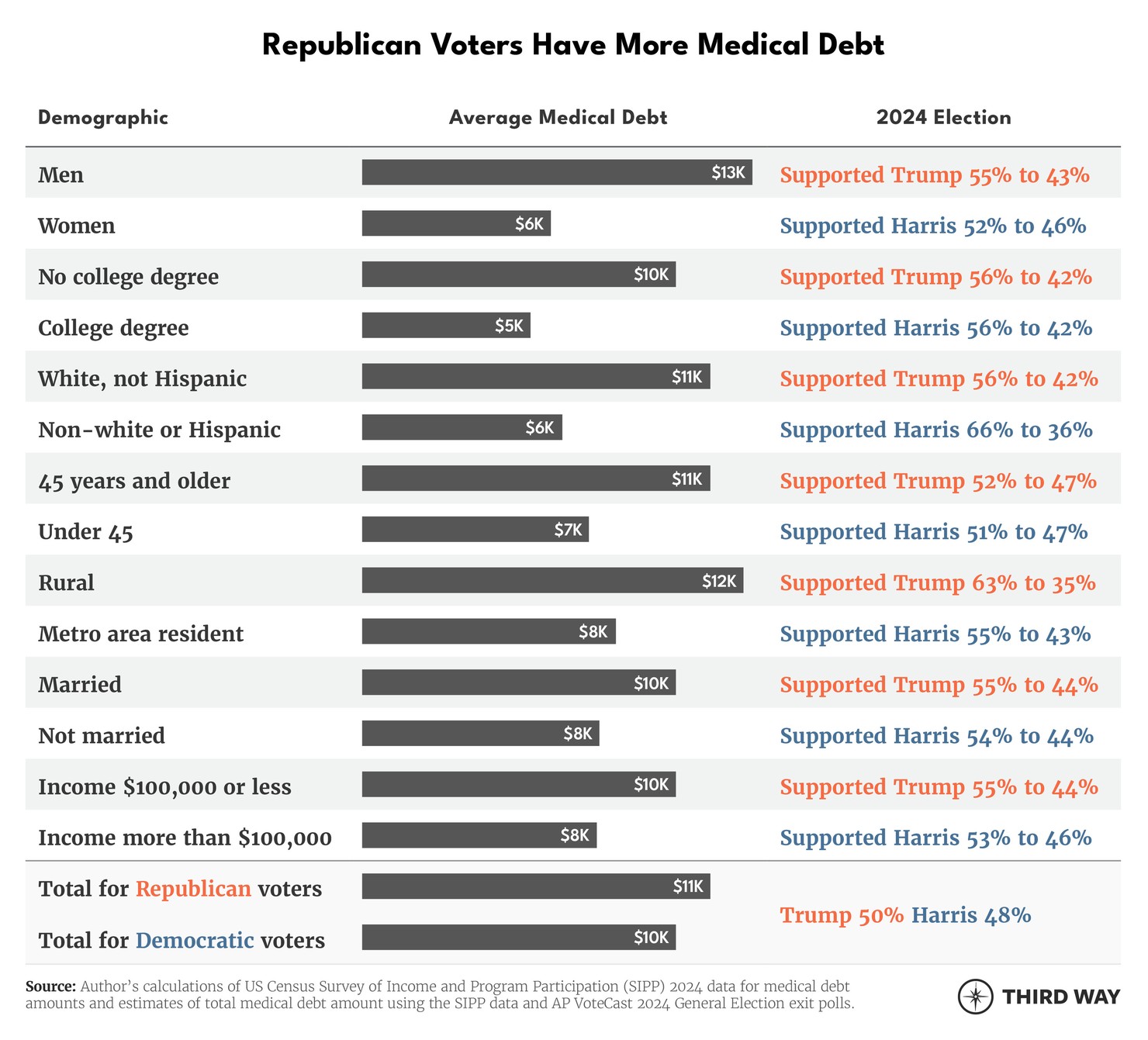
Medical Debt is Worse for Republican Voters 1

In total, we estimate that Trump-voting Americans have a cumulative medical debt balance of around $70 billion, compared to roughly $65 billion for Harris-voting Americans.5 The cumulative totals are closer than average debt because, while Republican voters have a larger amount of medical debt per person, the proportion of Harris debt holders slightly outpaces Trump debt holders by 9.2% to 8.0%, respectively.6 That’s principally because two groups of voters—men and white, non-Hispanic individuals—who supported Trump have lower rates of medical debt than women and non-white men. The chart below shows the breakdown for medical debt rates and voting.
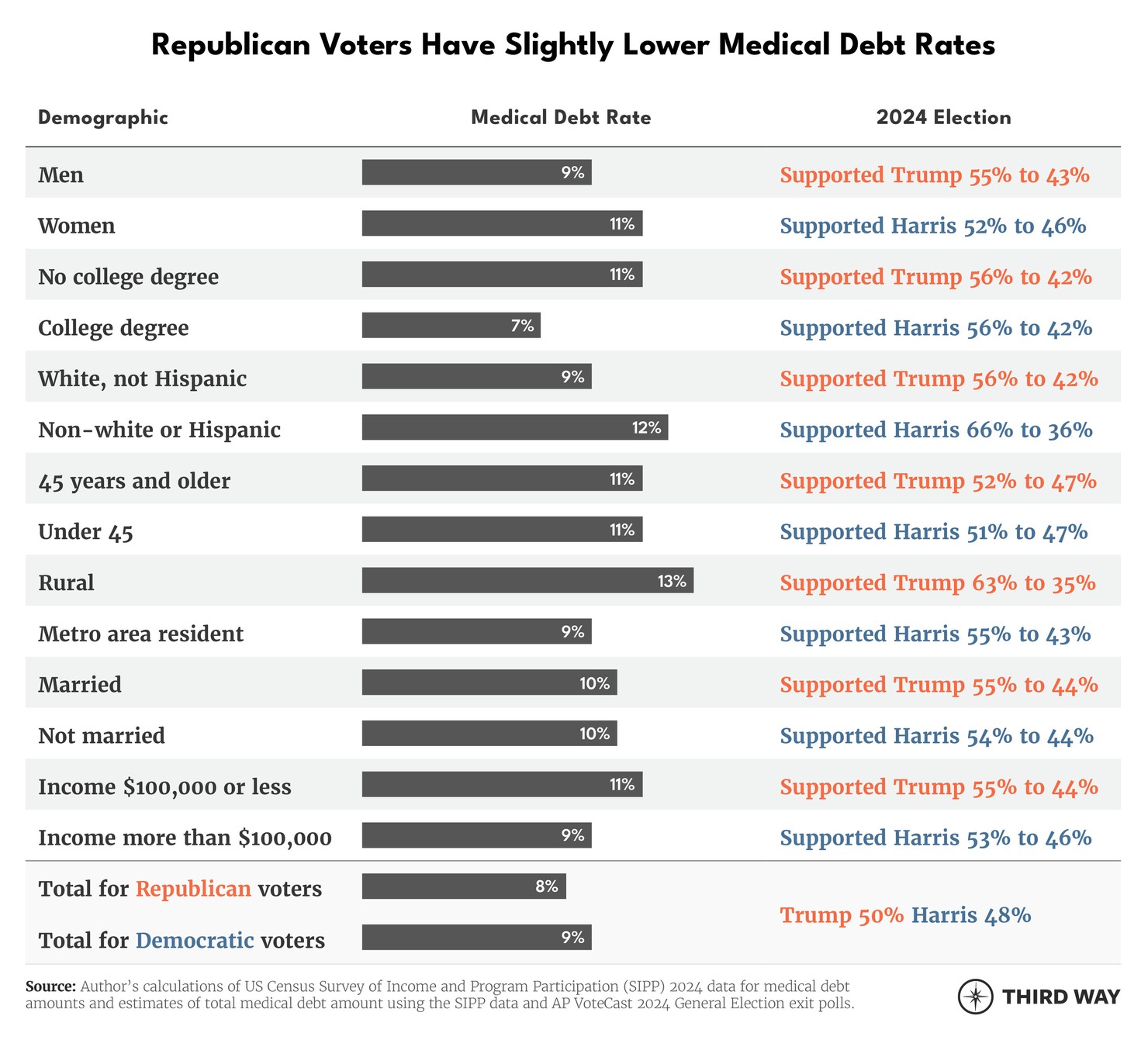
Medical Debt is Worse for Republican Voters 2

Republican and Democratic Voters Support Action to Reduce Medical Debt

Republican voters not only have more medical debt, they also strongly support proposals to fight medical debt. This support extends from specific policies to broad action to control health care costs that drive up medical debt.

  • Six-of-ten Republicans support keeping medical debt off credit reports, as do eight-of-ten Democrats.7
  • Eight-of-ten Republicans support stopping aggressive debt collection through wage garnishment and home foreclosures.8 Even more support requiring hospitals to provide charity care. Support for such policies is just as strong among Democrats and Independents.
  • Six-of-ten Republicans support state laws “to protect you from medical debt.”9 Eight-of-ten Independents and nine-of-ten Democrats agree.
  • Affordable health care is currently the top issue for Democrats and Independents and the second priority Republicans.10
  • Republicans, Democrats, and Independents agree by 60% or more that it’s the government’s role to manage health care to ensure that decisions are based on patient needs, not profits, and that everyone has access to care.11

Republican Leaders are Increasing Medical Debt

Despite broad support for action on medical debt and health care costs, Republican leaders have been making the problem worse. Here is a brief list of recent Republican actions:

  • President Trump is putting medical debt back on credit reports, reversing President Biden’s removal of them.12
  • Republicans have cut health care coverage, which will push five million people into medical debt.13
  • The Trump Administration and congressional Republicans are making enrollment in coverage more difficult by eliminating automatic reenrollment in coverage and preventing enrollment for working-class seniors in programs that cover high out-of-pocket costs.14
  • During and after the government shutdown in 2025, Republican leaders fought an extension of the Affordable Care Act tax credits, which protect millions from the high costs of coverage.
  • Trump’s tariffs have increased the cost of coverage as health insurers anticipate higher costs for drugs and medical supplies.15

Conclusion

Given the overwhelming evidence that action on medical debt is needed, the GOP should be working to address it—not make it worse. Instead, Republican leaders have been reluctant to even acknowledge medical debt as an issue. Meaningfully addressing this challenge will require ensuring that everyone has adequate coverage and that health care is genuinely affordable for every family.

Senior Fellow for Health and Fiscal Policy

Topics

Endnotes
  1. Author's calculations of US Census Survey of Income and Program Participation (SIPP) data and AP VoteCast 2024 General Election exit polls. The SIPP household data was analyzed on a per person basis to make it comparable to the exit polling data. Medical debt amounts and rates are calculated from SIPP data; demographic voting patterns come from AP Votecast data. Medical debt amounts and rates split by Republican and Democrat were imputed in the Votecast data using models trained on SIPP data. It is important to note exit polling is not a randomized selection of the U.S. population as is the SIPP data. That limits the accuracy of the results reported here but is still indicative of the demographics of the population. United States, Department of Commerce, Census Bureau. “Survey of Income and Program Participation Datasets: 2024. 9 July 2025,  www.census.gov/programs-surveys/sipp/data/datasets.html. Accessed 7 Jan. 2026; “AP VoteCast 2024 General Election,” AP and NORC, 3 Mar. 2025, apnorc.org/projects/ap-votecast-2024-general-election/. Accessed 7 Jan. 2026.

  2. Author's calculations based on United States, Department of Commerce, Census Bureau. “Survey of Income and Program Participation Datasets: 2024. 9 July 2025,  www.census.gov/programs-surveys/sipp/data/datasets.html. Accessed 7 Jan. 2026; “AP VoteCast 2024 General Election,” AP and NORC, 3 Mar. 2025, apnorc.org/projects/ap-votecast-2024-general-election/. Accessed 7 Jan. 2026. 

  3. Author's calculations based on United States, Department of Commerce, Census Bureau. “Survey of Income and Program Participation Datasets: 2024. 9 July 2025,  www.census.gov/programs-surveys/sipp/data/datasets.html. Accessed 7 Jan. 2026; “AP VoteCast 2024 General Election,” AP and NORC, 3 Mar. 2025, apnorc.org/projects/ap-votecast-2024-general-election/. Accessed 7 Jan. 2026.

  4. “2024 Fox News Voter Analysis.” Fox News, 2025, www.foxnews.com/elections/2024/general-results/voter-analysis. Accessed 7 Jan. 2026.

  5. Author's calculations based on United States, Department of Commerce, Census Bureau. “Survey of Income and Program Participation Datasets: 2024. 9 July 2025,  www.census.gov/programs-surveys/sipp/data/datasets.html. Accessed 7 Jan. 2026; “AP VoteCast 2024 General Election,” AP and NORC, 3 Mar. 2025, apnorc.org/projects/ap-votecast-2024-general-election/. Accessed 7 Jan. 2026; United States, Federal Elections Commission, “Official 2024 Presidential General Election Results, compiled from state election offices,” www.fec.gov/introduction-campaign-finance/election-results-and-voting-information/. Accessed 7 Jan. 2026. 

  6. This rate of medical debt from the US Census Bureau is lower than from other sources because it doesn’t include medical debt on credit cards, for example. Lopes, Lunna et al. “Health Care Debt In The U.S.: The Broad Consequences Of Medical And Dental Bills.” KFF, 16 June 2022, www.kff.org/health-costs/kff-health-care-debt-survey/. Accessed 7 Jan. 2026.

  7. “New Poll Shows Strong, Bipartisan Support for Consumer Bureau and Rules for Overdraft Fees, Medical Debt, Small Business Loans.” Center for Responsible Lending, 5 Mar. 2025, www.responsiblelending.org/media/new-poll-shows-strong-bipartisan-support-consumer-bureau-and-rules-overdraft-fees-medical. Accessed 7 Jan. 2026.

  8. “Impacts of Medical Debt: Findings from a National Survey.” American Cancer Society Cancer Action Network, 30 Oct. 2023, www.fightcancer.org/policy-resources/impacts-medical-debt-findings-national-survey. Accessed 7 Jan. 2026.

  9. “Voters Show Strong Bipartisan Support for Policies that Protect People from Medical.” Undue Medical Debt, Oct. 2025, unduemedicaldebt.org/bipartisan-support-for-policies-that-protect-people-from-medical-debt/. Accessed 7 Jan. 2026.

  10. “New Poll: Crushing Health Care Costs Top Priority for Voters.” Press release, Families USA, 22 Oct. 2025, www.familiesusa.org/press-releases/new-poll-crushing-health-care-costs-top-priority-for-voters/. Accessed 7 Jan. 2026.

  11. “Health Care Affordability is a Significant and Growing Concern for Most Voters and They Want Lawmakers to Take Action to Address Medical Debt and Rein in Big Insurance and Hospital Systems.” Press release, Community Catalyst, 5 May 2025, communitycatalyst.org/news/new-polling-health-care-affordability-is-a-significant-and-growing-concern-for-most-voters/. Accessed 7 Jan. 2026.

  12. Carrns, Ann. “Trump Administration Seeks to Return Medical Debt to Credit Reports.” The New York Times, 31 Oct 2025, www.nytimes.com/2025/10/31/your-money/medical-debt-credit-reports.html. Accessed 7 Jan. 2026.

  13. Kendall, David, Blair Elliott, and Timothy Kusuma. “GOP Health Care Cuts: A Recipe for Medical Debt Disaster.” Third Way, 9 Sept. 2025, www.thirdway.org/memo/gop-health-care-cuts-a-recipe-for-medical-debt-disaster. Accessed 7 Jan. 2026.

  14. Lambrew, Jeanne M. and Ellen Montz. “Closing Health Coverage Gaps: The Impact of Enrollment and Retention.” Commonwealth Fund, 9 Oct. 2025, www.commonwealthfund.org/publications/issue-briefs/2025/oct/closing-health-coverage-gaps-impact-enrollment-retention; “Impact of the “Big Bill” on Medicare.” Center for Medicare Advocacy, 24 July 2025, medicareadvocacy.org/impact-of-the-big-bill-on-medicare/. Accessed 7 Jan. 2026.

  15. McGough, Matt, Kaitlyn Vu, and Cynthia Cox. “Tariffs Are Driving up Premiums for Small Businesses.” KFF, 25 Aug. 2025, www.kff.org/health-costs/tariffs-are-driving-up-premiums-for-small-businesses/. Accessed 7 Jan. 2026.

Subscribe
Get updates whenever new content is added. We'll never share your email with anyone.

Downloads

pdf

Share