Memo Published June 10, 2026 · 11 minute read
How States Can Apply Federal College Accountability Standards to Enhance College Value

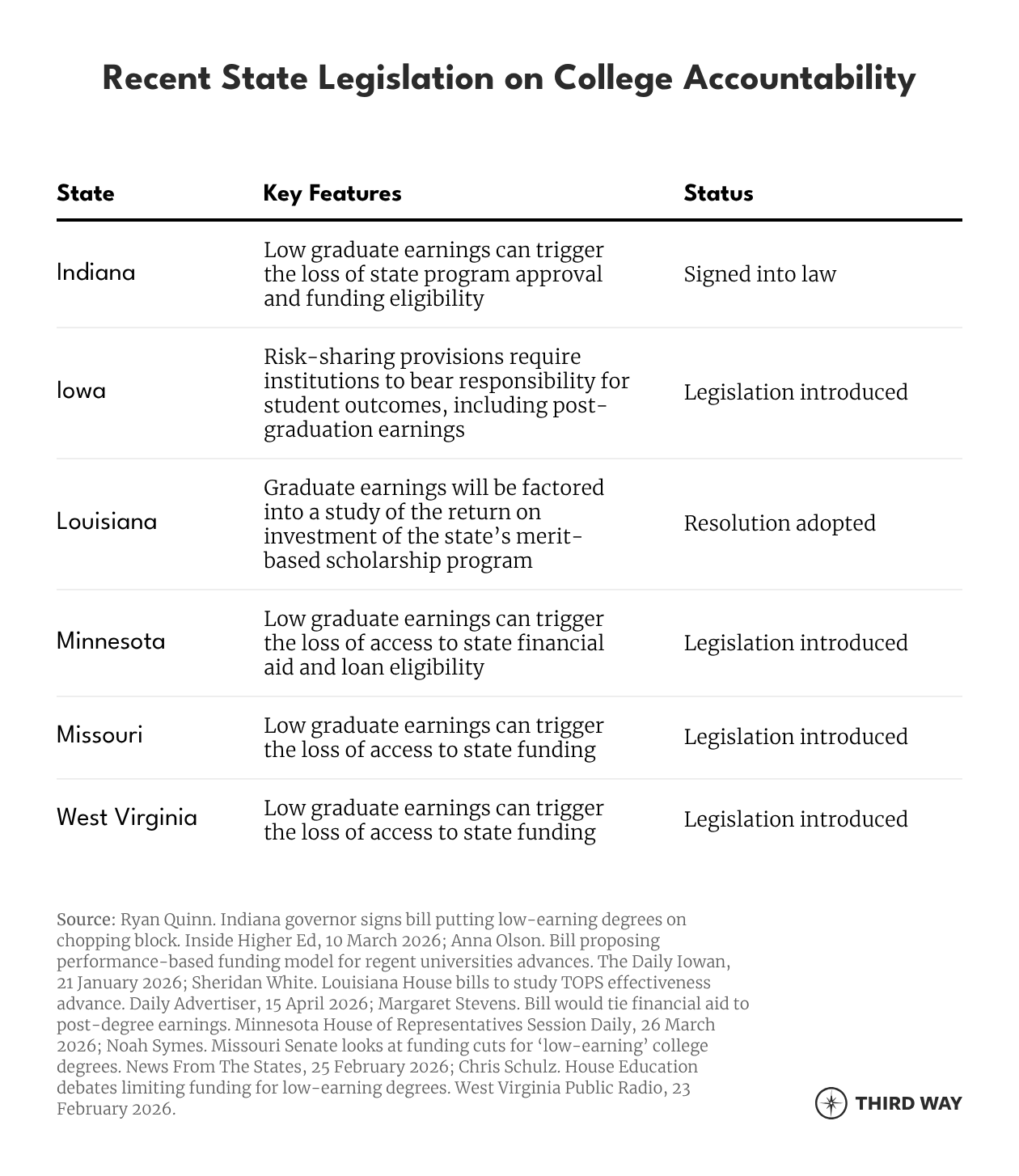
Following summer 2025’s One Big Beautiful Bill Act (OBBBA), the Department of Education (Department) is working to rapidly implement new higher education accountability regulations. The new Congressional framework established a new standard for higher education institutions to ensure a baseline return on investment (ROI) for college programs. While the Department is nearly finished finalizing details in advance of the July 1, 2026 implementation date, several states have already enacted or begun to explore legislation of their own that ties state funds to students’ postgraduate earnings, at times adopting a stricter stance than Congress.
This growing trend of using earnings outcomes for accountability is no doubt a step in the right direction. Yet as state leaders continue to make strides on accountability, it is important to balance comfort with closure of some underperforming programs with a greater emphasis on continuous improvement of higher education programs to the benefit of students and taxpayers alike. This memo outlines the state of play for higher education accountability, what several states are already doing, and key questions that state leaders should take into consideration for next steps.
Accountability’s New Normal
A new federal standard requires most graduates of a college program to earn more than their peers who never enrolled and is used to determine whether a program provides economic value that justifies public funding through federal loans. Undergraduate outcomes are compared to their state’s typical high school graduates, and graduate student outcomes are compared to those with bachelor’s degrees. Referred to by the Senate as the “Do No Harm” provision, the idea is simple: programs should deliver a clear baseline return on investment for students by equipping graduates to earn more than they could without the degree.1 The concept of earnings thresholds—in this case, a high school earnings metric—has long been popular as a common-sense measure of ROI in college programs.2 As a part of the federal legislation, programs that fail the earnings metric become ineligible for receiving federal student loans, ensuring that taxpayer dollars flow to programs that leave students demonstrably better off.
Why Some States Are on Board and How They Are Using the Threshold
States are turning to the OBBBA earnings standard in response to, among other things, three converging pressures. First, persistent concerns over student debt and low-return programs have increased the demand for transparency and consumer protection. In Louisiana, for instance, the state publishes program-level earnings and completion data on a public dashboard, allowing prospective students to see which programs consistently deliver a return on investment.
Second, the federal Gainful Employment rule, though subject to regulatory swings, established a framework linking program eligibility to debt-to-earnings ratios. And most recently, OBBBA included the “Do No Harm” standard, requiring undergraduate and graduate programs to provide an economic return above those typically earned by high school graduates and graduates with bachelor’s degrees respectively.
Third, states are seeing the potential for new federal data to provide powerful information on where public investment has the greatest payoff. West Virginia’s performance-based funding model ties a portion of each institution’s appropriations directly to graduates’ employment and earnings outcomes. The logic is straightforward; if taxpayers are subsidizing a nursing or welding program, the state should be able to verify that graduates are actually securing jobs that pay a family-sustaining wage.
Collectively, these three drivers have made the “Do No Harm” standard an attractive, though sometimes blunt, tool for state college accountability. While states are approaching accountability differently, key similarities—largely tied to post-completion earnings outcomes—pepper new state-level accountability metrics for both red and blue states.
States Should Implement the “Do No Harm” Standard Within a Balanced, Improvement-Focused Framework
It is commendable that many states are following the federal government’s lead on higher education accountability. Although Americans largely support colleges and universities, they have long wanted additional intervention to uplift value and return on investment.3 And while Americans still see the value of a college degree, there’s a consensus that costs and tuition are too high (88%) and too many graduates are burdened with student loans (77%).4 Tackling costs and value through stronger accountability also gets at the alarming belief (65%) that fewer high school graduates will pursue higher education in the next decade because it doesn’t offer the same value and advantages in the job market as it once did.5 States should strike a balance between strengthening the local labor market by encouraging essential programs to improve and eliminating programs that truly leave students worse off by injecting nuance into state-level policies impacting schools and students.
Here are three principles to inform states’ consideration of higher education accountability legislation to supplement the federal earnings baselines:
1. State Accountability Frameworks Should Account for Regional and Local Workforce and Labor Market Needs
The federal earnings baseline provides an important starting point for accountability, and states are uniquely positioned to add regional nuance. If the goal is to identify and close the lowest-performing programs, policymakers should use the federal test as a floor, not a ceiling, and examine why earnings are low before penalizing a program. For example, an early childhood education program may produce graduates who go on to run model preschool classrooms and institutions, yet those graduates may earn modest wages because of the broader economic context, rather than because of any factor related to program quality. A blunt application of the federal baseline alone could slate the program for elimination under some state proposals, even though its outcomes related to a market need for high-quality preschool may be crucial. Workforce shortages in critical fields like healthcare and education may arise if states do not prioritize the preservation of programs that serve critical needs. While it is important for earnings to be a baseline standard for programmatic eligibility, states must also balance the need for accountability with workforce needs. Not passing the federal standard will mean those programs can no longer be financed with federal loans, but the state may benefit from a targeted solution that strengthens the program so it can continue to meet state needs, rather than reflexively shuttering it.
To illustrate how this would work in practice, consider the example of an early childhood education program that fails the federal earnings baseline and would no longer be eligible for federal student loans, putting its survival at risk. Instead of automatically closing the program, state policymakers should first conduct a deeper inquiry into why earnings are low. If the investigation confirms that low wages are systemic—as in due to factors like underfunded childcare markets or regional compensation norms rather than poor training—the state may have an interest in intervening in other ways. Possible solutions include:
- a state-level wage supplement or loan repayment assistance for graduates entering critical early childcare roles,
- adjusting the program’s pricing or delivery model, or
- creating incentives for local employers to raise starting wages.
In this model, the earnings test leads not to immediate program closure but to targeted improvement plans. This approach preserves the federal baseline as a meaningful floor while giving states room to sustain programs that serve essential needs.
2. State Accountability Systems Should Prioritize Reasonable Improvement Opportunities Before Closure
Policymakers should begin with a focus on improving programs and consider closing them only as a last resort. The federal earnings baseline provides a useful signal, and states are well positioned to investigate further before acting to avoid unintended consequences to the detriment of students and workforce needs. Earnings tests that measure only at certain points in time and do not consider geographic and economic context may flag programs as failing even if completion rates are high, job placement in the field is strong, and long-term earnings are robust. States could end up closing programs that produce exactly the skilled labor the local economy needs and exacerbate workforce shortages.
As a first step, states can adopt the federal baseline while adding an additional layer of review that considers regional context to minimize downstream impacts to critical professions. By using the federal baseline as a starting point and then layering on a state-level review, improvement planning, and regional exceptions, states can enhance accountability without sacrificing local needs.
Before implementing a state-based “Do No Harm” standard, policymakers should ask: is the goal to eliminate programs that lead students to low-wage occupations or to improve programs that serve critical community needs despite low wages? The answer fundamentally changes how the federal baseline should be supplemented and what subsequent policy responses should look like. In practice, the policy loop would function as follows:
- Federal earnings data flags a program as below baseline.
- The state reviews the wage context, graduate employment rates in-field, and employer demand.
- If low earnings are due to structural market factors rather than program quality, the state offers a menu of improvement options like wage support, employer partnerships, and compensation incentives.
- After reasonable improvement opportunities are exhausted, closure should be considered if earnings remain persistently low without a critical-needs justification.
This ladder of interventions prioritizes program improvement and sustainability over automatic termination.
3. State Accountability Structures Should Prioritize Transparency and Informed Student Choice
State accountability reforms should be designed not only to identify underperforming programs for improvement or closure, but also to provide meaningful information to help students, institutions, and policymakers make better decisions. States should ensure that prospective students have clear, accessible information about program costs, completion rates, debt and earnings outcomes, and employment pathways. Transparency empowers student decision-making while creating market pressure for institutions to strengthen their offerings.
New federal policies, including the low-earnings indicator on the Free Application for Federal Student Aid and Student Tuition and Transparency System (STATS), have and will continue to expand the types of data available to students and the usability of those data systems. States can complement these efforts and enhance their effectiveness by:
- Equipping school counselors and academic advisors to use federal transparency tools. Federal data are only valuable if students know how to use and interpret them. States can invest in training on how to use tools like the STATS system, College Scorecard, and Postsecondary Student Employment Outcomes (PSEO) Explorer for high school counselors, college advising staff, workforce navigators, and other community intermediaries who provide college search guidance to students and their families. This will help ensure students can access and evaluate relevant outcomes data when deciding where to apply and enroll, and allows them to make the best choice for their circumstances and priorities.
- Promoting and integrating PSEO and federal outcomes data in state platforms. Many students and even some practitioners remain unfamiliar with the data tools that federal agencies and states have available to help them in their college search. In addition to training professionals on how to use and explain these sources, states should integrate PSEO and data tools that provide information on program-level earnings and employment outcomes into their college and career planning platforms, curricula, and public education campaigns.
- Connecting state wage and workforce data with education data systems. States have valuable administrative data that can complement federal transparency initiatives in important ways. By better linking state unemployment insurance wage records with workforce participation data and education records, states can produce more localized insights into how students progress from the education system into employment, how their industry placement and compensation evolve over time, and how geographic mobility factors into outcomes. Creating these data links also allows policymakers to understand how college programs are contributing to state workforce goals and identifying where system-level improvements or incentives may be needed.
These strategies treat federal data as the foundation but put states in the driver’s seat for helping students use the data, making it easier to access, and enhancing it with state-specific insights.
Conclusion
The federal “Do No Harm” standard offers a useful and logical starting point for states wishing to hold higher education programs more accountable for student outcomes. Rather than treating an earnings test as an automatic death sentence to programs, states should use it as a signal for inquiry or a trigger for asking why outcomes are low before delivering consequences. Where closure makes the most sense, such as for programs that consistently leave students with unmanageable debt and no job prospects, states should act decisively. But for programs that show potential for improvement, especially those which lead to fields that serve essential community needs, the response should be focused on improvement planning paired with capacity-building resources. By embedding the earnings standard within an improvement-focused framework and strengthening data transparency, states can protect students from low-value programs while also preserving critical workforce pipelines.