Memo Published April 1, 2026 · 10 minute read
Electricity Affordability in the Age of AI

Takeaways
- Data centers are one of many factors driving consumer concerns about high energy costs. Policymakers must find ways to provide the electricity hyperscalers need, without compromising consumer welfare.
- Federal policymakers must fix a slow and cumbersome system that is blocking new electricity supply and grid improvements. By supporting permitting reform, advancing an all-of-the-above energy strategy, implementing a functional interconnection process, and providing federal financing tools, policymakers can improve the grid for all consumers.
- For data-center-specific policies, there must be clear standards requiring that data centers don’t put additional strain on the grid, pay their fair share, and improve transparency. Given the rapid growth in the tech sector, these standards must be flexible enough to evolve with the industry and keep consumer welfare at the fore.
Many Americans are struggling to pay skyrocketing electricity bills that are rising at twice the rate of inflation. There are diverse factors causing bills to climb—including inflation, investments in an aging grid, and natural disasters like wildfires—but the most recent and widely discussed is the growing demand for electricity in America from artificial intelligence (AI) data centers.
Some elected officials have gone as far as calling for a moratorium on data center construction. That impulse is understandable, but misguided. Data centers are essential to the continued growth not only of AI but of other important industries. Still, the problem of high energy demand from data centers must be addressed.
US hyperscalers are expected to invest at least $500 billion annually over the coming years to build data centers and supply the energy needed to power them. To meet this moment, policymakers must ensure these investments are leveraged for the benefit of consumers, not just private industry.
Banning data centers does not get to the root cause of this demand challenge. Instead of providing a durable solution to rising energy demand and increasing pressure on the grid, a moratorium would only slow or stop US leadership in tech and other industries.
There is, without doubt, a better way forward. Rising energy bills stem from a complex network of problems, many of which must be addressed at the state level. But federal policymakers do have a role to play in addressing the rapid expansion of data centers and its impacts on energy affordability. That starts with addressing the core challenges of insufficient supply and speed. Here we outline a framework for policymakers to address rising energy costs from data centers, while maintaining America's competitive edge in AI.
Blocking Data Center Expansion is Not The Solution.
Slowing the development of data centers alone would not stop electricity prices from rising, but it would halt American technological innovation in everything from AI to autonomous vehicles to quantum computing.
AI is widely seen as a transformational technology. How we harness it will shape future economic growth and national security. If deployed thoughtfully, the productivity gains from AI could supercharge global economic growth. One analysis from Goldman Sachs predicted AI would add $7 trillion to the global economy over the next decade. Those productivity gains could translate to real improvements for our everyday life, including faster drug discovery and improved warning systems for natural disasters. But AI can also be used for military purposes, and autonomous drones powered by AI have already entered the battlefield. Maintaining our leadership in the development of AI—and the global guardrails we need to minimize its risks—will preserve American economic leadership in the decades to come and maintain our strategic position against geopolitical rivals.
Other countries, particularly China, have prioritized investments in the supply of energy and compute needed to eventually surpass American firms’ capabilities. The Chinese government alone was projected to invest $56 billion in 2025, and the top private Chinese firms are expected to add an another $70 billion this year. Other countries are clamoring to attract similar investment. Last year, French President Emanuel Macron announced a 109 billion euro joint investment between France and the United Arab Emirates to build out data center capacity. If we do not keep up, we risk relying on other countries’ infrastructure for future economic growth and national defense.
How Are Data Centers Contributing to Challenges in the Electricity Sector?
While data centers are not the only source of increased demand for electricity, they're on track to be one of the most significant. In 2010, data centers accounted for only 2% of US electricity demand. That share has since doubled to 4%, and analysts expect it to double again in just five years. Other estimates of future demand vary widely. Some analysts suggest data centers will drive about 65 GW of new demand by 2030, while others, like the Federal Energy Regulatory Commission (FERC) project demand to grow by 90 GW by 2030. That would make data center build out and operation as much as 55% of new electricity demand.
Whether the reality is closer to the top or bottom of demand projections, data centers will require considerable new generation and grid infrastructure investment. But the vast range of possible outcomes for data center growth makes it challenging for utilities and regulators to determine the right investments to meet growing demand. If utilities and regulators overbuild to satisfy data center growth that never materializes, those costs could spill over to the rest of us. Policymakers must establish strong guardrails to protect consumers from footing the bill.
What Can The Federal Government Do to Spur Investment While Keeping Costs Down?
To address growing demand from data centers and other sources, federal policymakers should focus on adding power generation and transmission capacity to the electricity system. Policy priorities should include:
- Permitting reforms that speed up federal permitting processes and reduce uncertainty.
- An all-of-the-above energy strategy that expands access to the most cost-effective technologies, including wind, solar, nuclear, geothermal, and natural gas, and does not allow politics to block affordable supply.
- A functioning interconnection process that connects viable projects to the grid quickly and efficiently.
- Federal financing tools that prioritize and accelerate least-cost electricity sector investments, especially for transmission and other enabling infrastructure, like grid-enhancing technologies, batteries, and smart meters.
These solutions are not new, and they do not target data centers alone. They will benefit new manufacturing and industrial facilities that need power, households and communities relying on electricity for more of their heating and transportation needs, and new and emerging sectors we have yet to see.
When it comes to data center-specific policies, federal authority is limited. Electricity market rules vary widely across the US, and a one-size-fits-all approach is impractical. Effective solutions will require coordination among states, regional grid operators, utilities, regulators, and federal policymakers.
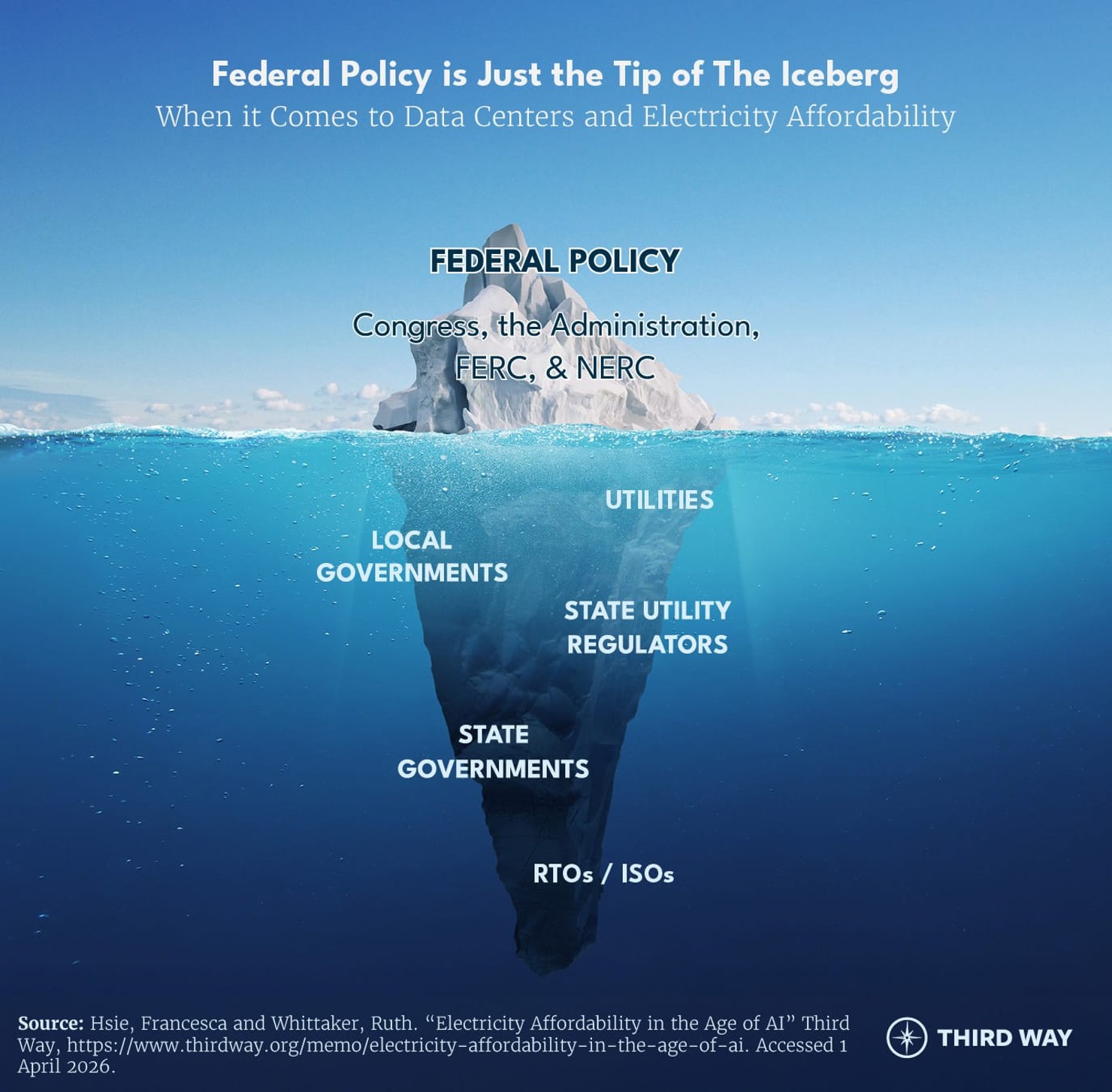
Below, we offer core principles to guide policymaking and messaging both at the federal level and beyond.
Principles For Effective Policymaking to Protect Affordability and Facilitate Economic Growth
1. Data center growth should strengthen the grid, not strain it.
The rapid expansion of data centers risks crowding out other consumers and reducing reliability reserves that keep the lights on for homes and local businesses. Policymakers should prioritize solutions that improve grid utilization, locate data centers in areas with available capacity, and bring new supply online where needed. Solutions can include incentivizing Bring-Your-Own-Generation arrangements where data centers add supply to the grid, requiring that co-location and behind-the-meter proposals undergo scrutiny for reliability impacts and effects on resource availability for other customers, and encouraging demand flexibility programs that make better use of existing resources. While the right approach will vary by location, data center growth should not come at the expense of grid reliability or other consumers’ access to adequate, affordable power.
2. Data centers should pay their fair share.
Policymakers need to ensure that households and small businesses don’t end up subsidizing the infrastructure that is being deployed at speed and scale to benefit data centers. Data centers should have to pay their fair share of expenses related to the poles, wires, transformers, and other grid infrastructure needed to get this power to them—that includes new infrastructure as well as the cost of added strain to the existing grid. Even facilities that connect directly to their own onsite power sources will likely still rely on the broader grid for some of their power or for emergency backup. Comprehensive cost-allocation rules will be essential to prevent loopholes and must require large new loads, like data centers, to pay their own way.
3. Data centers should increase transparency in siting and power demand.
Grid operators and regulators need better information about where data centers plan to locate, how much electricity they expect to use, and how quickly demand will ramp up to ensure reliability. That information is essential for planning and for evaluating whether existing rules are working. Transparency policies should respect confidential and proprietary business information, but policymakers should not allow large load growth to remain a black box. Better, more widely available data will improve planning, reduce uncertainty, and help avoid costly overbuilding of generation and transmission infrastructure.
4. Policymakers need flexible governance mechanisms for this emerging sector.
Policy interventions should provide regulatory certainty to developers while allowing room for revision as the sector matures. AI—particularly generative AI—remains a new sector, and the data center boom has only recently become visible at scale. As policymakers develop new laws and regulations, they should set clear implementation timelines and include structured policy review periods to assess impacts and adjust rules as needed. Any framework should also include provisions to grandfather projects already in development, so new or changing requirements do not disrupt investments already underway.
New Approaches To Managing Data Center Growth and Affordability
- In Ohio, regulators are requiring large data centers to bear more of the upfront infrastructure costs as well as 85% of estimated power demand, even if it goes unused.
- In Texas, the scale of new large-load interconnection requests has forced regulators and grid planners to tighten coordination and planning requirements.
- In the PJM region, rising prices and tight supply have forced the system operator to propose expedited interconnection and continued price caps for future capacity auctions.
- Microsoft, OpenAI, and Anthropic have pledged not to pass the cost of data center build-out to other electricity customers.
Looking Ahead
AI and data center buildout has happened so quickly that it can be difficult to conceptualize policy interventions that will work today, tomorrow, and into the years ahead. It is imperative that policymakers craft flexible approaches to AI’s growing energy demand, anchored in protecting consumers’ access to affordable, reliable energy.
Federal policies should strengthen the electricity sector overall, facilitate capacity expansion, and advance an all-of-the-above energy mix. States, regional bodies, utilities, and tech industry leaders have modeled some of the principles outlined above and must continue to advance these efforts. Broader reforms should focus on expanding supply, reducing bottlenecks, and accelerating least-cost investments, not blanket barriers to specific industries. The path forward must include smart cost-allocation rules, stronger planning frameworks, and meaningful private-sector engagement to help the US capture the economic benefits of AI without worsening affordability for households.
The principles outlined here are critical to growing America’s AI edge, without placing added strain on our already fragile grid. Failure to act puts both America’s leading tech companies and communities’ electricity at risk.